Browse by Category
Fiction
- Action & Adventure
- African American
- Anthologies
- Children's Fiction
- Classics
- Comics & Graphic Novels
- Coming of Age
- Contemporary
- Cultural & Regional
- Drama
- Erotica
- Fantasy
- General
- Historical Fiction
- Horror
- Humor & Satire
- Literary Fiction
- Mystery, Thriller & Suspense
- Poetry
- Religious & Inspirational
- Romance
- Science Fiction
- Short Stories
- War & Military
- Westerns
- Women's Fiction
- Young Adult
Non-Fiction
- Antiques & Collectibles
- Arts & Photography
- Biographies & Memoirs
- Business & Money
- Children's Non-Fiction
-
Computers & Technology
- Artificial Intelligence
- Computer Science
- Cybersecurity & Cryptography
- Data Science & Analytics
- Databases & Big Data
- Game Development & Design
- General
- Hardware & DIY
- Mobile App Development
- Networking & Cloud Computing
- Operating Systems
- Programming
- Robotics
- Software
- Software Engineering
- User Experience (UX) & Design
- Web Development & Design
- Cooking, Food & Wine
- Crafts, Hobbies & Home
- Education & Teaching
- Engineering
- General
- Health, Fitness & Dieting
-
History
- African History
- African History - North Africa
- African History - Sub-Saharan Africa
- American History
- American History - 20th Century
- American History - Civil War
- American History - Colonial Period
- Ancient History
- Asian History
- Asian History - China
- Asian History - India
- Asian History - Japan
- Asian History - Southeast Asia
- European History
- European History - Ancient Greece
- European History - Ancient Rome
- European History - Medieval
- European History - Modern
- European History - Renaissance
- General
- Middle Eastern History
- Military History
- Military History - Aviation
- Military History - Naval
- Social & Cultural History
- World History
- Humor & Entertainment
- Industrial Technology
- Language Learning
- Law
- LGBTQ+ Non-Fiction
- Literary Criticism
- Medical Books
- Parenting & Relationships
- Philosophy
- Politics & Social Sciences
- Reference
- Religion & Spirituality
-
Science & Math
- Agricultural Sciences
- Astronomy & Space Science
- Behavioral Sciences
- Biological Sciences
- Botany & Plant Science
- Chemistry
- Earth Sciences
- Engineering - Chemical
- Engineering - Civil
- Engineering - Electrical
- Engineering - Mechanical
- Environment
- General
- Geology
- Mathematics
- Nature & Ecology
- Oceanography
- Paleontology
- Physics
- Statistics
- Self-Help
- Sports & Outdoors
- Study Aids
- Sustainability & Green Living
- Textbooks
- Transportation
- Travel
- True Crime
- Urban Planning & Development
- Veterinary Medicine
- Writing & Publishing
Jump to Section
MixCache.com Total Access
Unlimited reading and audiobooks for every book published by MixCache.com.
Included titles carry the MTA badge.
Learn more →
Education In Moldova
MTA
A Comprehensive Overview from Early Childhood to Higher Education
About this book:
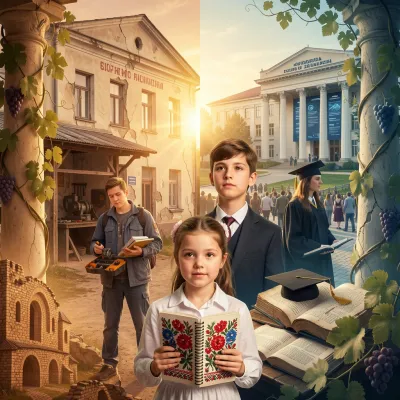
The book traces Moldova’s educational development from medieval monastic schools and ecclesiastical instruction through periods of Russian, Romanian, and Soviet rule, each leaving distinct linguistic and ideological imprints. Post‑independence reforms sought to de‑Sovietize the curriculum, restore Romanian as the language of instruction, and align the system with European standards, a process marked by both progress and persistent challenges rooted in economic hardship and legacy structures.
Moldova’s education system comprises early childhood education (nurseries and kindergartens), compulsory primary education (grades 1‑4), secondary education split into the lower gymnasium (grades 5‑9) and upper lyceum (grades 10‑12), vocational education and training (VET), and higher education organized under the Bologna three‑cycle framework. Governance is anchored by the Constitution and the Education Code, with the Ministry of Education and Research setting policy, local authorities managing pre‑university funding via a formula‑based model, and institutions like ANACEC overseeing quality assurance and accreditation across all levels. Teacher preparation occurs in pedagogical colleges and universities, supported by continuous professional development, while financing relies heavily on the state budget, supplemented by local contributions, tuition fees, and international aid.
Core themes include efforts toward inclusive education for children with special needs, integration of digital technologies and e‑learning platforms, promotion of multilingualism (Romanian alongside minority languages and foreign languages), civic and sustainable development education, and the vital role of NGOs in advocacy, innovation, and service delivery. Persistent challenges involve underfunding, low teacher salaries, rural‑urban disparities, a “brain drain” of skilled educators and students, and gaps between policy and practice in inclusion and vocational relevance. Ongoing reforms focus on curriculum modernization toward competency‑based learning, teacher professionalization, dual‑education VET models, higher‑education research and internationalization, infrastructure upgrades, and expanded lifelong‑learning opportunities.
Looking ahead, Moldova aims to strengthen its human‑capital investment through competitive teacher remuneration and career pathways, modernize school infrastructure and digital ecosystems, deepen curriculum relevance with interdisciplinary and entrepreneurial skills, expand dual‑training VET and green‑skills programs, enhance higher‑education research capacity and global partnerships, enforce inclusive practices, and develop a comprehensive national qualifications framework for adult learning. Continued alignment with European standards via the Bologna Process, Erasmus+, and bilateral cooperation, alongside sustained NGO engagement and targeted socio‑economic support, is envisioned to drive an equitable, quality‑oriented education system capable of supporting national development and European integration.
What You'll Find Inside:
- Comprehensive historical evolution of Moldova's education system from monastic traditions to post-Soviet reforms and European integration.
- Detailed analysis of legal frameworks, funding mechanisms, and governance structures shaping Moldova's educational landscape.
- Exploration of early childhood through higher education, including vocational training, quality assurance, and teacher development.
- Investigation of inclusive practices, digital transformation, and the role of NGOs in addressing educational disparities and innovation.
- Strategic insights into future reforms, internationalization efforts, and Moldova's alignment with European educational standards and practices.
Who's It For:
This book is essential for policymakers, educators, researchers, and development professionals seeking to understand Moldova's educational transformation. It benefits stakeholders involved in educational reform in transitional economies, international organizations supporting educational development, and those interested in comparative European education systems and best practices for inclusive, technology-driven learning environments.
Table of Contents:
- Introduction
- Chapter 1 Historical Context of Moldovan Education
- Chapter 2 Legal Framework and Governance of Education in Moldova
- Chapter 3 Funding and Expenditure in the Moldovan Education System
- Chapter 4 Early Childhood Education: Nurseries and Kindergartens
- Chapter 5 Curriculum and Pedagogy in Early Childhood Education
- Chapter 6 Primary Education: Structure and Objectives
- Chapter 7 Key Subjects and Teaching Methodologies in Primary Schools
- Chapter 8 Secondary Education: Lower and Upper Cycles
- Chapter 9 Vocational Education and Training (VET) in Moldova
- Chapter 10 Higher Education Institutions: Universities and Academies
- Chapter 11 Admission Processes and Student Demographics in Higher Education
- Chapter 12 Quality Assurance and Accreditation in Moldovan Education
- Chapter 13 Teacher Training and Professional Development
- Chapter 14 Inclusive Education: Addressing Special Educational Needs
- Chapter 15 Digitalization and Technology in Moldovan Classrooms
- Chapter 16 Internationalization of Moldovan Education
- Chapter 17 Challenges and Reforms in the Education System
- Chapter 18 Impact of Socio-Economic Factors on Education
- Chapter 19 Education for Sustainable Development in Moldova
- Chapter 20 Civic Education and Youth Engagement
- Chapter 21 Language of Instruction and Multilingualism in Schools
- Chapter 22 Adult Education and Lifelong Learning Initiatives
- Chapter 23 The Role of Non-Governmental Organizations in Education
- Chapter 24 Comparative Analysis with European Education Systems
- Chapter 25 Future Prospects and Strategic Directions for Moldovan Education
Author:
Published By:
Date Published:
July 1, 2026
Type:
Nonfiction
Language:
English
Word Count:
40,771 words
Reading Time:
2 hours 51 minutes
Sample:
Order:
Order Education In Moldova (Hardcover) on MixCache.com:
Buy NowPrint copy is made to order and ships worldwide. Includes the ebook free, ready to read instantly.
$5 account credit for all new MixCache.com accounts, usable toward any ebook purchase!*