Browse by Category
Fiction
- Action & Adventure
- African American
- Anthologies
- Children's Fiction
- Classics
- Comics & Graphic Novels
- Coming of Age
- Contemporary
- Cultural & Regional
- Drama
- Erotica
- Fantasy
- General
- Historical Fiction
- Horror
- Humor & Satire
- Literary Fiction
- Mystery, Thriller & Suspense
- Poetry
- Religious & Inspirational
- Romance
- Science Fiction
- Short Stories
- War & Military
- Westerns
- Women's Fiction
- Young Adult
Non-Fiction
- Antiques & Collectibles
- Arts & Photography
- Biographies & Memoirs
- Business & Money
- Children's Non-Fiction
-
Computers & Technology
- Artificial Intelligence
- Computer Science
- Cybersecurity & Cryptography
- Data Science & Analytics
- Databases & Big Data
- Game Development & Design
- General
- Hardware & DIY
- Mobile App Development
- Networking & Cloud Computing
- Operating Systems
- Programming
- Robotics
- Software
- Software Engineering
- User Experience (UX) & Design
- Web Development & Design
- Cooking, Food & Wine
- Crafts, Hobbies & Home
- Education & Teaching
- Engineering
- General
- Health, Fitness & Dieting
-
History
- African History
- African History - North Africa
- African History - Sub-Saharan Africa
- American History
- American History - 20th Century
- American History - Civil War
- American History - Colonial Period
- Ancient History
- Asian History
- Asian History - China
- Asian History - India
- Asian History - Japan
- Asian History - Southeast Asia
- European History
- European History - Ancient Greece
- European History - Ancient Rome
- European History - Medieval
- European History - Modern
- European History - Renaissance
- General
- Middle Eastern History
- Military History
- Military History - Aviation
- Military History - Naval
- Social & Cultural History
- World History
- Humor & Entertainment
- Industrial Technology
- Language Learning
- Law
- LGBTQ+ Non-Fiction
- Literary Criticism
- Medical Books
- Parenting & Relationships
- Philosophy
- Politics & Social Sciences
- Reference
- Religion & Spirituality
-
Science & Math
- Agricultural Sciences
- Astronomy & Space Science
- Behavioral Sciences
- Biological Sciences
- Botany & Plant Science
- Chemistry
- Earth Sciences
- Engineering - Chemical
- Engineering - Civil
- Engineering - Electrical
- Engineering - Mechanical
- Environment
- General
- Geology
- Mathematics
- Nature & Ecology
- Oceanography
- Paleontology
- Physics
- Statistics
- Self-Help
- Sports & Outdoors
- Study Aids
- Sustainability & Green Living
- Textbooks
- Transportation
- Travel
- True Crime
- Urban Planning & Development
- Veterinary Medicine
- Writing & Publishing
Jump to Section

Want unlimited access to all books published by MixCache.com (plus their audiobooks)? Try MixCache.com Total Access. Look for the MTA badge on book covers to identify included titles.
Access to infinite ebooks: Don't see the book you want? Suggest it and we'll create it (free!) for you from scratch with our powerful AI book writer. Then read it with MTA - besides profiting from any sales it makes!
Education In The Bahamas
MTA
A Comprehensive Overview from Early Childhood to Higher Education
About this book:
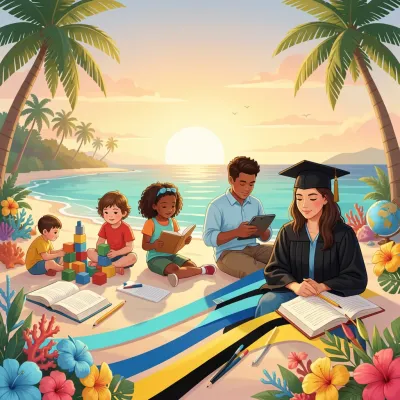
Education in The Bahamas has evolved from missionary‑run schools in the colonial era to a centralized, publicly funded system guided by the Ministry of Education and Technical and Vocational Training. Historical milestones—including the 1836 Education Act, the establishment of compulsory education, the abolition of the Common Entrance Examination, and the creation of the College of The Bahamas (later the University of The Bahamas)—have expanded access and shifted control toward the state. Today the system comprises early childhood education (public and private pre‑schools), compulsory free primary education (grades 1‑6), and compulsory free secondary education divided into junior high (grades 7‑9) and senior high (grades 10‑12) with national examinations (BJC and BGCSE) serving as key benchmarks. Technical and vocational training is delivered primarily through the Bahamas Technical and Vocational Institute, while higher education centers on the University of The Bahamas and several private institutions, all operating within a framework of centralized policy, district offices, and school‑level governance.
Curriculum development is led by the Ministry, aiming to balance national cultural relevance with international standards, and emphasizes holistic, inquiry‑based learning across all levels. Teacher preparation centers on the University of The Bahamas, supplemented by ongoing professional development, mentorship, and certification requirements. Assessment combines continuous formative practices with external national exams, while special education moves toward inclusive models supported by Individualized Education Plans and multidisciplinary services. TVET programs focus on industry‑relevant skills, work‑integrated learning, and pathways to employment or further study, and higher education stresses research, global partnerships, and lifelong learning to meet national development goals. Funding derives chiefly from the national budget, covering salaries, infrastructure, and targeted programs, supplemented by tuition, financial aid, and external contributions to promote access and equity across the archipelago.
Technology is increasingly woven into instruction, administration, and TVET, seeking to bridge geographical divides and enhance digital literacy, though challenges remain in infrastructure and teacher training. Education is linked to national development through workforce preparation, innovation, social cohesion, health, environmental stewardship, and democratic participation. Persistent challenges—including geographic dispersion, teacher recruitment, quality consistency, funding pressures, and the need for curriculum relevance—drive ongoing reforms centered on decentralization, inclusive practices, parental and community engagement, disaster preparedness, and global citizenship. Policy recommendations call for universal, high‑quality early childhood education, strengthened teacher recruitment and development, modernization of curriculum and assessment for 21st‑century skills, equitable technology access, expanded TVET investment, higher‑education research funding, robust inclusive‑education policies, enhanced guidance counseling, and deeper parental‑community partnerships to ensure the system remains resilient, equitable, and responsive to Bahamas’ aspirations.
What You'll Find Inside:
- Explores the historical evolution of Bahamian education from colonial-era foundations to modern reforms, including key legislative milestones and the impact of Majority Rule.
- Examines the structure and governance of the education system, covering early childhood to higher education, with emphasis on the Ministry of Education and Technical and Vocational Training (MOETVT).
- Analyzes curriculum development, assessment strategies (BJC/BGCSE), and teacher training initiatives aimed at enhancing pedagogical quality and relevance.
- Addresses inclusive practices in special education, the role of Technical and Vocational Education and Training (TVET) in workforce development, and efforts to bridge geographical disparities in educational access.
- Discusses contemporary challenges, globalization's influence, and strategic policy recommendations for advancing equitable and sustainable educational outcomes in The Bahamas.
Who's It For:
This comprehensive overview is designed for educators, policymakers, researchers, and students seeking an in-depth understanding of The Bahamas' education system. It offers practical insights for educators on curriculum implementation and student support, while providing researchers and policymakers with data-driven analysis and strategic recommendations for educational improvement. Anyone with an interest in Bahamian educational history, current challenges, and future development will find valuable perspectives on fostering equitable and innovative learning environments.
Author:
Published By:
Date Published:
June 18, 2026
Type:
Nonfiction
Language:
English
Word Count:
44,042 words
Reading Time:
3 hours 5 minutes
Sample:
Order:
Order Education In The Bahamas (Hardcover) on MixCache.com:
Buy NowPrint copy is made to order and ships worldwide. Includes the ebook free, ready to read instantly.
$5 account credit for all new MixCache.com accounts, usable toward any ebook purchase!*