
Browse by Category
Fiction
- Action & Adventure
- African American
- Anthologies
- Children's Fiction
- Classics
- Comics & Graphic Novels
- Coming of Age
- Contemporary
- Cultural & Regional
- Drama
- Erotica
- Fantasy
- General
- Historical Fiction
- Horror
- Humor & Satire
- Literary Fiction
- Mystery, Thriller & Suspense
- Poetry
- Religious & Inspirational
- Romance
- Science Fiction
- Short Stories
- War & Military
- Westerns
- Women's Fiction
- Young Adult
Non-Fiction
- Antiques & Collectibles
- Arts & Photography
- Biographies & Memoirs
- Business & Money
- Children's Non-Fiction
-
Computers & Technology
- Artificial Intelligence
- Computer Science
- Cybersecurity & Cryptography
- Data Science & Analytics
- Databases & Big Data
- Game Development & Design
- General
- Hardware & DIY
- Mobile App Development
- Networking & Cloud Computing
- Operating Systems
- Programming
- Robotics
- Software
- Software Engineering
- User Experience (UX) & Design
- Web Development & Design
- Cooking, Food & Wine
- Crafts, Hobbies & Home
- Education & Teaching
- Engineering
- General
- Health, Fitness & Dieting
-
History
- African History
- African History - North Africa
- African History - Sub-Saharan Africa
- American History
- American History - 20th Century
- American History - Civil War
- American History - Colonial Period
- Ancient History
- Asian History
- Asian History - China
- Asian History - India
- Asian History - Japan
- Asian History - Southeast Asia
- European History
- European History - Ancient Greece
- European History - Ancient Rome
- European History - Medieval
- European History - Modern
- European History - Renaissance
- General
- Middle Eastern History
- Military History
- Military History - Aviation
- Military History - Naval
- Social & Cultural History
- World History
- Humor & Entertainment
- Industrial Technology
- Language Learning
- Law
- LGBTQ+ Non-Fiction
- Literary Criticism
- Medical Books
- Parenting & Relationships
- Philosophy
- Politics & Social Sciences
- Reference
- Religion & Spirituality
-
Science & Math
- Agricultural Sciences
- Astronomy & Space Science
- Behavioral Sciences
- Biological Sciences
- Botany & Plant Science
- Chemistry
- Earth Sciences
- Engineering - Chemical
- Engineering - Civil
- Engineering - Electrical
- Engineering - Mechanical
- Environment
- General
- Geology
- Mathematics
- Nature & Ecology
- Oceanography
- Paleontology
- Physics
- Statistics
- Self-Help
- Sports & Outdoors
- Study Aids
- Sustainability & Green Living
- Textbooks
- Transportation
- Travel
- True Crime
- Urban Planning & Development
- Veterinary Medicine
- Writing & Publishing
Jump to Section
MixCache.com Total Access
Unlimited reading and audiobooks for every book published by MixCache.com.
Included titles carry the MTA badge.
Learn more →
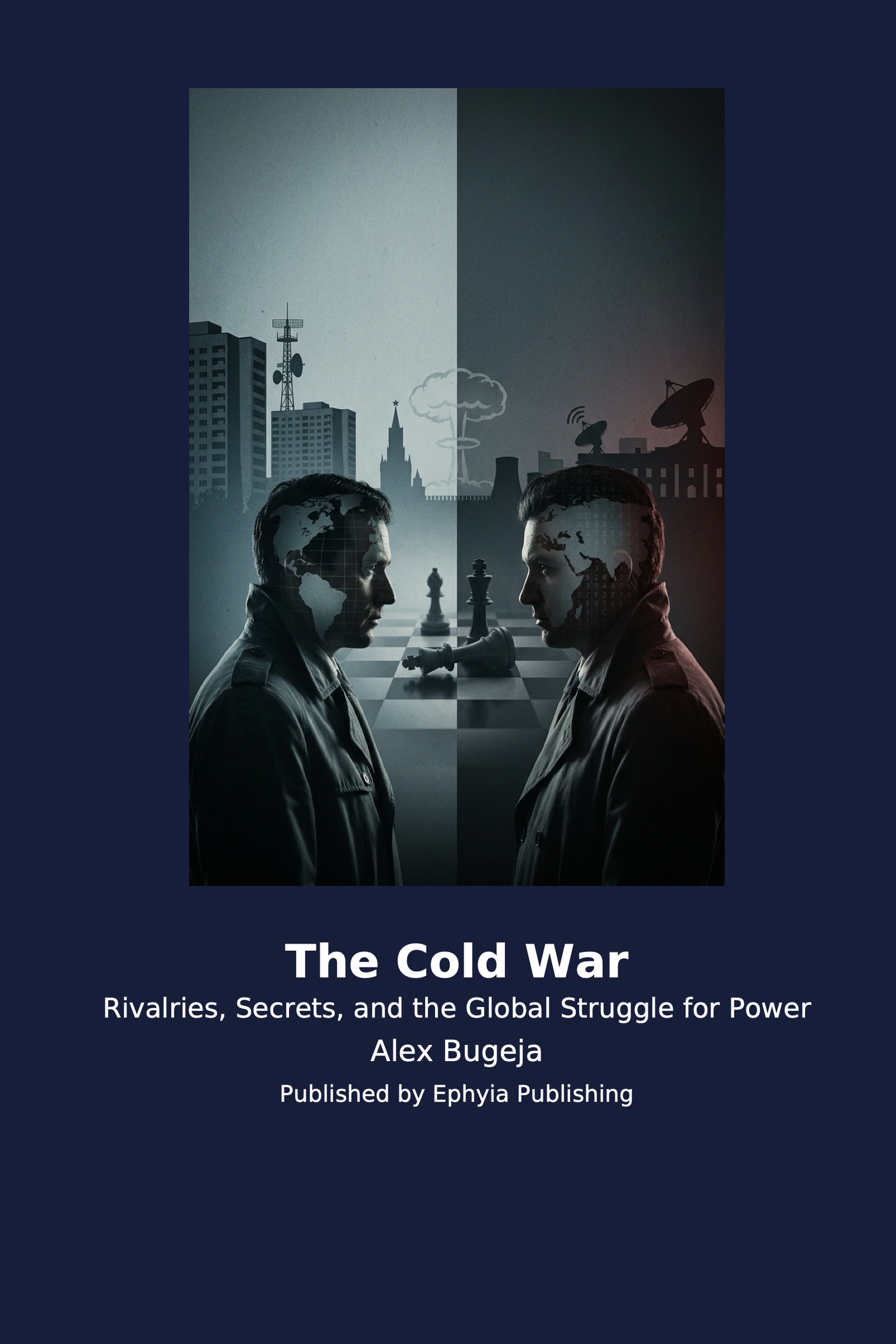
The Cold War
Rivalries, Secrets, and the Global Struggle for Power
About this book:

Discover how the Cold War emerged from the uneasy alliance of World War II, tracing the ideological clash between liberal democracy and communist totalitarianism that turned former allies into global rivals. This book walks you through the early postwar years, from the Yalta and Potsdam conferences to Churchill’s Iron Curtain speech and the Truman Doctrine, showing how mistrust hardened into a strategy of containment that shaped American and Soviet policies for decades.
Experience the dramatic flashpoints that brought the world to the brink of nuclear conflict, including the Berlin Blockade and Airlift, the Korean War, the Cuban Missile Crisis, and the Soviet invasion of Afghanistan. Each chapter reveals the decisions, miscalculations, and courage of leaders and ordinary people caught in superpower standoffs, illustrating how close humanity came to catastrophe and how diplomatic breakthroughs sometimes pulled us back from the edge.
Delve into the hidden dimensions of the struggle: the espionage networks of the CIA and KGB, covert operations in Iran, Guatemala, and Cuba, the propaganda battles waged through radio and cultural exchanges, and the technological race that produced spy satellites, intercontinental ballistic missiles, and the historic Space Race that culminated in the Moon landing. You’ll see how scientific advancement, intelligence gathering, and psychological warfare were as vital to the conflict as tanks and troops.
Understand how the Cold War spread far beyond Europe, fueling proxy wars in Vietnam, Angola, Nicaragua, and Afghanistan, and how newly independent nations in Asia, Africa, and Latin America became arenas where the United States and the Soviet Union competed for influence, often exacerbating local conflicts and leaving lasting legacies of violence and instability.
Finally, follow the thaw of détente, the rise of reform movements like Poland’s Solidarity, the pivotal reforms of Gorbachev’s perestroika and glasnost, and the peaceful revolutions of 1989 that led to the fall of the Berlin Wall, the reunification of Germany, and the dissolution of the Soviet Union. The book concludes by examining the Cold War’s enduring impact on today’s geopolitical landscape, from NATO expansion and rising powers to the lingering shadows of ideological distrust and the lessons learned from a half‑century of global struggle.
What You'll Find Inside:
- The ideological clash between US-led Western Bloc (democracy/capitalism) and Soviet-led Eastern Bloc (communism) that defined global politics for nearly five decades
- Key crises and confrontations including the Berlin Blockade, Korean War, Cuban Missile Crisis, and Vietnam War that brought the world to the brink of nuclear conflict
- The nuclear arms race and development of Mutually Assured Destruction (MAD) doctrine that prevented direct superpower war while creating constant global tension
- Espionage, intelligence operations, and covert actions by agencies like the CIA and KGB that shaped events behind the scenes
- The eventual collapse of Soviet communism through reforms like perestroika and glasnost, leading to the fall of the Berlin Wall and dissolution of the USSR
Who's It For:
This book is ideal for students of 20th-century history, international relations, or political science seeking a comprehensive understanding of the Cold War era. It also appeals to general readers interested in how this period shaped modern geopolitics, military strategy, and global alliances. Anyone looking to grasp the origins of contemporary international tensions, NATO-Russia dynamics, or the ideological foundations of 20th-century conflict will find valuable insights in this detailed historical account.
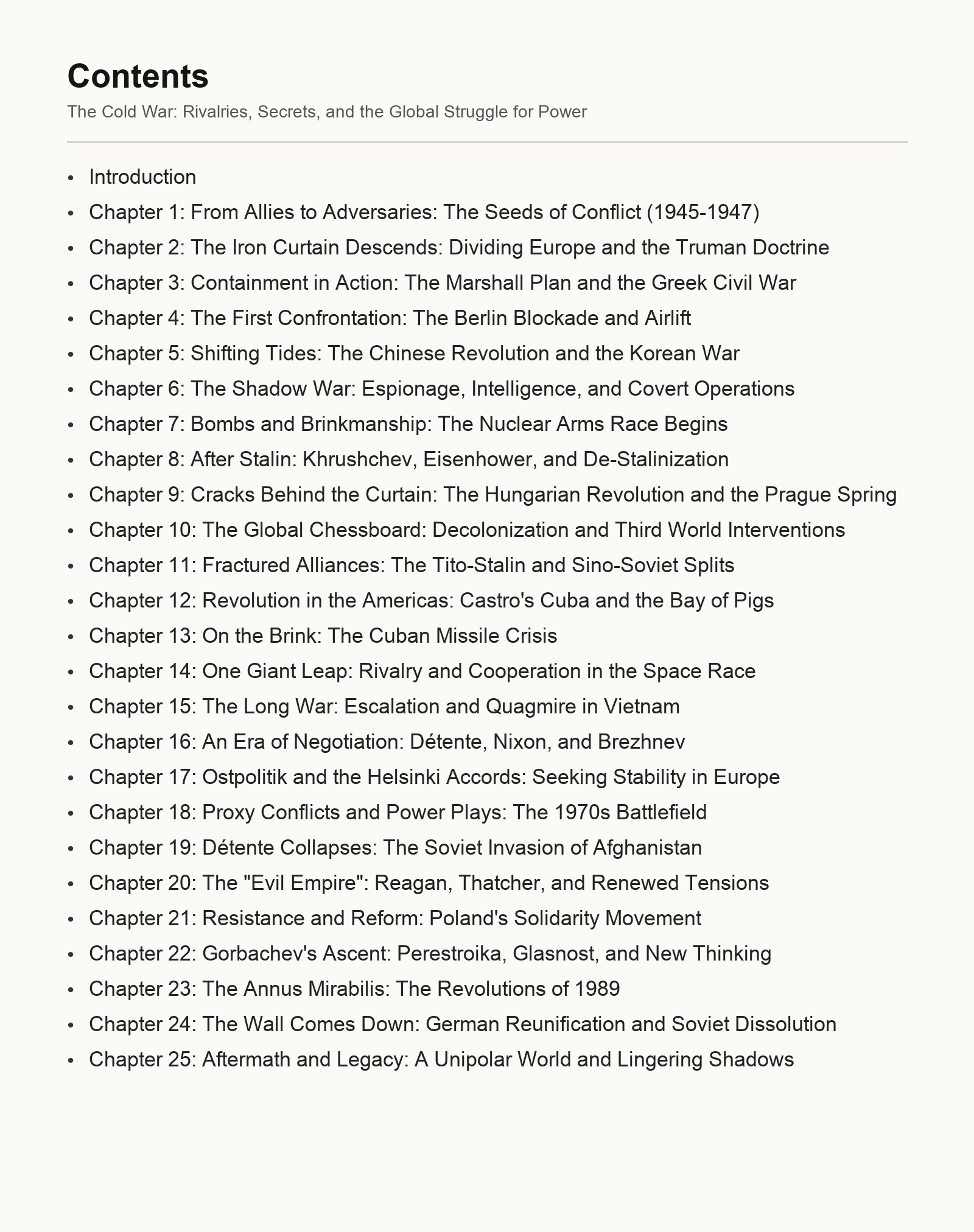
Table of Contents:
- Introduction
- Chapter 1: From Allies to Adversaries: The Seeds of Conflict (1945-1947)
- Chapter 2: The Iron Curtain Descends: Dividing Europe and the Truman Doctrine
- Chapter 3: Containment in Action: The Marshall Plan and the Greek Civil War
- Chapter 4: The First Confrontation: The Berlin Blockade and Airlift
- Chapter 5: Shifting Tides: The Chinese Revolution and the Korean War
- Chapter 6: The Shadow War: Espionage, Intelligence, and Covert Operations
- Chapter 7: Bombs and Brinkmanship: The Nuclear Arms Race Begins
- Chapter 8: After Stalin: Khrushchev, Eisenhower, and De-Stalinization
- Chapter 9: Cracks Behind the Curtain: The Hungarian Revolution and the Prague Spring
- Chapter 10: The Global Chessboard: Decolonization and Third World Interventions
- Chapter 11: Fractured Alliances: The Tito-Stalin and Sino-Soviet Splits
- Chapter 12: Revolution in the Americas: Castro's Cuba and the Bay of Pigs
- Chapter 13: On the Brink: The Cuban Missile Crisis
- Chapter 14: One Giant Leap: Rivalry and Cooperation in the Space Race
- Chapter 15: The Long War: Escalation and Quagmire in Vietnam
- Chapter 16: An Era of Negotiation: Détente, Nixon, and Brezhnev
- Chapter 17: Ostpolitik and the Helsinki Accords: Seeking Stability in Europe
- Chapter 18: Proxy Conflicts and Power Plays: The 1970s Battlefield
- Chapter 19: Détente Collapses: The Soviet Invasion of Afghanistan
- Chapter 20: The "Evil Empire": Reagan, Thatcher, and Renewed Tensions
- Chapter 21: Resistance and Reform: Poland's Solidarity Movement
- Chapter 22: Gorbachev's Ascent: Perestroika, Glasnost, and New Thinking
- Chapter 23: The Annus Mirabilis: The Revolutions of 1989
- Chapter 24: The Wall Comes Down: German Reunification and Soviet Dissolution
- Chapter 25: Aftermath and Legacy: A Unipolar World and Lingering Shadows
Author:
Published By:
Date Published:
May 24, 2026
Type:
Nonfiction
Language:
English
Also Available In:
Word Count:
51,777 words
Reading Time:
3 hours 38 minutes
Sample:
Order:
Buy the The Cold War ebook on MixCache.com:
Buy NowThe full ebook will be available immediately to read instantly on any device.
$5 account credit for all new MixCache.com accounts, usable toward any ebook purchase!*



Ratings & Reviews
Ask Questions About This Book
Have a question about the content? Ask our AI assistant!
Start by asking a question about "The Cold War"
Example: "Does this book mention William Shakespeare?"
Thinking...