Browse by Category
Fiction
- Action & Adventure
- African American
- Anthologies
- Children's Fiction
- Classics
- Comics & Graphic Novels
- Coming of Age
- Contemporary
- Cultural & Regional
- Drama
- Erotica
- Fantasy
- General
- Historical Fiction
- Horror
- Humor & Satire
- Literary Fiction
- Mystery, Thriller & Suspense
- Poetry
- Religious & Inspirational
- Romance
- Science Fiction
- Short Stories
- War & Military
- Westerns
- Women's Fiction
- Young Adult
Non-Fiction
- Antiques & Collectibles
- Arts & Photography
- Biographies & Memoirs
- Business & Money
- Children's Non-Fiction
-
Computers & Technology
- Artificial Intelligence
- Computer Science
- Cybersecurity & Cryptography
- Data Science & Analytics
- Databases & Big Data
- Game Development & Design
- General
- Hardware & DIY
- Mobile App Development
- Networking & Cloud Computing
- Operating Systems
- Programming
- Robotics
- Software
- Software Engineering
- User Experience (UX) & Design
- Web Development & Design
- Cooking, Food & Wine
- Crafts, Hobbies & Home
- Education & Teaching
- Engineering
- General
- Health, Fitness & Dieting
-
History
- African History
- African History - North Africa
- African History - Sub-Saharan Africa
- American History
- American History - 20th Century
- American History - Civil War
- American History - Colonial Period
- Ancient History
- Asian History
- Asian History - China
- Asian History - India
- Asian History - Japan
- Asian History - Southeast Asia
- European History
- European History - Ancient Greece
- European History - Ancient Rome
- European History - Medieval
- European History - Modern
- European History - Renaissance
- General
- Middle Eastern History
- Military History
- Military History - Aviation
- Military History - Naval
- Social & Cultural History
- World History
- Humor & Entertainment
- Industrial Technology
- Language Learning
- Law
- LGBTQ+ Non-Fiction
- Literary Criticism
- Medical Books
- Parenting & Relationships
- Philosophy
- Politics & Social Sciences
- Reference
- Religion & Spirituality
-
Science & Math
- Agricultural Sciences
- Astronomy & Space Science
- Behavioral Sciences
- Biological Sciences
- Botany & Plant Science
- Chemistry
- Earth Sciences
- Engineering - Chemical
- Engineering - Civil
- Engineering - Electrical
- Engineering - Mechanical
- Environment
- General
- Geology
- Mathematics
- Nature & Ecology
- Oceanography
- Paleontology
- Physics
- Statistics
- Self-Help
- Sports & Outdoors
- Study Aids
- Sustainability & Green Living
- Textbooks
- Transportation
- Travel
- True Crime
- Urban Planning & Development
- Veterinary Medicine
- Writing & Publishing
Jump to Section
MixCache.com Total Access
Unlimited reading and audiobooks for every book published by MixCache.com.
Included titles carry the MTA badge.
Learn more →
How the European Union works
Unraveling the EU: Understanding Its Structures, Institutions, And Procedures
About this book:



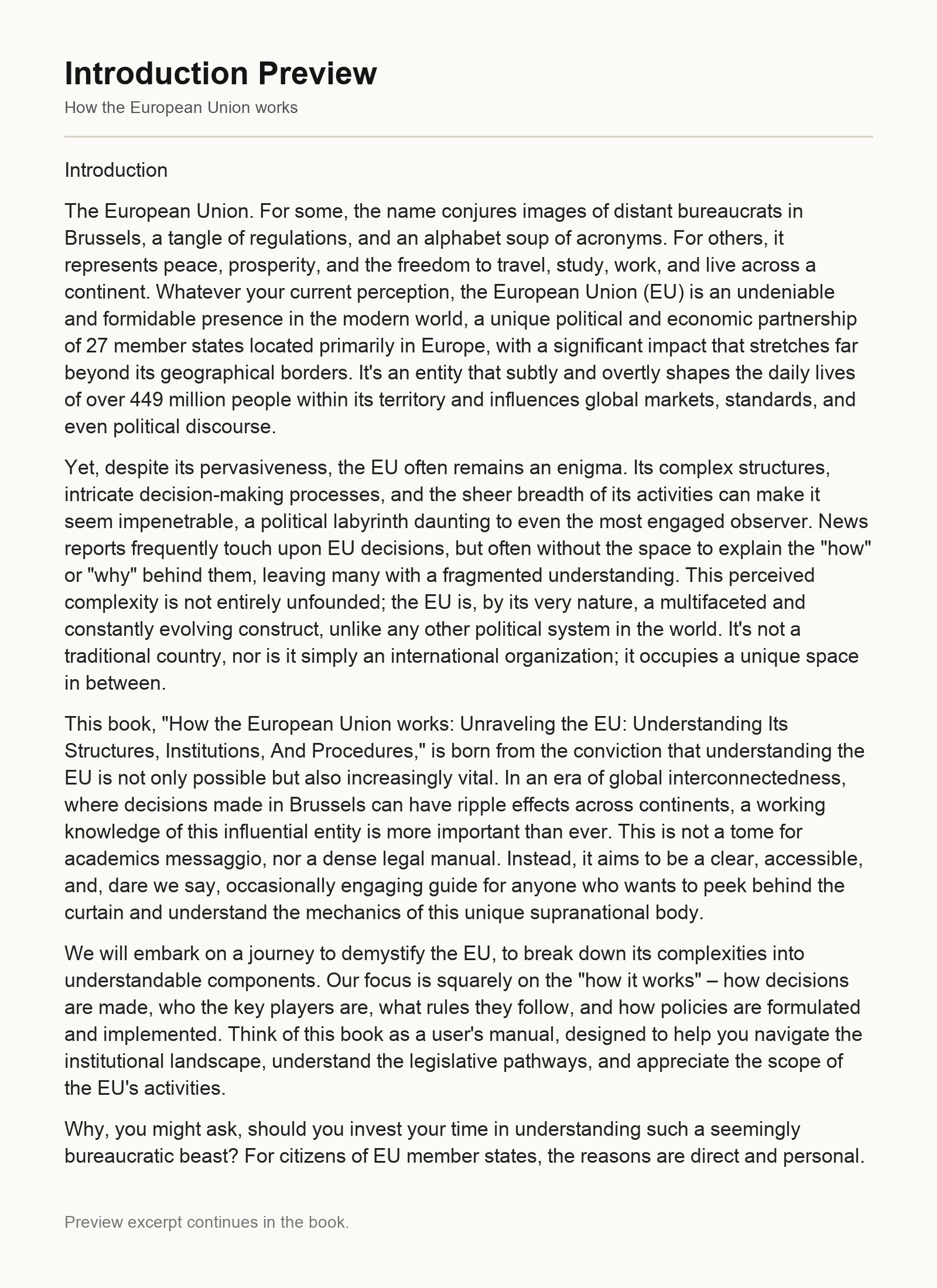

This book offers a clear, accessible guide to the inner workings of the European Union, turning what often seems like a bewildering maze of institutions and acronyms into a coherent story that anyone can follow. Whether you are a citizen trying to understand how decisions in Brussels affect your daily life, a student of politics or law seeking a solid foundation, or a business professional navigating the single market, the text walks you through the EU’s origins, its core institutions, and the procedures that turn ideas into binding rules. By the end, you will see the EU not as a distant bureaucracy but as a dynamic system shaped by compromise, legal principles, and the interplay of national and supranational actors.
You will begin with the historical journey from the Schuman Declaration to the Treaty of Lisbon, learning how economic cooperation in coal and steel evolved into a union that now covers everything from climate policy to digital regulation. The book explains the distinct roles of the European Council, the European Parliament, the Commission, the Council of the European Union, the Court of Justice, the European Central Bank, and the Court of Auditors, showing how each contributes to the Union’s balance of supranational initiative and intergovernmental control. Real‑world examples and clear language demystify concepts such as qualified majority voting, the ordinary legislative procedure, and the principle of subsidiarity, giving you a solid grasp of who does what and why.
Beyond the institutions, the text walks you through the practical mechanics of EU law‑making: how a proposal from the Commission moves through parliamentary committees, Council working parties, COREPER, and trilogue negotiations; how the budget is drafted, agreed, and discharged; and how specialized procedures like comitology, delegated acts, and the European Citizens’ Initiative fit into the larger picture. You will also see how national parliaments scrutinise EU proposals through the early‑warning system and how the Court of Justice ensures uniform interpretation across member states via preliminary rulings. This step‑by‑step view turns abstract theory into a usable roadmap for following current debates and anticipating future reforms.
The book then surveys the EU’s major policy areas, illustrating the tangible impact of Union action on everyday life and business. You will learn how the single market guarantees the free movement of goods, services, capital, and people; how competition policy curbs cartels and abuse of dominance; how trade policy shapes the EU’s global role through agreements and defence instruments; and how foreign and security policy, justice and home affairs, cohesion, environment, research, and digital initiatives are formulated and funded. Concrete examples—from the CE marking on products to GDPR rights, from Erasmus+ mobility to Horizon Europe grants—show how EU rules translate into consumer protections, business opportunities, and personal freedoms.
Finally, you will gain the tools to engage with the EU system yourself. The text points you to reliable information sources such as EUR‑Lex, the Official Journal, and the European Parliament’s Legislative Observatory, and explains how to use SOLVIT, the European Ombudsman, or a petition to the Parliament to resolve issues. It also outlines the challenges facing the Union today—from Brexit and geopolitical tensions to climate change and digital transformation—and presents the scenarios and debates about its future direction. By understanding both the mechanics and the stakes, you will be equipped to follow EU news critically, participate in informed discussions, and appreciate the Union as an ongoing experiment in cooperation that directly shapes the lives of over 449 million people.
What You'll Find Inside:
- Detailed explanation of EU institutions' roles and interactions, including the European Council, European Parliament, European Commission, and Court of Justice
- Step-by-step breakdown of the EU legislative process from proposal to law, covering the Ordinary Legislative Procedure and special procedures
- Analysis of the Single Market's four freedoms (goods, services, capital, people) and their practical implementation for citizens and businesses
- Overview of key EU policies including competition policy, trade policy, budget mechanisms, and major policy areas like environment and digital
- Examination of current challenges such as Brexit, geopolitical shifts, and debates about the EU's future direction, enlargement, and reform
Who's It For:
This book is designed for citizens of EU member states who want to understand how EU law affects their daily lives and rights, professionals and businesses operating within or trading with the EU who need to navigate its regulatory framework, and students of politics, economics, law, or international relations seeking a comprehensive yet accessible guide to EU structures and processes. It also serves anyone curious about the EU's role as a global actor in trade, diplomacy, and policy-making.
Table of Contents:
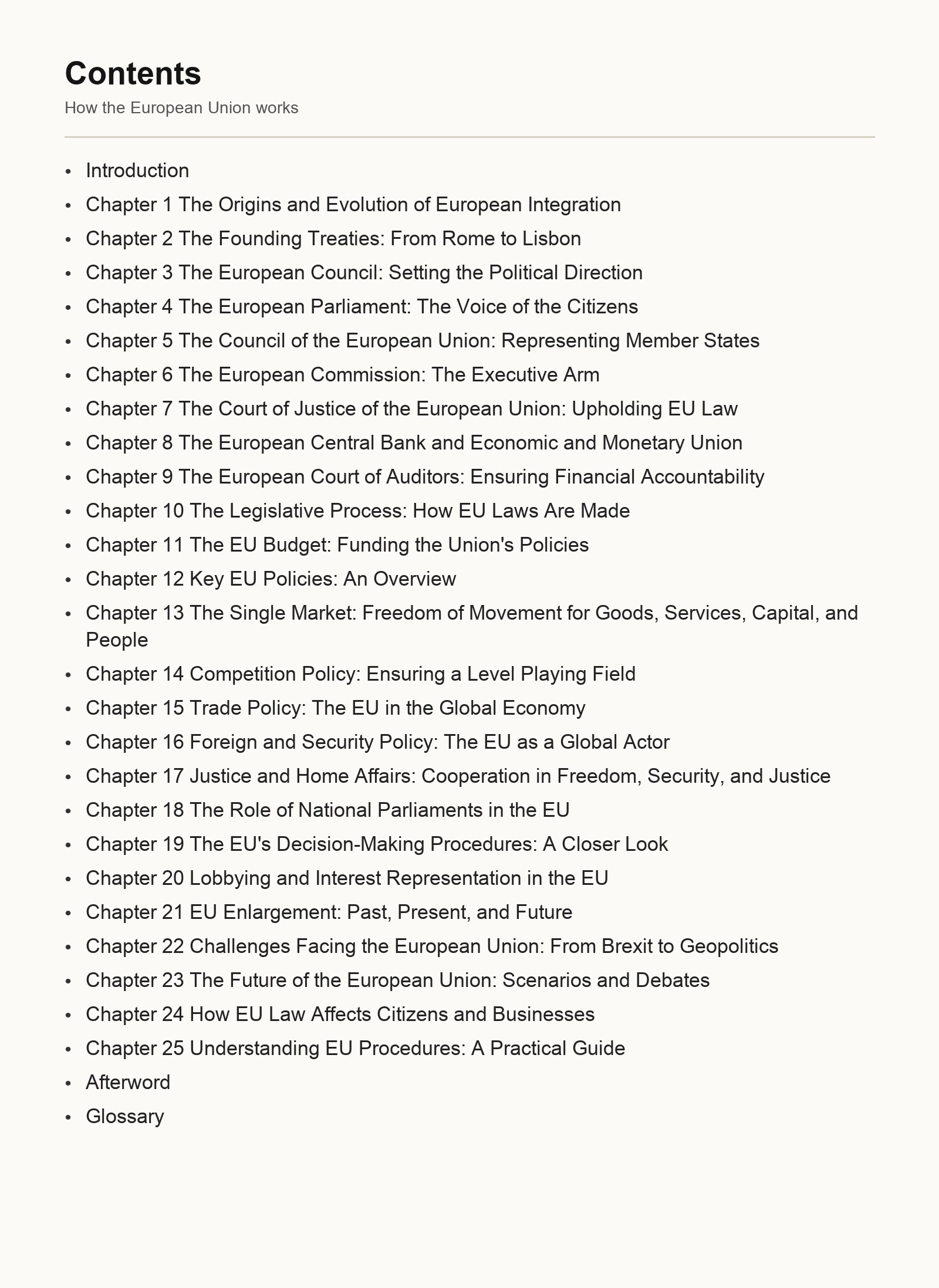
- Introduction
- Chapter 1 The Origins and Evolution of European Integration
- Chapter 2 The Founding Treaties: From Rome to Lisbon
- Chapter 3 The European Council: Setting the Political Direction
- Chapter 4 The European Parliament: The Voice of the Citizens
- Chapter 5 The Council of the European Union: Representing Member States
- Chapter 6 The European Commission: The Executive Arm
- Chapter 7 The Court of Justice of the European Union: Upholding EU Law
- Chapter 8 The European Central Bank and Economic and Monetary Union
- Chapter 9 The European Court of Auditors: Ensuring Financial Accountability
- Chapter 10 The Legislative Process: How EU Laws Are Made
- Chapter 11 The EU Budget: Funding the Union's Policies
- Chapter 12 Key EU Policies: An Overview
- Chapter 13 The Single Market: Freedom of Movement for Goods, Services, Capital, and People
- Chapter 14 Competition Policy: Ensuring a Level Playing Field
- Chapter 15 Trade Policy: The EU in the Global Economy
- Chapter 16 Foreign and Security Policy: The EU as a Global Actor
- Chapter 17 Justice and Home Affairs: Cooperation in Freedom, Security, and Justice
- Chapter 18 The Role of National Parliaments in the EU
- Chapter 19 The EU's Decision-Making Procedures: A Closer Look
- Chapter 20 Lobbying and Interest Representation in the EU
- Chapter 21 EU Enlargement: Past, Present, and Future
- Chapter 22 Challenges Facing the European Union: From Brexit to Geopolitics
- Chapter 23 The Future of the European Union: Scenarios and Debates
- Chapter 24 How EU Law Affects Citizens and Businesses
- Chapter 25 Understanding EU Procedures: A Practical Guide
- Afterword
- Glossary
Ephyia Publishing MixCache.com Book Reference: 15649
Author:
Published By:
Date Published:
May 19, 2026
Type:
Nonfiction
Language:
English
Also Available In:
Word Count:
59,390 words
Reading Time:
4 hours 10 minutes
Sample:
Order:
Order How the European Union works (Paperback) on MixCache.com:
Buy NowPrint copy is made to order and ships worldwide. Includes the ebook free, ready to read instantly.
$5 account credit for all new MixCache.com accounts, usable toward any ebook purchase!*