
Browse by Category
Fiction
- Action & Adventure
- African American
- Anthologies
- Children's Fiction
- Classics
- Comics & Graphic Novels
- Coming of Age
- Contemporary
- Cultural & Regional
- Drama
- Erotica
- Fantasy
- General
- Historical Fiction
- Horror
- Humor & Satire
- Literary Fiction
- Mystery, Thriller & Suspense
- Poetry
- Religious & Inspirational
- Romance
- Science Fiction
- Short Stories
- War & Military
- Westerns
- Women's Fiction
- Young Adult
Non-Fiction
- Antiques & Collectibles
- Arts & Photography
- Biographies & Memoirs
- Business & Money
- Children's Non-Fiction
-
Computers & Technology
- Artificial Intelligence
- Computer Science
- Cybersecurity & Cryptography
- Data Science & Analytics
- Databases & Big Data
- Game Development & Design
- General
- Hardware & DIY
- Mobile App Development
- Networking & Cloud Computing
- Operating Systems
- Programming
- Robotics
- Software
- Software Engineering
- User Experience (UX) & Design
- Web Development & Design
- Cooking, Food & Wine
- Crafts, Hobbies & Home
- Education & Teaching
- Engineering
- General
- Health, Fitness & Dieting
-
History
- African History
- African History - North Africa
- African History - Sub-Saharan Africa
- American History
- American History - 20th Century
- American History - Civil War
- American History - Colonial Period
- Ancient History
- Asian History
- Asian History - China
- Asian History - India
- Asian History - Japan
- Asian History - Southeast Asia
- European History
- European History - Ancient Greece
- European History - Ancient Rome
- European History - Medieval
- European History - Modern
- European History - Renaissance
- General
- Middle Eastern History
- Military History
- Military History - Aviation
- Military History - Naval
- Social & Cultural History
- World History
- Humor & Entertainment
- Industrial Technology
- Language Learning
- Law
- LGBTQ+ Non-Fiction
- Literary Criticism
- Medical Books
- Parenting & Relationships
- Philosophy
- Politics & Social Sciences
- Reference
- Religion & Spirituality
-
Science & Math
- Agricultural Sciences
- Astronomy & Space Science
- Behavioral Sciences
- Biological Sciences
- Botany & Plant Science
- Chemistry
- Earth Sciences
- Engineering - Chemical
- Engineering - Civil
- Engineering - Electrical
- Engineering - Mechanical
- Environment
- General
- Geology
- Mathematics
- Nature & Ecology
- Oceanography
- Paleontology
- Physics
- Statistics
- Self-Help
- Sports & Outdoors
- Study Aids
- Sustainability & Green Living
- Textbooks
- Transportation
- Travel
- True Crime
- Urban Planning & Development
- Veterinary Medicine
- Writing & Publishing
Jump to Section
MixCache.com Total Access
Unlimited reading and audiobooks for every book published by MixCache.com.
Included titles carry the MTA badge.
Learn more →
51st State
Exploring the Possibilities for the United States' Next Member
About this book:

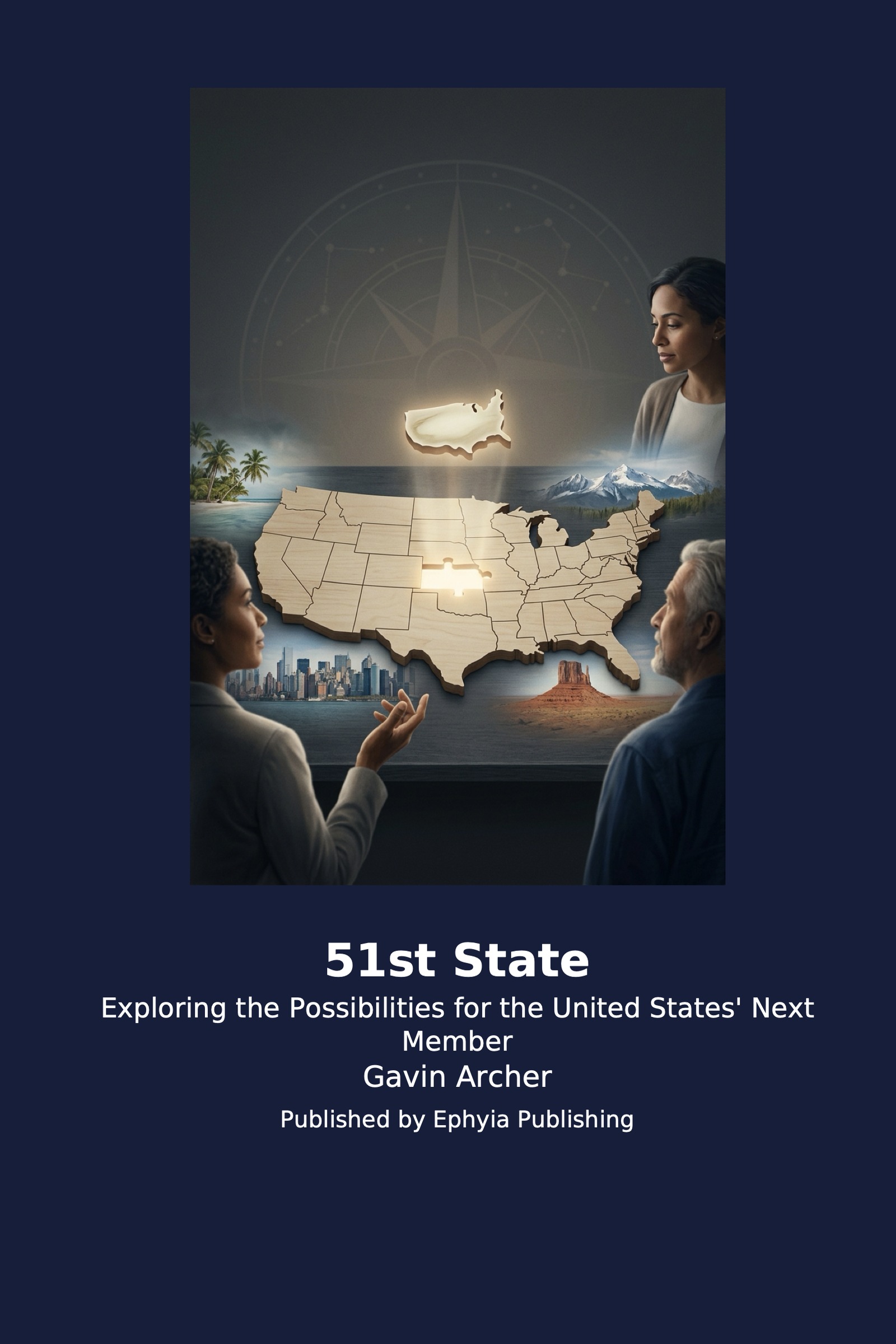
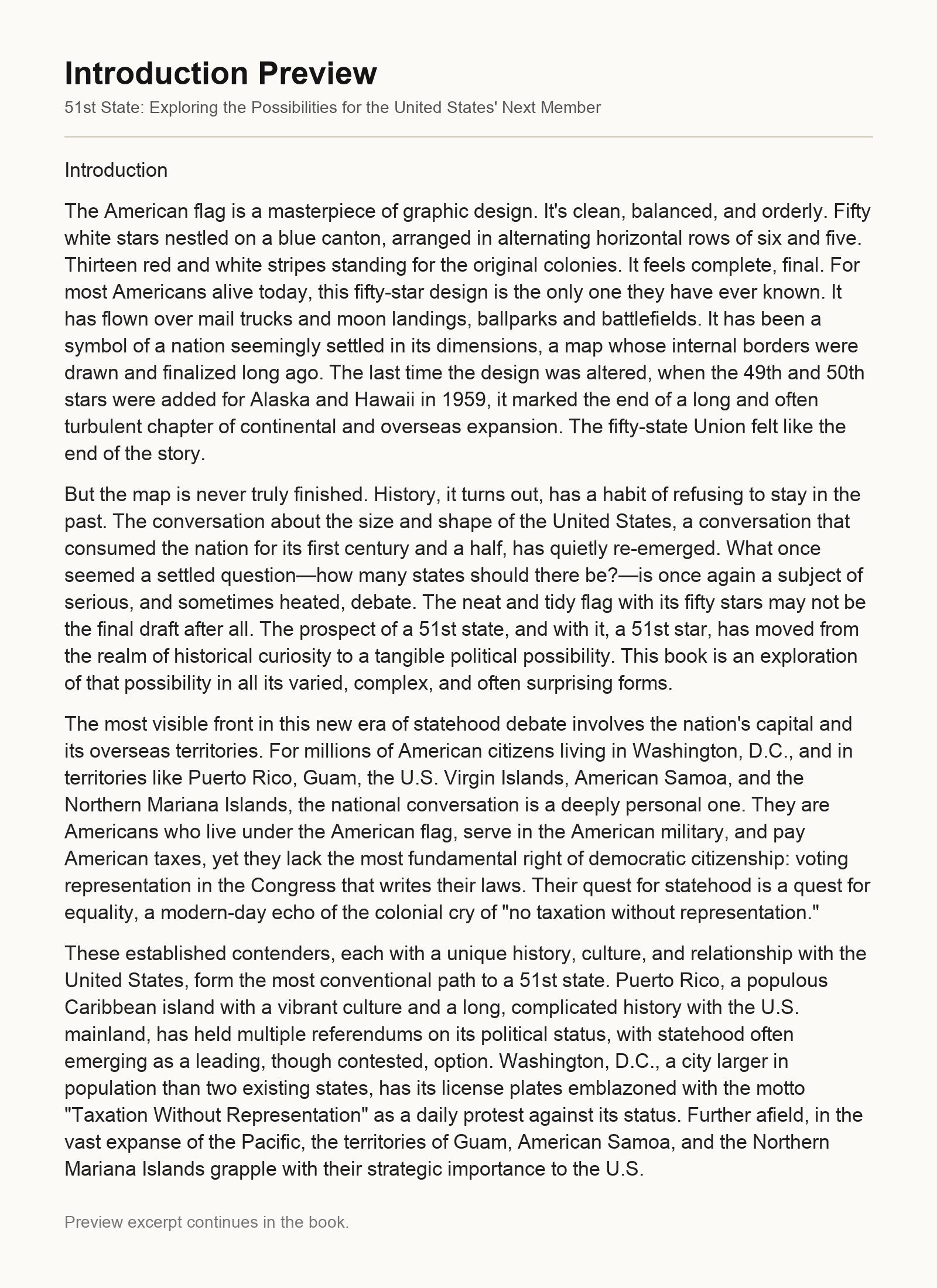
This book invites readers to explore the lively and often surprising debate over what the United States’ next state might look like. From the long‑standing aspirations of Puerto Rico and Washington, D.C., to the strategic considerations of Guam, the U.S. Virgin Islands, the Northern Mariana Islands, and American Samoa, each chapter lays out the historical roots, cultural nuances, and political realities that shape these territories’ quests for full statehood. Readers will walk through the milestones that have defined each region’s relationship with the federal government, gaining a clear picture of why statehood remains a pressing issue for millions of Americans who live under the flag but lack voting representation in Congress.
Beyond the overseas territories, the work turns inward to examine the myriad movements that seek to redraw the map from within existing states. Readers will discover the stories behind the State of Jefferson, the push for a State of Superior in the Great Lakes region, the Cascadia bioregional vision, and the recurring proposals to split California, Texas, and other states. Each case is presented with attention to the economic arguments, cultural identities, and partisan calculations that fuel these efforts, as well as the constitutional hurdles that make internal division a complex and rarely successful path.
The narrative then shifts to the mechanics of statehood itself, explaining how the Constitution’s Admissions Clause has been interpreted over two centuries, what an Enabling Act entails, and how historical precedents—from the Northwest Ordinance to the Tennessee Plan—have shaped the process. Readers will learn about the political power shifts that a new state would trigger in the Senate and House, the economic consequences of new federal revenues and expenditures, and the cultural tensions that arise when considering a state where English is not the dominant language or where communal land traditions clash with individual property rights. The book also tackles the symbolic weight of adding a 51st star to the flag, exploring design challenges and what such a change would say about American national unity.
Finally, the work looks at the more speculative fringes of the debate, from imaginative ideas of annexing Canadian provinces or purchasing Greenland to the science‑fiction notion of statehood on the Moon or Mars. By weighing these possibilities against the practical, legal, and ethical realities that have guided past expansions, readers will come away with a nuanced understanding of how the United States has continually renegotiated its borders and what that means for its future. Whether you are a student of history, a political enthusiast, or simply curious about the evolving story of the American flag, this book offers a comprehensive and engaging guide to the past, present, and potential next chapter of the nation’s growth.
What You'll Find Inside:
- The book examines the leading contenders for statehood - Puerto Rico and Washington D.C. - detailing their historical paths to citizenship, ongoing debates, and the unique challenges each faces in achieving equal representation.
- It explores the prospects of Pacific and Caribbean territories (Guam, U.S. Virgin Islands, Northern Mariana Islands, American Samoa) for statehood, weighing strategic value against cultural preservation concerns.
- The text investigates internal secession movements within existing states, from the State of Jefferson to proposals for splitting California and Texas, analyzing the cultural and political divisions driving these efforts.
- It provides a thorough analysis of the constitutional, economic, and political hurdles to statehood, including congressional power dynamics, fiscal impacts, and historical precedents for how states have joined the Union.
- The book concludes with considerations of cultural identity, public opinion, grassroots movements, and the symbolic significance of adding a 51st star to the American flag.
Who's It For:
This book is ideal for political science students, history enthusiasts, and engaged citizens seeking to understand the complex debate over expanding the United States beyond its current 50 states. It will particularly benefit those following current statehood discussions for Washington D.C. and Puerto Rico, as well as anyone interested in the constitutional processes, economic implications, and cultural considerations that would accompany the admission of a new state. Readers looking for a comprehensive examination of both established territories and internal secession movements will find valuable insights into the forces shaping America's potential future map.
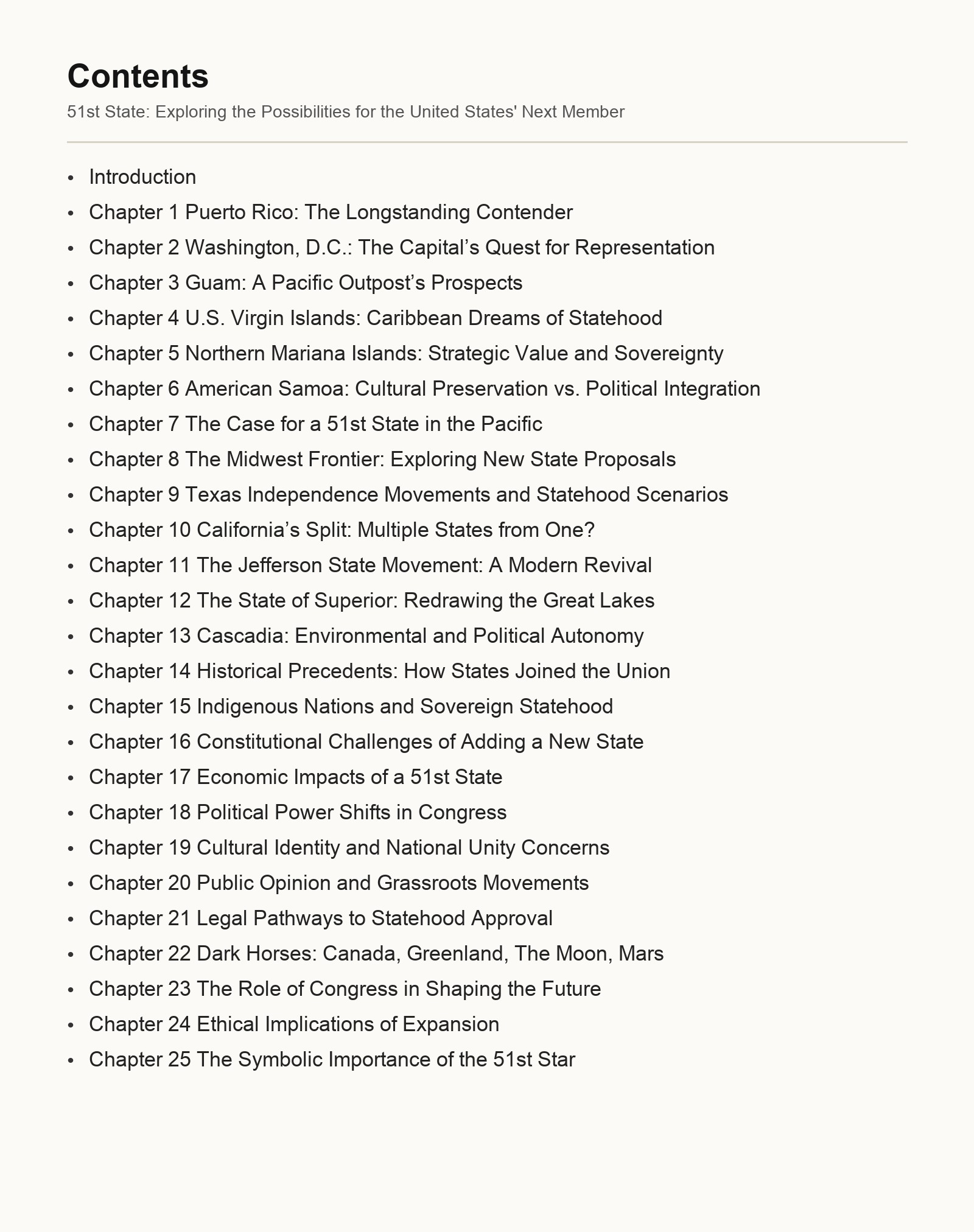
Table of Contents:
- Introduction
- Chapter 1 Puerto Rico: The Longstanding Contender
- Chapter 2 Washington, D.C.: The Capital’s Quest for Representation
- Chapter 3 Guam: A Pacific Outpost’s Prospects
- Chapter 4 U.S. Virgin Islands: Caribbean Dreams of Statehood
- Chapter 5 Northern Mariana Islands: Strategic Value and Sovereignty
- Chapter 6 American Samoa: Cultural Preservation vs. Political Integration
- Chapter 7 The Case for a 51st State in the Pacific
- Chapter 8 The Midwest Frontier: Exploring New State Proposals
- Chapter 9 Texas Independence Movements and Statehood Scenarios
- Chapter 10 California’s Split: Multiple States from One?
- Chapter 11 The Jefferson State Movement: A Modern Revival
- Chapter 12 The State of Superior: Redrawing the Great Lakes
- Chapter 13 Cascadia: Environmental and Political Autonomy
- Chapter 14 Historical Precedents: How States Joined the Union
- Chapter 15 Indigenous Nations and Sovereign Statehood
- Chapter 16 Constitutional Challenges of Adding a New State
- Chapter 17 Economic Impacts of a 51st State
- Chapter 18 Political Power Shifts in Congress
- Chapter 19 Cultural Identity and National Unity Concerns
- Chapter 20 Public Opinion and Grassroots Movements
- Chapter 21 Legal Pathways to Statehood Approval
- Chapter 22 Dark Horses: Canada, Greenland, The Moon, Mars...
- Chapter 23 The Role of Congress in Shaping the Future
- Chapter 24 Ethical Implications of Expansion
- Chapter 25 The Symbolic Importance of the 51st Star
Author:
Published By:
Date Published:
May 26, 2026
Type:
Nonfiction
Language:
English
Also Available In:
Word Count:
47,298 words
Reading Time:
3 hours 19 minutes
Sample:
Order:
Buy the 51st State ebook on MixCache.com:
Buy NowThe full ebook will be available immediately to read instantly on any device.
$5 account credit for all new MixCache.com accounts, usable toward any ebook purchase!*






Ratings & Reviews
Ask Questions About This Book
Have a question about the content? Ask our AI assistant!
Start by asking a question about "51st State"
Example: "Does this book mention William Shakespeare?"
Thinking...