
Browse by Category
Fiction
- Action & Adventure
- African American
- Anthologies
- Children's Fiction
- Classics
- Comics & Graphic Novels
- Coming of Age
- Contemporary
- Cultural & Regional
- Drama
- Erotica
- Fantasy
- General
- Historical Fiction
- Horror
- Humor & Satire
- Literary Fiction
- Mystery, Thriller & Suspense
- Poetry
- Religious & Inspirational
- Romance
- Science Fiction
- Short Stories
- War & Military
- Westerns
- Women's Fiction
- Young Adult
Non-Fiction
- Antiques & Collectibles
- Arts & Photography
- Biographies & Memoirs
- Business & Money
- Children's Non-Fiction
-
Computers & Technology
- Artificial Intelligence
- Computer Science
- Cybersecurity & Cryptography
- Data Science & Analytics
- Databases & Big Data
- Game Development & Design
- General
- Hardware & DIY
- Mobile App Development
- Networking & Cloud Computing
- Operating Systems
- Programming
- Robotics
- Software
- Software Engineering
- User Experience (UX) & Design
- Web Development & Design
- Cooking, Food & Wine
- Crafts, Hobbies & Home
- Education & Teaching
- Engineering
- General
- Health, Fitness & Dieting
-
History
- African History
- African History - North Africa
- African History - Sub-Saharan Africa
- American History
- American History - 20th Century
- American History - Civil War
- American History - Colonial Period
- Ancient History
- Asian History
- Asian History - China
- Asian History - India
- Asian History - Japan
- Asian History - Southeast Asia
- European History
- European History - Ancient Greece
- European History - Ancient Rome
- European History - Medieval
- European History - Modern
- European History - Renaissance
- General
- Middle Eastern History
- Military History
- Military History - Aviation
- Military History - Naval
- Social & Cultural History
- World History
- Humor & Entertainment
- Industrial Technology
- Language Learning
- Law
- LGBTQ+ Non-Fiction
- Literary Criticism
- Medical Books
- Parenting & Relationships
- Philosophy
- Politics & Social Sciences
- Reference
- Religion & Spirituality
-
Science & Math
- Agricultural Sciences
- Astronomy & Space Science
- Behavioral Sciences
- Biological Sciences
- Botany & Plant Science
- Chemistry
- Earth Sciences
- Engineering - Chemical
- Engineering - Civil
- Engineering - Electrical
- Engineering - Mechanical
- Environment
- General
- Geology
- Mathematics
- Nature & Ecology
- Oceanography
- Paleontology
- Physics
- Statistics
- Self-Help
- Sports & Outdoors
- Study Aids
- Sustainability & Green Living
- Textbooks
- Transportation
- Travel
- True Crime
- Urban Planning & Development
- Veterinary Medicine
- Writing & Publishing
Jump to Section
MixCache.com Total Access
Unlimited reading and audiobooks for every book published by MixCache.com.
Included titles carry the MTA badge.
Learn more →
Arsenal of Democracy: Industry, Economics, and War Production in World War II
MTA
The fiscal, industrial, and logistical architecture behind mass mobilization and victory
About this book:
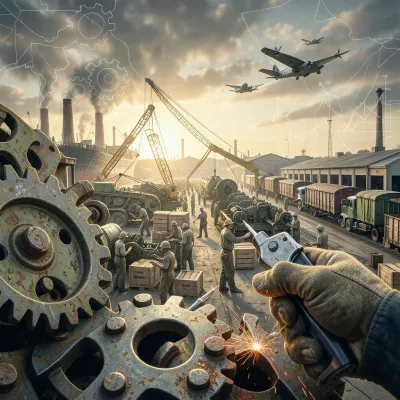
"Arsenal of Democracy" provides a comprehensive analysis of the industrial, fiscal, and logistical architecture that enabled Allied victory in World War II. Moving beyond traditional battlefield narratives, the book focuses on the "mobilization mandate," detailing how the United States converted a Depression-era economy into a high-output war machine. It explores the creation of centralized agencies like the War Production Board, the implementation of the Controlled Materials Plan to manage scarcity, and the use of cost-plus contracts to incentivize private industry. This systemic approach highlights how the fusion of public oversight and private initiative transformed peacetime plants—turning automakers into aircraft manufacturers and refrigerator factories into rifle arsenals.
The book emphasizes that production was fundamentally a human and scientific endeavor. It examines the massive labor shifts that brought millions of women and minorities into heavy industry, the "Double V" campaign's push for civil rights, and the rapid upskilling of workers through vocational pipelines and learning curves. Simultaneously, it details the rise of "science to scale," where research and development in fields like radar, synthetic rubber, and penicillin were integrated with rigorous statistical quality control and operations research. These chapters demonstrate that the Allied advantage lay not just in raw numbers, but in the reliability and technological superiority of their mass-produced equipment.
Logistics serves as the book's backbone, illustrating how the "circulatory system" of depots, railroads, and shipyards projected industrial power globally. The text compares the American experience with the distinct strategies of the Soviet Union’s command economy, Britain’s era of extreme austerity, and the fragmented industrial approaches of the Axis powers. By analyzing the "petroleum arsenal" and the complexities of island-hopping logistics in the Pacific, the author shows how the ability to fuel and supply distant fronts became the decisive variable in the conflict's outcome.
The final section addresses the long-term legacies of this unprecedented mobilization. The process of reconversion is presented as a second "miracle," where the potential for a postwar depression was averted through the GI Bill, the release of pent-up consumer demand, and the repurposing of wartime technological innovations. The book concludes that the fiscal and organizational structures built to win the war—ranging from payroll tax withholding to the military-industrial complex—not only secured victory but also laid the foundational infrastructure for the "Long Boom" and the modern global economic order.
What You'll Find Inside:
- The book explains how U.S. wartime agencies like the War Production Board, Office of Price Administration, and Controlled Materials Plan centralized planning while leveraging private industry to convert peacetime factories into an unprecedented production machine.
- It details the fiscal architecture of total war—massive tax expansion, war bond drives, and monetary policy—that funded $300 billion in wartime spending while curbing inflation and mobilizing national savings.
- It analyzes the labor mobilization that brought millions of women, minorities, and internal migrants into war industries, reshaping workplace dynamics through the War Labor Board, union no‑strike pledges, and rapid vocational training.
- It surveys the logistical backbone—railroads, trucking, pipelines (Big Inch/Little Big Inch), convoy systems, and amphibious supply chains—that turned factory output into delivered combat power across two oceans.
- It compares Allied and Axis production strategies, showing how material bottlenecks, strategic bombing, differing economic models, and approaches to standardization and innovation determined the war’s industrial outcome.
Who's It For:
This work is suited for economic historians, policy students, and planners interested in how nations mobilize industry, finance, labor, and logistics for large‑scale crises. It will also appeal to WWII enthusiasts seeking a deep, data‑driven look at the 'Arsenal of Democracy' and to professionals in defense, industrial economics, or supply‑chain management who want comparative lessons on wartime production and postwar reconversion.
Table of Contents:
- Introduction
- Chapter 1 The Mobilization Mandate: From Depression Industry to Wartime Arsenal
- Chapter 2 Designing the War Economy: Agencies, Authorities, and Planning
- Chapter 3 Converting Peacetime Plants: Autos to Aircraft, Refrigerators to Rifles
- Chapter 4 Financing Total War: Taxation, Bonds, and Monetary Policy
- Chapter 5 Pricing the Arsenal: Cost-Plus Contracts, Incentives, and Accountability
- Chapter 6 Managing Scarcity: Rationing, Priorities, and Material Substitution
- Chapter 7 Labor at War: Recruitment, Unions, and the War Labor Board
- Chapter 8 New Workers, New Roles: Women, Minorities, and Migration
- Chapter 9 Training for Productivity: Vocational Pipelines and Learning Curves
- Chapter 10 Science to Scale: R&D, Standardization, and Quality Control
- Chapter 11 The Aircraft Surge: Engines, Airframes, and Networked Supply
- Chapter 12 Shipyards as Systems: Liberty Ships, Tankers, and Maritime Logistics
- Chapter 13 Steel, Aluminum, and Rubber: Strategic Materials and Cartel Politics
- Chapter 14 Oil and Energy: Fueling Armies, Navies, and Air Forces
- Chapter 15 The Logistics Backbone: Depots, Railroads, Trucks, and Ports
- Chapter 16 Global Supply Lines: Convoys, Submarines, and Risk Management
- Chapter 17 Lend-Lease and Allied Integration: Allocations, Payments, and Politics
- Chapter 18 The Soviet Production Machine: Central Planning under Fire
- Chapter 19 Britain’s Wartime Economy: Austerity, Innovation, and Coordination
- Chapter 20 Axis Production Strategies: Germany, Japan, and Italy Compared
- Chapter 21 Airpower and Industry: Targeting, Dispersal, and Resilience
- Chapter 22 Information and Control: Statistics, Forecasting, and Operations Research
- Chapter 23 Home Front Consumption: Kitchens, Clothing, and Civilian Morale
- Chapter 24 War in the Pacific: Island Logistics and Amphibious Supply
- Chapter 25 Reconversion and the Postwar Order: Demobilization, the GI Bill, and the Long Boom
Author:
Published By:
Date Published:
April 14, 2026
Type:
Nonfiction
Language:
English
Word Count:
41,761 words
Reading Time:
2 hours 55 minutes
Sample:
MixCache.com Total Access
Get unlimited access to this book + all books published by MixCache.com for $11.99/month
Subscribe to MTAOr purchase this book individually below
Order:
Buy the Arsenal of Democracy: Industry, Economics, and War Production in World War II ebook on MixCache.com:
Buy Now
Full ebook will be available immediately
- read online or download as a PDF file.
$5 account credit for all new MixCache.com accounts, usable toward any ebook purchase!*






Ratings & Reviews
Ask Questions About This Book
Have a question about the content? Ask our AI assistant!
Start by asking a question about "Arsenal of Democracy: Industry, Economics, and War Production in World War II"
Example: "Does this book mention William Shakespeare?"
Thinking...