Browse by Category
Fiction
- Action & Adventure
- African American
- Anthologies
- Children's Fiction
- Classics
- Comics & Graphic Novels
- Coming of Age
- Contemporary
- Cultural & Regional
- Drama
- Erotica
- Fantasy
- General
- Historical Fiction
- Horror
- Humor & Satire
- Literary Fiction
- Mystery, Thriller & Suspense
- Poetry
- Religious & Inspirational
- Romance
- Science Fiction
- Short Stories
- War & Military
- Westerns
- Women's Fiction
- Young Adult
Non-Fiction
- Antiques & Collectibles
- Arts & Photography
- Biographies & Memoirs
- Business & Money
- Children's Non-Fiction
-
Computers & Technology
- Artificial Intelligence
- Computer Science
- Cybersecurity & Cryptography
- Data Science & Analytics
- Databases & Big Data
- Game Development & Design
- General
- Hardware & DIY
- Mobile App Development
- Networking & Cloud Computing
- Operating Systems
- Programming
- Robotics
- Software
- Software Engineering
- User Experience (UX) & Design
- Web Development & Design
- Cooking, Food & Wine
- Crafts, Hobbies & Home
- Education & Teaching
- Engineering
- General
- Health, Fitness & Dieting
-
History
- African History
- African History - North Africa
- African History - Sub-Saharan Africa
- American History
- American History - 20th Century
- American History - Civil War
- American History - Colonial Period
- Ancient History
- Asian History
- Asian History - China
- Asian History - India
- Asian History - Japan
- Asian History - Southeast Asia
- European History
- European History - Ancient Greece
- European History - Ancient Rome
- European History - Medieval
- European History - Modern
- European History - Renaissance
- General
- Middle Eastern History
- Military History
- Military History - Aviation
- Military History - Naval
- Social & Cultural History
- World History
- Humor & Entertainment
- Industrial Technology
- Language Learning
- Law
- LGBTQ+ Non-Fiction
- Literary Criticism
- Medical Books
- Parenting & Relationships
- Philosophy
- Politics & Social Sciences
- Reference
- Religion & Spirituality
-
Science & Math
- Agricultural Sciences
- Astronomy & Space Science
- Behavioral Sciences
- Biological Sciences
- Botany & Plant Science
- Chemistry
- Earth Sciences
- Engineering - Chemical
- Engineering - Civil
- Engineering - Electrical
- Engineering - Mechanical
- Environment
- General
- Geology
- Mathematics
- Nature & Ecology
- Oceanography
- Paleontology
- Physics
- Statistics
- Self-Help
- Sports & Outdoors
- Study Aids
- Sustainability & Green Living
- Textbooks
- Transportation
- Travel
- True Crime
- Urban Planning & Development
- Veterinary Medicine
- Writing & Publishing
Jump to Section
MixCache.com Total Access
Unlimited reading and audiobooks for every book published by MixCache.com.
Included titles carry the MTA badge.
Learn more →
A People's Timeline of Europe
MTA
A concise chronological guide to the major events that shaped Europe for beginners
About this book:
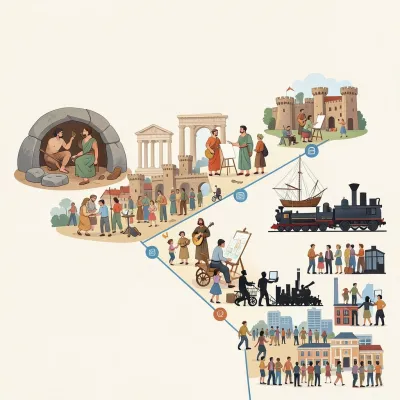
*A People's Timeline of Europe* provides a comprehensive chronological overview of the continent’s history, beginning with the migrations of early hominins and the sophisticated cultures of the Bronze Age. The book traces the foundational influence of the Greek polis and Roman law, followed by the transformative rise of Christianity and the subsequent fragmentation of the Western Roman Empire. It highlights how the Middle Ages were shaped by the resilience of Byzantium, the intellectual brilliance of Al-Andalus, and the structured social hierarchies of the feudal order, eventually giving way to the expansion of trade, towns, and the fervor of the Crusades.
The narrative transitions into the early modern era by examining the devastating impact of the Black Death and the Hundred Years' War, which cleared the path for the Renaissance and the Scientific Revolution. The book details how the invention of the printing press amplified the religious upheavals of the Reformation, leading to a century of religious wars and the eventual rise of centralized absolute monarchies. It also explores the "Age of Discovery," noting how European expansion and the Atlantic slave trade created a global economic network that funded both imperial power and the intellectual inquiries of the Enlightenment.
The latter portion of the book focuses on the era of revolutions, starting with the French Revolution’s challenge to monarchy and Napoleon’s dramatic reshaping of the European map. The 19th century is characterized by the rapid social and technological shifts of the Industrial Revolution and the nationalistic fervor of 1848. This leads into the catastrophic global conflicts of the 20th century—World War I and World War II—which shattered empires and resulted in the horrific tragedy of the Holocaust.
The final chapters address the Cold War’s ideological division of Europe and the subsequent recovery efforts through the Marshall Plan and early European integration. Following the peaceful revolutions of 1989 and the reunification of Germany, the book concludes by analyzing the contemporary challenges facing the European Union. It examines the complexities of globalization, the rise of populism, the migration crisis, and 21st-century emergencies such as climate change, the COVID-19 pandemic, and the return of large-scale warfare to the continent.
What You'll Find Inside:
- Covers European history from prehistory to the 21st century in clear chronological steps, showing how events connect across time
- Focuses on how major historical events affected ordinary people's daily lives, including farmers, artisans, migrants, and enslaved populations
- Examines Europe's shifting boundaries and identities as a historical conversation rather than a fixed geographic entity
- Highlights Europe's connections to the wider world through trade, migration, conquest, and cultural exchange
- Presents a balanced view of both progress and creativity alongside violence, exclusion, and catastrophe throughout European history
Who's It For:
This book is designed for beginners approaching European history for the first time, offering an accessible chronological guide that connects political events to social and cultural developments. It will particularly benefit readers who want to understand not just what happened in European history, but why it mattered to ordinary lives across different regions, classes, and eras. The text serves as both a solid foundation for newcomers and a springboard for deeper exploration of specific periods or themes.
Table of Contents:
- Introduction
- Chapter 1 Deep Roots: Prehistory to the Bronze Age
- Chapter 2 The Greek Polis and Classical Thought
- Chapter 3 Rome: Republic, Empire, and the Rule of Law
- Chapter 4 Faith and Upheaval: Christianity and the Fall of Rome
- Chapter 5 Migrations and the Making of Early Medieval Europe
- Chapter 6 Byzantium: Europe’s Eastern Anchor
- Chapter 7 The Rise of Islam and Al-Andalus
- Chapter 8 Vikings, Franks, and the Feudal Order
- Chapter 9 The High Middle Ages: Towns, Trade, and the Crusades
- Chapter 10 Crisis and Transformation: Plague, War, and State-Building
- Chapter 11 The Italian Renaissance and Humanism
- Chapter 12 Printing, Reformation, and Religious Wars
- Chapter 13 The Scientific Revolution and New Worlds
- Chapter 14 Absolutism, Empires, and the Enlightenment
- Chapter 15 Revolutions of Liberty: 1776–1789 and Beyond
- Chapter 16 Napoleon and the Remaking of the Map
- Chapter 17 Industry, Railways, and Social Change
- Chapter 18 1848: The Springtime of Nations
- Chapter 19 Imperial Rivalries and the Road to 1914
- Chapter 20 World War I and Its Aftermath
- Chapter 21 Between Democracy and Dictatorship: The Interwar Years
- Chapter 22 World War II: Total War and the Holocaust
- Chapter 23 Cold War Europe: Division, Recovery, and Integration
- Chapter 24 1989: Revolutions, Reunification, and the New Europe
- Chapter 25 The European Union, Globalization, and 21st‑Century Challenges
Author:
Published By:
Date Published:
May 14, 2026
Type:
Nonfiction
Language:
English
Word Count:
70,389 words
Reading Time:
4 hours 56 minutes
Sample:
Order:
Order A People's Timeline of Europe (Paperback) on MixCache.com:
Buy NowPrint copy is made to order and ships worldwide. Includes the ebook free, ready to read instantly.
$5 account credit for all new MixCache.com accounts, usable toward any ebook purchase!*