
Browse by Category
Fiction
- Action & Adventure
- African American
- Anthologies
- Children's Fiction
- Classics
- Comics & Graphic Novels
- Coming of Age
- Contemporary
- Cultural & Regional
- Drama
- Erotica
- Fantasy
- General
- Historical Fiction
- Horror
- Humor & Satire
- Literary Fiction
- Mystery, Thriller & Suspense
- Poetry
- Religious & Inspirational
- Romance
- Science Fiction
- Short Stories
- War & Military
- Westerns
- Women's Fiction
- Young Adult
Non-Fiction
- Antiques & Collectibles
- Arts & Photography
- Biographies & Memoirs
- Business & Money
- Children's Non-Fiction
-
Computers & Technology
- Artificial Intelligence
- Computer Science
- Cybersecurity & Cryptography
- Data Science & Analytics
- Databases & Big Data
- Game Development & Design
- General
- Hardware & DIY
- Mobile App Development
- Networking & Cloud Computing
- Operating Systems
- Programming
- Robotics
- Software
- Software Engineering
- User Experience (UX) & Design
- Web Development & Design
- Cooking, Food & Wine
- Crafts, Hobbies & Home
- Education & Teaching
- Engineering
- General
- Health, Fitness & Dieting
-
History
- African History
- African History - North Africa
- African History - Sub-Saharan Africa
- American History
- American History - 20th Century
- American History - Civil War
- American History - Colonial Period
- Ancient History
- Asian History
- Asian History - China
- Asian History - India
- Asian History - Japan
- Asian History - Southeast Asia
- European History
- European History - Ancient Greece
- European History - Ancient Rome
- European History - Medieval
- European History - Modern
- European History - Renaissance
- General
- Middle Eastern History
- Military History
- Military History - Aviation
- Military History - Naval
- Social & Cultural History
- World History
- Humor & Entertainment
- Industrial Technology
- Language Learning
- Law
- LGBTQ+ Non-Fiction
- Literary Criticism
- Medical Books
- Parenting & Relationships
- Philosophy
- Politics & Social Sciences
- Reference
- Religion & Spirituality
-
Science & Math
- Agricultural Sciences
- Astronomy & Space Science
- Behavioral Sciences
- Biological Sciences
- Botany & Plant Science
- Chemistry
- Earth Sciences
- Engineering - Chemical
- Engineering - Civil
- Engineering - Electrical
- Engineering - Mechanical
- Environment
- General
- Geology
- Mathematics
- Nature & Ecology
- Oceanography
- Paleontology
- Physics
- Statistics
- Self-Help
- Sports & Outdoors
- Study Aids
- Sustainability & Green Living
- Textbooks
- Transportation
- Travel
- True Crime
- Urban Planning & Development
- Veterinary Medicine
- Writing & Publishing
Jump to Section
MixCache.com Total Access
Unlimited reading and audiobooks for every book published by MixCache.com.
Included titles carry the MTA badge.
Learn more →
Red Stars and Rockets
MTA
Soviet Science, Space Race Innovation, and the Politics of Technology
About this book:
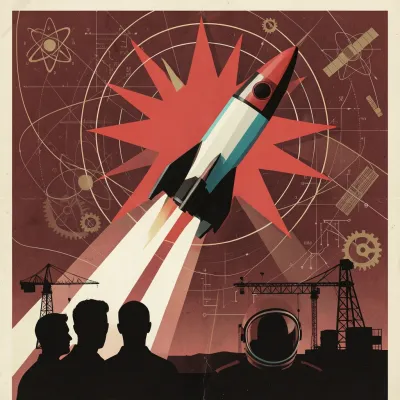
*Red Stars and Rockets* provides an interdisciplinary analysis of the Soviet space program, moving beyond a mere timeline of milestones to examine the complex interplay between centralized planning, institutional rivalries, and the "design bureau state." The book argues that Soviet innovation was not a miracle of isolated genius but the product of a technocratic system that married Marxist-Leninist ideology with pragmatic engineering. By exploring the influence of "Chief Designers" like Sergei Korolev and Valentin Glushko, the narrative reveals how personal enmities and differing philosophies on propulsion shaped the hardware that propelled the USSR into the cosmos, often favoring robustness and redundancy over Western elegance.
The text delves into the hidden infrastructure of the Soviet effort, from the geographic secrecy of the Baikonur Cosmodrome to the "provinces of progress" found in specialized institutes and provincial shop floors. It highlights the pervasive role of secrecy and the "shadow economy" of the command system, where resources were secured through patronage and barter rather than market logic. The book also shines a light on the invisible labor of women and the life sciences, framing missions like Laika’s and Gagarin’s not just as scientific breakthroughs, but as meticulously choreographed state performances designed to project socialist modernity to a global audience.
Crucially, the book examines the program's failures—such as the catastrophic Nedelin disaster and the ill-fated N1 lunar rocket—as essential moments of organizational learning. It traces the transition from the frantic "race for firsts" to the more sustainable era of Salyut and Mir space stations, which normalized human presence in orbit. The narrative concludes with the era of Perestroika, showing how the pressures of reform and the eventual collapse of the Soviet Union forced a transition toward commercialization and international collaboration. Ultimately, the book positions the Soviet space legacy as a foundational element of modern aerospace, demonstrating that the politics of technology remains as decisive as the physics of propulsion.
What You'll Find Inside:
- The Soviet space program succeeded through a unique 'design bureau state' system that balanced central planning with autonomous innovation hubs, enabling breakthroughs despite economic constraints.
- Space achievements were deeply politicized, serving as demonstrations of socialist superiority while being shaped by internal bureau rivalries, military priorities, and secrecy requirements.
- The program relied on immense human effort and improvisation, from engineers working with scarce resources to women performing critical but often invisible labor in technical roles.
- Failures and catastrophes were managed through secrecy and narrative control, revealing tensions between technical reality and political imperatives in the Soviet system.
- The Soviet space legacy continues to influence today's space exploration through technology transfer, operational practices, and lessons about balancing innovation with institutional constraints.
Who's It For:
This book is ideal for students and scholars of the history of technology, Cold War studies, and Soviet history who seek to understand how political systems shape technological innovation. It will also appeal to space enthusiasts interested in the lesser-known human stories, institutional dynamics, and political context behind the Soviet space program's triumphs and tragedies. General readers with an interest in how ideology and bureaucracy interact with scientific progress will find valuable insights into the enduring legacies of Soviet aerospace engineering.
Table of Contents:
- Introduction
- Chapter 1 Seeds of a Red Technocracy
- Chapter 2 Plans, Academies, and the Design Bureau State
- Chapter 3 War, Rockets, and Reconstruction
- Chapter 4 The Chief Designer: Korolev and System-Building
- Chapter 5 Engines and Enmities: Glushko, Propellants, and Power
- Chapter 6 Building Baikonur: Geography of Secrecy
- Chapter 7 From R-7 to Sputnik: A Planet Hears the Beep
- Chapter 8 Laika and the Life Sciences of Spaceflight
- Chapter 9 Gagarin’s Orbit: Human Spaceflight as State Performance
- Chapter 10 Luna and Lunokhod: Robotic Pioneers
- Chapter 11 Venera and the Perils of Planetary Science
- Chapter 12 Rivalry in Orbit: Voskhod, Gemini, and the Battle of Narratives
- Chapter 13 Soyuz and Salyut: Space Stations as Statecraft
- Chapter 14 Almaz and the Militarization of Orbit
- Chapter 15 The Moon That Wasn’t: N1-L3 and Organizational Learning
- Chapter 16 Calculating Control: Cybernetics, Computing, and Ideology
- Chapter 17 Women, Work, and the Invisible Labor of Innovation
- Chapter 18 Safety, Secrecy, and Catastrophe: From Nedelin to Soyuz 11
- Chapter 19 The Economy of Rockets: Costs, Shortages, and Shadow Prices
- Chapter 20 Intercosmos, Europe, and the Politics of Collaboration
- Chapter 21 Energiya–Buran: Ambition at the Edge
- Chapter 22 Provinces of Progress: Institutes, Schools, and Shop Floors
- Chapter 23 Propaganda, Publics, and the Poetics of Space
- Chapter 24 Perestroika in Orbit: Reform and Rupture
- Chapter 25 Legacies and Lessons: From the Soviet Past to Today’s Politics of Technology
Author:
Published By:
Date Published:
May 2, 2026
Type:
Nonfiction
Language:
English
Word Count:
59,473 words
Reading Time:
4 hours 10 minutes
Sample:
MixCache.com Total Access
Get unlimited access to this book + all books published by MixCache.com for $11.99/month
Subscribe to MTAOr purchase this book individually below
Order:
Buy the Red Stars and Rockets ebook on MixCache.com:
Buy Now
Full ebook will be available immediately
- read online or download as a PDF file.
$5 account credit for all new MixCache.com accounts, usable toward any ebook purchase!*




Ratings & Reviews
Ask Questions About This Book
Have a question about the content? Ask our AI assistant!
Start by asking a question about "Red Stars and Rockets"
Example: "Does this book mention William Shakespeare?"
Thinking...