Browse by Category
Fiction
- Action & Adventure
- African American
- Anthologies
- Children's Fiction
- Classics
- Comics & Graphic Novels
- Coming of Age
- Contemporary
- Cultural & Regional
- Drama
- Erotica
- Fantasy
- General
- Historical Fiction
- Horror
- Humor & Satire
- Literary Fiction
- Mystery, Thriller & Suspense
- Poetry
- Religious & Inspirational
- Romance
- Science Fiction
- Short Stories
- War & Military
- Westerns
- Women's Fiction
- Young Adult
Non-Fiction
- Antiques & Collectibles
- Arts & Photography
- Biographies & Memoirs
- Business & Money
- Children's Non-Fiction
-
Computers & Technology
- Artificial Intelligence
- Computer Science
- Cybersecurity & Cryptography
- Data Science & Analytics
- Databases & Big Data
- Game Development & Design
- General
- Hardware & DIY
- Mobile App Development
- Networking & Cloud Computing
- Operating Systems
- Programming
- Robotics
- Software
- Software Engineering
- User Experience (UX) & Design
- Web Development & Design
- Cooking, Food & Wine
- Crafts, Hobbies & Home
- Education & Teaching
- Engineering
- General
- Health, Fitness & Dieting
-
History
- African History
- African History - North Africa
- African History - Sub-Saharan Africa
- American History
- American History - 20th Century
- American History - Civil War
- American History - Colonial Period
- Ancient History
- Asian History
- Asian History - China
- Asian History - India
- Asian History - Japan
- Asian History - Southeast Asia
- European History
- European History - Ancient Greece
- European History - Ancient Rome
- European History - Medieval
- European History - Modern
- European History - Renaissance
- General
- Middle Eastern History
- Military History
- Military History - Aviation
- Military History - Naval
- Social & Cultural History
- World History
- Humor & Entertainment
- Industrial Technology
- Language Learning
- Law
- LGBTQ+ Non-Fiction
- Literary Criticism
- Medical Books
- Parenting & Relationships
- Philosophy
- Politics & Social Sciences
- Reference
- Religion & Spirituality
-
Science & Math
- Agricultural Sciences
- Astronomy & Space Science
- Behavioral Sciences
- Biological Sciences
- Botany & Plant Science
- Chemistry
- Earth Sciences
- Engineering - Chemical
- Engineering - Civil
- Engineering - Electrical
- Engineering - Mechanical
- Environment
- General
- Geology
- Mathematics
- Nature & Ecology
- Oceanography
- Paleontology
- Physics
- Statistics
- Self-Help
- Sports & Outdoors
- Study Aids
- Sustainability & Green Living
- Textbooks
- Transportation
- Travel
- True Crime
- Urban Planning & Development
- Veterinary Medicine
- Writing & Publishing
Jump to Section
MixCache.com Total Access
Unlimited reading and audiobooks for every book published by MixCache.com.
Included titles carry the MTA badge.
Learn more →
Seafloor Mapping and Marine Geophysics
MTA
Techniques, case studies, and applications of multibeam, seismic, and geophysical surveys
About this book:
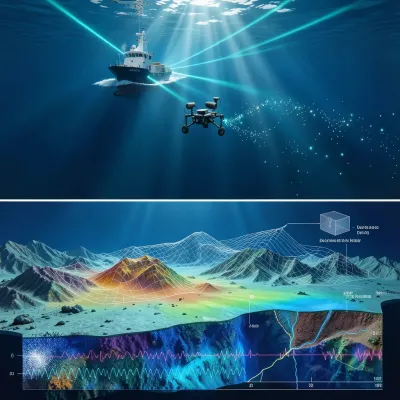
This book provides a comprehensive guide to seafloor mapping and marine geophysics, bridging the gap between raw acoustic data and geological interpretation. It details the fundamental physics of sound in water and the technical specifications of essential instrumentation, including multibeam echosounders, side-scan sonar, and sub-bottom profilers. The text emphasizes that high-quality maps depend on rigorous survey design, precise positioning through GNSS and inertial motion sensors, and a deep understanding of environmental variables such as sound speed and tidal datums.
The middle chapters focus on the "volumetric" view of the seafloor through deeper geophysical methods, including marine seismic reflection, refraction, and potential field surveys like magnetics and gravity. These techniques allow researchers to move beyond surface topography to image the Earth's crustal architecture and sedimentary history. The book also covers the logistical shift toward autonomous platforms, such as AUVs and USVs, which offer high-resolution coverage and increased efficiency in challenging or remote environments.
Processing and interpretation form the core of the book’s practical application, outlining workflows for data cleaning, gridding, and uncertainty quantification. By connecting mapped patterns to physical processes, the text explores the geomorphology of submarine canyons, the dynamics of tectonic margins, and the identification of seafloor hazards like landslides. Case studies illustrate how integrated geophysical datasets are used in real-world resource management, infrastructure planning for cables and pipelines, and habitat conservation.
The final section looks toward the future of the discipline, highlighting the transformative role of machine learning in automating classification and feature extraction. It introduces the concept of 4D mapping—monitoring seafloor changes over time—and the power of sensor fusion to resolve complex environmental ambiguities. The book concludes by stressing the importance of robust data management and international standards to ensure that seafloor records remain defensible, reproducible, and accessible for future generations.
What You'll Find Inside:
- Comprehensive overview of acoustic and geophysical techniques (multibeam, backscatter, side-scan, sub-bottom, seismic, magnetics, gravity) for seafloor mapping.
- Practical guidance on survey design, planning, positioning, timing, and environmental controls to ensure data quality and reduce uncertainty.
- Step‑by‑step data processing workflows for bathymetry, backscatter, sub‑bottom, and seismic data, including quality control and uncertainty quantification.
- Interpretation frameworks linking mapped patterns to geomorphology, sediment transport, tectonic structure, and habitat distribution, reinforced by real‑world case studies.
- Emerging trends such as machine learning, 4D (time‑lapse) mapping, sensor fusion, and autonomous platforms that are shaping the future of seafloor exploration.
Who's It For:
The book is aimed at graduate students, early‑career researchers, and practicing professionals in marine geophysics, hydrography, ocean engineering, and environmental management who need a hands‑on, application‑focused reference for planning, executing, and interpreting seafloor surveys. It will also benefit offshore industry personnel involved in cable/pipeline routing, wind farm siting, and hazard assessment, as well as resource managers requiring reliable habitat and substrate maps.
Table of Contents:
- Introduction
- Chapter 1: The Seafloor in Context—Why We Map the Ocean
- Chapter 2: Survey Design and Project Planning
- Chapter 3: Positioning, Timing, and Geodesy at Sea
- Chapter 4: Acoustic Principles—How Sound Images the Seafloor
- Chapter 5: Multibeam Echosounders—Systems, Modes, and Configuration
- Chapter 6: Backscatter and Seafloor Characterization
- Chapter 7: Side-Scan Sonar Imaging and Mosaicking
- Chapter 8: Sub-Bottom Profiling—Chirp, Boomer, and Pinger Systems
- Chapter 9: Marine Seismic Reflection—2D/3D Acquisition and Design
- Chapter 10: Seismic Refraction and Tomography
- Chapter 11: Marine Magnetics and Gravity Surveys
- Chapter 12: AUVs, USVs, and ROVs—Platforms and Payload Integration
- Chapter 13: Environmental Controls—Sound Speed, Tides, and Water Column
- Chapter 14: Motion Sensors and Sensor Fusion—Heave, Roll, and Pitch
- Chapter 15: Data Acquisition Workflows and Real-Time Quality Control
- Chapter 16: Bathymetric Processing—Cleaning, Gridding, and Uncertainty
- Chapter 17: Backscatter Processing and Seafloor Classification
- Chapter 18: Seismic and Sub-Bottom Data Processing
- Chapter 19: Interpretation—Geomorphology, Sediments, and Structure
- Chapter 20: Data Management, GIS Integration, and Standards
- Chapter 21: Habitat Mapping for Resource Management—Methods and Cases
- Chapter 22: Submarine Canyons—Processes, Hazards, and Case Studies
- Chapter 23: Tectonic Margins—Rifts, Transforms, and Subduction Case Studies
- Chapter 24: Seafloor Hazards and Infrastructure—Landslides, Pipelines, and Cables
- Chapter 25: Emerging Trends—Machine Learning, 4D Mapping, and Sensor Fusion
Author:
Published By:
Date Published:
May 3, 2026
Type:
Nonfiction
Language:
English
Word Count:
60,447 words
Reading Time:
4 hours 14 minutes
Sample:
Order:
Order Seafloor Mapping and Marine Geophysics (Hardcover) on MixCache.com:
Buy NowPrint copy is made to order and ships worldwide. Includes the ebook free, ready to read instantly.
$5 account credit for all new MixCache.com accounts, usable toward any ebook purchase!*