Browse by Category
Fiction
- Action & Adventure
- African American
- Anthologies
- Children's Fiction
- Classics
- Comics & Graphic Novels
- Coming of Age
- Contemporary
- Cultural & Regional
- Drama
- Erotica
- Fantasy
- General
- Historical Fiction
- Horror
- Humor & Satire
- Literary Fiction
- Mystery, Thriller & Suspense
- Poetry
- Religious & Inspirational
- Romance
- Science Fiction
- Short Stories
- War & Military
- Westerns
- Women's Fiction
- Young Adult
Non-Fiction
- Antiques & Collectibles
- Arts & Photography
- Biographies & Memoirs
- Business & Money
- Children's Non-Fiction
-
Computers & Technology
- Artificial Intelligence
- Computer Science
- Cybersecurity & Cryptography
- Data Science & Analytics
- Databases & Big Data
- Game Development & Design
- General
- Hardware & DIY
- Mobile App Development
- Networking & Cloud Computing
- Operating Systems
- Programming
- Robotics
- Software
- Software Engineering
- User Experience (UX) & Design
- Web Development & Design
- Cooking, Food & Wine
- Crafts, Hobbies & Home
- Education & Teaching
- Engineering
- General
- Health, Fitness & Dieting
-
History
- African History
- African History - North Africa
- African History - Sub-Saharan Africa
- American History
- American History - 20th Century
- American History - Civil War
- American History - Colonial Period
- Ancient History
- Asian History
- Asian History - China
- Asian History - India
- Asian History - Japan
- Asian History - Southeast Asia
- European History
- European History - Ancient Greece
- European History - Ancient Rome
- European History - Medieval
- European History - Modern
- European History - Renaissance
- General
- Middle Eastern History
- Military History
- Military History - Aviation
- Military History - Naval
- Social & Cultural History
- World History
- Humor & Entertainment
- Industrial Technology
- Language Learning
- Law
- LGBTQ+ Non-Fiction
- Literary Criticism
- Medical Books
- Parenting & Relationships
- Philosophy
- Politics & Social Sciences
- Reference
- Religion & Spirituality
-
Science & Math
- Agricultural Sciences
- Astronomy & Space Science
- Behavioral Sciences
- Biological Sciences
- Botany & Plant Science
- Chemistry
- Earth Sciences
- Engineering - Chemical
- Engineering - Civil
- Engineering - Electrical
- Engineering - Mechanical
- Environment
- General
- Geology
- Mathematics
- Nature & Ecology
- Oceanography
- Paleontology
- Physics
- Statistics
- Self-Help
- Sports & Outdoors
- Study Aids
- Sustainability & Green Living
- Textbooks
- Transportation
- Travel
- True Crime
- Urban Planning & Development
- Veterinary Medicine
- Writing & Publishing
Jump to Section
MixCache.com Total Access
Unlimited reading and audiobooks for every book published by MixCache.com.
Included titles carry the MTA badge.
Learn more →
Education In Zambia
MTA
A Comprehensive Overview from Early Childhood to Higher Education
About this book:
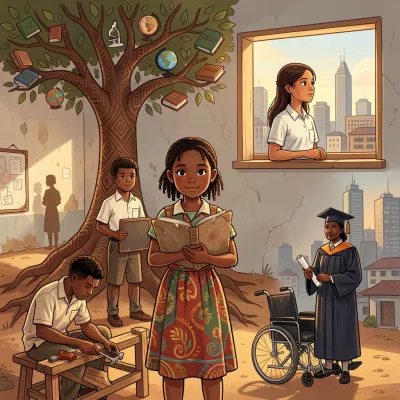
This book offers a comprehensive examination of Zambia's education system, tracing its evolution from pre-colonial indigenous learning through missionary and colonial influences to the post-independence era and its current state. It analyzes the system's multifaceted structure, covering early childhood, primary, secondary, vocational, and higher education. Central themes include the historical legacy of underinvestment, the policy and governance frameworks that guide the system, and the persistent challenges of equitable access, quality, and relevance. The book explores critical issues such as financing, curriculum development, teacher education, special needs inclusion, gender disparities, and the stark rural-urban divide that profoundly shapes educational opportunities.
A significant portion of the text is dedicated to the obstacles that hinder the system's effectiveness. Chronic underfunding, a shortage of qualified teachers, particularly in rural areas, inadequate infrastructure, and a scarcity of learning materials are recurring challenges. The book also addresses the impact of societal factors like poverty, early marriage, and HIV/AIDS on student enrollment and retention, as well as systemic issues like brain drain in higher education and the need for stronger quality assurance mechanisms. The examination-oriented nature of the system and the mismatch between graduate skills and labor market demands are also critically analyzed.
Despite these challenges, the book highlights ongoing reforms, strategic initiatives, and promising practices aimed at transforming Zambian education. These include efforts to expand access through free primary education and new school construction, improve quality through curriculum reforms and teacher professional development, and leverage technology to bridge gaps. The importance of partnerships with international donors, NGOs, the private sector, and local communities is consistently emphasized. Case studies of successful programs in early childhood literacy, girls' education, and vocational training demonstrate that targeted, well-implemented interventions can yield significant positive outcomes.
Ultimately, the book presents Zambian education as a dynamic, resilient, and evolving system. It underscores the nation's unwavering commitment to using education as a primary engine for national development, poverty reduction, and social progress. While the path is fraught with difficulties, the ongoing reforms, strategic investments, and collaborative spirit point toward a future where the system can better equip all Zambian learners with the knowledge, skills, and values needed to thrive in the 21st century and contribute meaningfully to their country's prosperity.
What You'll Find Inside:
- A complete historical journey of Zambian education from indigenous traditions through missionary influence, colonial era, to post-independence reforms
- In-depth analysis of systemic challenges including rural-urban disparities, gender inequities, HIV/AIDS impact, and brain drain in higher education
- Examination of policy frameworks, governance structures, financing mechanisms, and quality assurance across all education levels
- Exploration of specialized areas such as early childhood development, vocational training, special needs education, and technology integration
- Practical insights from case studies of successful initiatives and future trends shaping Zambia's educational landscape
Who's It For:
This book is essential reading for policymakers and education administrators seeking to understand and improve Zambia's education system, educators and teacher trainers looking for contextualized insights into teaching and learning challenges, researchers and students studying African education systems or international development, and anyone with a professional or personal interest in Zambia's educational landscape who wants a comprehensive, evidence-based overview of its evolution, current state, and future prospects.
Table of Contents:
- Introduction
- Chapter 1: Historical Foundations of Zambian Education
- Chapter 2: Educational Policy and Governance in Zambia
- Chapter 3: Financing Education in Zambia: Challenges and Strategies
- Chapter 4: Early Childhood Education: Foundations and Development
- Chapter 5: Primary Education: Access, Quality, and Completion
- Chapter 6: Curriculum Development in Zambian Primary Schools
- Chapter 7: Secondary Education: Structure, Challenges, and Reforms
- Chapter 8: Vocational Education and Training (TVET) in Zambia
- Chapter 9: Higher Education in Zambia: Universities and Colleges
- Chapter 10: Teacher Education and Professional Development
- Chapter 11: Special Education Needs and Inclusive Education
- Chapter 12: Gender and Education in Zambia
- Chapter 13: Rural-Urban Disparities in Educational Access and Quality
- Chapter 14: The Role of Technology in Zambian Education
- Chapter 15: Education and National Development Goals
- Chapter 16: Non-Formal Education and Lifelong Learning
- Chapter 17: Assessment and Examinations in the Zambian Education System
- Chapter 18: Challenges and Opportunities in Educational Infrastructure
- Chapter 19: The Impact of HIV/AIDS on Education in Zambia
- Chapter 20: Partnerships and Collaborations in Education
- Chapter 21: Quality Assurance in Zambian Education
- Chapter 22: Brain Drain and its Impact on Higher Education
- Chapter 23: The Role of Research in Educational Advancement
- Chapter 24: Future Trends and Prospects for Zambian Education
- Chapter 25: Case Studies of Successful Educational Initiatives in Zambia
Author:
Published By:
Date Published:
July 7, 2026
Type:
Nonfiction
Language:
English
Word Count:
50,704 words
Reading Time:
3 hours 33 minutes
Sample:
Order:
Order Education In Zambia (Hardcover) on MixCache.com:
Buy NowPrint copy is made to order and ships worldwide. Includes the ebook free, ready to read instantly.
$5 account credit for all new MixCache.com accounts, usable toward any ebook purchase!*