
Browse by Category
Fiction
- Action & Adventure
- African American
- Anthologies
- Children's Fiction
- Classics
- Comics & Graphic Novels
- Coming of Age
- Contemporary
- Cultural & Regional
- Drama
- Erotica
- Fantasy
- General
- Historical Fiction
- Horror
- Humor & Satire
- Literary Fiction
- Mystery, Thriller & Suspense
- Poetry
- Religious & Inspirational
- Romance
- Science Fiction
- Short Stories
- War & Military
- Westerns
- Women's Fiction
- Young Adult
Non-Fiction
- Antiques & Collectibles
- Arts & Photography
- Biographies & Memoirs
- Business & Money
- Children's Non-Fiction
-
Computers & Technology
- Artificial Intelligence
- Computer Science
- Cybersecurity & Cryptography
- Data Science & Analytics
- Databases & Big Data
- Game Development & Design
- General
- Hardware & DIY
- Mobile App Development
- Networking & Cloud Computing
- Operating Systems
- Programming
- Robotics
- Software
- Software Engineering
- User Experience (UX) & Design
- Web Development & Design
- Cooking, Food & Wine
- Crafts, Hobbies & Home
- Education & Teaching
- Engineering
- General
- Health, Fitness & Dieting
-
History
- African History
- African History - North Africa
- African History - Sub-Saharan Africa
- American History
- American History - 20th Century
- American History - Civil War
- American History - Colonial Period
- Ancient History
- Asian History
- Asian History - China
- Asian History - India
- Asian History - Japan
- Asian History - Southeast Asia
- European History
- European History - Ancient Greece
- European History - Ancient Rome
- European History - Medieval
- European History - Modern
- European History - Renaissance
- General
- Middle Eastern History
- Military History
- Military History - Aviation
- Military History - Naval
- Social & Cultural History
- World History
- Humor & Entertainment
- Industrial Technology
- Language Learning
- Law
- LGBTQ+ Non-Fiction
- Literary Criticism
- Medical Books
- Parenting & Relationships
- Philosophy
- Politics & Social Sciences
- Reference
- Religion & Spirituality
-
Science & Math
- Agricultural Sciences
- Astronomy & Space Science
- Behavioral Sciences
- Biological Sciences
- Botany & Plant Science
- Chemistry
- Earth Sciences
- Engineering - Chemical
- Engineering - Civil
- Engineering - Electrical
- Engineering - Mechanical
- Environment
- General
- Geology
- Mathematics
- Nature & Ecology
- Oceanography
- Paleontology
- Physics
- Statistics
- Self-Help
- Sports & Outdoors
- Study Aids
- Sustainability & Green Living
- Textbooks
- Transportation
- Travel
- True Crime
- Urban Planning & Development
- Veterinary Medicine
- Writing & Publishing
Jump to Section
MixCache.com Total Access
Unlimited reading and audiobooks for every book published by MixCache.com.
Included titles carry the MTA badge.
Learn more →
The Rise and Fall of the Mongol Empire
MTA
How Genghis Khan's Legacy Shaped the World
About this book:
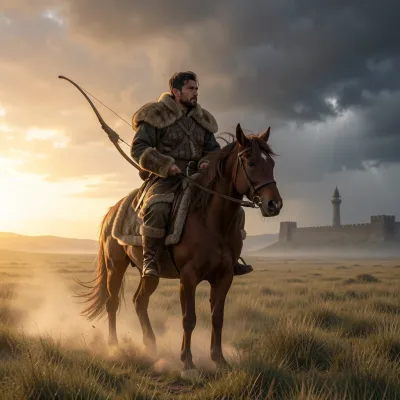
The Mongol Empire, founded by Genghis Khan in the early 13th century, emerged from the unification of nomadic Central Asian tribes under his charismatic leadership. Beginning with Temüjin’s rise to power and his consolidation of disparate clans, Genghis Khan forged a formidable military force through military innovations like the decimal system, feigned retreats, and psychological warfare. These strategies enabled swift conquests across Northern China and Central Asia, including the sacking of the Khwarezmian Empire, Baghdad, and the Western Xia. The capture of key cities and the establishment of the Yassa, a legal code emphasizing meritocracy and discipline, laid the groundwork for administrative unity. However, Genghis Khan’s death in 1227 initiated a succession crisis that exposed the fragility of the empire’s structure, as regional leaders carved out independent khanates under his descendants.
Under Ögedei Khan and later Genghis’s grandchildren, the empire expanded westward into Europe and southward into the Middle East and China. The *Pax Mongolica* facilitated unprecedented trade and cultural exchange across the continent via the revitalized Silk Road, enabling the movement of technologies like gunpowder, printing, and the compass. Simultaneously, devastating campaigns into Russia, Hungary, and the Middle East—culminating in the Mamluks halting Mongol advances at the Battle of Ain Jalut—demonstrated both their military prowess and their limits. Kublai Khan completed the conquest of China, founding the Yuan Dynasty and fostering a synthesis of Mongol and Chinese traditions, while the Golden Horde and Ilkhanate solidified their rule over the West. These khanates, however, grew increasingly autonomous, leading to prolonged succession wars and conflicts such as the Berke-Hülagü War between the Golden Horde and Ilkhanate.
The empire’s internal fragmentation was accelerated by the Black Death in the 14th century, which decimated populations and disrupted trade networks, further weakening central authorities. The dissolution of the Yuan Dynasty in China (1368), the splintering of the Ilkhanate into smaller states, and the eventual collapse of the Golden Horde into regional Turkic khanates marked the end of Mongol political unity. Figures like Timur (Tamerlane) briefly revived Mongol-style expansion, but their conquests were ephemeral. The rise of Moscow, the Mamluks, and indigenous Persian dynasties (e.g., the Safavids) replaced Mongol authority, reshaping Eurasia. The Mongol era’s destruction and reconfiguration, however, left enduring legacies: trade networks that connected East and West, the spread of Islam and Buddhism by the Ilkhanate and Yuan Dynasty, and architectural marvels that blended Central Asian, Chinese, and Islamic styles.
Genghis Khan’s legacy is a dual narrative of ruthless conquest and transformative innovation. While his campaigns caused immense destruction and demographic upheaval, they also established a model of cross-cultural governance that blurred East-West boundaries and advanced global interconnectedness. The empire’s fragmentation underscored the challenges of governing vast, diverse territories through a decentralized system, but its cultural and economic exchanges catalyzed developments in science, art, and technology that influenced the Renaissance and beyond. Though the Mongol Empire itself dissolved, its echoes persist in the historical trajectories of modern nations, from Russia and China to Central Asia and the Islamic world, making it a pivotal chapter in the evolution of global history.
What You'll Find Inside:
- Explores the rise of Genghis Khan and the unification of nomadic tribes into a formidable empire through military genius and strategic alliances.
- Analyzes Mongol military innovations, including cavalry tactics, siege warfare, and psychological strategies, that enabled unprecedented territorial expansion.
- Details the Pax Mongolica era's impact on global trade, cultural exchange, and the revitalization of the Silk Road under centralized Mongol rule.
- Examines the Western Campaigns in Europe, the Golden Horde's influence in Eastern Europe, and the pivotal Battle of Ain Jalut halting Mongol advance.
- Discusses the Mongol Empire's enduring legacy in technology transfer, religious tolerance, and the unintended consequences of the Black Death on global history.
Who's It For:
This book is ideal for history enthusiasts, students, and scholars interested in military history, cultural exchange, and the rise and fall of empires. Readers seeking to understand the Mongol Empire's pivotal role in shaping global interconnectedness, from conquest to trade, will find comprehensive insights. It also appeals to those curious about lesser-known historical figures and events, such as the Battle of Ain Jalut or the Ilkhanate's cultural renaissance. Perfect for anyone wanting to explore how Genghis Khan's legacy transcended mere warfare to influence art, science, and governance across Eurasia.
Table of Contents:
- Introduction: The Genesis of an Empire
- Chapter 1: Nomadic Roots and Tribal Unification
- Chapter 2: Temüjin's Ascent: From Outcast to Khan
- Chapter 3: The Art of War: Mongol Military Innovations
- Chapter 4: The Conquest of Northern China and Central Asia
- Chapter 5: Pax Mongolica: Administration and Governance
- Chapter 6: Cultural Crossroads: Exchange and Assimilation
- Chapter 7: The Western Campaigns: Europe on the Brink
- Chapter 8: Ögedei Khan and the Expansion Continues
- Chapter 9: The Mongol Yassa: Law and Order Across the Empire
- Chapter 10: The Silk Road Reborn: Trade and Communication
- Chapter 11: Great Khans and Power Struggles: The Succession Crisis
- Chapter 12: Batu Khan and the Golden Horde
- Chapter 13: Hülagü Khan and the Ilkhanate in Persia
- Chapter 14: Kublai Khan and the Yuan Dynasty in China
- Chapter 15: The Mongol Navy and Invasions of Japan
- Chapter 16: The Mamluks and the Defense of the Levant
- Chapter 17: Decline of the Golden Horde and Rise of New Powers
- Chapter 18: Internal Divisions and the Fragmentation of the Empire
- Chapter 19: The Black Death: A Global Catastrophe
- Chapter 20: Timur's Legacy: The Last Great Nomad Conqueror
- Chapter 21: The End of an Era: Dissolution of the Mongol Successor States
- Chapter 22: Enduring Cultural Impacts: Art, Science, and Religion
- Chapter 23: Architectural Marvels and Urban Development
- Chapter 24: Genghis Khan's Enduring Legacy: Myth and Reality
- Chapter 25: The Mongol Empire in World History: A Concluding Perspective
Author:
Published By:
Date Published:
July 13, 2026
Type:
Nonfiction
Language:
English
Word Count:
42,756 words
Reading Time:
3 hours
Sample:
MixCache.com Total Access
Get unlimited access to this book + all books published by MixCache.com for $11.99/month
Subscribe to MTAOr purchase this book individually below
Order:
Buy the The Rise and Fall of the Mongol Empire ebook on MixCache.com:
Buy Now
Full ebook will be available immediately
- read online or download as a PDF file.
$5 account credit for all new MixCache.com accounts, usable toward any ebook purchase!*




Ratings & Reviews
Ask Questions About This Book
Have a question about the content? Ask our AI assistant!
Start by asking a question about "The Rise and Fall of the Mongol Empire"
Example: "Does this book mention William Shakespeare?"
Thinking...