Browse by Category
Fiction
- Action & Adventure
- African American
- Anthologies
- Children's Fiction
- Classics
- Comics & Graphic Novels
- Coming of Age
- Contemporary
- Cultural & Regional
- Drama
- Erotica
- Fantasy
- General
- Historical Fiction
- Horror
- Humor & Satire
- Literary Fiction
- Mystery, Thriller & Suspense
- Poetry
- Religious & Inspirational
- Romance
- Science Fiction
- Short Stories
- War & Military
- Westerns
- Women's Fiction
- Young Adult
Non-Fiction
- Antiques & Collectibles
- Arts & Photography
- Biographies & Memoirs
- Business & Money
- Children's Non-Fiction
-
Computers & Technology
- Artificial Intelligence
- Computer Science
- Cybersecurity & Cryptography
- Data Science & Analytics
- Databases & Big Data
- Game Development & Design
- General
- Hardware & DIY
- Mobile App Development
- Networking & Cloud Computing
- Operating Systems
- Programming
- Robotics
- Software
- Software Engineering
- User Experience (UX) & Design
- Web Development & Design
- Cooking, Food & Wine
- Crafts, Hobbies & Home
- Education & Teaching
- Engineering
- General
- Health, Fitness & Dieting
-
History
- African History
- African History - North Africa
- African History - Sub-Saharan Africa
- American History
- American History - 20th Century
- American History - Civil War
- American History - Colonial Period
- Ancient History
- Asian History
- Asian History - China
- Asian History - India
- Asian History - Japan
- Asian History - Southeast Asia
- European History
- European History - Ancient Greece
- European History - Ancient Rome
- European History - Medieval
- European History - Modern
- European History - Renaissance
- General
- Middle Eastern History
- Military History
- Military History - Aviation
- Military History - Naval
- Social & Cultural History
- World History
- Humor & Entertainment
- Industrial Technology
- Language Learning
- Law
- LGBTQ+ Non-Fiction
- Literary Criticism
- Medical Books
- Parenting & Relationships
- Philosophy
- Politics & Social Sciences
- Reference
- Religion & Spirituality
-
Science & Math
- Agricultural Sciences
- Astronomy & Space Science
- Behavioral Sciences
- Biological Sciences
- Botany & Plant Science
- Chemistry
- Earth Sciences
- Engineering - Chemical
- Engineering - Civil
- Engineering - Electrical
- Engineering - Mechanical
- Environment
- General
- Geology
- Mathematics
- Nature & Ecology
- Oceanography
- Paleontology
- Physics
- Statistics
- Self-Help
- Sports & Outdoors
- Study Aids
- Sustainability & Green Living
- Textbooks
- Transportation
- Travel
- True Crime
- Urban Planning & Development
- Veterinary Medicine
- Writing & Publishing
Jump to Section
MixCache.com Total Access
Unlimited reading and audiobooks for every book published by MixCache.com.
Included titles carry the MTA badge.
Learn more →
Education In Vanuatu
MTA
A Comprehensive Overview from Early Childhood to Higher Education
About this book:
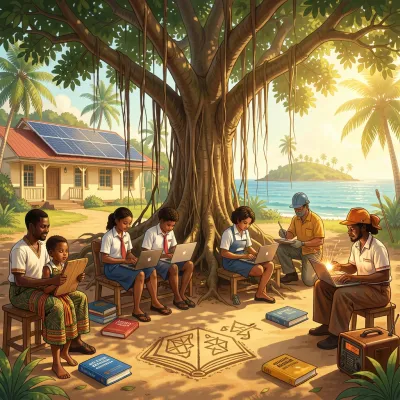
Education in Vanuatu represents a unique blend of modern pedagogical approaches and deep cultural traditions, shaped by its colonial history and post-independence aspirations. The system, overseen by the Ministry of Education and Training (MoET), spans early childhood care and education (ECCE), six years of primary schooling, seven years of secondary education divided into junior and senior cycles, and diverse post-secondary pathways including Technical and Vocational Education and Training (TVET) and higher education via the University of the South Pacific (USP) Emalus Campus and the newly established National University of Vanuatu (NUV). Governance is complex due to Vanuatu’s multilingual landscape—over 130 indigenous languages alongside official languages English, French, and Bislama—which influences policies such as mother-tongue instruction in early primary years and the integration of plurilingualism throughout the system. The MoET drives curriculum development, teacher training through the Vanuatu Institute of Teacher Education (VITE), and national assessments like the Vanuatu Standardized Test of Achievement (VANSTA), while navigating challenges such as geographical dispersion across islands, resource allocation, and bridging educational divides between urban and remote communities.
Inclusive and equitable education remain central priorities, with policies promoting gender equality, disability inclusion, and access to education in disaster-prone regions. The government’s phased shift to fee-free education reduces financial barriers, yet logistical hurdles like teacher retention in remote areas, lack of infrastructure, and the need for culturally sensitive curricula persist. Community-led initiatives and partnerships with NGOs and churches play vital roles in sustaining ECCE and primary schools, especially in rural regions, while international aid from Australia, New Zealand, and multilateral organizations supports teacher training, infrastructure development, and disaster-resilient education. Technology integration, particularly through solar-powered learning devices and offline educational tools, seeks to bridge the digital divide, though connectivity remains uneven. The curriculum increasingly incorporates Education for Sustainable Development (ESD) and Disaster Risk Reduction (DRR), reflecting Vanuatu’s vulnerability to climate change and natural hazards.
The establishment of the National University of Vanuatu (NUV) in 2020 marks a strategic milestone, consolidating post-secondary programs and fostering locally relevant education amid the nation’s cultural and linguistic diversity. Despite facing resource scarcity, language complexity, and the lingering impacts of its colonial legacy, Vanuatu’s education system thrives through community resilience, adaptive teaching models, and global partnerships. Innovative solutions—such as multi-grade classrooms in remote schools, scholarships linking education to workforce development, and culturally integrated learning—demonstrate the system’s capacity to evolve while honoring kastom (traditional customs). As Vanuatu navigates future challenges, its education sector reflects a dynamic interplay of tradition and modernization, positioning the nation to empower its youth while safeguarding its heritage and confronting global threats like climate change through resilient, inclusive learning frameworks.
What You'll Find Inside:
- The historical evolution of Vanuatu's education system from traditional kastom learning through Anglo-French Condominium dual systems to post-independence nation-building efforts.
- The current structure and governance of the education system overseen by the Ministry of Education and Training, including ECCE, primary, secondary, TVET, and higher education pathways.
- Persistent challenges including geographical dispersion across 80+ islands, linguistic diversity with over 130 indigenous languages, resource constraints, and balancing global standards with local cultural relevance.
- Key initiatives such as the Early Primary Years Curriculum (EPYC) promoting vernacular instruction, phased fee-free education policy up to Year 8, and Technical and Vocational Education and Training (TVET) for workforce development.
- Cross-cutting themes addressed throughout: inclusive education for disabilities, gender equality, education for sustainable development, disaster risk reduction, and technology integration in geographically challenging contexts.
Who's It For:
This book is essential for policymakers within Vanuatu's Ministry of Education and Training seeking evidence-based insights for reform, educators and teacher trainers aiming to understand contextual challenges and solutions, researchers studying small island developing states' education systems, international development partners designing effective aid programs, and anyone interested in how Melanesian nations balance cultural preservation with modern educational demands in geographically dispersed contexts.
Table of Contents:
- Introduction
- Chapter 1: Historical Foundations of Education in Vanuatu
- Chapter 2: The Structure and Governance of the Vanuatu Education System
- Chapter 3: Early Childhood Care and Education (ECCE) in Vanuatu
- Chapter 4: Primary Education: Access, Equity, and Quality
- Chapter 5: Secondary Education: Pathways and Challenges
- Chapter 6: Technical and Vocational Education and Training (TVET)
- Chapter 7: Higher Education Landscape and Institutions
- Chapter 8: Curriculum Development and Implementation
- Chapter 9: Language of Instruction in Vanuatu Schools
- Chapter 10: Teacher Training and Professional Development
- Chapter 11: Educational Financing and Resource Allocation
- Chapter 12: The Role of Government in Education
- Chapter 13: Non-Governmental Organizations (NGOs) and Community Involvement in Education
- Chapter 14: Inclusive Education: Addressing Special Needs and Disabilities
- Chapter 15: Gender Equality in Education
- Chapter 16: Education in Remote and Rural Areas
- Chapter 17: The Impact of Culture on Education
- Chapter 18: Assessment and Examination Systems
- Chapter 19: Educational Challenges and Opportunities in Vanuatu
- Chapter 20: The Role of Technology in Education
- Chapter 21: Education for Sustainable Development
- Chapter 22: Disaster Risk Reduction and Education
- Chapter 23: The Future of Education Policy in Vanuatu
- Chapter 24: International Partnerships and Educational Aid
- Chapter 25: Case Studies and Success Stories in Vanuatu Education
Author:
Published By:
Date Published:
July 8, 2026
Type:
Nonfiction
Language:
English
Word Count:
41,801 words
Reading Time:
2 hours 56 minutes
Sample:
Order:
Order Education In Vanuatu (Hardcover) on MixCache.com:
Buy NowPrint copy is made to order and ships worldwide. Includes the ebook free, ready to read instantly.
$5 account credit for all new MixCache.com accounts, usable toward any ebook purchase!*