
Browse by Category
Fiction
- Action & Adventure
- African American
- Anthologies
- Children's Fiction
- Classics
- Comics & Graphic Novels
- Coming of Age
- Contemporary
- Cultural & Regional
- Drama
- Erotica
- Fantasy
- General
- Historical Fiction
- Horror
- Humor & Satire
- Literary Fiction
- Mystery, Thriller & Suspense
- Poetry
- Religious & Inspirational
- Romance
- Science Fiction
- Short Stories
- War & Military
- Westerns
- Women's Fiction
- Young Adult
Non-Fiction
- Antiques & Collectibles
- Arts & Photography
- Biographies & Memoirs
- Business & Money
- Children's Non-Fiction
-
Computers & Technology
- Artificial Intelligence
- Computer Science
- Cybersecurity & Cryptography
- Data Science & Analytics
- Databases & Big Data
- Game Development & Design
- General
- Hardware & DIY
- Mobile App Development
- Networking & Cloud Computing
- Operating Systems
- Programming
- Robotics
- Software
- Software Engineering
- User Experience (UX) & Design
- Web Development & Design
- Cooking, Food & Wine
- Crafts, Hobbies & Home
- Education & Teaching
- Engineering
- General
- Health, Fitness & Dieting
-
History
- African History
- African History - North Africa
- African History - Sub-Saharan Africa
- American History
- American History - 20th Century
- American History - Civil War
- American History - Colonial Period
- Ancient History
- Asian History
- Asian History - China
- Asian History - India
- Asian History - Japan
- Asian History - Southeast Asia
- European History
- European History - Ancient Greece
- European History - Ancient Rome
- European History - Medieval
- European History - Modern
- European History - Renaissance
- General
- Middle Eastern History
- Military History
- Military History - Aviation
- Military History - Naval
- Social & Cultural History
- World History
- Humor & Entertainment
- Industrial Technology
- Language Learning
- Law
- LGBTQ+ Non-Fiction
- Literary Criticism
- Medical Books
- Parenting & Relationships
- Philosophy
- Politics & Social Sciences
- Reference
- Religion & Spirituality
-
Science & Math
- Agricultural Sciences
- Astronomy & Space Science
- Behavioral Sciences
- Biological Sciences
- Botany & Plant Science
- Chemistry
- Earth Sciences
- Engineering - Chemical
- Engineering - Civil
- Engineering - Electrical
- Engineering - Mechanical
- Environment
- General
- Geology
- Mathematics
- Nature & Ecology
- Oceanography
- Paleontology
- Physics
- Statistics
- Self-Help
- Sports & Outdoors
- Study Aids
- Sustainability & Green Living
- Textbooks
- Transportation
- Travel
- True Crime
- Urban Planning & Development
- Veterinary Medicine
- Writing & Publishing
Jump to Section
MixCache.com Total Access
Unlimited reading and audiobooks for every book published by MixCache.com.
Included titles carry the MTA badge.
Learn more →
Education In Tuvalu
MTA
A Comprehensive Overview from Early Childhood to Higher Education
About this book:

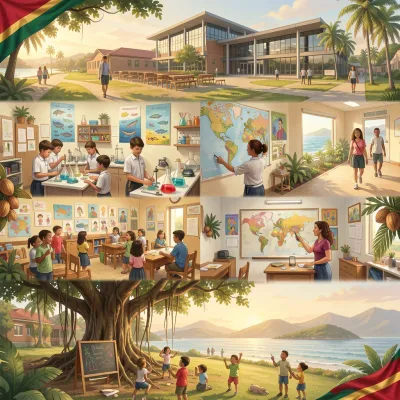
"Education In Tuvalu: A Comprehensive Overview from Early Childhood to Higher Education" offers an in-depth examination of Tuvalu’s educational landscape, reflecting its unique position as a small island developing state navigating modernization while preserving cultural identity. The book traces the historical evolution of education from indigenous Polynesian knowledge transfer systems through the influence of missionary and colonial education, leading to post-independence reforms that established a free, compulsory primary system and a selective secondary framework. Central to the narrative is the tension between maintaining Tuvaluan language and traditions—such as traditional ecological knowledge and community-based learning—while integrating global curricula, particularly in response to climate change adaptation and technological advancement.
The text details the structure and governance of Tuvalu’s education system, emphasizing the pivotal roles of the Ministry of Education, Youth and Sports (MEYS), Island Councils, and community organizations in delivering education across nine dispersed atolls. It explores specialized sectors like Technical and Vocational Education and Training (TVET), with the Tuvalu Maritime Training Institute highlighted as a successful model linking vocational skills to global employment opportunities. The integration of technology, though constrained by infrastructure gaps, is shown as a critical frontier for overcoming geographical isolation and enhancing access to resources and professional development.
Key themes include the promotion of bilingual education (Tuvaluan and English), inclusive education for students with special needs, and gender equality, which emphasize equity and cultural relevance. The book underscores persistent challenges such as resource limitations, teacher shortages in remote areas, and the existential threat of climate change, which influences curriculum design and school infrastructure. Despite these hurdles, Tuvalu’s education system is marked by community resilience, international partnerships, and innovative approaches—such as localized curriculum adaptation and climate-resilient schooling—that exemplify its commitment to fostering a knowledgeable and sustainable future for its youth. The text concludes with hopeful projections, noting strategic reforms and emerging opportunities in digital learning and environmental education that aim to build a more adaptive and empowered society.
What You'll Find Inside:
- Climate change adaptation strategies integrated into curriculum and infrastructure to address environmental challenges.
- Bilingual education policies balancing Tuvaluan language and cultural preservation with global English proficiency.
- Inclusive education practices and support systems for students with special needs and disabilities.
- Community-led solutions and cultural integration fostering resilience in rural and remote schooling.
- International partnerships and donor collaborations driving educational innovation and global opportunities.
Who's It For:
This book is essential reading for educators, policymakers, and development practitioners working in small island developing states, particularly those focused on climate-resilient education, bilingual pedagogy, and community-based learning models. It provides valuable insights for international partners seeking to support educational initiatives in geographically isolated regions, as well as researchers interested in the intersection of indigenous knowledge and modern educational systems. The content is also highly relevant for government officials in Tuvalu and the broader Pacific region aiming to enhance educational equity, teacher training, and lifelong learning opportunities in the face of global and environmental challenges.
Table of Contents:
- Introduction
- Chapter 1: The Historical Development of Education in Tuvalu
- Chapter 2: Traditional Forms of Learning and Knowledge Transfer
- Chapter 3: The Structure and Governance of Tuvalu's Education System
- Chapter 4: Early Childhood Education: Foundations and Provision
- Chapter 5: Primary Education: Curriculum, Challenges, and Achievements
- Chapter 6: Secondary Education: Pathways and Opportunities
- Chapter 7: Technical and Vocational Education and Training (TVET)
- Chapter 8: Higher Education: Institutions and Programs
- Chapter 9: Teacher Training and Professional Development
- Chapter 10: Curriculum Development and Educational Standards
- Chapter 11: Language of Instruction and Bilingual Education
- Chapter 12: Assessment and Examinations in Tuvaluan Schools
- Chapter 13: Inclusive Education: Addressing Special Needs and Disabilities
- Chapter 14: Gender Equality in Education
- Chapter 15: The Role of Community and Culture in Education
- Chapter 16: Funding and Financing of Education in Tuvalu
- Chapter 17: International Aid and Partnerships in Education
- Chapter 18: Challenges and Opportunities in Rural and Remote Education
- Chapter 19: Education and Climate Change Adaptation
- Chapter 20: The Impact of Technology on Education
- Chapter 21: Health and Well-being in Schools
- Chapter 22: Non-formal and Lifelong Learning Initiatives
- Chapter 23: Educational Outcomes and Future Prospects
- Chapter 24: Policy Reforms and Strategic Plans for Educational Development
- Chapter 25: Case Studies and Success Stories in Tuvaluan Education
Author:
Published By:
Date Published:
July 7, 2026
Type:
Nonfiction
Language:
English
Word Count:
81,681 words
Reading Time:
5 hours 43 minutes
Sample:
MixCache.com Total Access
Get unlimited access to this book + all books published by MixCache.com for $11.99/month
Subscribe to MTAOr purchase this book individually below
Order:
Buy the Education In Tuvalu ebook on MixCache.com:
Buy Now
Full ebook will be available immediately
- read online or download as a PDF file.
$5 account credit for all new MixCache.com accounts, usable toward any ebook purchase!*




Ratings & Reviews
Ask Questions About This Book
Have a question about the content? Ask our AI assistant!
Start by asking a question about "Education In Tuvalu"
Example: "Does this book mention William Shakespeare?"
Thinking...