
Browse by Category
Fiction
- Action & Adventure
- African American
- Anthologies
- Children's Fiction
- Classics
- Comics & Graphic Novels
- Coming of Age
- Contemporary
- Cultural & Regional
- Drama
- Erotica
- Fantasy
- General
- Historical Fiction
- Horror
- Humor & Satire
- Literary Fiction
- Mystery, Thriller & Suspense
- Poetry
- Religious & Inspirational
- Romance
- Science Fiction
- Short Stories
- War & Military
- Westerns
- Women's Fiction
- Young Adult
Non-Fiction
- Antiques & Collectibles
- Arts & Photography
- Biographies & Memoirs
- Business & Money
- Children's Non-Fiction
-
Computers & Technology
- Artificial Intelligence
- Computer Science
- Cybersecurity & Cryptography
- Data Science & Analytics
- Databases & Big Data
- Game Development & Design
- General
- Hardware & DIY
- Mobile App Development
- Networking & Cloud Computing
- Operating Systems
- Programming
- Robotics
- Software
- Software Engineering
- User Experience (UX) & Design
- Web Development & Design
- Cooking, Food & Wine
- Crafts, Hobbies & Home
- Education & Teaching
- Engineering
- General
- Health, Fitness & Dieting
-
History
- African History
- African History - North Africa
- African History - Sub-Saharan Africa
- American History
- American History - 20th Century
- American History - Civil War
- American History - Colonial Period
- Ancient History
- Asian History
- Asian History - China
- Asian History - India
- Asian History - Japan
- Asian History - Southeast Asia
- European History
- European History - Ancient Greece
- European History - Ancient Rome
- European History - Medieval
- European History - Modern
- European History - Renaissance
- General
- Middle Eastern History
- Military History
- Military History - Aviation
- Military History - Naval
- Social & Cultural History
- World History
- Humor & Entertainment
- Industrial Technology
- Language Learning
- Law
- LGBTQ+ Non-Fiction
- Literary Criticism
- Medical Books
- Parenting & Relationships
- Philosophy
- Politics & Social Sciences
- Reference
- Religion & Spirituality
-
Science & Math
- Agricultural Sciences
- Astronomy & Space Science
- Behavioral Sciences
- Biological Sciences
- Botany & Plant Science
- Chemistry
- Earth Sciences
- Engineering - Chemical
- Engineering - Civil
- Engineering - Electrical
- Engineering - Mechanical
- Environment
- General
- Geology
- Mathematics
- Nature & Ecology
- Oceanography
- Paleontology
- Physics
- Statistics
- Self-Help
- Sports & Outdoors
- Study Aids
- Sustainability & Green Living
- Textbooks
- Transportation
- Travel
- True Crime
- Urban Planning & Development
- Veterinary Medicine
- Writing & Publishing
Jump to Section
MixCache.com Total Access
Unlimited reading and audiobooks for every book published by MixCache.com.
Included titles carry the MTA badge.
Learn more →
Education In Somalia
MTA
A Comprehensive Overview from Early Childhood to Higher Education
About this book:
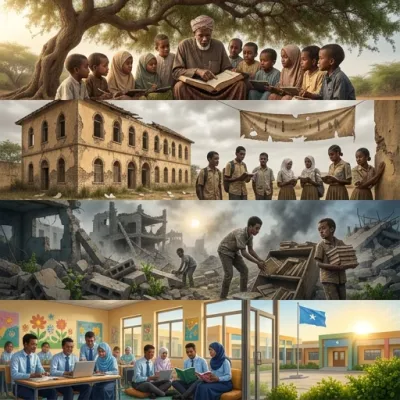
The book provides a comprehensive overview of the Somali education system, tracing its evolution from pre-colonial traditional and Islamic learning systems through the disruptive impacts of colonialism and civil war to its current state of recovery and reform. It examines how the *dugsi* system provided resilient, community-based religious education for centuries, which was later challenged by the introduction of secular, foreign-language colonial schooling. Following independence, Somalia made initial progress in expanding education, but the collapse of the state in 1991 resulted in the total destruction of the formal system, forcing communities, NGOs, and international aid to become the primary providers of education during decades of conflict.
The core of the work offers a detailed analysis of all educational levels. It covers the challenges in Early Childhood, Primary, and Secondary Education, focusing on issues of access, quality, and gender disparities. The text highlights the critical role of Technical and Vocational Education and Training (TVET) for youth employment and the remarkable resurgence of Higher Education, where private and diaspora-founded universities emerged from the ashes of conflict. It also delves into specialized areas such as teacher training, curriculum standardization, and the vital need for inclusive education for children with disabilities, as well as the importance of non-formal education and adult literacy programs for marginalized populations.
Thematic chapters address the persistent gender gap in education, the potential of technology to bridge access and quality gaps, and the complex dynamics of funding and governance in a fragile federal state. The book underscores the profound contributions of the Somali diaspora in financing institutions, providing expertise, and fostering international partnerships. It also emphasizes the critical role of peace education and conflict resolution in healing a society traumatized by war and rebuilding social cohesion through the school system.
In conclusion, the book presents both a sobering account of the immense challenges—including insecurity, underfunding, weak institutions, and deep-seated inequalities—and an inspiring narrative of resilience and innovation. It outlines a strategic vision for the future, aiming for a unified, high-quality, and equitable national education system that balances traditional values with modern skills. Through case studies of successful schools and programs, the work demonstrates that despite the overwhelming odds, dedicated communities, educators, and international partners are actively building a brighter, more educated future for Somalia, making the book a testament to the enduring power of learning in a nation striving for lasting peace and prosperity.
What You'll Find Inside:
- A thorough historical account tracing Somali education from traditional Quranic schools through colonialism, independence, state collapse, and ongoing rebuilding efforts.
- In-depth analysis of the roles played by communities, NGOs, international aid, and the Somali diaspora in sustaining education when the central government failed.
- Examination of persistent challenges including gender disparities, access for nomadic populations, quality of instruction, and the needs of children with disabilities.
- Coverage of all educational levels from early childhood and primary through secondary, technical/vocational training, and higher education across multiple Somali regions.
- Exploration of cross-cutting themes such as peace education, technology integration, funding mechanisms, and the formulation of national education policy and governance.
Who's It For:
This book is essential reading for policymakers, educators, humanitarian workers, and researchers focused on education in fragile and conflict-affected states. It will also be highly valuable for members of the Somali diaspora seeking to understand the complexities and opportunities within their homeland's education sector, as well as for international development professionals designing or evaluating education programs in the Horn of Africa.
Table of Contents:
- Introduction
- Chapter 1: Historical Context of Education in Somalia
- Chapter 2: Traditional and Islamic Education Systems
- Chapter 3: The Impact of Colonialism on Somali Education
- Chapter 4: Education During the Early Post-Independence Era
- Chapter 5: The Collapse of the State and its Effects on Education
- Chapter 6: The Role of NGOs and International Aid in Education
- Chapter 7: Early Childhood Education: Foundations and Challenges
- Chapter 8: Primary Education: Access, Quality, and Curriculum
- Chapter 9: Secondary Education: Structure, Enrollment, and Transition
- Chapter 10: Technical and Vocational Education and Training (TVET)
- Chapter 11: Higher Education: Universities and Institutions
- Chapter 12: Challenges and Opportunities in Higher Education
- Chapter 13: Teacher Training and Professional Development
- Chapter 14: Curriculum Development and Educational Standards
- Chapter 15: Education in Emergency Settings and Refugee Camps
- Chapter 16: Gender Disparities in Somali Education
- Chapter 17: The Role of Technology in Education
- Chapter 18: Funding and Financing of Education in Somalia
- Chapter 19: Education Policy and Governance
- Chapter 20: The Diaspora's Contribution to Somali Education
- Chapter 21: Peace Education and Conflict Resolution
- Chapter 22: Inclusive Education for Children with Disabilities
- Chapter 23: Non-Formal Education and Adult Literacy Programs
- Chapter 24: The Future of Education in Somalia: Visions and Strategies
- Chapter 25: Case Studies and Success Stories in Somali Education
Author:
Published By:
Date Published:
July 4, 2026
Type:
Nonfiction
Language:
English
Word Count:
49,166 words
Reading Time:
3 hours 27 minutes
Sample:
MixCache.com Total Access
Get unlimited access to this book + all books published by MixCache.com for $11.99/month
Subscribe to MTAOr purchase this book individually below
Order:
Buy the Education In Somalia ebook on MixCache.com:
Buy Now
Full ebook will be available immediately
- read online or download as a PDF file.
$5 account credit for all new MixCache.com accounts, usable toward any ebook purchase!*



Ratings & Reviews
Ask Questions About This Book
Have a question about the content? Ask our AI assistant!
Start by asking a question about "Education In Somalia"
Example: "Does this book mention William Shakespeare?"
Thinking...