Browse by Category
Fiction
- Action & Adventure
- African American
- Anthologies
- Children's Fiction
- Classics
- Comics & Graphic Novels
- Coming of Age
- Contemporary
- Cultural & Regional
- Drama
- Erotica
- Fantasy
- General
- Historical Fiction
- Horror
- Humor & Satire
- Literary Fiction
- Mystery, Thriller & Suspense
- Poetry
- Religious & Inspirational
- Romance
- Science Fiction
- Short Stories
- War & Military
- Westerns
- Women's Fiction
- Young Adult
Non-Fiction
- Antiques & Collectibles
- Arts & Photography
- Biographies & Memoirs
- Business & Money
- Children's Non-Fiction
-
Computers & Technology
- Artificial Intelligence
- Computer Science
- Cybersecurity & Cryptography
- Data Science & Analytics
- Databases & Big Data
- Game Development & Design
- General
- Hardware & DIY
- Mobile App Development
- Networking & Cloud Computing
- Operating Systems
- Programming
- Robotics
- Software
- Software Engineering
- User Experience (UX) & Design
- Web Development & Design
- Cooking, Food & Wine
- Crafts, Hobbies & Home
- Education & Teaching
- Engineering
- General
- Health, Fitness & Dieting
-
History
- African History
- African History - North Africa
- African History - Sub-Saharan Africa
- American History
- American History - 20th Century
- American History - Civil War
- American History - Colonial Period
- Ancient History
- Asian History
- Asian History - China
- Asian History - India
- Asian History - Japan
- Asian History - Southeast Asia
- European History
- European History - Ancient Greece
- European History - Ancient Rome
- European History - Medieval
- European History - Modern
- European History - Renaissance
- General
- Middle Eastern History
- Military History
- Military History - Aviation
- Military History - Naval
- Social & Cultural History
- World History
- Humor & Entertainment
- Industrial Technology
- Language Learning
- Law
- LGBTQ+ Non-Fiction
- Literary Criticism
- Medical Books
- Parenting & Relationships
- Philosophy
- Politics & Social Sciences
- Reference
- Religion & Spirituality
-
Science & Math
- Agricultural Sciences
- Astronomy & Space Science
- Behavioral Sciences
- Biological Sciences
- Botany & Plant Science
- Chemistry
- Earth Sciences
- Engineering - Chemical
- Engineering - Civil
- Engineering - Electrical
- Engineering - Mechanical
- Environment
- General
- Geology
- Mathematics
- Nature & Ecology
- Oceanography
- Paleontology
- Physics
- Statistics
- Self-Help
- Sports & Outdoors
- Study Aids
- Sustainability & Green Living
- Textbooks
- Transportation
- Travel
- True Crime
- Urban Planning & Development
- Veterinary Medicine
- Writing & Publishing
Jump to Section
MixCache.com Total Access
Unlimited reading and audiobooks for every book published by MixCache.com.
Included titles carry the MTA badge.
Learn more →
Education In Sao Tome and Principe
MTA
A Comprehensive Overview from Early Childhood to Higher Education
About this book:
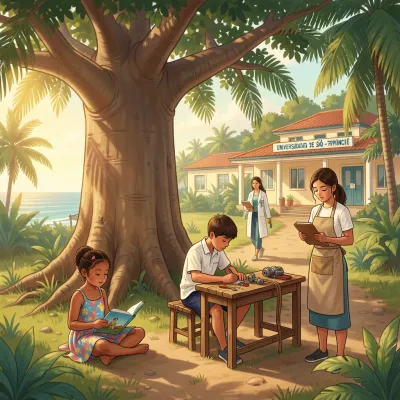
EducationIn Sao Tome and Principe provides a thorough examination of the nation's educational system from its colonial origins to contemporary developments and future prospects. The book traces how education evolved from limited, exclusionary colonial practices focused on serving a Portuguese elite to post-independence efforts aimed at universal access and national empowerment. It details the structured tiers of the system—early childhood, primary, secondary (divided into academic and vocational cycles), technical and vocational education and training (TVET), and higher education—highlighting the Universidade de São Tomé e Príncipe as a pivotal domestic institution. The analysis emphasizes Portuguese as the enduring language of instruction amidst a multilingual society where local creoles are widely spoken, creating persistent linguistic barriers for many learners.
The work critically investigates systemic challenges affecting educational quality and equity. These include significant resource constraints, inadequate infrastructure (particularly in rural areas), teacher shortages and uneven distribution, and the rural-urban divide that exacerbates disparities in access to qualified educators, learning materials, and specialized programs. Gender dynamics, socioeconomic status, and geographical location are shown to influence enrollment, retention, and achievement, with specific attention to barriers faced by girls in secondary education and children with special education needs. The book also addresses curriculum relevance, assessment practices dominated by high-stakes national examinations, the gradual integration of technology, and the vital role of international cooperation and aid in funding infrastructure, teacher training, and program development amid ongoing financial limitations.
Beyond structural analysis, the book highlights education's profound impact on socio-economic development, linking improved literacy and skills acquisition to poverty reduction, better health outcomes, civic engagement, and economic diversification. It showcases notable achievements such as near-universal primary enrollment, the establishment of domestic higher education, progress in girls' education, and successful TVET alignments with labor market needs. Case studies illustrate effective community-driven initiatives, bilingual literacy approaches leveraging local creoles, inclusive education models, and industry-linked TVET programs. Looking forward, the text outlines strategic priorities centered on enhancing learning outcomes, investing in teacher quality and relevance, expanding equitable access (especially rural and inclusive education), deepening curriculum ties to 21st-century skills and local context, strengthening TVET-industry partnerships, advancing digital transformation, and sustaining data-driven policymaking—all while navigating persistent challenges of funding, capacity, and systemic change to build a resilient, equitable education system for all São Toméans.
What You'll Find Inside:
- Explores the historical evolution of education in São Tomé and Príncipe, from Portuguese colonial rule to post-independence reforms, highlighting the challenges and transformations that shaped the current system.
- Details the structure of the education system, including early childhood, primary, secondary, technical/vocational training (TVET), and higher education, with insights into curriculum design, language of instruction, and assessment practices.
- Examines critical issues of access, equity, and inclusion, addressing gender disparities, rural-urban divides, and special education needs to ensure equitable opportunities for all learners.
- Discusses the role of international cooperation, funding mechanisms, and partnerships in advancing education, alongside persistent obstacles like resource scarcity and infrastructure deficits.
- Features case studies and success stories showcasing innovative initiatives in ECCE, TVET, inclusive education, and community-driven programs that have driven progress in São Tomé and Príncipe's educational landscape.
Who's It For:
This book is essential for educators, policymakers, and researchers interested in the education system of São Tomé and Príncipe and small island developing states. It is particularly valuable for those studying Lusophone African education, vocational training strategies, or inclusive education models. Readers seeking to understand the interplay between historical context, socio-economic development, and educational policy in a unique island nation will find it insightful.
Table of Contents:
- Introduction
- Chapter 1: Historical Context of Education in Sao Tome and Principe
- Chapter 2: The Structure of the Educational System
- Chapter 3: Early Childhood Education: Foundations and Access
- Chapter 4: Primary Education: Curriculum and Challenges
- Chapter 5: Secondary Education: Pathways and Opportunities
- Chapter 6: Technical and Vocational Education and Training (TVET)
- Chapter 7: Higher Education Landscape: Institutions and Programs
- Chapter 8: Teacher Training and Professional Development
- Chapter 9: Educational Policy and Governance
- Chapter 10: Funding and Financing of Education
- Chapter 11: Access and Equity in Education
- Chapter 12: Gender Disparities in Educational Attainment
- Chapter 13: Rural-Urban Divide in Educational Provision
- Chapter 14: Special Education Needs and Inclusive Practices
- Chapter 15: Curriculum Development and Reform
- Chapter 16: Language of Instruction and Multilingualism
- Chapter 17: Assessment and Evaluation in the Educational System
- Chapter 18: The Role of Technology in Education
- Chapter 19: International Cooperation and Educational Aid
- Chapter 20: Challenges and Obstacles to Educational Development
- Chapter 21: Educational Achievements and Success Stories
- Chapter 22: The Impact of Education on Socio-Economic Development
- Chapter 23: Non-Formal and Adult Education Initiatives
- Chapter 24: Future Directions and Prospects for Education
- Chapter 25: Case Studies and Best Practices in Sao Tome and Principe Education
Author:
Published By:
Date Published:
July 3, 2026
Type:
Nonfiction
Language:
English
Word Count:
43,271 words
Reading Time:
3 hours 2 minutes
Sample:
Order:
Order Education In Sao Tome and Principe (Hardcover) on MixCache.com:
Buy NowPrint copy is made to order and ships worldwide. Includes the ebook free, ready to read instantly.
$5 account credit for all new MixCache.com accounts, usable toward any ebook purchase!*