Browse by Category
Fiction
- Action & Adventure
- African American
- Anthologies
- Children's Fiction
- Classics
- Comics & Graphic Novels
- Coming of Age
- Contemporary
- Cultural & Regional
- Drama
- Erotica
- Fantasy
- General
- Historical Fiction
- Horror
- Humor & Satire
- Literary Fiction
- Mystery, Thriller & Suspense
- Poetry
- Religious & Inspirational
- Romance
- Science Fiction
- Short Stories
- War & Military
- Westerns
- Women's Fiction
- Young Adult
Non-Fiction
- Antiques & Collectibles
- Arts & Photography
- Biographies & Memoirs
- Business & Money
- Children's Non-Fiction
-
Computers & Technology
- Artificial Intelligence
- Computer Science
- Cybersecurity & Cryptography
- Data Science & Analytics
- Databases & Big Data
- Game Development & Design
- General
- Hardware & DIY
- Mobile App Development
- Networking & Cloud Computing
- Operating Systems
- Programming
- Robotics
- Software
- Software Engineering
- User Experience (UX) & Design
- Web Development & Design
- Cooking, Food & Wine
- Crafts, Hobbies & Home
- Education & Teaching
- Engineering
- General
- Health, Fitness & Dieting
-
History
- African History
- African History - North Africa
- African History - Sub-Saharan Africa
- American History
- American History - 20th Century
- American History - Civil War
- American History - Colonial Period
- Ancient History
- Asian History
- Asian History - China
- Asian History - India
- Asian History - Japan
- Asian History - Southeast Asia
- European History
- European History - Ancient Greece
- European History - Ancient Rome
- European History - Medieval
- European History - Modern
- European History - Renaissance
- General
- Middle Eastern History
- Military History
- Military History - Aviation
- Military History - Naval
- Social & Cultural History
- World History
- Humor & Entertainment
- Industrial Technology
- Language Learning
- Law
- LGBTQ+ Non-Fiction
- Literary Criticism
- Medical Books
- Parenting & Relationships
- Philosophy
- Politics & Social Sciences
- Reference
- Religion & Spirituality
-
Science & Math
- Agricultural Sciences
- Astronomy & Space Science
- Behavioral Sciences
- Biological Sciences
- Botany & Plant Science
- Chemistry
- Earth Sciences
- Engineering - Chemical
- Engineering - Civil
- Engineering - Electrical
- Engineering - Mechanical
- Environment
- General
- Geology
- Mathematics
- Nature & Ecology
- Oceanography
- Paleontology
- Physics
- Statistics
- Self-Help
- Sports & Outdoors
- Study Aids
- Sustainability & Green Living
- Textbooks
- Transportation
- Travel
- True Crime
- Urban Planning & Development
- Veterinary Medicine
- Writing & Publishing
Jump to Section
MixCache.com Total Access
Unlimited reading and audiobooks for every book published by MixCache.com.
Included titles carry the MTA badge.
Learn more →
Education In Poland
MTA
A Comprehensive Overview from Early Childhood to Higher Education
About this book:
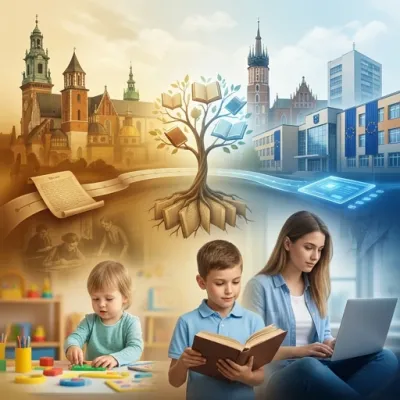
Educationin Poland has evolved through centuries of historical transformation, from monastic schools in the medieval era to the modern system shaped by partitions, wars, communist rule, and post-1989 reforms. Key milestones include the founding of the Jagiellonian University in 1364, the establishment of the Commission of National Education in 1773 as the world's first state ministry of education, and the post-independence efforts to unify partitioned systems. The system has consistently emphasized accessibility and national identity, overcoming adversity through underground teaching during occupations and ideological shifts under communism, ultimately progressing toward democratization and EU alignment.
The contemporary Polish educational structure begins with non-compulsory early childhood education (nurseries and kindergartens), followed by eight years of compulsory primary school (szkoła podstawowa), which integrates foundational learning in early grades and subject-specific instruction later. Secondary education offers diverse pathways: general secondary schools (liceum ogólnokształcące) preparing students for university via the Matura examination, technical secondary schools (technika) providing dual academic-vocational qualifications, and sectoral vocational schools (branżowe szkoły) focusing on direct workforce entry. The Matura serves as the national gateway to higher education, assessing compulsory and extended-level subjects. Higher education encompasses universities, technical universities, academies, and state higher vocational schools, adhering to the Bologna Process with Bachelor's, Master's, and Doctoral degrees, supported by a mix of public (state-funded, tuition-free for citizens) and private institutions.
Ongoing challenges include demographic shifts affecting school funding and staffing, efforts to elevate vocational education's prestige, ensuring equitable access to quality education across regions, integrating technology effectively while addressing the digital divide, supporting students with special educational needs through inclusive practices and Individualized Education Programs, and maintaining teacher quality amid recruitment pressures. The system is continuously reformed, influenced by EU policies that have driven modernization through structural funds, the Bologna Process, Erasmus+ mobility, and alignment with European standards. Future outlook emphasizes digital transformation (including AI integration), lifelong learning responsiveness to labor market demands, strengthened environmental education, continued internationalization of higher education, and sustained focus on equity, student well-being, and adapting governance to evolving societal needs while preserving Poland's educational resilience and commitment to learning as a national cornerstone.
What You'll Find Inside:
- Traces Polish education's historical evolution from 11th-century monastic schools through the world's first Ministry of Education (KEN), foreign partitions, communist era, and post-1989 reforms to current EU-aligned system.
- Provides a comprehensive structural breakdown of all education levels: early childhood (nurseries/kindergartens), 8-year primary school, general/technical/vocational secondary pathways, and diverse higher education landscape (universities, technical schools, academies).
- Offers an in-depth analysis of the Matura examination as Poland's national gateway to higher education, detailing its compulsory/extended subjects, scoring system, and decisive role in university admissions.
- Explores Poland's dual education pathways: academic routes (liceum ogólnokształcące) preparing for university and vocational pathways (technika technical schools, branżowe szkoły sectoral vocational schools) leading to immediate employment or further study.
- Examines contemporary challenges and innovations including technology integration in classrooms, EU policy impacts, inclusive practices for special needs, STEM education focus, and ongoing reforms addressing demographic shifts and labor market demands.
Who's It For:
This book serves academics and researchers requiring detailed analysis of Polish educational history and structure, policymakers seeking comparative insights for reform, educators pursuing best practices in teaching and administration, and international students or families evaluating Poland as a study destination. It also appeals to general readers interested in how national education systems reflect and shape societal resilience and cultural identity, particularly through Poland's unique historical trajectory and contemporary EU-integrated reforms.
Table of Contents:
- Introduction
- Chapter 1: Historical Foundations of Polish Education
- Chapter 2: The Structure of the Polish Educational System
- Chapter 3: Early Childhood Education: Nurseries and Kindergartens
- Chapter 4: Primary Education: Curriculum and Key Stages
- Chapter 5: Secondary Education: General and Vocational Schools
- Chapter 6: Matura Examination: The Gateway to Higher Education
- Chapter 7: Higher Education Landscape: Universities and Colleges
- Chapter 8: Vocational Education and Training (VET) in Poland
- Chapter 9: Special Education Needs and Inclusive Practices
- Chapter 10: Teacher Training and Professional Development
- Chapter 11: Educational Funding and Governance
- Chapter 12: Curriculum Development and Educational Standards
- Chapter 13: Assessment and Evaluation in Polish Schools
- Chapter 14: The Role of Technology in Education
- Chapter 15: Internationalization of Polish Higher Education
- Chapter 16: Adult Education and Lifelong Learning
- Chapter 17: Challenges and Reforms in Polish Education
- Chapter 18: The Impact of EU Policies on Polish Education
- Chapter 19: Private vs. Public Education in Poland
- Chapter 20: Civic Education and National Identity
- Chapter 21: Arts and Sports Education
- Chapter 22: Science, Technology, Engineering, and Mathematics (STEM) Education
- Chapter 23: Student Support Services and Well-being
- Chapter 24: Research and Innovation in Higher Education
- Chapter 25: Future Outlook for Education in Poland
Author:
Published By:
Date Published:
July 2, 2026
Type:
Nonfiction
Language:
English
Word Count:
45,741 words
Reading Time:
3 hours 12 minutes
Sample:
Order:
Order Education In Poland (Paperback) on MixCache.com:
Buy NowPrint copy is made to order and ships worldwide. Includes the ebook free, ready to read instantly.
$5 account credit for all new MixCache.com accounts, usable toward any ebook purchase!*