Browse by Category
Fiction
- Action & Adventure
- African American
- Anthologies
- Children's Fiction
- Classics
- Comics & Graphic Novels
- Coming of Age
- Contemporary
- Cultural & Regional
- Drama
- Erotica
- Fantasy
- General
- Historical Fiction
- Horror
- Humor & Satire
- Literary Fiction
- Mystery, Thriller & Suspense
- Poetry
- Religious & Inspirational
- Romance
- Science Fiction
- Short Stories
- War & Military
- Westerns
- Women's Fiction
- Young Adult
Non-Fiction
- Antiques & Collectibles
- Arts & Photography
- Biographies & Memoirs
- Business & Money
- Children's Non-Fiction
-
Computers & Technology
- Artificial Intelligence
- Computer Science
- Cybersecurity & Cryptography
- Data Science & Analytics
- Databases & Big Data
- Game Development & Design
- General
- Hardware & DIY
- Mobile App Development
- Networking & Cloud Computing
- Operating Systems
- Programming
- Robotics
- Software
- Software Engineering
- User Experience (UX) & Design
- Web Development & Design
- Cooking, Food & Wine
- Crafts, Hobbies & Home
- Education & Teaching
- Engineering
- General
- Health, Fitness & Dieting
-
History
- African History
- African History - North Africa
- African History - Sub-Saharan Africa
- American History
- American History - 20th Century
- American History - Civil War
- American History - Colonial Period
- Ancient History
- Asian History
- Asian History - China
- Asian History - India
- Asian History - Japan
- Asian History - Southeast Asia
- European History
- European History - Ancient Greece
- European History - Ancient Rome
- European History - Medieval
- European History - Modern
- European History - Renaissance
- General
- Middle Eastern History
- Military History
- Military History - Aviation
- Military History - Naval
- Social & Cultural History
- World History
- Humor & Entertainment
- Industrial Technology
- Language Learning
- Law
- LGBTQ+ Non-Fiction
- Literary Criticism
- Medical Books
- Parenting & Relationships
- Philosophy
- Politics & Social Sciences
- Reference
- Religion & Spirituality
-
Science & Math
- Agricultural Sciences
- Astronomy & Space Science
- Behavioral Sciences
- Biological Sciences
- Botany & Plant Science
- Chemistry
- Earth Sciences
- Engineering - Chemical
- Engineering - Civil
- Engineering - Electrical
- Engineering - Mechanical
- Environment
- General
- Geology
- Mathematics
- Nature & Ecology
- Oceanography
- Paleontology
- Physics
- Statistics
- Self-Help
- Sports & Outdoors
- Study Aids
- Sustainability & Green Living
- Textbooks
- Transportation
- Travel
- True Crime
- Urban Planning & Development
- Veterinary Medicine
- Writing & Publishing
Jump to Section
MixCache.com Total Access
Unlimited reading and audiobooks for every book published by MixCache.com.
Included titles carry the MTA badge.
Learn more →
Education In Morocco
MTA
A Comprehensive Overview from Early Childhood to Higher Education
About this book:
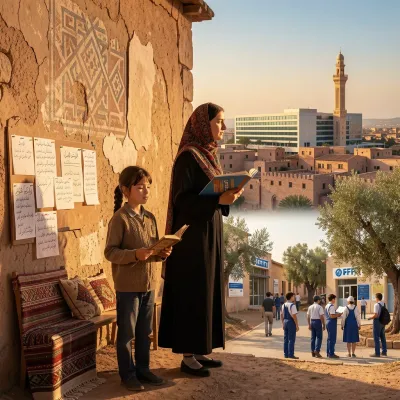
Morocco’s education system has evolved from ancient Islamic learning centers and oral Amazigh traditions to a multi-tiered structure covering early childhood through higher education. Post-independence reforms prioritized Arabization, Moroccanization, and universal access, replacing the dual French-protectorate system with a unified national framework. Despite progress in expanding enrollment, disparities persist between urban and rural areas, and the sector faces ongoing challenges linked to quality, equity, and labor-market relevance.
The system is structured around compulsory six-year primary cycles, three-year junior secondary (collège), and three-year senior secondary (lycée) with general, literary, and technical streams. National examinations at each level gatekeep progression, with the Baccalauréat being pivotal for university entry. Vocational training, mostly managed by OFPPT, and private education have grown rapidly, offering alternative pathways and easing pressure on public universities. Teacher training is centralized through Regional Centers (CRMEFs), while higher education includes public universities, specialized institutes, and expanding private programs.
Key cross-cutting issues include a complex linguistic landscape—Arabic is dominant in primary and literary tracks, French prevails in scientific and higher education, and Amazigh is being gradually integrated—alongside deep rural-urban divides in infrastructure and teacher distribution. Gender parity has improved significantly, especially at lower levels, though gaps remain in technical fields and graduate employment. The system also grapples with high dropout rates, brain drain, a mismatch between graduate skills and labor-market demands, and the need for more inclusive education for learners with special needs.
Reforms have moved through Arabization, the National Charter of Education and Training (1999–2009), and the current Strategic Vision 2015–2030, which emphasizes equity, quality, and promotion through student-centered learning, digital transformation, and stronger vocational linkages. Yet equitable resource allocation, consistent implementation, and teacher-quality challenges continue to test these reforms. Looking ahead, the focus is shifting toward lifelong learning, multilingual competence, technology integration, and stronger industry alignment to ensure education drives inclusive national development.
What You'll Find Inside:
- Historical evolution of Moroccan education from ancient Islamic learning centers like Al-Qarawiyyin to post-independence reforms and modern challenges.
- Comprehensive breakdown of the multi-tiered educational system structure, covering early childhood, primary, secondary, vocational, and higher education pathways.
- In-depth analysis of access and equity issues, including urban-rural disparities, gender dynamics, special education inclusion, and socioeconomic barriers.
- Examination of curriculum development, language of instruction (Arabic, French, Amazigh), and the growing role of technology in Moroccan classrooms.
- Insights into teacher training, assessment systems, financing mechanisms, and the impact of educational policies on national development and graduate employment.
Who's It For:
This book is ideal for policymakers and education planners seeking evidence-based insights for reform, educators and administrators aiming to understand systemic challenges and opportunities, researchers and students studying North African education systems, and anyone with a professional or personal interest in the dynamics, history, and future of education in Morocco.
Table of Contents:
- Introduction
- Chapter 1: Historical Foundations of Moroccan Education
- Chapter 2: The Structure of the Moroccan Educational System
- Chapter 3: Early Childhood Education: Nurseries and Preschools
- Chapter 4: Primary Education: Curriculum and Pedagogy
- Chapter 5: Challenges and Reforms in Primary Education
- Chapter 6: Secondary Education: General and Technical Streams
- Chapter 7: Vocational Training and Apprenticeships
- Chapter 8: Higher Education: Universities and Institutes
- Chapter 9: Access and Equity in Moroccan Education
- Chapter 10: Teacher Training and Professional Development
- Chapter 11: Language of Instruction: Arabic, French, and Amazigh
- Chapter 12: Curriculum Development and Educational Standards
- Chapter 13: The Role of Technology in Moroccan Classrooms
- Chapter 14: Private Education: Growth and Impact
- Chapter 15: Special Education Needs and Inclusive Practices
- Chapter 16: Education in Rural vs. Urban Areas
- Chapter 17: Gender Disparities and Achievements in Education
- Chapter 18: International Cooperation and Educational Partnerships
- Chapter 19: Funding and Financing of Education in Morocco
- Chapter 20: The Impact of Educational Policies on National Development
- Chapter 21: Student Assessment and Evaluation Systems
- Chapter 22: Brain Drain and Graduate Employment Challenges
- Chapter 23: Lifelong Learning and Adult Education Initiatives
- Chapter 24: Educational Reforms: Past, Present, and Future
- Chapter 25: Future Outlook and Recommendations for Moroccan Education
Author:
Published By:
Date Published:
June 30, 2026
Type:
Nonfiction
Language:
English
Word Count:
38,497 words
Reading Time:
2 hours 42 minutes
Sample:
Order:
Order Education In Morocco (Hardcover) on MixCache.com:
Buy NowPrint copy is made to order and ships worldwide. Includes the ebook free, ready to read instantly.
$5 account credit for all new MixCache.com accounts, usable toward any ebook purchase!*