Browse by Category
Fiction
- Action & Adventure
- African American
- Anthologies
- Children's Fiction
- Classics
- Comics & Graphic Novels
- Coming of Age
- Contemporary
- Cultural & Regional
- Drama
- Erotica
- Fantasy
- General
- Historical Fiction
- Horror
- Humor & Satire
- Literary Fiction
- Mystery, Thriller & Suspense
- Poetry
- Religious & Inspirational
- Romance
- Science Fiction
- Short Stories
- War & Military
- Westerns
- Women's Fiction
- Young Adult
Non-Fiction
- Antiques & Collectibles
- Arts & Photography
- Biographies & Memoirs
- Business & Money
- Children's Non-Fiction
-
Computers & Technology
- Artificial Intelligence
- Computer Science
- Cybersecurity & Cryptography
- Data Science & Analytics
- Databases & Big Data
- Game Development & Design
- General
- Hardware & DIY
- Mobile App Development
- Networking & Cloud Computing
- Operating Systems
- Programming
- Robotics
- Software
- Software Engineering
- User Experience (UX) & Design
- Web Development & Design
- Cooking, Food & Wine
- Crafts, Hobbies & Home
- Education & Teaching
- Engineering
- General
- Health, Fitness & Dieting
-
History
- African History
- African History - North Africa
- African History - Sub-Saharan Africa
- American History
- American History - 20th Century
- American History - Civil War
- American History - Colonial Period
- Ancient History
- Asian History
- Asian History - China
- Asian History - India
- Asian History - Japan
- Asian History - Southeast Asia
- European History
- European History - Ancient Greece
- European History - Ancient Rome
- European History - Medieval
- European History - Modern
- European History - Renaissance
- General
- Middle Eastern History
- Military History
- Military History - Aviation
- Military History - Naval
- Social & Cultural History
- World History
- Humor & Entertainment
- Industrial Technology
- Language Learning
- Law
- LGBTQ+ Non-Fiction
- Literary Criticism
- Medical Books
- Parenting & Relationships
- Philosophy
- Politics & Social Sciences
- Reference
- Religion & Spirituality
-
Science & Math
- Agricultural Sciences
- Astronomy & Space Science
- Behavioral Sciences
- Biological Sciences
- Botany & Plant Science
- Chemistry
- Earth Sciences
- Engineering - Chemical
- Engineering - Civil
- Engineering - Electrical
- Engineering - Mechanical
- Environment
- General
- Geology
- Mathematics
- Nature & Ecology
- Oceanography
- Paleontology
- Physics
- Statistics
- Self-Help
- Sports & Outdoors
- Study Aids
- Sustainability & Green Living
- Textbooks
- Transportation
- Travel
- True Crime
- Urban Planning & Development
- Veterinary Medicine
- Writing & Publishing
Jump to Section
MixCache.com Total Access
Unlimited reading and audiobooks for every book published by MixCache.com.
Included titles carry the MTA badge.
Learn more →
Education In Laos
MTA
A Comprehensive Overview from Early Childhood to Higher Education
About this book:
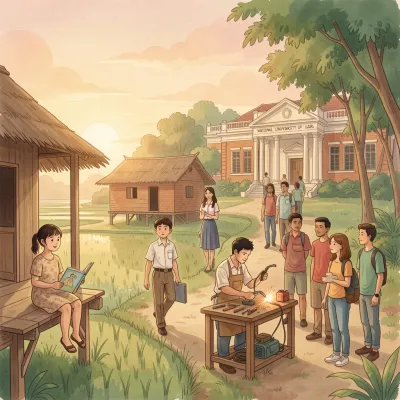
Education in Laos has evolved from traditional monastic instruction through French colonial influences and post‑1975 socialist reforms to a modern system overseen by the Ministry of Education and Sports. The system is structured into early childhood, primary (five years, soon to be six), secondary (lower and upper), vocational and technical education, and higher education centered on the National University of Laos. Governance is centralized at the national level with provincial and district bureaus implementing policies, while funding comes from government budgets, household contributions, private investment, and substantial international aid.
Historically, education expanded slowly; monastic schools provided basic literacy, French colonial efforts were elitist and limited, and the post‑1975 Lao People's Democratic Republic pursued universal primary education and adult literacy campaigns. Since the 2000s, reforms have focused on curriculum renewal, teacher training, access expansion, and quality improvement. Persistent challenges include geographic isolation, limited resources, teacher shortages, linguistic diversity for ethnic‑minority students, infrastructure deficits, and socioeconomic barriers that affect enrollment, retention, and learning outcomes. Ongoing reforms address these through a new student‑centered primary curriculum, bilingual education initiatives, structural shift to a 6+3+3 model, strengthened teacher standards, and efforts to align vocational and higher‑education programs with labor‑market needs.
Future prospects hinge on increasing domestic financing, professionalizing teachers, scaling mother‑tongue‑based multilingual education, improving school infrastructure, leveraging educational technology, and deepening public‑private partnerships to ensure relevance and employability. Policy recommendations emphasize equitable resource allocation, enhanced teacher salaries and training, robust assessment of genuine learning, inclusive practices for children with disabilities, and data‑driven governance. Together, these strategies aim to build an accessible, high‑quality, and resilient education system that supports Laos’s socio‑economic development and prepares all learners for meaningful participation in the nation’s future.
What You'll Find Inside:
- Historical evolution of Lao education from monastic roots through French colonialism to post-1975 reforms, highlighting how past influences shape current policies and practices.
- Comprehensive breakdown of the Laotian education system's structure, governance, and stages—from early childhood through higher education—including roles of MOES, provincial/district bodies, and key institutions.
- In-depth analysis of access and equity challenges, especially in early childhood and rural/remote areas, with strategies such as mother-tongue-based multilingual education, community-based centers, and targeted scholarships.
- Overview of ongoing curriculum reforms, teacher training initiatives, and pedagogical shifts toward student-centered, active learning to improve learning outcomes and relevance to labor market needs.
- Examination of financing mechanisms, quality assurance frameworks, and policy recommendations for sustainable development, emphasizing domestic resource mobilization, teacher professionalization, and inclusive education.
Who's It For:
This book is essential for policymakers and government officials shaping education strategy, educators and administrators seeking to understand systemic challenges and reforms, researchers and academics studying Southeast Asian education systems, international development partners and aid organizations involved in Lao education projects, and anyone requiring a thorough, evidence-based overview of Laos's educational landscape from early childhood to higher education.
Table of Contents:
- Introduction
- Chapter 1: Historical Context of Education in Laos
- Chapter 2: Educational Philosophy and National Goals
- Chapter 3: Structure and Governance of the Laotian Education System
- Chapter 4: Early Childhood Education: Policies and Provision
- Chapter 5: Access and Equity in Early Childhood Education
- Chapter 6: Primary Education: Curriculum and Pedagogy
- Chapter 7: Teacher Training and Professional Development in Primary Education
- Chapter 8: Challenges and Reforms in Primary Education
- Chapter 9: Secondary Education: Structure and Specializations
- Chapter 10: Curriculum Development and Implementation in Secondary Education
- Chapter 11: Vocational and Technical Education: Pathways and Opportunities
- Chapter 12: Higher Education Landscape: Universities and Institutions
- Chapter 13: Access, Admissions, and Funding in Higher Education
- Chapter 14: Quality Assurance and Accreditation in Laotian Higher Education
- Chapter 15: Distance Learning and Educational Technology in Laos
- Chapter 16: Inclusive Education for Students with Special Needs
- Chapter 17: Education in Rural and Remote Areas
- Chapter 18: Gender Equality in Education
- Chapter 19: The Role of Language in Education: Lao and Minority Languages
- Chapter 20: International Cooperation and Aid in Laotian Education
- Chapter 21: Financing Education: Public and Private Investment
- Chapter 22: Educational Outcomes and Employability
- Chapter 23: Impact of Socioeconomic Factors on Educational Attainment
- Chapter 24: Current Challenges and Future Prospects for Education in Laos
- Chapter 25: Policy Recommendations for Sustainable Educational Development
Author:
Published By:
Date Published:
June 29, 2026
Type:
Nonfiction
Language:
English
Word Count:
40,416 words
Reading Time:
2 hours 50 minutes
Sample:
Order:
Order Education In Laos (Hardcover) on MixCache.com:
Buy NowPrint copy is made to order and ships worldwide. Includes the ebook free, ready to read instantly.
$5 account credit for all new MixCache.com accounts, usable toward any ebook purchase!*