Browse by Category
Fiction
- Action & Adventure
- African American
- Anthologies
- Children's Fiction
- Classics
- Comics & Graphic Novels
- Coming of Age
- Contemporary
- Cultural & Regional
- Drama
- Erotica
- Fantasy
- General
- Historical Fiction
- Horror
- Humor & Satire
- Literary Fiction
- Mystery, Thriller & Suspense
- Poetry
- Religious & Inspirational
- Romance
- Science Fiction
- Short Stories
- War & Military
- Westerns
- Women's Fiction
- Young Adult
Non-Fiction
- Antiques & Collectibles
- Arts & Photography
- Biographies & Memoirs
- Business & Money
- Children's Non-Fiction
-
Computers & Technology
- Artificial Intelligence
- Computer Science
- Cybersecurity & Cryptography
- Data Science & Analytics
- Databases & Big Data
- Game Development & Design
- General
- Hardware & DIY
- Mobile App Development
- Networking & Cloud Computing
- Operating Systems
- Programming
- Robotics
- Software
- Software Engineering
- User Experience (UX) & Design
- Web Development & Design
- Cooking, Food & Wine
- Crafts, Hobbies & Home
- Education & Teaching
- Engineering
- General
- Health, Fitness & Dieting
-
History
- African History
- African History - North Africa
- African History - Sub-Saharan Africa
- American History
- American History - 20th Century
- American History - Civil War
- American History - Colonial Period
- Ancient History
- Asian History
- Asian History - China
- Asian History - India
- Asian History - Japan
- Asian History - Southeast Asia
- European History
- European History - Ancient Greece
- European History - Ancient Rome
- European History - Medieval
- European History - Modern
- European History - Renaissance
- General
- Middle Eastern History
- Military History
- Military History - Aviation
- Military History - Naval
- Social & Cultural History
- World History
- Humor & Entertainment
- Industrial Technology
- Language Learning
- Law
- LGBTQ+ Non-Fiction
- Literary Criticism
- Medical Books
- Parenting & Relationships
- Philosophy
- Politics & Social Sciences
- Reference
- Religion & Spirituality
-
Science & Math
- Agricultural Sciences
- Astronomy & Space Science
- Behavioral Sciences
- Biological Sciences
- Botany & Plant Science
- Chemistry
- Earth Sciences
- Engineering - Chemical
- Engineering - Civil
- Engineering - Electrical
- Engineering - Mechanical
- Environment
- General
- Geology
- Mathematics
- Nature & Ecology
- Oceanography
- Paleontology
- Physics
- Statistics
- Self-Help
- Sports & Outdoors
- Study Aids
- Sustainability & Green Living
- Textbooks
- Transportation
- Travel
- True Crime
- Urban Planning & Development
- Veterinary Medicine
- Writing & Publishing
Jump to Section
MixCache.com Total Access
Unlimited reading and audiobooks for every book published by MixCache.com.
Included titles carry the MTA badge.
Learn more →
Education In Malaysia
MTA
A Comprehensive Overview from Early Childhood to Higher Education
About this book:
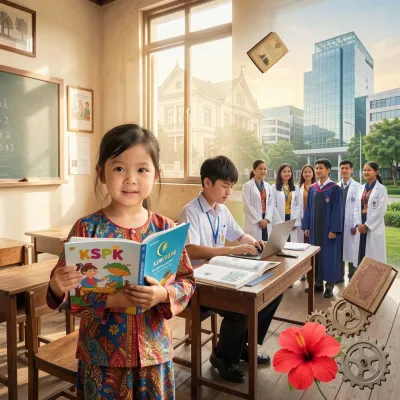
Malaysia’s education system is a comprehensive, multi-tiered framework designed to foster national unity, economic development, and individual growth from early childhood through higher learning. Rooted in historical foundations shaped by colonial legacies and post-independence reforms, the system evolved from fragmented vernacular schools to a unified national structure guided by policies like the Razak Report (1956) and the National Education Philosophy (NEP), which emphasizes holistic development, moral values, and cultural cohesion. Governed by the Ministry of Education (MOE) and Ministry of Higher Education (MOHE), the system includes public and private institutions, with distinct pathways for primary, secondary, and technical/vocational education (TVET), all calibrated to meet diverse societal needs through standardized curricula (e.g., KSPK for preschools, KSSR/KSSM for primary/secondary) and assessment systems transitioning toward school-based evaluations.
The system prioritizes inclusivity, with initiatives like the Inclusive Education Program (PPI) and efforts to support indigenous communities and special needs students, reflecting Malaysia’s commitment to equitable access. Technical education, managed through vocational colleges and polytechnics, addresses workforce demands, while higher education—spanning public universities like the University of Malaya and private institutions—emphasizes research, innovation, and internationalization. Quality assurance is maintained by bodies like the Malaysian Qualifications Agency (MQA), ensuring alignment with global standards. Challenges persist, including urban-rural educational disparities, teacher distribution, and maintaining curriculum relevance amid rapid technological change, prompting reforms under blueprints like the Malaysia Education Blueprint 2013-2025 to integrate outcome-based learning, technology-driven pedagogies, and 21st-century skills.
Key examination reforms have abolished high-stakes tests like UPSR and PT3, favoring continuous assessment and reducing student stress, while the SPM remains a critical gateway for higher education. Teacher training, centered at institutions like IPGM, focuses on pedagogical excellence and digital literacy, supported by ongoing professional development. Funding, primarily federal, supplements private investments and aims to bridge resource gaps, though equitable access remains a priority. Malaysia’s education also seeks to enhance its global standing through international partnerships, branch campuses of foreign universities, and a growing emphasis on research and entrepreneurship.
Ultimately, Malaysian education serves as a cornerstone of national development, driving economic growth through skilled workforce production, fostering social cohesion via multicultural curricula, and nurturing innovation through research-intensive universities. By continuously adapting to global trends and addressing systemic challenges, the system aims to position Malaysia as a knowledge-driven, inclusive society, empowering citizens to contribute to sustainable development and global competitiveness while preserving cultural heritage and promoting lifelong learning.
What You'll Find Inside:
- Comprehensive exploration of the historical evolution of Malaysia's education system, including colonial influences and policy shifts from the Barnes and Razak Reports to modern reforms.
- Detailed analysis of the National Education Philosophy (FPN) and its goals, such as fostering national unity, human capital development, and holistic individual growth.
- In-depth coverage of the structure and curriculum across all education levels—from early childhood and primary school to secondary, TVET, and higher education sectors.
- Insights into teacher education, professional development frameworks, and the role of institutions like IPGM in preparing educators for diverse learning environments.
- Examination of education's impact on national development, including economic growth, social cohesion, technological innovation, and Malaysia's position as a regional education hub.
Who's It For:
This book is for educators, policymakers, and researchers seeking a thorough understanding of Malaysia's education system. It benefits those involved in educational planning, curriculum development, or cross-cultural studies, offering insights into policy implementation, challenges, and future reforms in a multicultural context. Academics and students researching Southeast Asian education systems will also find it invaluable.
Table of Contents:
- Introduction
- Chapter 1: Historical Foundations of Malaysian Education
- Chapter 2: The Philosophy and Goals of Malaysian Education
- Chapter 3: Governance and Administration of the Education System
- Chapter 4: Early Childhood Education: Policies and Practices
- Chapter 5: The National Preschool Curriculum
- Chapter 6: Primary Education: Structure and Curriculum
- Chapter 7: Key Stages and Assessment in Primary Schools
- Chapter 8: Secondary Education: Lower Secondary
- Chapter 9: Secondary Education: Upper Secondary and Diversification
- Chapter 10: Technical and Vocational Education and Training (TVET)
- Chapter 11: The Malaysian Examinations System
- Chapter 12: Teacher Education and Professional Development
- Chapter 13: Higher Education Landscape: Public Universities
- Chapter 14: Higher Education Landscape: Private Institutions
- Chapter 15: Quality Assurance in Higher Education
- Chapter 16: Curriculum Development in Higher Education
- Chapter 17: Research and Innovation in Malaysian Universities
- Chapter 18: Internationalization of Malaysian Education
- Chapter 19: Inclusive Education for Special Needs Students
- Chapter 20: Education for Indigenous Communities
- Chapter 21: The Role of Technology in Education
- Chapter 22: Funding and Financing of Education in Malaysia
- Chapter 23: Challenges and Issues in Malaysian Education
- Chapter 24: Educational Reforms and Future Directions
- Chapter 25: The Impact of Education on National Development
Author:
Published By:
Date Published:
June 28, 2026
Type:
Nonfiction
Language:
English
Word Count:
43,813 words
Reading Time:
3 hours 4 minutes
Sample:
Order:
Order Education In Malaysia (Paperback) on MixCache.com:
Buy NowPrint copy is made to order and ships worldwide. Includes the ebook free, ready to read instantly.
$5 account credit for all new MixCache.com accounts, usable toward any ebook purchase!*