Browse by Category
Fiction
- Action & Adventure
- African American
- Anthologies
- Children's Fiction
- Classics
- Comics & Graphic Novels
- Coming of Age
- Contemporary
- Cultural & Regional
- Drama
- Erotica
- Fantasy
- General
- Historical Fiction
- Horror
- Humor & Satire
- Literary Fiction
- Mystery, Thriller & Suspense
- Poetry
- Religious & Inspirational
- Romance
- Science Fiction
- Short Stories
- War & Military
- Westerns
- Women's Fiction
- Young Adult
Non-Fiction
- Antiques & Collectibles
- Arts & Photography
- Biographies & Memoirs
- Business & Money
- Children's Non-Fiction
-
Computers & Technology
- Artificial Intelligence
- Computer Science
- Cybersecurity & Cryptography
- Data Science & Analytics
- Databases & Big Data
- Game Development & Design
- General
- Hardware & DIY
- Mobile App Development
- Networking & Cloud Computing
- Operating Systems
- Programming
- Robotics
- Software
- Software Engineering
- User Experience (UX) & Design
- Web Development & Design
- Cooking, Food & Wine
- Crafts, Hobbies & Home
- Education & Teaching
- Engineering
- General
- Health, Fitness & Dieting
-
History
- African History
- African History - North Africa
- African History - Sub-Saharan Africa
- American History
- American History - 20th Century
- American History - Civil War
- American History - Colonial Period
- Ancient History
- Asian History
- Asian History - China
- Asian History - India
- Asian History - Japan
- Asian History - Southeast Asia
- European History
- European History - Ancient Greece
- European History - Ancient Rome
- European History - Medieval
- European History - Modern
- European History - Renaissance
- General
- Middle Eastern History
- Military History
- Military History - Aviation
- Military History - Naval
- Social & Cultural History
- World History
- Humor & Entertainment
- Industrial Technology
- Language Learning
- Law
- LGBTQ+ Non-Fiction
- Literary Criticism
- Medical Books
- Parenting & Relationships
- Philosophy
- Politics & Social Sciences
- Reference
- Religion & Spirituality
-
Science & Math
- Agricultural Sciences
- Astronomy & Space Science
- Behavioral Sciences
- Biological Sciences
- Botany & Plant Science
- Chemistry
- Earth Sciences
- Engineering - Chemical
- Engineering - Civil
- Engineering - Electrical
- Engineering - Mechanical
- Environment
- General
- Geology
- Mathematics
- Nature & Ecology
- Oceanography
- Paleontology
- Physics
- Statistics
- Self-Help
- Sports & Outdoors
- Study Aids
- Sustainability & Green Living
- Textbooks
- Transportation
- Travel
- True Crime
- Urban Planning & Development
- Veterinary Medicine
- Writing & Publishing
Jump to Section
MixCache.com Total Access
Unlimited reading and audiobooks for every book published by MixCache.com.
Included titles carry the MTA badge.
Learn more →
Education In Kuwait
MTA
A Comprehensive Overview from Early Childhood to Higher Education
About this book:
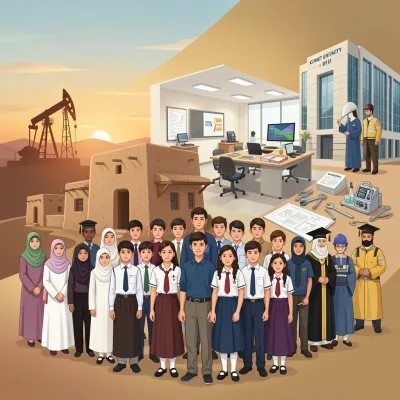
Educationin Kuwait has evolved from traditional Quranic schools (Al-Katatib) to a modern, centralized system overseen by the Ministry of Education, beginning with the establishment of Al-Mubarakiya School in 1911 and accelerating after oil wealth enabled state control in the 1930s. Compulsory education laws enacted in 1965 mandate schooling for children aged 6 to 14, structuring the system into non-compulsory early childhood education (nurseries and kindergartens), five years of primary education, three years of intermediate education, and three years of secondary education offering scientific and literary tracks, alongside a robust technical and vocational education and training (TVET) pathway managed by the Public Authority for Applied Education and Training (PAAET). Higher education culminates in a diverse landscape featuring Kuwait University as the flagship public institution, a growing number of private universities often affiliated with international partners, and PAAET’s applied degree programs, all supported by extensive government scholarship schemes that send students abroad for specialized study.
Curriculum development is centrally directed by the Ministry of Education, emphasizing Arabic language, Islamic studies, and national identity while integrating international best practices in STEM, critical thinking, and digital literacy; educational standards are continuously refined to align with national visions such as Kuwait Vision 2035. Teacher training and professional development are delivered through institutions like PAAET’s College of Basic Education and Kuwait University’s College of Education, with ongoing in-service programs focusing on pedagogy, technology integration, and inclusive practices. Educational technology initiatives, including smart classrooms and e-learning platforms, have been expanded system-wide, especially after the COVID-19 pandemic, to foster digital literacy and personalized learning. The system also provides specialized support for students with special educational needs through individualized education programs and specialized schools, while gifted and talented students are nurtured via enrichment, acceleration, and dedicated centers such as the Sabah Al-Ahmad Center for Giftedness and Creativity. Private schools, adult education, and lifelong learning initiatives further diversify offerings, catering to expatriate populations, workforce upskilling, and community engagement.
Ongoing reforms aim to bridge the gap between educational outputs and labor market demands by emphasizing future-ready skills like entrepreneurship, AI, and digital fluency, strengthening public-private partnerships, and enhancing career guidance. Challenges persist, including societal preferences for public sector employment, ensuring equitable access to quality education, maintaining teacher quality, and aligning curricula with rapid technological change. Cultural and societal values—particularly Kuwait’s Arab and Islamic heritage, strong family ties, and collective identity—deeply influence curriculum content, pedagogical approaches, and the role of schools in transmitting national identity. Funding remains a top national priority, with substantial budget allocations covering free public education, teacher salaries, infrastructure, scholarships, and TVET, while ongoing efforts seek to optimize resource utilization and explore public-private partnerships for sustainability. Looking ahead, Kuwait’s educational strategy envisions personalized learning pathways powered by AI, expanded immersive technologies (VR/AR), deeper industry-academia collaboration, greater emphasis on innovation and entrepreneurship, and continued international cooperation to position its system as a globally competitive, inclusive, and future-ready engine for national development.
What You'll Find Inside:
- The historical evolution of Kuwaiti education from traditional Quranic schools (Al-Katatib) to a modern, comprehensive system driven by oil wealth and government investment, establishing free public education for all citizens.
- The structured educational pathway encompassing early childhood, compulsory primary/intermediate education, secondary tracks (scientific/literary), technical/vocational training (TVET), and higher education through Kuwait University and private institutions.
- Kuwait's strategic alignment of education with national development goals (Vision 2035), emphasizing curriculum reforms focused on STEM, critical thinking, and future-ready skills to support economic diversification and reduce oil dependence.
- Comprehensive support systems including special education programs, gifted and talented initiatives, overseas scholarship programs, and extensive teacher training and professional development to ensure educational quality and inclusivity.
- Ongoing challenges such as curriculum implementation gaps, labor market mismatches favoring public sector employment, and the need for continuous improvement in educational quality and technological integration.
Who's It For:
This book is essential reading for educators, administrators, and policymakers working within or with Kuwait's educational system who need a comprehensive understanding of its structure, challenges, and reforms. It will also benefit researchers and students studying Middle Eastern education systems, international development professionals focused on education in Gulf countries, and anyone interested in how national oil wealth has been strategically invested in human capital development through education. Scholarship program administrators and those involved in Kuwait-Vision 2035 initiatives will find particular value in the detailed coverage of alignment between education and national development goals.
Table of Contents:
- Introduction
- Chapter 1: Historical Foundations of Kuwaiti Education
- Chapter 2: The Structure of the Kuwaiti Educational System
- Chapter 3: Early Childhood Education: Nurseries and Kindergartens
- Chapter 4: Primary Education: Curriculum and Development
- Chapter 5: Intermediate Education: Building on Fundamentals
- Chapter 6: Secondary Education: Pathways to Higher Learning
- Chapter 7: Technical and Vocational Education and Training (TVET)
- Chapter 8: Higher Education Landscape: Universities and Colleges
- Chapter 9: Kuwait University: A Flagship Institution
- Chapter 10: Private Universities and Their Role
- Chapter 11: Scholarship Programs and Studying Abroad
- Chapter 12: Curriculum Development and Educational Standards
- Chapter 13: Teacher Training and Professional Development
- Chapter 14: Educational Technology and Digital Learning Initiatives
- Chapter 15: Special Education: Catering to Diverse Needs
- Chapter 16: Gifted and Talented Education Programs
- Chapter 17: The Role of Private Schools in Kuwait
- Chapter 18: Adult Education and Lifelong Learning
- Chapter 19: Educational Reforms and Future Visions
- Chapter 20: Challenges Facing the Kuwaiti Educational System
- Chapter 21: International Cooperation in Education
- Chapter 22: Education and the Labor Market: Bridging the Gap
- Chapter 23: The Impact of Culture and Society on Education
- Chapter 24: Funding and Investment in Education
- Chapter 25: Future Outlook and Prospects for Education in Kuwait
Author:
Published By:
Date Published:
June 27, 2026
Type:
Nonfiction
Language:
English
Word Count:
40,427 words
Reading Time:
2 hours 50 minutes
Sample:
Order:
Order Education In Kuwait (Hardcover) on MixCache.com:
Buy NowPrint copy is made to order and ships worldwide. Includes the ebook free, ready to read instantly.
$5 account credit for all new MixCache.com accounts, usable toward any ebook purchase!*