Browse by Category
Fiction
- Action & Adventure
- African American
- Anthologies
- Children's Fiction
- Classics
- Comics & Graphic Novels
- Coming of Age
- Contemporary
- Cultural & Regional
- Drama
- Erotica
- Fantasy
- General
- Historical Fiction
- Horror
- Humor & Satire
- Literary Fiction
- Mystery, Thriller & Suspense
- Poetry
- Religious & Inspirational
- Romance
- Science Fiction
- Short Stories
- War & Military
- Westerns
- Women's Fiction
- Young Adult
Non-Fiction
- Antiques & Collectibles
- Arts & Photography
- Biographies & Memoirs
- Business & Money
- Children's Non-Fiction
-
Computers & Technology
- Artificial Intelligence
- Computer Science
- Cybersecurity & Cryptography
- Data Science & Analytics
- Databases & Big Data
- Game Development & Design
- General
- Hardware & DIY
- Mobile App Development
- Networking & Cloud Computing
- Operating Systems
- Programming
- Robotics
- Software
- Software Engineering
- User Experience (UX) & Design
- Web Development & Design
- Cooking, Food & Wine
- Crafts, Hobbies & Home
- Education & Teaching
- Engineering
- General
- Health, Fitness & Dieting
-
History
- African History
- African History - North Africa
- African History - Sub-Saharan Africa
- American History
- American History - 20th Century
- American History - Civil War
- American History - Colonial Period
- Ancient History
- Asian History
- Asian History - China
- Asian History - India
- Asian History - Japan
- Asian History - Southeast Asia
- European History
- European History - Ancient Greece
- European History - Ancient Rome
- European History - Medieval
- European History - Modern
- European History - Renaissance
- General
- Middle Eastern History
- Military History
- Military History - Aviation
- Military History - Naval
- Social & Cultural History
- World History
- Humor & Entertainment
- Industrial Technology
- Language Learning
- Law
- LGBTQ+ Non-Fiction
- Literary Criticism
- Medical Books
- Parenting & Relationships
- Philosophy
- Politics & Social Sciences
- Reference
- Religion & Spirituality
-
Science & Math
- Agricultural Sciences
- Astronomy & Space Science
- Behavioral Sciences
- Biological Sciences
- Botany & Plant Science
- Chemistry
- Earth Sciences
- Engineering - Chemical
- Engineering - Civil
- Engineering - Electrical
- Engineering - Mechanical
- Environment
- General
- Geology
- Mathematics
- Nature & Ecology
- Oceanography
- Paleontology
- Physics
- Statistics
- Self-Help
- Sports & Outdoors
- Study Aids
- Sustainability & Green Living
- Textbooks
- Transportation
- Travel
- True Crime
- Urban Planning & Development
- Veterinary Medicine
- Writing & Publishing
Jump to Section
MixCache.com Total Access
Unlimited reading and audiobooks for every book published by MixCache.com.
Included titles carry the MTA badge.
Learn more →
Education In Iceland
MTA
A Comprehensive Overview from Early Childhood to Higher Education
About this book:
# Education In Iceland: A Comprehensive Overview from Early Childhood to Higher Education
## Summary
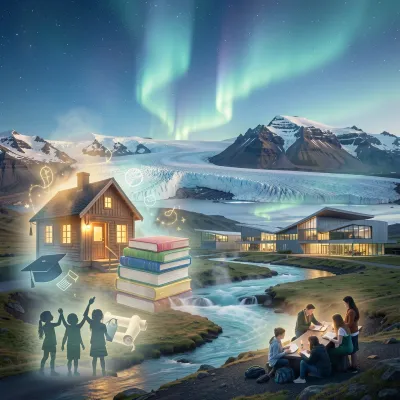
The book "Education In Iceland" offers a comprehensive exploration of the nation's educational system, tracing its evolution from historical roots in Christianity and Danish influence to its modern, inclusive structure. It highlights the system's division into four key stages: early childhood education (preschool/leikskóli), compulsory schooling (grunnskóli), upper secondary education (framhaldsskóli), and higher education (háskóli). Each level is meticulously described, emphasizing Iceland's commitment to equity, quality, and accessibility. Preschool education focuses on play-based learning and holistic development, while compulsory schooling provides a unified, decennial program with a strong emphasis on Icelandic language, mathematics, and social studies. Upper secondary education offers both academic pathways leading to university and vocational programs tailored to industry needs, supported by a robust accreditation system and the matriculation examination (stúdentspróf) for university entrance. Higher education, housed in institutions like the University of Iceland and specialized universities, follows the Bologna Process structure, offering bachelor's, master's, and doctoral programs with strong research components, particularly in fields leveraging Iceland's unique geographical and cultural strengths.
The book strongly emphasizes inclusive education policies, detailing how Iceland integrates students with diverse needs, including those with disabilities and immigrant backgrounds, into mainstream classrooms with tailored support such as Individualized Education Plans (IEPs) and specialized assistance. Special needs education is portrayed as a collaborative effort involving teachers, municipal services, and specialists. The decentralized governance, especially in compulsory schools, allows municipalities to adapt national frameworks to local contexts, fostering community engagement and flexibility. The text also explores the pivotal role of technology in enhancing learning across all levels, from interactive tools in preschools to advanced digital platforms in higher education, ensuring accessibility and modern pedagogical approaches. Internationalization is highlighted as a strategic priority, with Iceland actively participating in global programs, offering English-taught degrees, and fostering student and faculty exchanges to maintain global competitiveness.
Quality assurance and accreditation are presented as integral to maintaining educational standards, involving both internal institutional evaluations and external reviews by bodies like the Quality Board for Icelandic Higher Education. The book underscores the rigorous training of educators, including mandatory higher education degrees and ongoing professional development, ensuring teachers are well-prepared to meet evolving demands. Additionally, adult education and lifelong learning initiatives are detailed, showcasing flexible programs, language training for immigrants, and vocational upskilling to support continuous personal and professional growth. These initiatives are supported by public funding and collaborative partnerships with labor unions, emphasizing education as a lifelong journey.
The book concludes by addressing ongoing challenges such as resource disparities between municipalities, recruitment and retention of educators, and adapting to demographic changes, while also highlighting future directions focused on strengthening inclusivity, fostering innovation, and enhancing global engagement. Through case studies and success stories, it demonstrates the practical impact of Icelandic educational policies, illustrating achievements in inclusive practices, vocational excellence, environmental education, and specialized research. These examples underscore how Iceland's educational system, despite its small scale, consistently strives for excellence, equity, and adaptability, preparing students for both national and global contributions.
What You'll Find Inside:
- Comprehensive historical evolution of the Icelandic education system from informal *fóstri* origins to modern universities and specialized institutions.
- Structured four-level education framework (preschool, compulsory school, upper secondary, and higher education) emphasizing equity, inclusivity, and municipal autonomy in compulsory schooling.
- Play-based and holistic early childhood education philosophy prioritizing nature, language development, and inclusive practices for all learners, including immigrant children and those with special needs.
- Strong focus on inclusive education system-wide with robust support services, individualized education plans, and integration strategies for students with diverse linguistic, cultural, and ability backgrounds.
- Strategic emphasis on technology integration, internationalization, and lifelong learning initiatives to foster digital literacy, global engagement, and continued professional development for all citizens.
Who's It For:
This book is for educators, policymakers, researchers, and students focused on educational systems, particularly those interested in comparative education, Nordic models, or the specific educational landscape of Iceland. It serves as an essential resource for understanding how a small nation with a unique cultural identity has built an inclusive, publicly funded system spanning early childhood through higher education. Professionals in adult education, vocational training, and educational leadership will also benefit from insights into innovative practices and policy frameworks.
Table of Contents:
- Introduction
- Chapter 1 Historical Development of Icelandic Education
- Chapter 2 The Icelandic Educational System: An Overview
- Chapter 3 Early Childhood Education: Philosophy and Practice
- Chapter 4 Curriculum and Pedagogy in Preschools
- Chapter 5 Compulsory Education: Structure and Stages
- Chapter 6 Primary Schooling: Key Features and Objectives
- Chapter 7 Lower Secondary Education: Transition and Specialization
- Chapter 8 Inclusive Education in Iceland: Policies and Implementation
- Chapter 9 Special Needs Education: Support and Services
- Chapter 10 Upper Secondary Education: Pathways and Programs
- Chapter 11 Vocational Education and Training (VET) in Iceland
- Chapter 12 General Academic Programs at the Upper Secondary Level
- Chapter 13 Matriculation Examination and University Entrance
- Chapter 14 Higher Education Landscape: Universities and Institutions
- Chapter 15 Bachelor's Degree Programs: Structure and Disciplines
- Chapter 16 Master's and Doctoral Studies: Research and Innovation
- Chapter 17 Quality Assurance and Accreditation in Icelandic Education
- Chapter 18 Teacher Education and Professional Development
- Chapter 19 Educational Leadership and Governance
- Chapter 20 Funding and Economics of Education in Iceland
- Chapter 21 The Role of Technology in Icelandic Education
- Chapter 22 Internationalization of Icelandic Education
- Chapter 23 Adult Education and Lifelong Learning Initiatives
- Chapter 24 Challenges and Future Directions in Icelandic Education
- Chapter 25 Case Studies and Success Stories in Icelandic Education
Author:
Published By:
Date Published:
June 26, 2026
Type:
Nonfiction
Language:
English
Word Count:
42,389 words
Reading Time:
2 hours 58 minutes
Sample:
Order:
Order Education In Iceland (Paperback) on MixCache.com:
Buy NowPrint copy is made to order and ships worldwide. Includes the ebook free, ready to read instantly.
$5 account credit for all new MixCache.com accounts, usable toward any ebook purchase!*