Browse by Category
Fiction
- Action & Adventure
- African American
- Anthologies
- Children's Fiction
- Classics
- Comics & Graphic Novels
- Coming of Age
- Contemporary
- Cultural & Regional
- Drama
- Erotica
- Fantasy
- General
- Historical Fiction
- Horror
- Humor & Satire
- Literary Fiction
- Mystery, Thriller & Suspense
- Poetry
- Religious & Inspirational
- Romance
- Science Fiction
- Short Stories
- War & Military
- Westerns
- Women's Fiction
- Young Adult
Non-Fiction
- Antiques & Collectibles
- Arts & Photography
- Biographies & Memoirs
- Business & Money
- Children's Non-Fiction
-
Computers & Technology
- Artificial Intelligence
- Computer Science
- Cybersecurity & Cryptography
- Data Science & Analytics
- Databases & Big Data
- Game Development & Design
- General
- Hardware & DIY
- Mobile App Development
- Networking & Cloud Computing
- Operating Systems
- Programming
- Robotics
- Software
- Software Engineering
- User Experience (UX) & Design
- Web Development & Design
- Cooking, Food & Wine
- Crafts, Hobbies & Home
- Education & Teaching
- Engineering
- General
- Health, Fitness & Dieting
-
History
- African History
- African History - North Africa
- African History - Sub-Saharan Africa
- American History
- American History - 20th Century
- American History - Civil War
- American History - Colonial Period
- Ancient History
- Asian History
- Asian History - China
- Asian History - India
- Asian History - Japan
- Asian History - Southeast Asia
- European History
- European History - Ancient Greece
- European History - Ancient Rome
- European History - Medieval
- European History - Modern
- European History - Renaissance
- General
- Middle Eastern History
- Military History
- Military History - Aviation
- Military History - Naval
- Social & Cultural History
- World History
- Humor & Entertainment
- Industrial Technology
- Language Learning
- Law
- LGBTQ+ Non-Fiction
- Literary Criticism
- Medical Books
- Parenting & Relationships
- Philosophy
- Politics & Social Sciences
- Reference
- Religion & Spirituality
-
Science & Math
- Agricultural Sciences
- Astronomy & Space Science
- Behavioral Sciences
- Biological Sciences
- Botany & Plant Science
- Chemistry
- Earth Sciences
- Engineering - Chemical
- Engineering - Civil
- Engineering - Electrical
- Engineering - Mechanical
- Environment
- General
- Geology
- Mathematics
- Nature & Ecology
- Oceanography
- Paleontology
- Physics
- Statistics
- Self-Help
- Sports & Outdoors
- Study Aids
- Sustainability & Green Living
- Textbooks
- Transportation
- Travel
- True Crime
- Urban Planning & Development
- Veterinary Medicine
- Writing & Publishing
Jump to Section
MixCache.com Total Access
Unlimited reading and audiobooks for every book published by MixCache.com.
Included titles carry the MTA badge.
Learn more →
Education In Ghana
MTA
A Comprehensive Overview from Early Childhood to Higher Education
About this book:
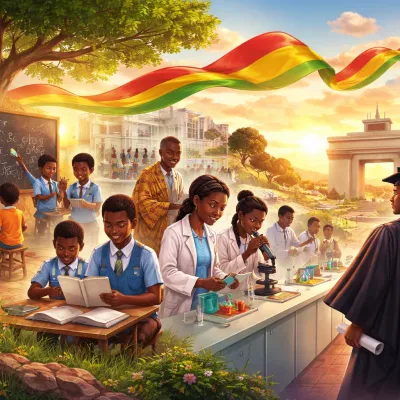
# Education In Ghana: A Comprehensive Overview
This comprehensive book traces the evolution of Ghana's education system from its indigenous roots through colonial foundations to contemporary reforms. Beginning with traditional apprenticeship models where children learned practical skills and cultural values through community participation, the system was transformed by Christian missionary schools and British colonial administration, which introduced Western curricula focused on literacy and Christianity. Post-independence leaders like Kwame Nkrumah championed massive educational expansion through initiatives like the Accelerated Development Plan, establishing universities and expanding access. Subsequent reforms including the 1987 Education Reform and the more recent Free Senior High School policy have continuously reshaped the landscape, aiming for universal access while grappling with quality and resource constraints.
The modern Ghanaian education structure operates through pre-tertiary and tertiary levels, managed by the Ministry of Education and the Ghana Education Service. Pre-tertiary education encompasses Early Childhood Care and Education (kindergartens), nine years of Basic Education (six years primary plus three years Junior High School), and three years of Senior High School leading to the West African Senior School Certificate Examination (WASSCE). Tertiary education includes universities, technical universities, and colleges of education, overseen by the Ghana Tertiary Education Commission (GTEC) for quality assurance. The system emphasizes competency-based learning, integrates Information and Communication Technology, and includes diverse academic and vocational streams.
Major policy challenges persist despite significant progress in expanding access. Issues of inadequate infrastructure, teacher shortages and quality, equity gaps between urban and rural schools, and disparities based on socioeconomic status continue to hinder effective learning outcomes. The Free SHS policy dramatically increased enrollment but created new pressures on infrastructure and resource allocation. Private school proliferation has expanded options but raised equity concerns, while Technical and Vocational Education struggles for recognition and adequate funding. Adult education and lifelong learning programs address continuing education needs, and special needs education seeks to integrate students with disabilities into mainstream schooling. Research and innovation in universities drive national development priorities, particularly in agriculture, health, and technology.
Looking toward the future, Ghana envisions an education system centered on universal quality learning outcomes, a resilient curriculum fostering 21st-century skills, and a highly professionalized teaching force. Strategic technology integration, revitalized TVET programs, diversified financing mechanisms, and robust quality assurance frameworks will define ongoing reforms. The vision prioritizes equity and inclusion, ensuring every child regardless of background or ability has access to quality education while embedding Education for Sustainable Development principles throughout the curriculum. This future system aims to be responsive to national development needs while maintaining global competitiveness through strengthened governance and international collaboration.
What You'll Find Inside:
- Explores the historical evolution of Ghanaian education from indigenous systems to post-independence reforms, highlighting key policy milestones like the 1987 Education Reform and Free SHS initiative.
- Analyzes challenges in implementing inclusive and quality education across all levels, including infrastructure deficits, teacher shortages, and disparities in access and learning outcomes.
- Discusses the critical role of policy frameworks, funding mechanisms, and administrative structures in shaping education delivery, emphasizing the Ministry of Education and Ghana Education Service.
- Addresses cross-cutting issues such as gender disparities, special needs education, and the integration of ICT and sustainable development principles into the curriculum.
- Examines future directions for Ghanaian education, focusing on equity, teacher professionalization, curriculum innovation, and leveraging technology for resilience and global competitiveness.
Who's It For:
This book is essential for policymakers, educators, researchers, and students seeking a comprehensive understanding of Ghana's education system. It benefits education stakeholders aiming to grasp historical foundations, current challenges, and strategic reforms for equitable, quality education across all levels.
Table of Contents:
- Introduction
- Chapter 1: Historical Foundations of Ghanaian Education
- Chapter 2: The Structure and Administration of Education in Ghana
- Chapter 3: Early Childhood Education: Policies and Practices
- Chapter 4: Access and Equity in Early Childhood Education
- Chapter 5: Primary Education: Curriculum and Pedagogy
- Chapter 6: Challenges and Reforms in Primary Education
- Chapter 7: Junior High School Education: Transition and Foundation
- Chapter 8: Vocational and Technical Education at the Junior High Level
- Chapter 9: Senior High School Education: Diverse Streams and Pathways
- Chapter 10: The West African Senior School Certificate Examination (WASSCE)
- Chapter 11: Teacher Education and Professional Development
- Chapter 12: Special Needs Education in Ghana
- Chapter 13: Gender and Education: Addressing Disparities
- Chapter 14: Information and Communication Technology (ICT) in Education
- Chapter 15: Funding and Financing Education in Ghana
- Chapter 16: The Role of Private Schools in the Ghanaian Educational Landscape
- Chapter 17: Tertiary Education: Universities and Polytechnics
- Chapter 18: Quality Assurance in Higher Education
- Chapter 19: Research and Innovation in Ghanaian Universities
- Chapter 20: Distance Learning and Open Education
- Chapter 21: Adult Education and Lifelong Learning
- Chapter 22: Education for Sustainable Development
- Chapter 23: The Impact of Globalization on Ghanaian Education
- Chapter 24: Policy Challenges and Future Directions
- Chapter 25: A Vision for the Future of Education in Ghana
Author:
Published By:
Date Published:
June 26, 2026
Type:
Nonfiction
Language:
English
Word Count:
47,797 words
Reading Time:
3 hours 21 minutes
Sample:
Order:
Order Education In Ghana (Hardcover) on MixCache.com:
Buy NowPrint copy is made to order and ships worldwide. Includes the ebook free, ready to read instantly.
$5 account credit for all new MixCache.com accounts, usable toward any ebook purchase!*