Browse by Category
Fiction
- Action & Adventure
- African American
- Anthologies
- Children's Fiction
- Classics
- Comics & Graphic Novels
- Coming of Age
- Contemporary
- Cultural & Regional
- Drama
- Erotica
- Fantasy
- General
- Historical Fiction
- Horror
- Humor & Satire
- Literary Fiction
- Mystery, Thriller & Suspense
- Poetry
- Religious & Inspirational
- Romance
- Science Fiction
- Short Stories
- War & Military
- Westerns
- Women's Fiction
- Young Adult
Non-Fiction
- Antiques & Collectibles
- Arts & Photography
- Biographies & Memoirs
- Business & Money
- Children's Non-Fiction
-
Computers & Technology
- Artificial Intelligence
- Computer Science
- Cybersecurity & Cryptography
- Data Science & Analytics
- Databases & Big Data
- Game Development & Design
- General
- Hardware & DIY
- Mobile App Development
- Networking & Cloud Computing
- Operating Systems
- Programming
- Robotics
- Software
- Software Engineering
- User Experience (UX) & Design
- Web Development & Design
- Cooking, Food & Wine
- Crafts, Hobbies & Home
- Education & Teaching
- Engineering
- General
- Health, Fitness & Dieting
-
History
- African History
- African History - North Africa
- African History - Sub-Saharan Africa
- American History
- American History - 20th Century
- American History - Civil War
- American History - Colonial Period
- Ancient History
- Asian History
- Asian History - China
- Asian History - India
- Asian History - Japan
- Asian History - Southeast Asia
- European History
- European History - Ancient Greece
- European History - Ancient Rome
- European History - Medieval
- European History - Modern
- European History - Renaissance
- General
- Middle Eastern History
- Military History
- Military History - Aviation
- Military History - Naval
- Social & Cultural History
- World History
- Humor & Entertainment
- Industrial Technology
- Language Learning
- Law
- LGBTQ+ Non-Fiction
- Literary Criticism
- Medical Books
- Parenting & Relationships
- Philosophy
- Politics & Social Sciences
- Reference
- Religion & Spirituality
-
Science & Math
- Agricultural Sciences
- Astronomy & Space Science
- Behavioral Sciences
- Biological Sciences
- Botany & Plant Science
- Chemistry
- Earth Sciences
- Engineering - Chemical
- Engineering - Civil
- Engineering - Electrical
- Engineering - Mechanical
- Environment
- General
- Geology
- Mathematics
- Nature & Ecology
- Oceanography
- Paleontology
- Physics
- Statistics
- Self-Help
- Sports & Outdoors
- Study Aids
- Sustainability & Green Living
- Textbooks
- Transportation
- Travel
- True Crime
- Urban Planning & Development
- Veterinary Medicine
- Writing & Publishing
Jump to Section
MixCache.com Total Access
Unlimited reading and audiobooks for every book published by MixCache.com.
Included titles carry the MTA badge.
Learn more →
Education In Bhutan
MTA
A Comprehensive Overview from Early Childhood to Higher Education
About this book:
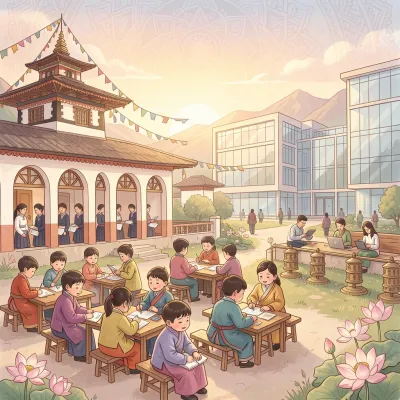
Education in Bhutan is deeply intertwined with the nation’s guiding philosophy of Gross National Happiness, which shapes every level of the system from early childhood to higher education. Originating from a monastic tradition focused on religious study, the modern education framework emerged under royal vision in the mid‑20th century, expanding through successive Five‑Year Plans and evolving into a 7‑2‑2‑2 structure (seven years primary, two each lower secondary, middle secondary, and higher secondary). Governance is centralized through the Ministry of Education and Skills Development, supported by decentralized Dzongkhag and Gewog offices, specialized bodies such as the Royal Education Council and the Bhutan Council for School Examinations and Assessment, and a network of public, private, and central schools that together aim to deliver equitable, quality instruction aligned with GNH principles.
The curriculum across all stages integrates GNH’s four pillars—sustainable socio‑economic development, cultural preservation, environmental conservation, and good governance—through subjects like Dzongkha, English, mathematics, science, and social studies, while pedagogical shifts emphasize active, inquiry‑based, and experiential learning rather than rote memorization. Early Childhood Care and Development lays a play‑based, culturally rooted foundation; primary education builds literacy, numeracy, and values; secondary education deepens academic specialization and prepares students for the Bhutan Certificate of Secondary Education; higher secondary offers science, commerce, and arts streams leading to the Bhutan Higher Secondary Education Certificate, now co‑branded with Cambridge International for global recognition. Parallel pathways include Technical and Vocational Education and Training, which supplies skilled labor for national development, and a growing higher education sector anchored by the Royal University of Bhutan and its constituent colleges, which emphasize research, innovation, and the production of locally rooted, globally competent graduates. Teacher education and continuous professional development are prioritized to ensure educators can effectively implement the GNH‑infused curriculum, while inclusive education policies strive to meet the needs of children with disabilities and promote gender equity.
Persistent challenges—geographical isolation, resource scarcity, digital divides, and the need for relevant, high‑quality instruction in remote areas—are met with innovations such as central schools with boarding facilities, community‑based learning, green school initiatives, and expanding ICT infrastructure. International cooperation, scholarships, and partnerships with agencies like the World Bank, UNICEF, and bilateral donors have historically supported infrastructure, curriculum reform, teacher training, and higher education development. Non‑formal education and lifelong learning programs provide literacy, vocational, and life‑skills opportunities for out‑of‑school youth and adults, reinforcing the vision of education as a continuous, holistic process. Looking ahead, Bhutan’s education policy aims to deepen GNH integration, enhance equity and inclusivity, leverage technology for personalized and blended learning, strengthen teacher capacity, diversify funding through endowments and public‑private partnerships, and continue aligning with international benchmarks while preserving cultural identity, ultimately fostering a generation of citizens who contribute to national happiness and sustainable development.
What You'll Find Inside:
- The book traces Bhutan's education system from its monastic origins to a modern framework guided by Gross National Happiness (GNH), highlighting how historical reforms have shaped today's inclusive and holistic approach.
- GNH philosophy permeates curriculum, assessment, and pedagogy, emphasizing values like compassion, environmental stewardship, cultural preservation, and good governance alongside academic learning.
- The system follows a 7-2-2-2 structure governed by the Ministry of Education and Skills Development, with decentralized Dzongkhag and Gewog offices ensuring local responsiveness and quality assurance.
- Key initiatives include inclusive education for Special Education Needs, gender equity programs, rural access strategies such as Central Schools, and Technical and Vocational Education aligned with labor market needs.
- The text examines ongoing reforms—technology integration, teacher professional development, curriculum alignment with Cambridge standards, and future vision for a globally competent yet locally rooted education system.
Who's It For:
This book is ideal for policymakers, education planners, and government officials seeking insights into Bhutan's unique GNH-driven education model. Educators, teacher trainers, and school administrators will find valuable context on curriculum, pedagogy, and inclusive practices. Researchers and international development practitioners interested in alternative education frameworks, holistic development, or South-South cooperation will also benefit from the detailed case studies and policy analyses.
Table of Contents:
- Introduction
- Chapter 1: Historical Foundations of Bhutanese Education
- Chapter 2: The Philosophy of Gross National Happiness and Education
- Chapter 3: Structure and Governance of the Bhutanese Education System
- Chapter 4: Early Childhood Care and Development (ECCD) in Bhutan
- Chapter 5: Primary Education: Curriculum and Pedagogy
- Chapter 6: Secondary Education: Lower and Middle Secondary
- Chapter 7: Higher Secondary Education: Pathways and Specializations
- Chapter 8: Technical and Vocational Education and Training (TVET)
- Chapter 9: Teacher Education and Professional Development
- Chapter 10: Special Education Needs (SEN) and Inclusive Education
- Chapter 11: Curriculum Development and Educational Reforms
- Chapter 12: Assessment and Examination Systems
- Chapter 13: The Role of Dzongkha in Education
- Chapter 14: English as a Medium of Instruction
- Chapter 15: Higher Education Landscape: Colleges and Universities
- Chapter 16: Research and Innovation in Bhutanese Higher Education
- Chapter 17: Challenges and Opportunities in Rural Education
- Chapter 18: Gender Equity and Access to Education
- Chapter 19: Education for Sustainable Development in Bhutan
- Chapter 20: The Impact of Technology on Education
- Chapter 21: Funding and Financing Education in Bhutan
- Chapter 22: International Cooperation and Partnerships in Education
- Chapter 23: Non-Formal Education and Lifelong Learning
- Chapter 24: The Future of Education in Bhutan: Vision and Policy
- Chapter 25: Case Studies and Success Stories in Bhutanese Education
Author:
Published By:
Date Published:
June 19, 2026
Type:
Nonfiction
Language:
English
Word Count:
73,303 words
Reading Time:
5 hours 8 minutes
Sample:
Order:
Order Education In Bhutan (Paperback) on MixCache.com:
Buy NowPrint copy is made to order and ships worldwide. Includes the ebook free, ready to read instantly.
$5 account credit for all new MixCache.com accounts, usable toward any ebook purchase!*