
Browse by Category
Fiction
- Action & Adventure
- African American
- Anthologies
- Children's Fiction
- Classics
- Comics & Graphic Novels
- Coming of Age
- Contemporary
- Cultural & Regional
- Drama
- Erotica
- Fantasy
- General
- Historical Fiction
- Horror
- Humor & Satire
- Literary Fiction
- Mystery, Thriller & Suspense
- Poetry
- Religious & Inspirational
- Romance
- Science Fiction
- Short Stories
- War & Military
- Westerns
- Women's Fiction
- Young Adult
Non-Fiction
- Antiques & Collectibles
- Arts & Photography
- Biographies & Memoirs
- Business & Money
- Children's Non-Fiction
-
Computers & Technology
- Artificial Intelligence
- Computer Science
- Cybersecurity & Cryptography
- Data Science & Analytics
- Databases & Big Data
- Game Development & Design
- General
- Hardware & DIY
- Mobile App Development
- Networking & Cloud Computing
- Operating Systems
- Programming
- Robotics
- Software
- Software Engineering
- User Experience (UX) & Design
- Web Development & Design
- Cooking, Food & Wine
- Crafts, Hobbies & Home
- Education & Teaching
- Engineering
- General
- Health, Fitness & Dieting
-
History
- African History
- African History - North Africa
- African History - Sub-Saharan Africa
- American History
- American History - 20th Century
- American History - Civil War
- American History - Colonial Period
- Ancient History
- Asian History
- Asian History - China
- Asian History - India
- Asian History - Japan
- Asian History - Southeast Asia
- European History
- European History - Ancient Greece
- European History - Ancient Rome
- European History - Medieval
- European History - Modern
- European History - Renaissance
- General
- Middle Eastern History
- Military History
- Military History - Aviation
- Military History - Naval
- Social & Cultural History
- World History
- Humor & Entertainment
- Industrial Technology
- Language Learning
- Law
- LGBTQ+ Non-Fiction
- Literary Criticism
- Medical Books
- Parenting & Relationships
- Philosophy
- Politics & Social Sciences
- Reference
- Religion & Spirituality
-
Science & Math
- Agricultural Sciences
- Astronomy & Space Science
- Behavioral Sciences
- Biological Sciences
- Botany & Plant Science
- Chemistry
- Earth Sciences
- Engineering - Chemical
- Engineering - Civil
- Engineering - Electrical
- Engineering - Mechanical
- Environment
- General
- Geology
- Mathematics
- Nature & Ecology
- Oceanography
- Paleontology
- Physics
- Statistics
- Self-Help
- Sports & Outdoors
- Study Aids
- Sustainability & Green Living
- Textbooks
- Transportation
- Travel
- True Crime
- Urban Planning & Development
- Veterinary Medicine
- Writing & Publishing
Jump to Section
MixCache.com Total Access
Unlimited reading and audiobooks for every book published by MixCache.com.
Included titles carry the MTA badge.
Learn more →
Additive Edge: 3D Printing Strategies for Volume Manufacturing
MTA
How additive manufacturing reshapes production, tooling, and supply chains for modern factories.
About this book:
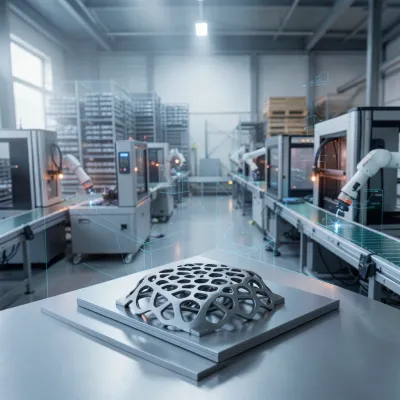
Additive manufacturing has evolved from a prototyping novelty to a viable production method, offering a strategic "additive edge" that compresses lead times, enables geometric complexity, and transforms tooling and supply‑chain economics. The book surveys the full technology landscape—polymers (vat photopolymerization, material extrusion, powder‑bed fusion, binder jetting), metals (laser and electron‑beam powder bed fusion, directed energy deposition, binder jetting), and composites—and explains how to match part requirements to the appropriate AM modality. Core to successful implementation is Design for Additive Manufacturing (DfAM), which leverages topology optimization, lattice structures, part consolidation, conformal cooling, and support‑aware strategies to reduce weight, material use, and assembly steps while unlocking performance gains unattainable with traditional processes.
Production‑grade outcomes depend on mastering tolerances, surface finish, and geometric accuracy, necessitating thoughtful build orientation, process control, and often hybrid workflows that combine near‑net AM with precision CNC machining. Post‑processing at scale—support removal, cleaning, heat treatment, HIP, and surface finishing—is critical for achieving functional parts, and automation of these steps is a key enabler of throughput. Quality assurance integrates in‑process monitoring, non‑destructive evaluation (X‑ray CT, ultrasonic testing), statistical process control, and rigorous traceability, while qualification and certification follow material, machine, and process qualification pathways aligned with aerospace, medical, automotive, and industry standards. Cost modeling compares total landed cost, break‑even volume, machine utilization, and hybrid approaches to determine when additive manufacturing outperforms molding, machining, or casting.
Beyond the part, additive manufacturing reshapes supply chains through digital inventory, on‑demand spares, distributed manufacturing, and resilient networks, supporting mass customization, localized production, and rapid response to disruptions. Sustainability is examined via lifecycle assessment, highlighting material‑efficiency, lightweighting, and circular‑economy opportunities while accounting for energy‑intensive builds and post‑processing. The book details emerging business models (make‑buy decisions, partnerships, manufacturing‑as‑a‑service, product‑as‑a‑service), workforce development, safety protocols, and real‑world case studies across automotive, aerospace, medical, and consumer sectors. Finally, it provides a phased roadmap—strategic assessment, technology and workforce selection, pilot production, workflow integration, quality assurance, and progressive scaling—to help factories implement and scale additive manufacturing for measurable business results.
What You'll Find Inside:
- Learn how to select the optimal additive manufacturing process for production parts by evaluating material requirements, geometric complexity, accuracy needs, and economic factors across polymer, metal, and composite technologies.
- Master Design for Additive Manufacturing (DfAM) strategies including part consolidation, lattice structures, topology optimization, and design for post-processing to unlock lightweighting, complexity-for-free, and assembly simplification.
- Discover how to build a scalable additive manufacturing workflow integrating digital thread (CAD/PLM/data standards), hybrid print-machine approaches, and automated post-processing for consistent quality at volume production scales.
- Understand practical cost modeling techniques including break-even analysis, total cost of ownership, and ROI calculations to determine when additive manufacturing delivers economic advantages over traditional methods.
- Explore how additive manufacturing transforms supply chains through digital inventory, on-demand spares, distributed production, and mass customization while addressing sustainability, qualification standards, and workforce development.
Who's It For:
This book is designed for manufacturing engineers, production managers, supply chain professionals, and industrial leaders who are implementing or scaling additive manufacturing in volume production environments. It provides actionable guidance for those needing to make strategic decisions about when to print, how to qualify processes, and how to build an additive-enabled factory that delivers measurable business results across automotive, aerospace, medical, and consumer goods industries.
Table of Contents:
- Introduction
- Chapter 1 From Prototype to Production: The Additive Edge
- Chapter 2 The Technology Landscape: Polymers, Metals, and Composites
- Chapter 3 Process Selection: Matching Parts to AM Modalities
- Chapter 4 Design for Additive Manufacturing: Principles and Patterns
- Chapter 5 Lattices, Topology Optimization, and Lightweighting
- Chapter 6 Tolerances, Surface Finish, and Geometric Accuracy
- Chapter 7 Materials for Production: Engineering Polymers
- Chapter 8 Materials for Production: Metals and Alloys
- Chapter 9 Building the Digital Thread: CAD, PLM, and Data Standards
- Chapter 10 Hybrid Workflows: Print, Machine, and Assemble
- Chapter 11 Post-Processing at Scale: Cleaning, Heat Treat, and Finishing
- Chapter 12 Quality Assurance: Inspection, NDE, and Statistical Control
- Chapter 13 Qualification and Certification: Standards and Compliance
- Chapter 14 Cost Modeling: When to Print and When Not To
- Chapter 15 Throughput, Capacity, and Factory Simulation
- Chapter 16 Tooling Reinvented: Jigs, Fixtures, End-of-Arm, and Molds
- Chapter 17 Bridge Manufacturing and Pilot Production
- Chapter 18 Mass Customization and Product Personalization
- Chapter 19 Digital Inventory and On‑Demand Spares
- Chapter 20 Supply Chains Reimagined: Distributed and Resilient Networks
- Chapter 21 Sustainability and Lifecycle Assessment for AM
- Chapter 22 Business Models and ROI: Make–Buy and Partnerships
- Chapter 23 Workforce, Safety, and Skills for the AM Factory
- Chapter 24 Case Studies Across Industries: Automotive, Aerospace, Medical, Consumer
- Chapter 25 Your Roadmap: Implementing and Scaling Additive in the Plant
Author:
Published By:
Date Published:
May 29, 2026
Type:
Nonfiction
Language:
English
Word Count:
68,337 words
Reading Time:
4 hours 47 minutes
Sample:
MixCache.com Total Access
Get unlimited access to this book + all books published by MixCache.com for $11.99/month
Subscribe to MTAOr purchase this book individually below
Order:
Buy the Additive Edge: 3D Printing Strategies for Volume Manufacturing ebook on MixCache.com:
Buy Now
Full ebook will be available immediately
- read online or download as a PDF file.
$5 account credit for all new MixCache.com accounts, usable toward any ebook purchase!*






Ratings & Reviews
Ask Questions About This Book
Have a question about the content? Ask our AI assistant!
Start by asking a question about "Additive Edge: 3D Printing Strategies for Volume Manufacturing"
Example: "Does this book mention William Shakespeare?"
Thinking...