
Browse by Category
Fiction
- Action & Adventure
- African American
- Anthologies
- Children's Fiction
- Classics
- Comics & Graphic Novels
- Coming of Age
- Contemporary
- Cultural & Regional
- Drama
- Erotica
- Fantasy
- General
- Historical Fiction
- Horror
- Humor & Satire
- Literary Fiction
- Mystery, Thriller & Suspense
- Poetry
- Religious & Inspirational
- Romance
- Science Fiction
- Short Stories
- War & Military
- Westerns
- Women's Fiction
- Young Adult
Non-Fiction
- Antiques & Collectibles
- Arts & Photography
- Biographies & Memoirs
- Business & Money
- Children's Non-Fiction
-
Computers & Technology
- Artificial Intelligence
- Computer Science
- Cybersecurity & Cryptography
- Data Science & Analytics
- Databases & Big Data
- Game Development & Design
- General
- Hardware & DIY
- Mobile App Development
- Networking & Cloud Computing
- Operating Systems
- Programming
- Robotics
- Software
- Software Engineering
- User Experience (UX) & Design
- Web Development & Design
- Cooking, Food & Wine
- Crafts, Hobbies & Home
- Education & Teaching
- Engineering
- General
- Health, Fitness & Dieting
-
History
- African History
- African History - North Africa
- African History - Sub-Saharan Africa
- American History
- American History - 20th Century
- American History - Civil War
- American History - Colonial Period
- Ancient History
- Asian History
- Asian History - China
- Asian History - India
- Asian History - Japan
- Asian History - Southeast Asia
- European History
- European History - Ancient Greece
- European History - Ancient Rome
- European History - Medieval
- European History - Modern
- European History - Renaissance
- General
- Middle Eastern History
- Military History
- Military History - Aviation
- Military History - Naval
- Social & Cultural History
- World History
- Humor & Entertainment
- Industrial Technology
- Language Learning
- Law
- LGBTQ+ Non-Fiction
- Literary Criticism
- Medical Books
- Parenting & Relationships
- Philosophy
- Politics & Social Sciences
- Reference
- Religion & Spirituality
-
Science & Math
- Agricultural Sciences
- Astronomy & Space Science
- Behavioral Sciences
- Biological Sciences
- Botany & Plant Science
- Chemistry
- Earth Sciences
- Engineering - Chemical
- Engineering - Civil
- Engineering - Electrical
- Engineering - Mechanical
- Environment
- General
- Geology
- Mathematics
- Nature & Ecology
- Oceanography
- Paleontology
- Physics
- Statistics
- Self-Help
- Sports & Outdoors
- Study Aids
- Sustainability & Green Living
- Textbooks
- Transportation
- Travel
- True Crime
- Urban Planning & Development
- Veterinary Medicine
- Writing & Publishing
Jump to Section
MixCache.com Total Access
Unlimited reading and audiobooks for every book published by MixCache.com.
Included titles carry the MTA badge.
Learn more →A History of Buddhism
About this book:
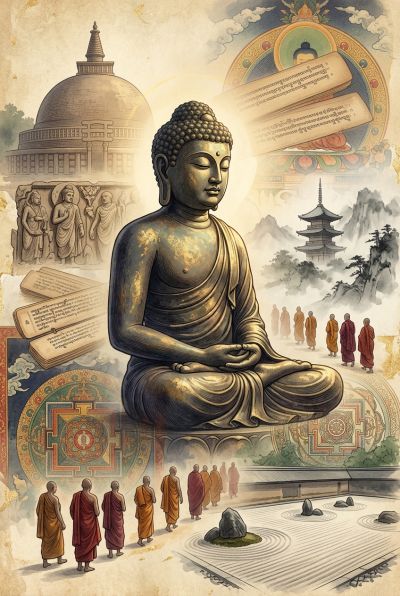
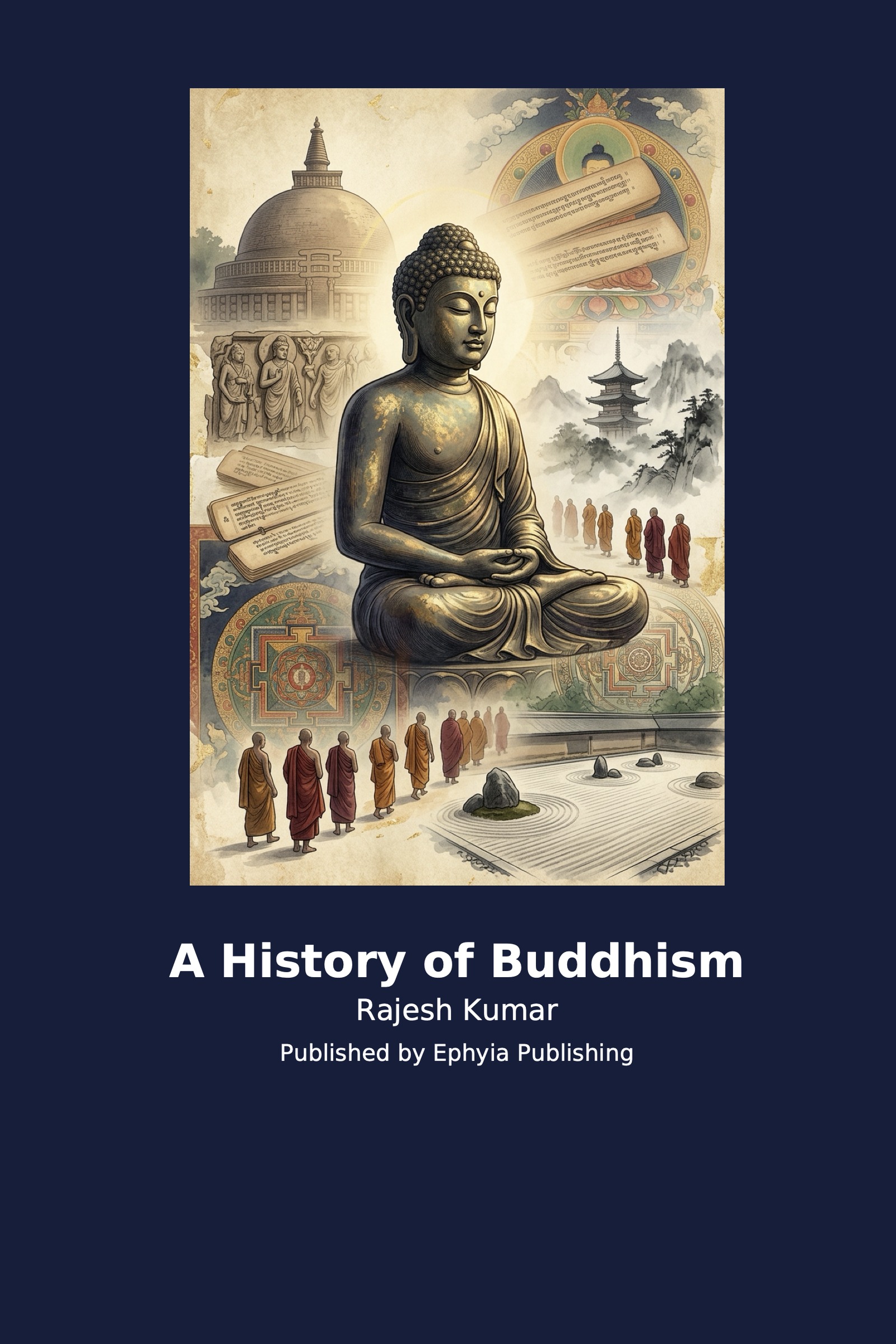
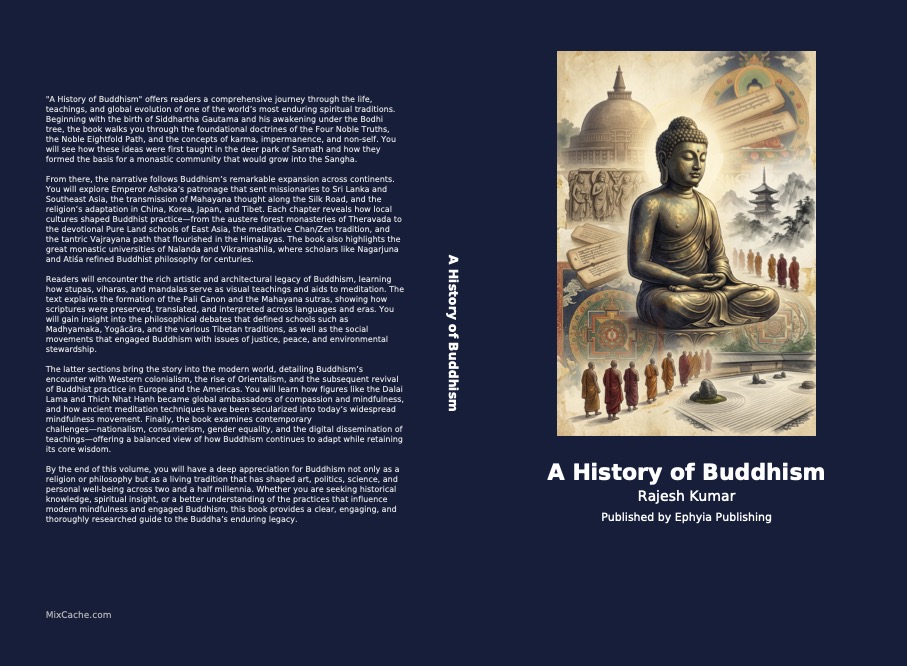
"A History of Buddhism" offers readers a comprehensive journey through the life, teachings, and global evolution of one of the world’s most enduring spiritual traditions. Beginning with the birth of Siddhartha Gautama and his awakening under the Bodhi tree, the book walks you through the foundational doctrines of the Four Noble Truths, the Noble Eightfold Path, and the concepts of karma, impermanence, and non‑self. You will see how these ideas were first taught in the deer park of Sarnath and how they formed the basis for a monastic community that would grow into the Sangha.
From there, the narrative follows Buddhism’s remarkable expansion across continents. You will explore Emperor Ashoka’s patronage that sent missionaries to Sri Lanka and Southeast Asia, the transmission of Mahayana thought along the Silk Road, and the religion’s adaptation in China, Korea, Japan, and Tibet. Each chapter reveals how local cultures shaped Buddhist practice—from the austere forest monasteries of Theravada to the devotional Pure Land schools of East Asia, the meditative Chan/Zen tradition, and the tantric Vajrayana path that flourished in the Himalayas. The book also highlights the great monastic universities of Nalanda and Vikramashila, where scholars like Nagarjuna and Atiśa refined Buddhist philosophy for centuries.
Readers will encounter the rich artistic and architectural legacy of Buddhism, learning how stupas, viharas, and mandalas serve as visual teachings and aids to meditation. The text explains the formation of the Pali Canon and the Mahayana sutras, showing how scriptures were preserved, translated, and interpreted across languages and eras. You will gain insight into the philosophical debates that defined schools such as Madhyamaka, Yogācāra, and the various Tibetan traditions, as well as the social movements that engaged Buddhism with issues of justice, peace, and environmental stewardship.
The latter sections bring the story into the modern world, detailing Buddhism’s encounter with Western colonialism, the rise of Orientalism, and the subsequent revival of Buddhist practice in Europe and the Americas. You will learn how figures like the Dalai Lama and Thich Nhat Hanh became global ambassadors of compassion and mindfulness, and how ancient meditation techniques have been secularized into today’s widespread mindfulness movement. Finally, the book examines contemporary challenges—nationalism, consumerism, gender equality, and the digital dissemination of teachings—offering a balanced view of how Buddhism continues to adapt while retaining its core wisdom.
By the end of this volume, you will have a deep appreciation for Buddhism not only as a religion or philosophy but as a living tradition that has shaped art, politics, science, and personal well‑being across two and a half millennia. Whether you are seeking historical knowledge, spiritual insight, or a better understanding of the practices that influence modern mindfulness and engaged Buddhism, this book provides a clear, engaging, and thoroughly researched guide to the Buddha’s enduring legacy.
What You'll Find Inside:
- The life of Siddhartha Gautama and the core teachings of the Four Noble Truths and Eightfold Path that form the foundation of all Buddhist traditions
- Emperor Ashoka's crucial role in spreading Buddhism beyond India through imperial patronage, missionary efforts, and the Third Buddhist Council
- The development and distinctions between Theravada, Mahayana, and Vajrayana Buddhism as they evolved across different regions and cultures
- Buddhism's transmission along the Silk Road and its adaptation in China, Korea, Japan, Tibet, and Southeast Asia through cultural exchange and syncretism
- Modern developments including socially engaged Buddhism, the mindfulness movement, and contemporary global figures like the Dalai Lama and Thich Nhat Hanh
Who's It For:
This book is ideal for students of religious studies, Asian history, or philosophy seeking a comprehensive overview of Buddhism's 2,500-year journey. It will also benefit Buddhist practitioners wishing to understand the historical context of their tradition, as well as general readers interested in world religions, cultural diffusion, or the intersection of spirituality and society across different civilizations.
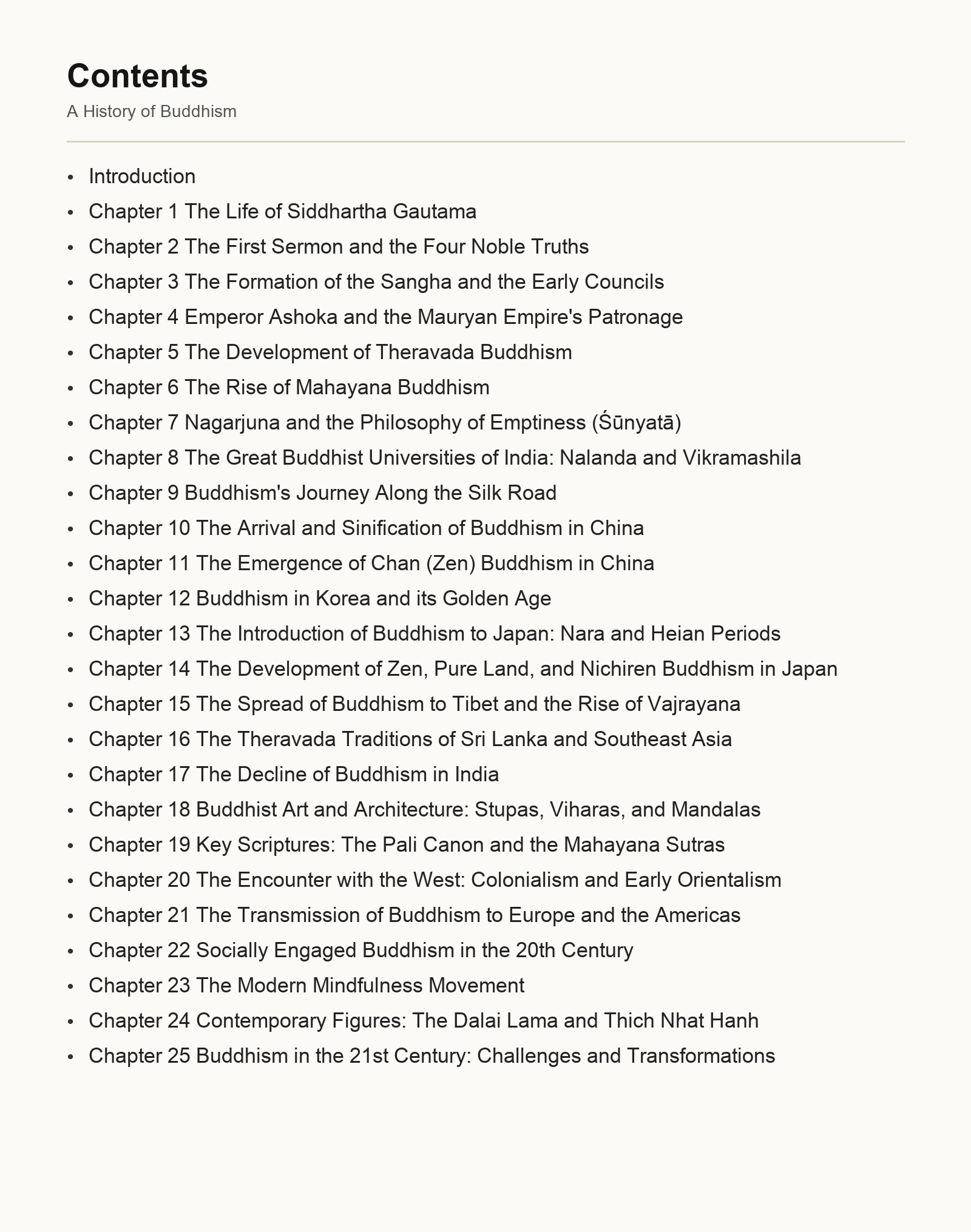
Table of Contents:
- Introduction
- Chapter 1 The Life of Siddhartha Gautama
- Chapter 2 The First Sermon and the Four Noble Truths
- Chapter 3 The Formation of the Sangha and the Early Councils
- Chapter 4 Emperor Ashoka and the Mauryan Empire's Patronage
- Chapter 5 The Development of Theravada Buddhism
- Chapter 6 The Rise of Mahayana Buddhism
- Chapter 7 Nagarjuna and the Philosophy of Emptiness (Śūnyatā)
- Chapter 8 The Great Buddhist Universities of India: Nalanda and Vikramashila
- Chapter 9 Buddhism's Journey Along the Silk Road
- Chapter 10 The Arrival and Sinification of Buddhism in China
- Chapter 11 The Emergence of Chan (Zen) Buddhism in China
- Chapter 12 Buddhism in Korea and its Golden Age
- Chapter 13 The Introduction of Buddhism to Japan: Nara and Heian Periods
- Chapter 14 The Development of Zen, Pure Land, and Nichiren Buddhism in Japan
- Chapter 15 The Spread of Buddhism to Tibet and the Rise of Vajrayana
- Chapter 16 The Theravada Traditions of Sri Lanka and Southeast Asia
- Chapter 17 The Decline of Buddhism in India
- Chapter 18 Buddhist Art and Architecture: Stupas, Viharas, and Mandalas
- Chapter 19 Key Scriptures: The Pali Canon and the Mahayana Sutras
- Chapter 20 The Encounter with the West: Colonialism and Early Orientalism
- Chapter 21 The Transmission of Buddhism to Europe and the Americas
- Chapter 22 Socially Engaged Buddhism in the 20th Century
- Chapter 23 The Modern Mindfulness Movement
- Chapter 24 Contemporary Figures: The Dalai Lama and Thich Nhat Hanh
- Chapter 25 Buddhism in the 21st Century: Challenges and Transformations
Author:
Published By:
Date Published:
May 29, 2026
Type:
Nonfiction
Language:
English
Also Available In:
Word Count:
60,619 words
Reading Time:
4 hours 15 minutes
Sample:
Order:
Buy the A History of Buddhism ebook on MixCache.com:
Buy NowThe full ebook will be available immediately to read instantly on any device.
$5 account credit for all new MixCache.com accounts, usable toward any ebook purchase!*


Ratings & Reviews
Ask Questions About This Book
Have a question about the content? Ask our AI assistant!
Start by asking a question about "A History of Buddhism"
Example: "Does this book mention William Shakespeare?"
Thinking...