Browse by Category
Fiction
- Action & Adventure
- African American
- Anthologies
- Children's Fiction
- Classics
- Comics & Graphic Novels
- Coming of Age
- Contemporary
- Cultural & Regional
- Drama
- Erotica
- Fantasy
- General
- Historical Fiction
- Horror
- Humor & Satire
- Literary Fiction
- Mystery, Thriller & Suspense
- Poetry
- Religious & Inspirational
- Romance
- Science Fiction
- Short Stories
- War & Military
- Westerns
- Women's Fiction
- Young Adult
Non-Fiction
- Antiques & Collectibles
- Arts & Photography
- Biographies & Memoirs
- Business & Money
- Children's Non-Fiction
-
Computers & Technology
- Artificial Intelligence
- Computer Science
- Cybersecurity & Cryptography
- Data Science & Analytics
- Databases & Big Data
- Game Development & Design
- General
- Hardware & DIY
- Mobile App Development
- Networking & Cloud Computing
- Operating Systems
- Programming
- Robotics
- Software
- Software Engineering
- User Experience (UX) & Design
- Web Development & Design
- Cooking, Food & Wine
- Crafts, Hobbies & Home
- Education & Teaching
- Engineering
- General
- Health, Fitness & Dieting
-
History
- African History
- African History - North Africa
- African History - Sub-Saharan Africa
- American History
- American History - 20th Century
- American History - Civil War
- American History - Colonial Period
- Ancient History
- Asian History
- Asian History - China
- Asian History - India
- Asian History - Japan
- Asian History - Southeast Asia
- European History
- European History - Ancient Greece
- European History - Ancient Rome
- European History - Medieval
- European History - Modern
- European History - Renaissance
- General
- Middle Eastern History
- Military History
- Military History - Aviation
- Military History - Naval
- Social & Cultural History
- World History
- Humor & Entertainment
- Industrial Technology
- Language Learning
- Law
- LGBTQ+ Non-Fiction
- Literary Criticism
- Medical Books
- Parenting & Relationships
- Philosophy
- Politics & Social Sciences
- Reference
- Religion & Spirituality
-
Science & Math
- Agricultural Sciences
- Astronomy & Space Science
- Behavioral Sciences
- Biological Sciences
- Botany & Plant Science
- Chemistry
- Earth Sciences
- Engineering - Chemical
- Engineering - Civil
- Engineering - Electrical
- Engineering - Mechanical
- Environment
- General
- Geology
- Mathematics
- Nature & Ecology
- Oceanography
- Paleontology
- Physics
- Statistics
- Self-Help
- Sports & Outdoors
- Study Aids
- Sustainability & Green Living
- Textbooks
- Transportation
- Travel
- True Crime
- Urban Planning & Development
- Veterinary Medicine
- Writing & Publishing
Jump to Section
MixCache.com Total Access
Unlimited reading and audiobooks for every book published by MixCache.com.
Included titles carry the MTA badge.
Learn more →
Law and Order
A Concise History
About this book:



"Law and Order: A Concise History" invites readers on a sweeping journey through the development of legal thought and practice from the earliest human societies to the challenges of the digital age. Across twenty‑five chapters, the book traces how concepts of justice, authority, and social order have emerged, transformed, and intersected with religion, politics, economics, and technology. Readers will gain a clear understanding of the origins of customary and tribal norms, the rise of codified law in Mesopotamia and Egypt, and the distinctive contributions of Hebrew covenant law, Greek democracy, and Roman jurisprudence.
The narrative continues with the profound influences of Byzantine codification, Islamic Sharia, and medieval European feudal and canon law, showing how diverse traditions shaped the foundations of modern legal systems. Readers will explore the birth of common law in England, the unifying Yassa of the Mongol Empire, and the rich legal tapestries of pre‑Columbian Americas, appreciating how geography, culture, and power dynamics have dictated the evolution of rules and institutions. Each chapter highlights pivotal moments—such as the Twelve Tables, the Napoleonic Code, the Magna Carta, and the Corpus Juris Civilis—while explaining their lasting impact on contemporary law.
Moving into the modern era, the book examines the Enlightenment’s natural‑rights philosophy, the revolutionary legal orders of America and France, and the 19th‑century rise of nation‑states, labor law, and international norms. Readers will see how industrialization sparked labor and commercial regulations, how world wars forged institutions like the United Nations and the Nuremberg trials, and how the Cold War juxtaposed competing legal ideologies. The text also illuminates the post‑colonial struggle to forge new legal identities, the expansion of human rights treaties, and the ongoing efforts to balance sovereignty with global justice.
Finally, "Law and Order: A Concise History" confronts the digital age, explaining how the internet, artificial intelligence, blockchain, and data privacy are reshaping legal frameworks worldwide. Readers will learn about emerging challenges—cybercrime, jurisdiction, intellectual property, and AI accountability—and the opportunities these technologies present for improving access to justice and fostering international cooperation. By the end, readers will possess a comprehensive, contextualized grasp of law as a living, evolving human endeavor that continues to define societies across time and space.
What You'll Find Inside:
- Traces the evolution of legal systems from prehistoric customs to modern digital-age law, highlighting continuity and change across millennia.
- Examines foundational contributions of Mesopotamian codified law, Roman law and Justinian's Corpus Juris Civilis, and the development of English common law.
- Explores how Enlightenment ideals, the American and French Revolutions, and the Napoleonic Code reshaped concepts of rights, sovereignty, and legal equality.
- Analyzes the impact of colonialism, decolonization, and Cold War ideological conflicts on the spread and transformation of legal traditions worldwide.
- Addresses contemporary challenges in the digital age, including cybercrime, data privacy, AI regulation, and the need for international legal cooperation.
Who's It For:
This book is ideal for undergraduate and graduate students of law, history, or political science seeking a concise yet comprehensive overview of global legal development. It also serves general readers, educators, and professionals interested in understanding how historical legal traditions influence contemporary law and policy. Policymakers and legal practitioners will find valuable context for current legal debates and reforms.
Table of Contents:
-
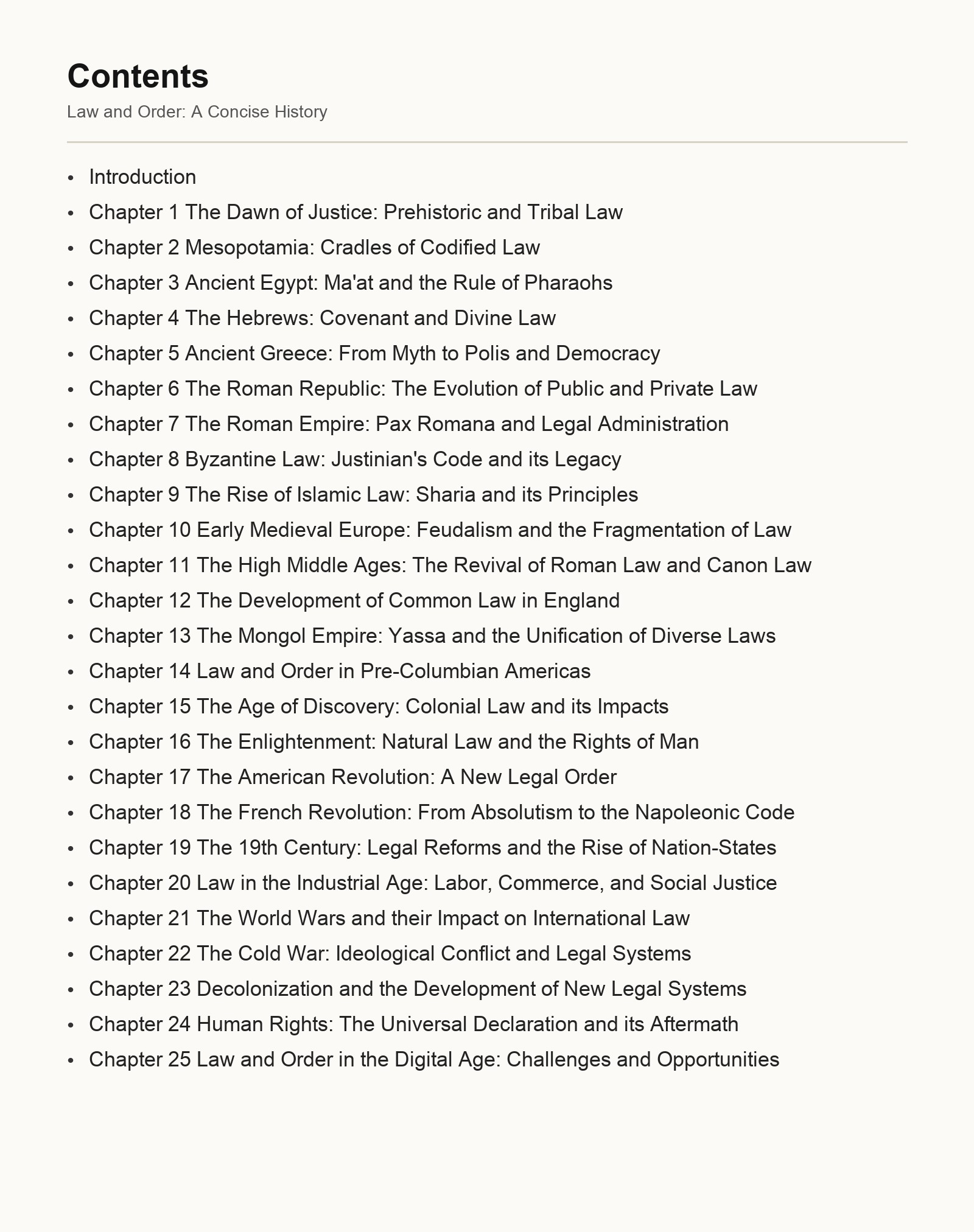
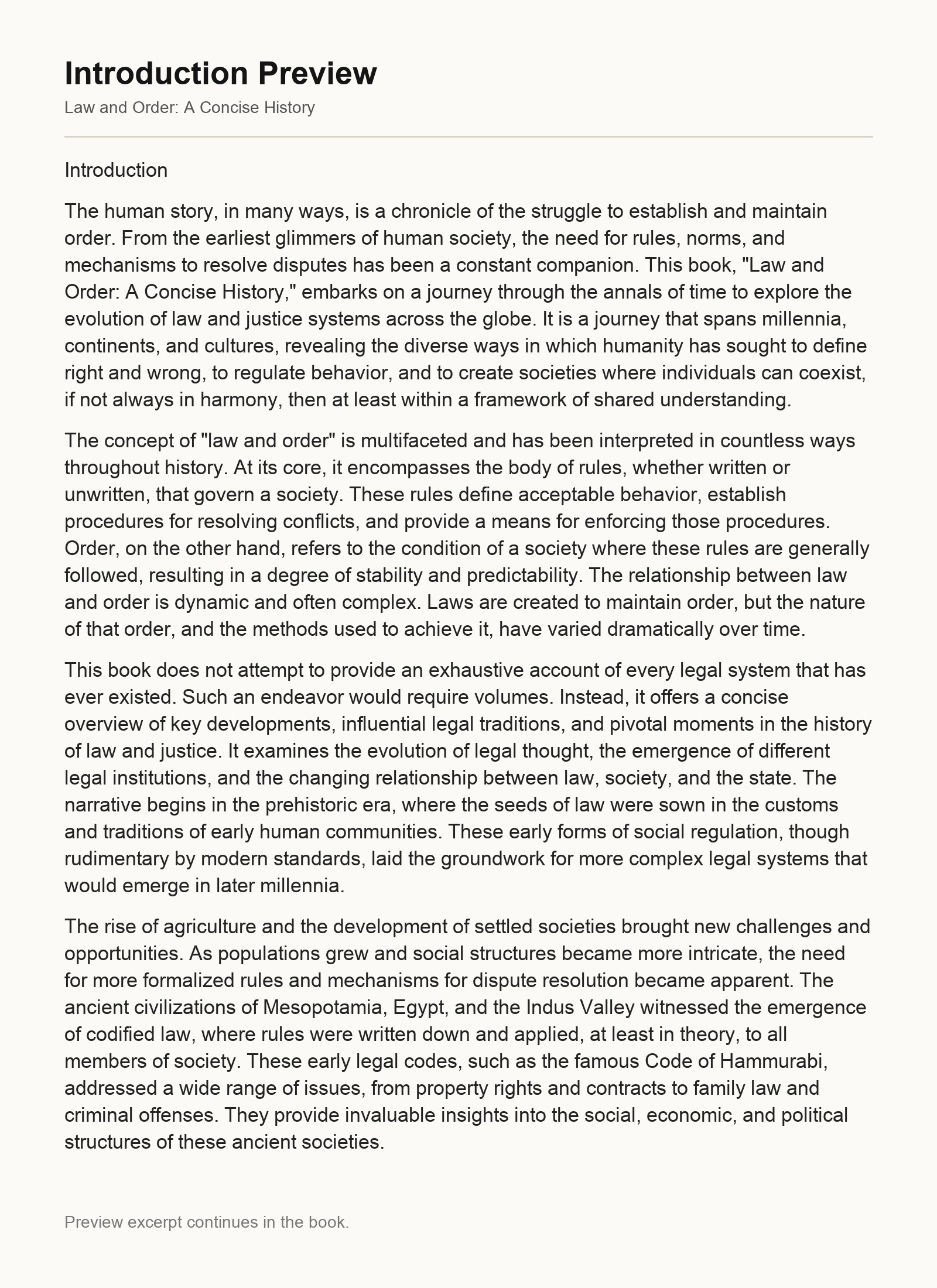
Introduction
-
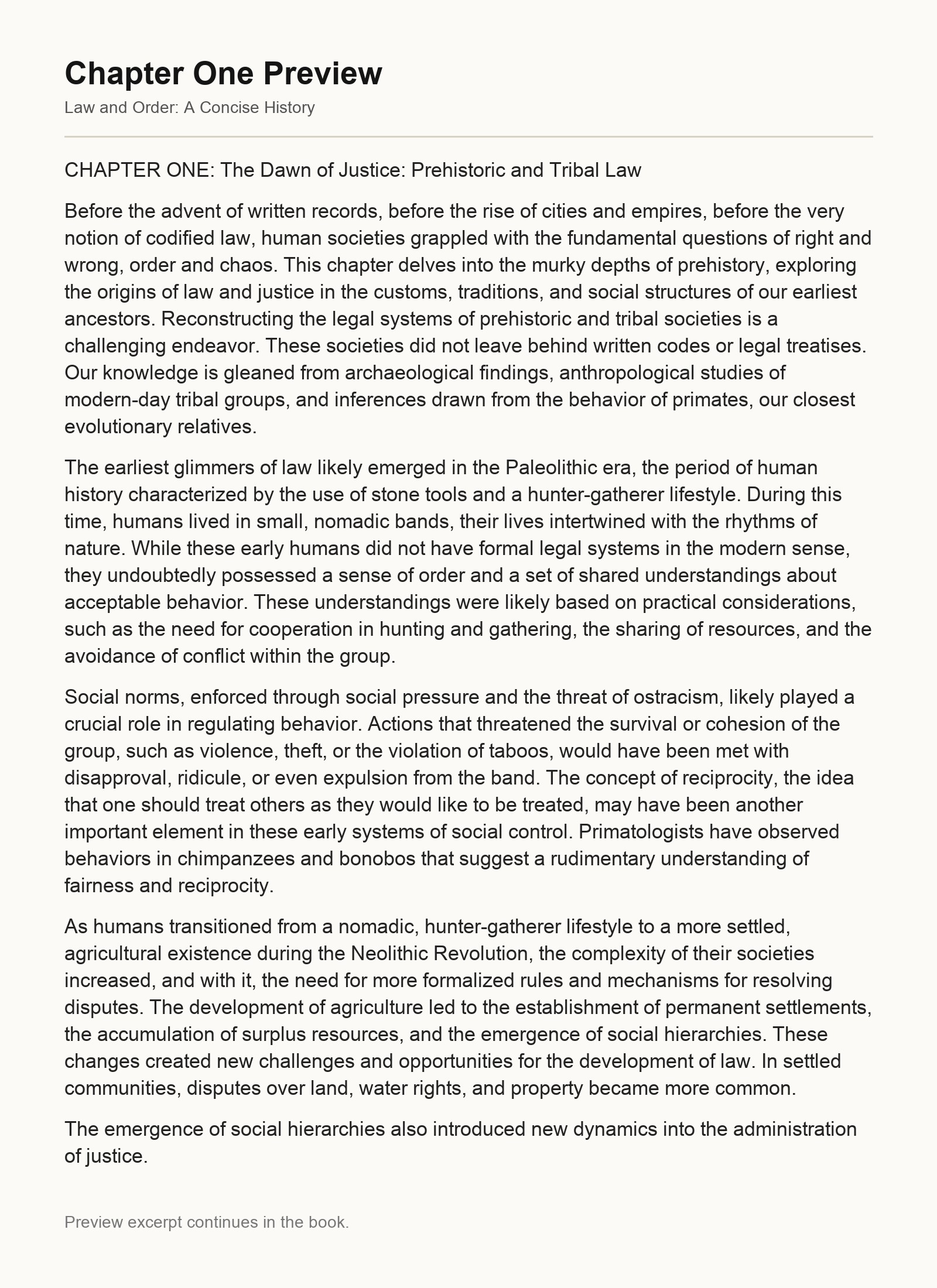
Chapter 1 The Dawn of Justice: Prehistoric and Tribal Law
-
Chapter 2 Mesopotamia: Cradles of Codified Law
-
Chapter 3 Ancient Egypt: Ma'at and the Rule of Pharaohs
-
Chapter 4 The Hebrews: Covenant and Divine Law
-
Chapter 5 Ancient Greece: From Myth to Polis and Democracy
-
Chapter 6 The Roman Republic: The Evolution of Public and Private Law
-
Chapter 7 The Roman Empire: Pax Romana and Legal Administration
-
Chapter 8 Byzantine Law: Justinian's Code and its Legacy
-
Chapter 9 The Rise of Islamic Law: Sharia and its Principles
-
Chapter 10 Early Medieval Europe: Feudalism and the Fragmentation of Law
-
Chapter 11 The High Middle Ages: The Revival of Roman Law and Canon Law
-
Chapter 12 The Development of Common Law in England
-
Chapter 13 The Mongol Empire: Yassa and the Unification of Diverse Laws
-
Chapter 14 Law and Order in Pre-Columbian Americas
-
Chapter 15 The Age of Discovery: Colonial Law and its Impacts
-
Chapter 16 The Enlightenment: Natural Law and the Rights of Man
-
Chapter 17 The American Revolution: A New Legal Order
-
Chapter 18 The French Revolution: From Absolutism to the Napoleonic Code
-
Chapter 19 The 19th Century: Legal Reforms and the Rise of Nation-States
-
Chapter 20 Law in the Industrial Age: Labor, Commerce, and Social Justice
-
Chapter 21 The World Wars and their Impact on International Law
-
Chapter 22 The Cold War: Ideological Conflict and Legal Systems
-
Chapter 23 Decolonization and the Development of New Legal Systems
-
Chapter 24 Human Rights: The Universal Declaration and its Aftermath
-
Chapter 25 Law and Order in the Digital Age: Challenges and Opportunities
Author:
Published By:
Date Published:
May 28, 2026
Type:
Nonfiction
Language:
English
Also Available In:
Word Count:
52,296 words
Reading Time:
3 hours 40 minutes
Sample:
Order:
Order Law and Order (Paperback) on MixCache.com:
Buy NowPrint copy is made to order and ships worldwide. Includes the ebook free, ready to read instantly.
$5 account credit for all new MixCache.com accounts, usable toward any ebook purchase!*