
Browse by Category
Fiction
- Action & Adventure
- African American
- Anthologies
- Children's Fiction
- Classics
- Comics & Graphic Novels
- Coming of Age
- Contemporary
- Cultural & Regional
- Drama
- Erotica
- Fantasy
- General
- Historical Fiction
- Horror
- Humor & Satire
- Literary Fiction
- Mystery, Thriller & Suspense
- Poetry
- Religious & Inspirational
- Romance
- Science Fiction
- Short Stories
- War & Military
- Westerns
- Women's Fiction
- Young Adult
Non-Fiction
- Antiques & Collectibles
- Arts & Photography
- Biographies & Memoirs
- Business & Money
- Children's Non-Fiction
-
Computers & Technology
- Artificial Intelligence
- Computer Science
- Cybersecurity & Cryptography
- Data Science & Analytics
- Databases & Big Data
- Game Development & Design
- General
- Hardware & DIY
- Mobile App Development
- Networking & Cloud Computing
- Operating Systems
- Programming
- Robotics
- Software
- Software Engineering
- User Experience (UX) & Design
- Web Development & Design
- Cooking, Food & Wine
- Crafts, Hobbies & Home
- Education & Teaching
- Engineering
- General
- Health, Fitness & Dieting
-
History
- African History
- African History - North Africa
- African History - Sub-Saharan Africa
- American History
- American History - 20th Century
- American History - Civil War
- American History - Colonial Period
- Ancient History
- Asian History
- Asian History - China
- Asian History - India
- Asian History - Japan
- Asian History - Southeast Asia
- European History
- European History - Ancient Greece
- European History - Ancient Rome
- European History - Medieval
- European History - Modern
- European History - Renaissance
- General
- Middle Eastern History
- Military History
- Military History - Aviation
- Military History - Naval
- Social & Cultural History
- World History
- Humor & Entertainment
- Industrial Technology
- Language Learning
- Law
- LGBTQ+ Non-Fiction
- Literary Criticism
- Medical Books
- Parenting & Relationships
- Philosophy
- Politics & Social Sciences
- Reference
- Religion & Spirituality
-
Science & Math
- Agricultural Sciences
- Astronomy & Space Science
- Behavioral Sciences
- Biological Sciences
- Botany & Plant Science
- Chemistry
- Earth Sciences
- Engineering - Chemical
- Engineering - Civil
- Engineering - Electrical
- Engineering - Mechanical
- Environment
- General
- Geology
- Mathematics
- Nature & Ecology
- Oceanography
- Paleontology
- Physics
- Statistics
- Self-Help
- Sports & Outdoors
- Study Aids
- Sustainability & Green Living
- Textbooks
- Transportation
- Travel
- True Crime
- Urban Planning & Development
- Veterinary Medicine
- Writing & Publishing
Jump to Section

Want unlimited access to all books published by MixCache.com (plus their audiobooks)? Try MixCache.com Total Access. Look for the MTA badge on book covers to identify included titles.
Access to infinite ebooks: Don't see the book you want? Suggest it and we'll create it (free!) for you from scratch with our powerful AI book writer. Then read it with MTA - besides profiting from any sales it makes!
A History of Sri Lanka
About this book:
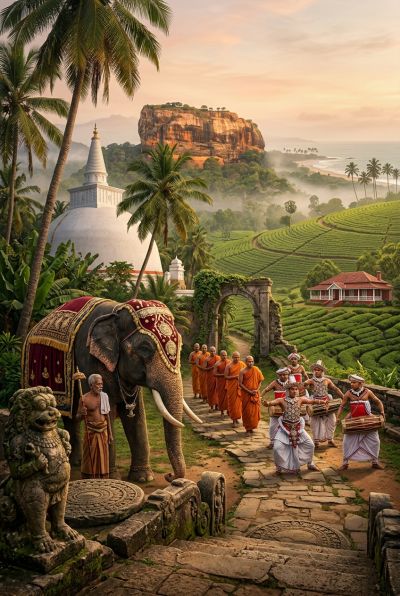
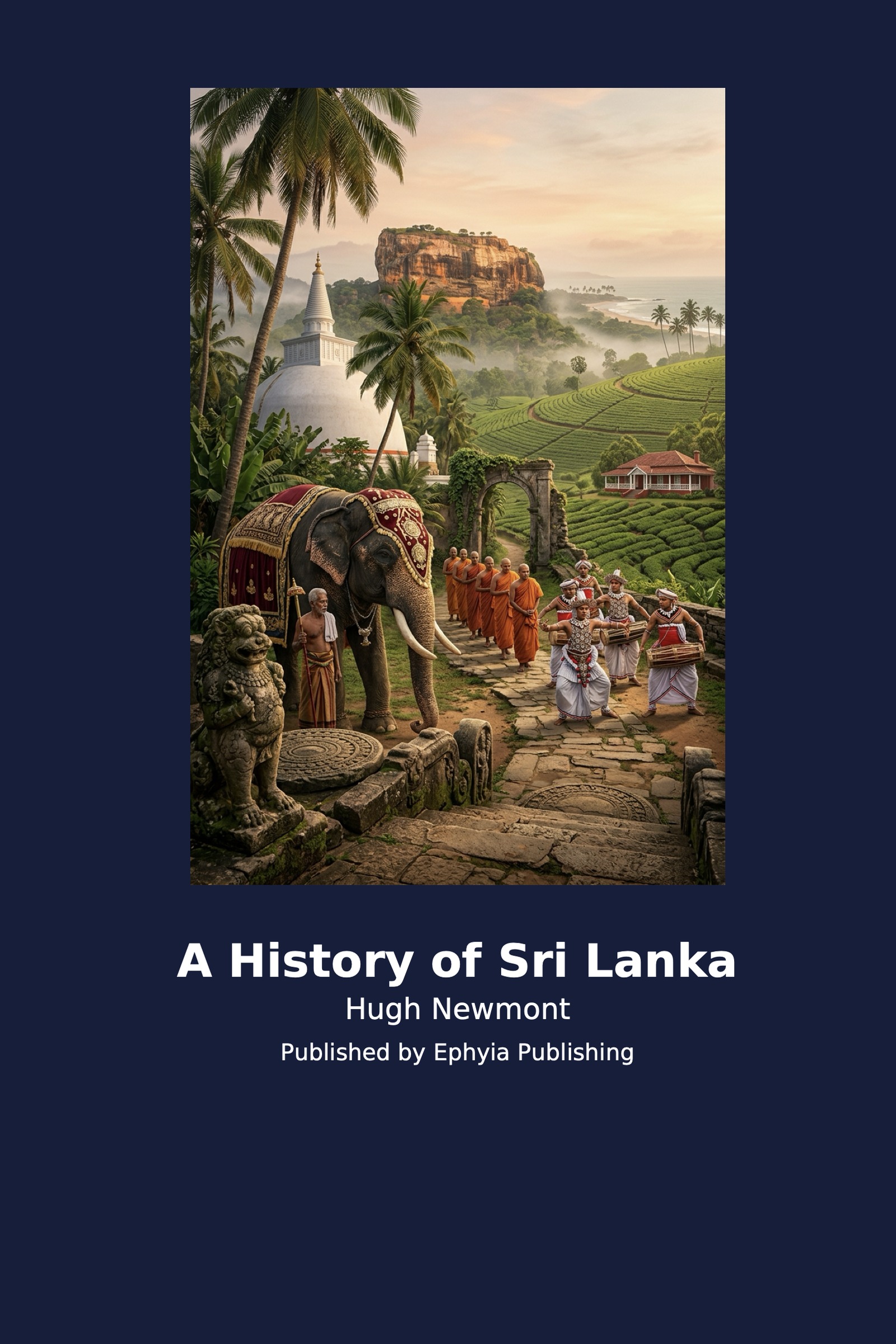
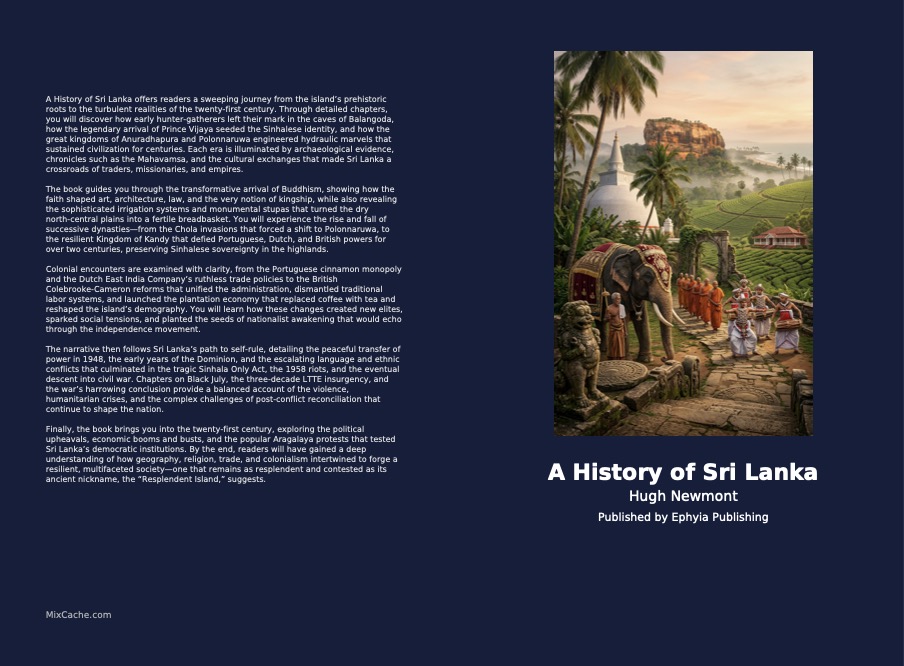
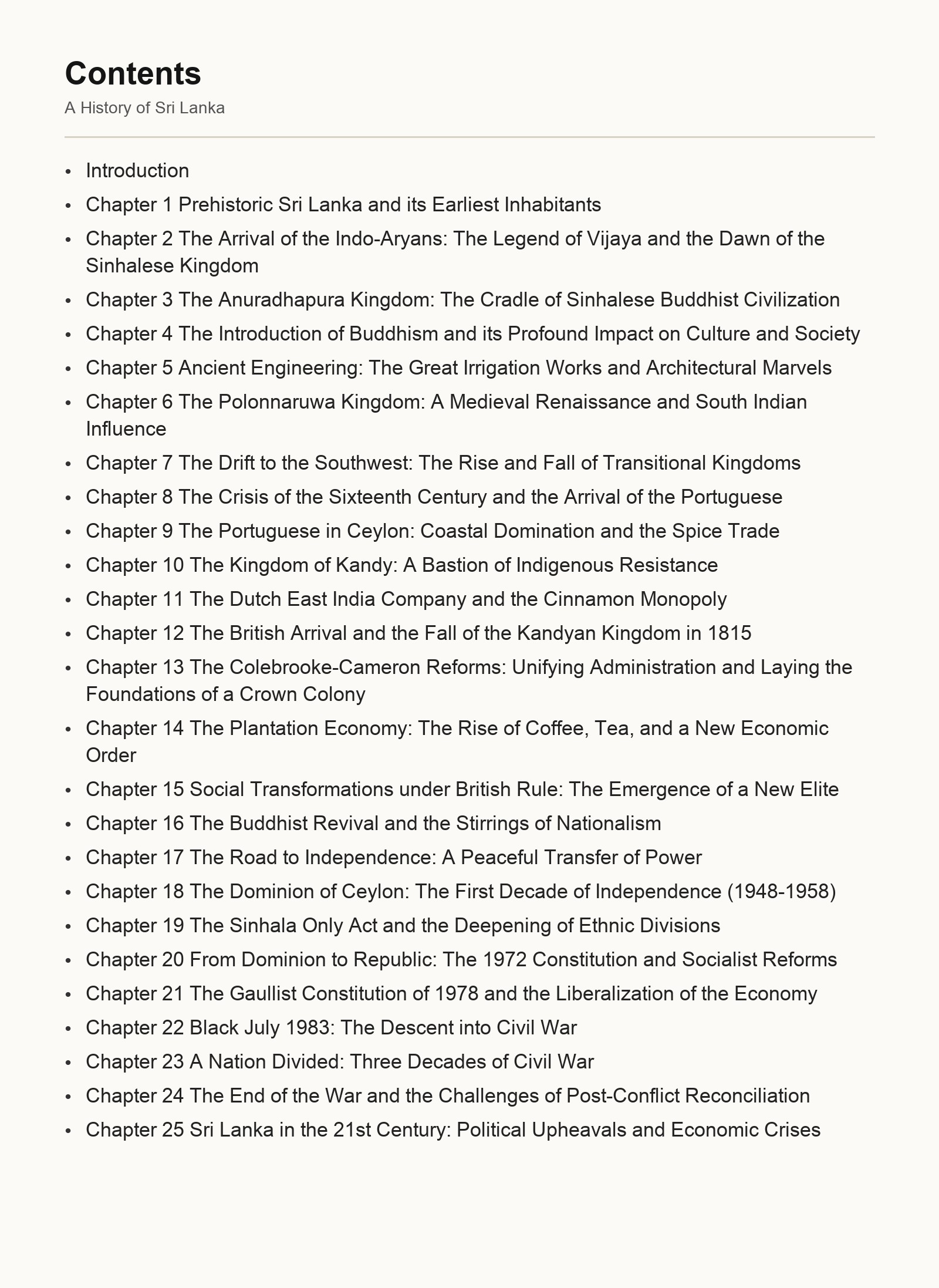
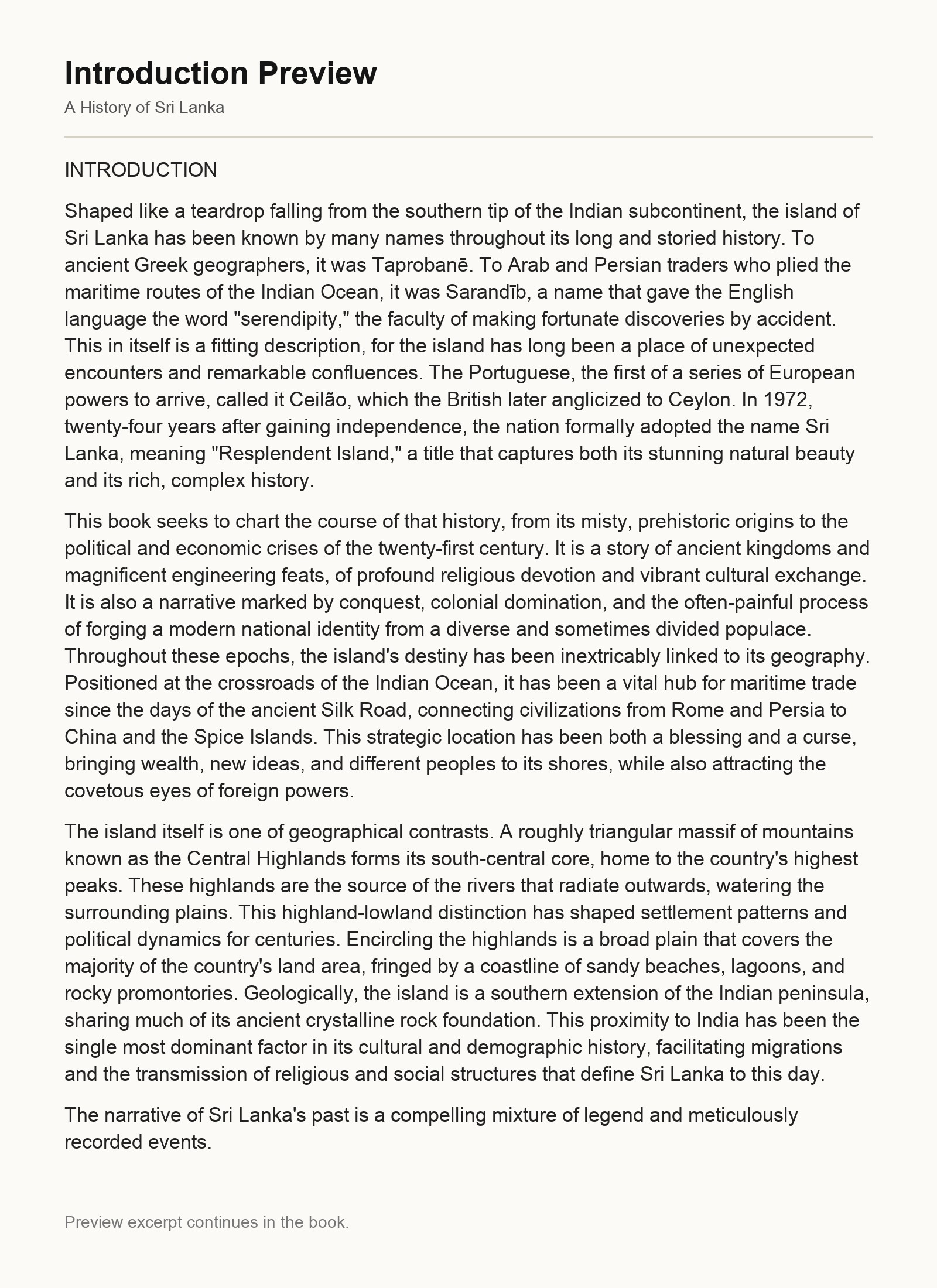
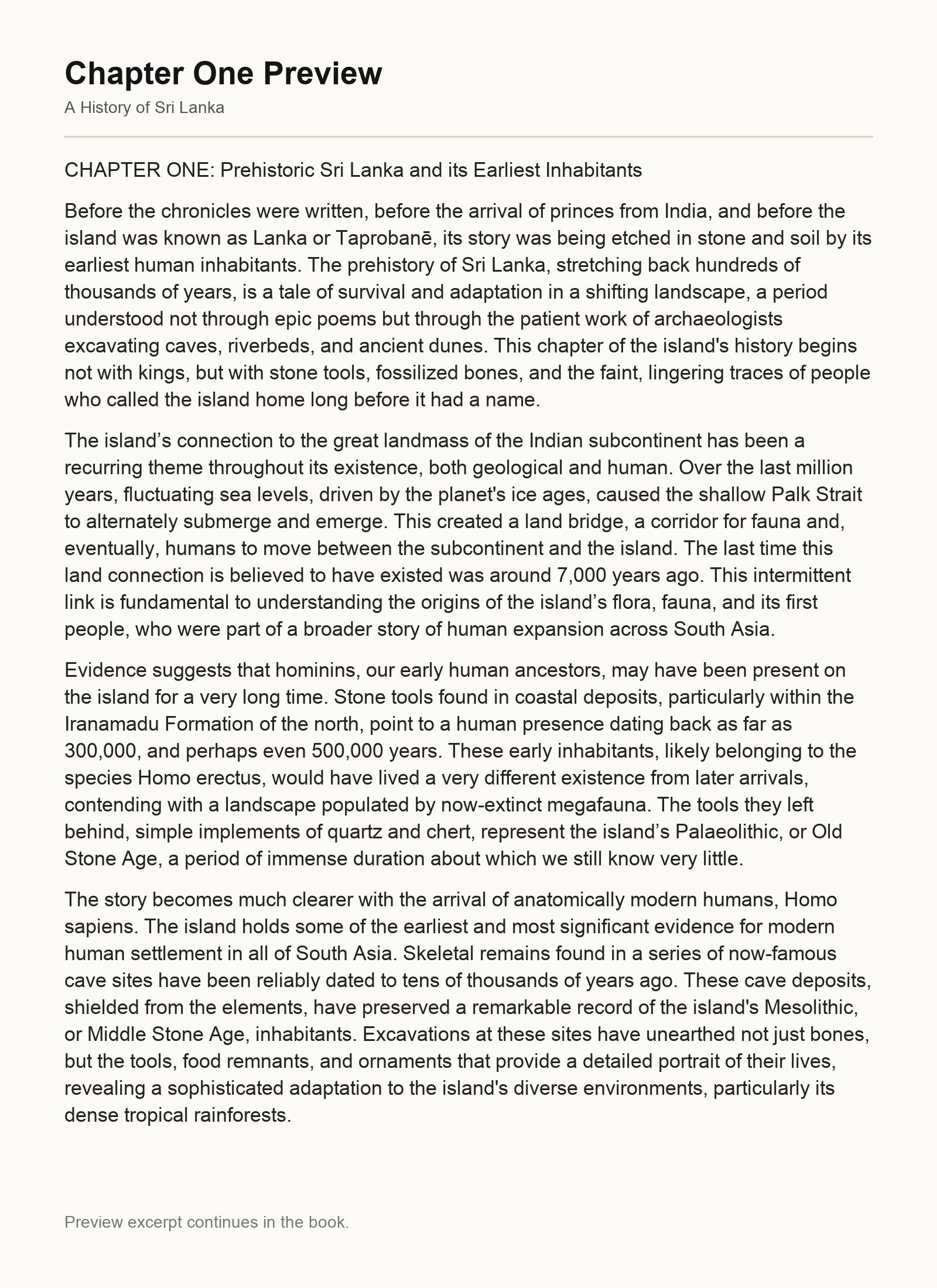
A History of Sri Lanka offers readers a sweeping journey from the island’s prehistoric roots to the turbulent realities of the twenty‑first century. Through detailed chapters, you will discover how early hunter‑gatherers left their mark in the caves of Balangoda, how the legendary arrival of Prince Vijaya seeded the Sinhalese identity, and how the great kingdoms of Anuradhapura and Polonnaruwa engineered hydraulic marvels that sustained civilization for centuries. Each era is illuminated by archaeological evidence, chronicles such as the Mahavamsa, and the cultural exchanges that made Sri Lanka a crossroads of traders, missionaries, and empires.
The book guides you through the transformative arrival of Buddhism, showing how the faith shaped art, architecture, law, and the very notion of kingship, while also revealing the sophisticated irrigation systems and monumental stupas that turned the dry north‑central plains into a fertile breadbasket. You will experience the rise and fall of successive dynasties—from the Chola invasions that forced a shift to Polonnaruwa, to the resilient Kingdom of Kandy that defied Portuguese, Dutch, and British powers for over two centuries, preserving Sinhalese sovereignty in the highlands.
Colonial encounters are examined with clarity, from the Portuguese cinnamon monopoly and the Dutch East India Company’s ruthless trade policies to the British Colebrooke‑Cameron reforms that unified the administration, dismantled traditional labor systems, and launched the plantation economy that replaced coffee with tea and reshaped the island’s demography. You will learn how these changes created new elites, sparked social tensions, and planted the seeds of nationalist awakening that would echo through the independence movement.
The narrative then follows Sri Lanka’s path to self‑rule, detailing the peaceful transfer of power in 1948, the early years of the Dominion, and the escalating language and ethnic conflicts that culminated in the tragic Sinhala Only Act, the 1958 riots, and the eventual descent into civil war. Chapters on Black July, the three‑decade LTTE insurgency, and the war’s harrowing conclusion provide a balanced account of the violence, humanitarian crises, and the complex challenges of post‑conflict reconciliation that continue to shape the nation.
Finally, the book brings you into the twenty‑first century, exploring the political upheavals, economic booms and busts, and the popular Aragalaya protests that tested Sri Lanka’s democratic institutions. By the end, readers will have gained a deep understanding of how geography, religion, trade, and colonialism intertwined to forge a resilient, multifaceted society—one that remains as resplendent and contested as its ancient nickname, the “Resplendent Island,” suggests.
What You'll Find Inside:
- Traces Sri Lanka's complete historical journey from prehistoric Balangoda Man settlements through ancient kingdoms to modern 21st-century political and economic challenges
- Explores the transformative introduction of Buddhism in the 3rd century BCE and its enduring influence on Sri Lankan identity, culture, and governance
- Details the remarkable ancient engineering feats, including sophisticated irrigation systems and architectural marvels like Sigiriya and the Jetavanaramaya stupa
- Chronicles the colonial era (Portuguese, Dutch, British) and the peaceful path to independence in 1948, followed by the complex journey of nation-building
- Examines the origins and escalation of ethnic tensions, the devastating civil war (1983-2009), and ongoing challenges of reconciliation and economic recovery
Who's It For:
This comprehensive history is ideal for students and scholars of South Asian studies, post-colonial history, and Buddhist studies seeking to understand Sri Lanka's complex trajectory. It will particularly benefit readers interested in the intersection of religion and politics, the legacy of colonialism, and the roots of ethnic conflict. General readers with an interest in world history or those seeking to comprehend contemporary Sri Lanka's political and economic struggles will also find valuable insights.
Author:
Published By:
Date Published:
May 27, 2026
Type:
Nonfiction
Language:
English
Also Available In:
Word Count:
47,931 words
Reading Time:
3 hours 21 minutes
Sample:
Order:
Order A History of Sri Lanka (Paperback) on MixCache.com:
Buy NowPrint copy is made to order and ships worldwide. Includes the ebook free, ready to read instantly.
$5 account credit for all new MixCache.com accounts, usable toward any ebook purchase!*


