
Browse by Category
Fiction
- Action & Adventure
- African American
- Anthologies
- Children's Fiction
- Classics
- Comics & Graphic Novels
- Coming of Age
- Contemporary
- Cultural & Regional
- Drama
- Erotica
- Fantasy
- General
- Historical Fiction
- Horror
- Humor & Satire
- Literary Fiction
- Mystery, Thriller & Suspense
- Poetry
- Religious & Inspirational
- Romance
- Science Fiction
- Short Stories
- War & Military
- Westerns
- Women's Fiction
- Young Adult
Non-Fiction
- Antiques & Collectibles
- Arts & Photography
- Biographies & Memoirs
- Business & Money
- Children's Non-Fiction
-
Computers & Technology
- Artificial Intelligence
- Computer Science
- Cybersecurity & Cryptography
- Data Science & Analytics
- Databases & Big Data
- Game Development & Design
- General
- Hardware & DIY
- Mobile App Development
- Networking & Cloud Computing
- Operating Systems
- Programming
- Robotics
- Software
- Software Engineering
- User Experience (UX) & Design
- Web Development & Design
- Cooking, Food & Wine
- Crafts, Hobbies & Home
- Education & Teaching
- Engineering
- General
- Health, Fitness & Dieting
-
History
- African History
- African History - North Africa
- African History - Sub-Saharan Africa
- American History
- American History - 20th Century
- American History - Civil War
- American History - Colonial Period
- Ancient History
- Asian History
- Asian History - China
- Asian History - India
- Asian History - Japan
- Asian History - Southeast Asia
- European History
- European History - Ancient Greece
- European History - Ancient Rome
- European History - Medieval
- European History - Modern
- European History - Renaissance
- General
- Middle Eastern History
- Military History
- Military History - Aviation
- Military History - Naval
- Social & Cultural History
- World History
- Humor & Entertainment
- Industrial Technology
- Language Learning
- Law
- LGBTQ+ Non-Fiction
- Literary Criticism
- Medical Books
- Parenting & Relationships
- Philosophy
- Politics & Social Sciences
- Reference
- Religion & Spirituality
-
Science & Math
- Agricultural Sciences
- Astronomy & Space Science
- Behavioral Sciences
- Biological Sciences
- Botany & Plant Science
- Chemistry
- Earth Sciences
- Engineering - Chemical
- Engineering - Civil
- Engineering - Electrical
- Engineering - Mechanical
- Environment
- General
- Geology
- Mathematics
- Nature & Ecology
- Oceanography
- Paleontology
- Physics
- Statistics
- Self-Help
- Sports & Outdoors
- Study Aids
- Sustainability & Green Living
- Textbooks
- Transportation
- Travel
- True Crime
- Urban Planning & Development
- Veterinary Medicine
- Writing & Publishing
Jump to Section
MixCache.com Total Access
Unlimited reading and audiobooks for every book published by MixCache.com.
Included titles carry the MTA badge.
Learn more →L'AI Act dell'UE spiegato
Informazioni sul libro:


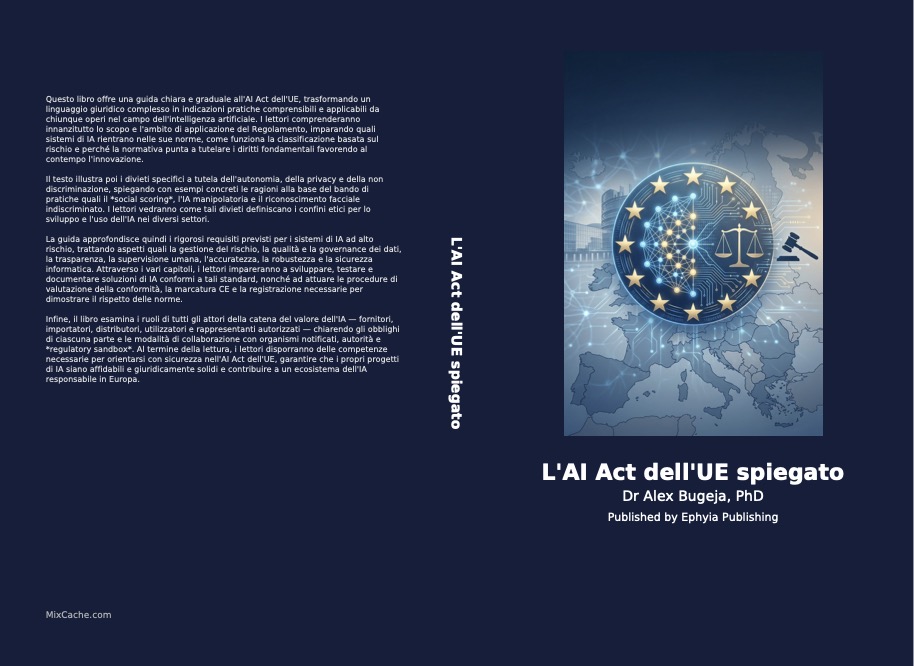
Questo libro offre una guida chiara e graduale all'AI Act dell'UE, trasformando un linguaggio giuridico complesso in indicazioni pratiche comprensibili e applicabili da chiunque operi nel campo dell'intelligenza artificiale. I lettori comprenderanno innanzitutto lo scopo e l'ambito di applicazione del Regolamento, imparando quali sistemi di IA rientrano nelle sue norme, come funziona la classificazione basata sul rischio e perché la normativa punta a tutelare i diritti fondamentali favorendo al contempo l'innovazione.
Il testo illustra poi i divieti specifici a tutela dell'autonomia, della privacy e della non discriminazione, spiegando con esempi concreti le ragioni alla base del bando di pratiche quali il *social scoring*, l'IA manipolatoria e il riconoscimento facciale indiscriminato. I lettori vedranno come tali divieti definiscano i confini etici per lo sviluppo e l'uso dell'IA nei diversi settori.
La guida approfondisce quindi i rigorosi requisiti previsti per i sistemi di IA ad alto rischio, trattando aspetti quali la gestione del rischio, la qualità e la governance dei dati, la trasparenza, la supervisione umana, l'accuratezza, la robustezza e la sicurezza informatica. Attraverso i vari capitoli, i lettori impareranno a sviluppare, testare e documentare soluzioni di IA conformi a tali standard, nonché ad attuare le procedure di valutazione della conformità, la marcatura CE e la registrazione necessarie per dimostrare il rispetto delle norme.
Infine, il libro esamina i ruoli di tutti gli attori della catena del valore dell'IA — fornitori, importatori, distributori, utilizzatori e rappresentanti autorizzati — chiarendo gli obblighi di ciascuna parte e le modalità di collaborazione con organismi notificati, autorità e *regulatory sandbox*. Al termine della lettura, i lettori disporranno delle competenze necessarie per orientarsi con sicurezza nell'AI Act dell'UE, garantire che i propri progetti di IA siano affidabili e giuridicamente solidi e contribuire a un ecosistema dell'IA responsabile in Europa.
Cosa troverai all'interno:
- The EU AI Act adopts a risk‑based approach, classifying AI systems by their intended use and potential harm, with strict rules for high‑risk applications.
- Certain AI practices are outright banned because they threaten fundamental rights, including subliminal manipulation, social scoring, and real‑time remote biometric identification.
- Providers of high‑risk AI must implement robust risk‑management, data governance, transparency, human oversight, accuracy, robustness, and cybersecurity measures throughout the system’s lifecycle.
- Conformity assessment—either self‑assessment or third‑party evaluation by a notified body—is required before placing high‑risk AI on the market, accompanied by CE marking and registration in the EU database.
- The Act also addresses general‑purpose AI models, systemic risks, regulatory sandboxes, and real‑world testing to foster innovation while safeguarding rights and safety.
A chi è rivolto:
This book is essential for AI system providers, developers, and integrators who need to understand and comply with the EU AI Act’s obligations for high‑risk and general‑purpose AI. It also serves compliance officers, legal advisors, and product managers responsible for conformity assessments, documentation, and market placement. Policymakers, regulators, and anyone involved in deploying AI in sectors such as healthcare, transportation, law enforcement, or critical infrastructure will find practical guidance on risk management, transparency, and oversight. Finally, students and researchers seeking a clear, structured overview of the EU’s approach to trustworthy AI will benefit from the comprehensive explanations and real‑world examples.
Indice:
-
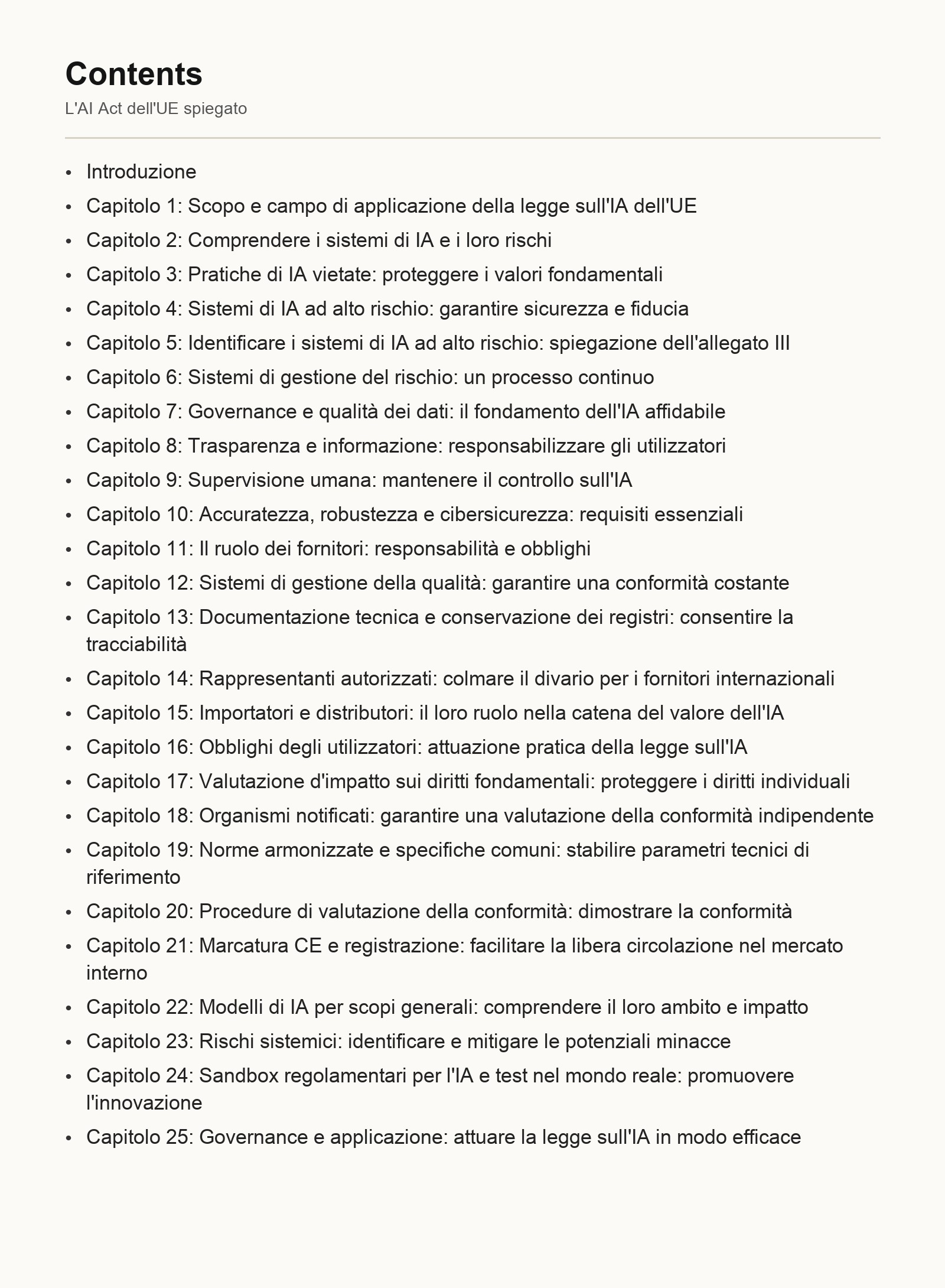
Introduzione
-
Capitolo 1: Scopo e campo di applicazione della legge sull'IA dell'UE
-
Capitolo 2: Comprendere i sistemi di IA e i loro rischi
-
Capitolo 3: Pratiche di IA vietate: proteggere i valori fondamentali
-
Capitolo 4: Sistemi di IA ad alto rischio: garantire sicurezza e fiducia
-
Capitolo 5: Identificare i sistemi di IA ad alto rischio: spiegazione dell'allegato III
-
Capitolo 6: Sistemi di gestione del rischio: un processo continuo
-
Capitolo 7: Governance e qualità dei dati: il fondamento dell'IA affidabile
-
Capitolo 8: Trasparenza e informazione: responsabilizzare gli utilizzatori
-
Capitolo 9: Supervisione umana: mantenere il controllo sull'IA
-
Capitolo 10: Accuratezza, robustezza e cibersicurezza: requisiti essenziali
-
Capitolo 11: Il ruolo dei fornitori: responsabilità e obblighi
-
Capitolo 12: Sistemi di gestione della qualità: garantire una conformità costante
-
Capitolo 13: Documentazione tecnica e conservazione dei registri: consentire la tracciabilità
-
Capitolo 14: Rappresentanti autorizzati: colmare il divario per i fornitori internazionali
-
Capitolo 15: Importatori e distributori: il loro ruolo nella catena del valore dell'IA
-
Capitolo 16: Obblighi degli utilizzatori: attuazione pratica della legge sull'IA
-
Capitolo 17: Valutazione d'impatto sui diritti fondamentali: proteggere i diritti individuali
-
Capitolo 18: Organismi notificati: garantire una valutazione della conformità indipendente
-
Capitolo 19: Norme armonizzate e specifiche comuni: stabilire parametri tecnici di riferimento
-
Capitolo 20: Procedure di valutazione della conformità: dimostrare la conformità
-
Capitolo 21: Marcatura CE e registrazione: facilitare la libera circolazione nel mercato interno
-
Capitolo 22: Modelli di IA per scopi generali: comprendere il loro ambito e impatto
-
Capitolo 23: Rischi sistemici: identificare e mitigare le potenziali minacce
-
Capitolo 24: Sandbox regolamentari per l'IA e test nel mondo reale: promuovere l'innovazione
-
Capitolo 25: Governance e applicazione: attuare la legge sull'IA in modo efficace
Autore:
Pubblicato da:
Data di pubblicazione:
27 maggio 2026
Tipo:
Saggistica
Lingua:
Italiano
Disponibile anche in:
Tedesco, Inglese, Spagnolo, Francese
Numero di parole:
56.961 parole
Tempo di lettura:
3 ore 59 minuti
Anteprima:
Ordina:
Ordina L'AI Act dell'UE spiegato (Copertina flessibile) su MixCache.com:
Acquista oraLa copia cartacea è stampata su ordinazione e spedita in tutto il mondo. Include l'ebook gratis, pronto da leggere subito.
$5 di credito per tutti i nuovi account MixCache.com, utilizzabili per qualsiasi acquisto di ebook!*
 IT
IT
 IT
IT
 IT
IT
 IT
IT
 IT
IT
 IT
IT