
Browse by Category
Fiction
- Action & Adventure
- African American
- Anthologies
- Children's Fiction
- Classics
- Comics & Graphic Novels
- Coming of Age
- Contemporary
- Cultural & Regional
- Drama
- Erotica
- Fantasy
- General
- Historical Fiction
- Horror
- Humor & Satire
- Literary Fiction
- Mystery, Thriller & Suspense
- Poetry
- Religious & Inspirational
- Romance
- Science Fiction
- Short Stories
- War & Military
- Westerns
- Women's Fiction
- Young Adult
Non-Fiction
- Antiques & Collectibles
- Arts & Photography
- Biographies & Memoirs
- Business & Money
- Children's Non-Fiction
-
Computers & Technology
- Artificial Intelligence
- Computer Science
- Cybersecurity & Cryptography
- Data Science & Analytics
- Databases & Big Data
- Game Development & Design
- General
- Hardware & DIY
- Mobile App Development
- Networking & Cloud Computing
- Operating Systems
- Programming
- Robotics
- Software
- Software Engineering
- User Experience (UX) & Design
- Web Development & Design
- Cooking, Food & Wine
- Crafts, Hobbies & Home
- Education & Teaching
- Engineering
- General
- Health, Fitness & Dieting
-
History
- African History
- African History - North Africa
- African History - Sub-Saharan Africa
- American History
- American History - 20th Century
- American History - Civil War
- American History - Colonial Period
- Ancient History
- Asian History
- Asian History - China
- Asian History - India
- Asian History - Japan
- Asian History - Southeast Asia
- European History
- European History - Ancient Greece
- European History - Ancient Rome
- European History - Medieval
- European History - Modern
- European History - Renaissance
- General
- Middle Eastern History
- Military History
- Military History - Aviation
- Military History - Naval
- Social & Cultural History
- World History
- Humor & Entertainment
- Industrial Technology
- Language Learning
- Law
- LGBTQ+ Non-Fiction
- Literary Criticism
- Medical Books
- Parenting & Relationships
- Philosophy
- Politics & Social Sciences
- Reference
- Religion & Spirituality
-
Science & Math
- Agricultural Sciences
- Astronomy & Space Science
- Behavioral Sciences
- Biological Sciences
- Botany & Plant Science
- Chemistry
- Earth Sciences
- Engineering - Chemical
- Engineering - Civil
- Engineering - Electrical
- Engineering - Mechanical
- Environment
- General
- Geology
- Mathematics
- Nature & Ecology
- Oceanography
- Paleontology
- Physics
- Statistics
- Self-Help
- Sports & Outdoors
- Study Aids
- Sustainability & Green Living
- Textbooks
- Transportation
- Travel
- True Crime
- Urban Planning & Development
- Veterinary Medicine
- Writing & Publishing
Jump to Section
MixCache.com Total Access
Unlimited reading and audiobooks for every book published by MixCache.com.
Included titles carry the MTA badge.
Learn more →Colonizing Alpha Centauri
About this book:

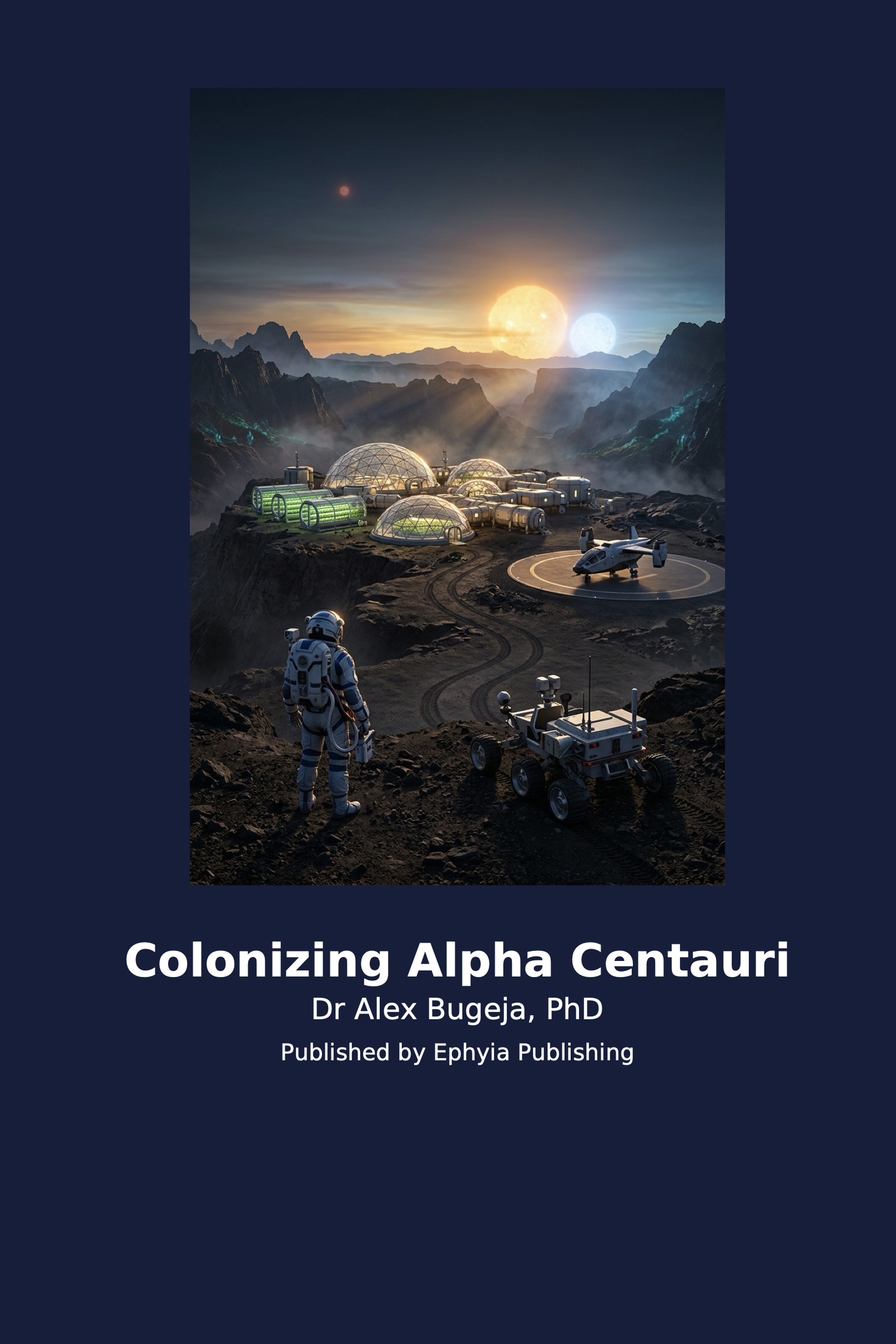
Colonizing Alpha Centauri offers readers a rigorous, step‑by‑step exploration of what it would truly take to become a multi‑stellar species. Beginning with the motivations behind interstellar travel—survival, curiosity, resource needs, and technological innovation—the book lays out why the Alpha Centauri system, our nearest stellar neighbor at just over four light‑years away, is the logical first destination. Readers will gain a clear picture of the system’s architecture, from the Sun‑like stars Alpha Centauri A and B to the flare‑prone red dwarf Proxima Centauri and its intriguing, potentially habitable world Proxima b, setting the stage for the formidable challenges ahead.
The narrative then dives into the heart of the endeavor: the engineering of a starship capable of sustaining human life for centuries. Readers will learn about the trade‑offs between generation ships and sleeper ships, the design of rotating habitats that create artificial gravity, the complexities of closed‑loop life support, radiation shielding, and the immense power requirements met by onboard fusion reactors. Detailed sections on propulsion technologies—from nuclear pulse and fusion drives to laser sails and antimatter concepts—explain how humanity might bridge the interstellar void, while chapters on cryogenics and synthetic torpor examine the possibilities of suspending or slowing human metabolism for the journey.
Once the ark is under way, the book follows the voyage through the perils of the interstellar medium, the delicate maneuver of braking into orbit around a new sun, and the systematic survey of the Alpha Centauri system using increasingly sophisticated robotic vanguards. Readers will experience the tension of selecting the ideal colonists based on psychology, genetics, and diversity, and they will share in the historic moment when the first humans set foot on Proxima b, establishing a subterranean beachhead in the harsh terminator zone. Subsequent chapters reveal how colonists learn to live off the land—extracting water, producing breathable air, mining metals, and building agriculture—while harnessing the planet’s wind, geothermal heat, and dayside solar power to grow from a bunker into a thriving civilization.
Beyond survival, the book examines the long‑term project of terraforming Proxima b, the social and governance structures that emerge in isolation, the physiological adaptations of the first generation born under a foreign sun, and the profound challenges of communicating across a nine‑year light‑gap. It confronts the ethical dilemma of discovering indigenous life, the ensuing planetary protection protocols, and the eventual expansion from a single crater to a system‑wide network of subterranean cities, orbital habitats, and asteroid mines. Finally, readers are invited to contemplate humanity’s future as a stellar species—how the success at Alpha Centauri could seed further diasporas, drive deliberate evolution, and reshape our place in the galaxy. The result is a compelling, realistic roadmap that turns the age‑old dream of touching the stars into a tangible, multi‑generational plan for our species’ destiny.
What You'll Find Inside:
- The book details the propulsion breakthroughs—fusion, antimatter, laser sails, and nuclear pulse—required to reduce the Alpha Centauri journey from millennia to decades or centuries.
- It explains how a starship must become a self-contained world, covering artificial gravity via rotation, closed-loop life support, radiation shielding, and redundancy for centuries‑long habitation.
- Colonist selection hinges on psychological resilience, genetic diversity, and disease screening to create a healthy, cooperative founding population capable of multi‑generational survival.
- Post‑arrival strategies focus on in‑situ resource utilization, terraforming, energy harvesting (fusion, solar, wind, geothermal), and agriculture to turn Proxima b into a sustainable foothold.
- The work also examines societal governance, human adaptation to new gravity and environment, the communication lag with Earth, and the ethical implications of discovering indigenous life.
Who's It For:
This book is aimed at readers with a strong interest in hard science fiction, space exploration, and futurism—including aerospace engineers, astrophysicists, policy makers, and educated enthusiasts who want a rigorous, interdisciplinary look at what it would take to become a multi‑stellar species. It will also appeal to students and professionals in fields such as robotics, biology, and sociology who seek to understand the technological, biological, and societal challenges of interstellar colonization.
Table of Contents:
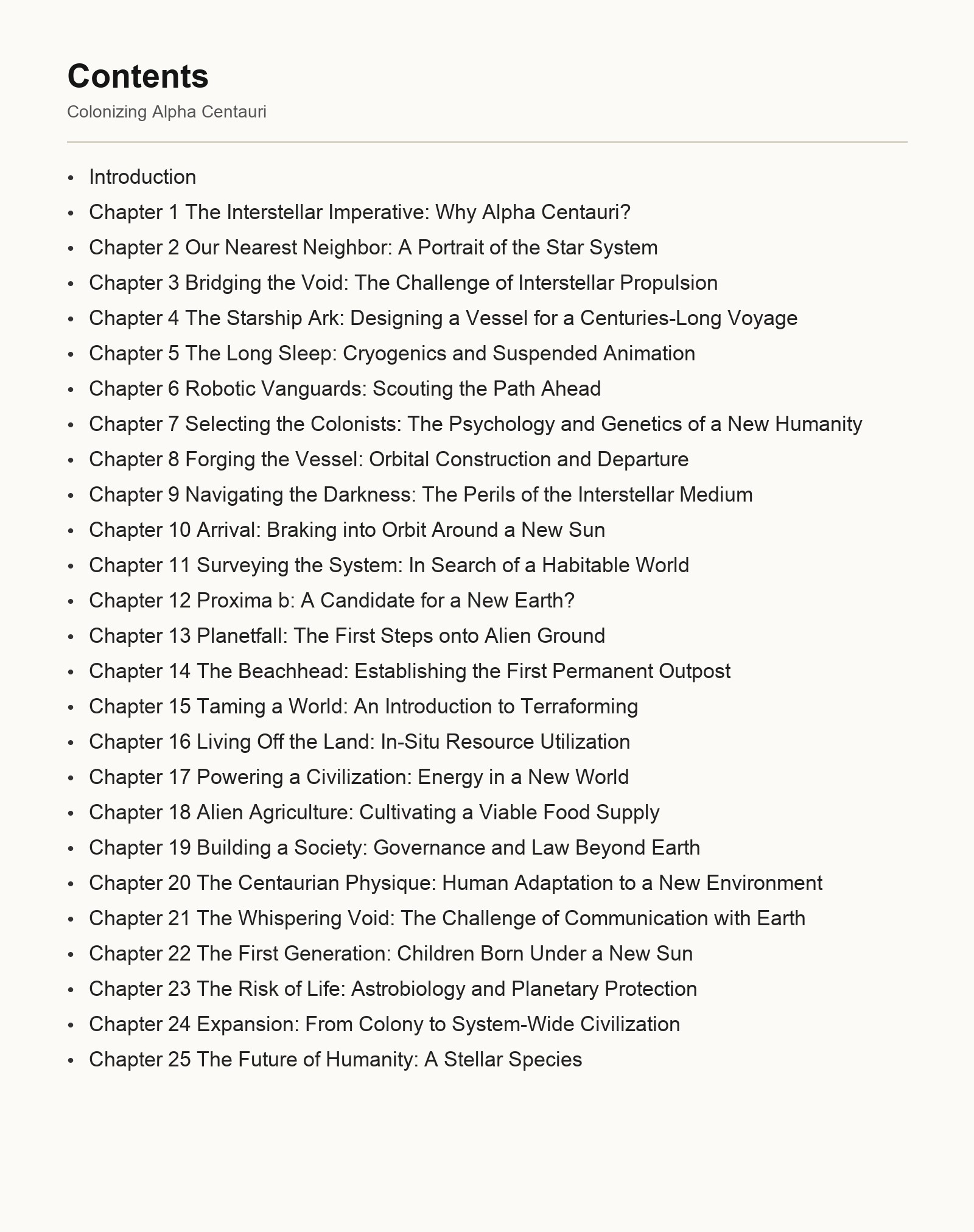
- Introduction
- Chapter 1 The Interstellar Imperative: Why Alpha Centauri?
- Chapter 2 Our Nearest Neighbor: A Portrait of the Star System
- Chapter 3 Bridging the Void: The Challenge of Interstellar Propulsion
- Chapter 4 The Starship Ark: Designing a Vessel for a Centuries-Long Voyage
- Chapter 5 The Long Sleep: Cryogenics and Suspended Animation
- Chapter 6 Robotic Vanguards: Scouting the Path Ahead
- Chapter 7 Selecting the Colonists: The Psychology and Genetics of a New Humanity
- Chapter 8 Forging the Vessel: Orbital Construction and Departure
- Chapter 9 Navigating the Darkness: The Perils of the Interstellar Medium
- Chapter 10 Arrival: Braking into Orbit Around a New Sun
- Chapter 11 Surveying the System: In Search of a Habitable World
- Chapter 12 Proxima b: A Candidate for a New Earth?
- Chapter 13 Planetfall: The First Steps onto Alien Ground
- Chapter 14 The Beachhead: Establishing the First Permanent Outpost
- Chapter 15 Taming a World: An Introduction to Terraforming
- Chapter 16 Living Off the Land: In-Situ Resource Utilization
- Chapter 17 Powering a Civilization: Energy in a New World
- Chapter 18 Alien Agriculture: Cultivating a Viable Food Supply
- Chapter 19 Building a Society: Governance and Law Beyond Earth
- Chapter 20 The Centaurian Physique: Human Adaptation to a New Environment
- Chapter 21 The Whispering Void: The Challenge of Communication with Earth
- Chapter 22 The First Generation: Children Born Under a New Sun
- Chapter 23 The Risk of Life: Astrobiology and Planetary Protection
- Chapter 24 Expansion: From Colony to System-Wide Civilization
- Chapter 25 The Future of Humanity: A Stellar Species
Author:
Published By:
Date Published:
May 27, 2026
Type:
Nonfiction
Language:
English
Word Count:
46,737 words
Reading Time:
3 hours 16 minutes
Sample:
Order:
Buy the Colonizing Alpha Centauri ebook on MixCache.com:
Buy NowThe full ebook will be available immediately to read instantly on any device.
$5 account credit for all new MixCache.com accounts, usable toward any ebook purchase!*



Ratings & Reviews
Ask Questions About This Book
Have a question about the content? Ask our AI assistant!
Start by asking a question about "Colonizing Alpha Centauri"
Example: "Does this book mention William Shakespeare?"
Thinking...