Browse by Category
Fiction
- Action & Adventure
- African American
- Anthologies
- Children's Fiction
- Classics
- Comics & Graphic Novels
- Coming of Age
- Contemporary
- Cultural & Regional
- Drama
- Erotica
- Fantasy
- General
- Historical Fiction
- Horror
- Humor & Satire
- Literary Fiction
- Mystery, Thriller & Suspense
- Poetry
- Religious & Inspirational
- Romance
- Science Fiction
- Short Stories
- War & Military
- Westerns
- Women's Fiction
- Young Adult
Non-Fiction
- Antiques & Collectibles
- Arts & Photography
- Biographies & Memoirs
- Business & Money
- Children's Non-Fiction
-
Computers & Technology
- Artificial Intelligence
- Computer Science
- Cybersecurity & Cryptography
- Data Science & Analytics
- Databases & Big Data
- Game Development & Design
- General
- Hardware & DIY
- Mobile App Development
- Networking & Cloud Computing
- Operating Systems
- Programming
- Robotics
- Software
- Software Engineering
- User Experience (UX) & Design
- Web Development & Design
- Cooking, Food & Wine
- Crafts, Hobbies & Home
- Education & Teaching
- Engineering
- General
- Health, Fitness & Dieting
-
History
- African History
- African History - North Africa
- African History - Sub-Saharan Africa
- American History
- American History - 20th Century
- American History - Civil War
- American History - Colonial Period
- Ancient History
- Asian History
- Asian History - China
- Asian History - India
- Asian History - Japan
- Asian History - Southeast Asia
- European History
- European History - Ancient Greece
- European History - Ancient Rome
- European History - Medieval
- European History - Modern
- European History - Renaissance
- General
- Middle Eastern History
- Military History
- Military History - Aviation
- Military History - Naval
- Social & Cultural History
- World History
- Humor & Entertainment
- Industrial Technology
- Language Learning
- Law
- LGBTQ+ Non-Fiction
- Literary Criticism
- Medical Books
- Parenting & Relationships
- Philosophy
- Politics & Social Sciences
- Reference
- Religion & Spirituality
-
Science & Math
- Agricultural Sciences
- Astronomy & Space Science
- Behavioral Sciences
- Biological Sciences
- Botany & Plant Science
- Chemistry
- Earth Sciences
- Engineering - Chemical
- Engineering - Civil
- Engineering - Electrical
- Engineering - Mechanical
- Environment
- General
- Geology
- Mathematics
- Nature & Ecology
- Oceanography
- Paleontology
- Physics
- Statistics
- Self-Help
- Sports & Outdoors
- Study Aids
- Sustainability & Green Living
- Textbooks
- Transportation
- Travel
- True Crime
- Urban Planning & Development
- Veterinary Medicine
- Writing & Publishing
Jump to Section
MixCache.com Total Access
Unlimited reading and audiobooks for every book published by MixCache.com.
Included titles carry the MTA badge.
Learn more →A History of Liechtenstein
About this book:


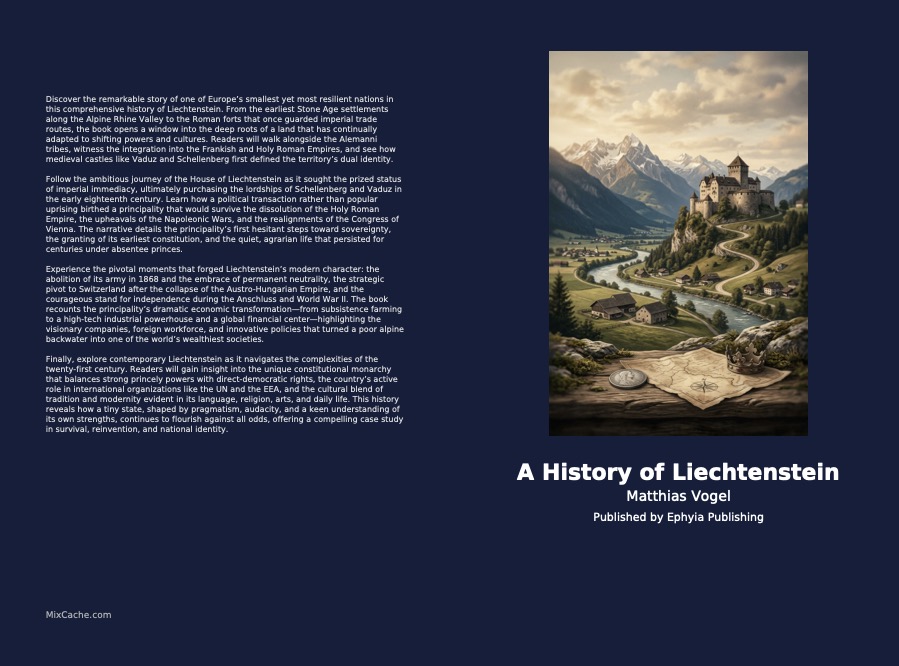
Discover the remarkable story of one of Europe’s smallest yet most resilient nations in this comprehensive history of Liechtenstein. From the earliest Stone Age settlements along the Alpine Rhine Valley to the Roman forts that once guarded imperial trade routes, the book opens a window into the deep roots of a land that has continually adapted to shifting powers and cultures. Readers will walk alongside the Alemanni tribes, witness the integration into the Frankish and Holy Roman Empires, and see how medieval castles like Vaduz and Schellenberg first defined the territory’s dual identity.
Follow the ambitious journey of the House of Liechtenstein as it sought the prized status of imperial immediacy, ultimately purchasing the lordships of Schellenberg and Vaduz in the early eighteenth century. Learn how a political transaction rather than popular uprising birthed a principality that would survive the dissolution of the Holy Roman Empire, the upheavals of the Napoleonic Wars, and the realignments of the Congress of Vienna. The narrative details the principality’s first hesitant steps toward sovereignty, the granting of its earliest constitution, and the quiet, agrarian life that persisted for centuries under absentee princes.
Experience the pivotal moments that forged Liechtenstein’s modern character: the abolition of its army in 1868 and the embrace of permanent neutrality, the strategic pivot to Switzerland after the collapse of the Austro‑Hungarian Empire, and the courageous stand for independence during the Anschluss and World War II. The book recounts the principality’s dramatic economic transformation—from subsistence farming to a high‑tech industrial powerhouse and a global financial center—highlighting the visionary companies, foreign workforce, and innovative policies that turned a poor alpine backwater into one of the world’s wealthiest societies.
Finally, explore contemporary Liechtenstein as it navigates the complexities of the twenty‑first century. Readers will gain insight into the unique constitutional monarchy that balances strong princely powers with direct‑democratic rights, the country’s active role in international organizations like the UN and the EEA, and the cultural blend of tradition and modernity evident in its language, religion, arts, and daily life. This history reveals how a tiny state, shaped by pragmatism, audacity, and a keen understanding of its own strengths, continues to flourish against all odds, offering a compelling case study in survival, reinvention, and national identity.
What You'll Find Inside:
- How Liechtenstein evolved from purchased mountain territories into a sovereign principality through shrewd political maneuvering by the House of Liechtenstein
- The country's survival strategy through wars and empire collapses via pragmatism, neutrality, and diplomatic skill
- Liechtenstein's abolition of its army in 1868 and commitment to permanent neutrality as a core national identity
- The post-WWII economic miracle that transformed Liechtenstein from agrarian poverty to a global financial and high-tech industrial center
- The unique 21st-century constitutional system that grants the monarch significant power while affirming citizens' right to abolish the monarchy via referendum
Who's It For:
This book appeals to readers interested in European history, political science, and economic development, particularly those studying small state survival strategies, monarchies in the modern world, and economic transformation cases. It's valuable for students of international relations and comparative politics due to its detailed account of Liechtenstein's unique political system and relationship with larger neighbors. Anyone fascinated by how microstates navigate global challenges while maintaining sovereignty will find this book insightful.
Table of Contents:
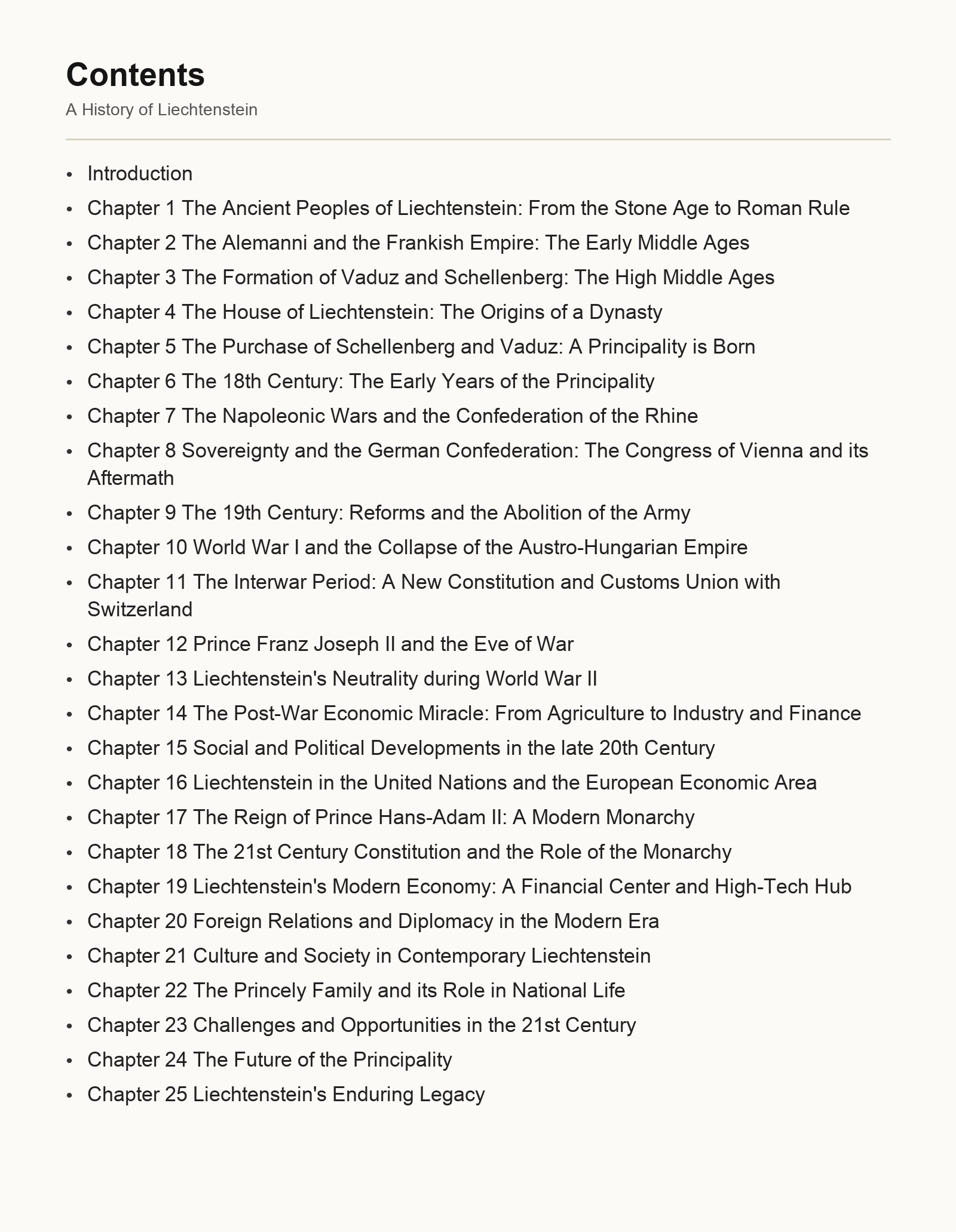
- Introduction
- Chapter 1 The Ancient Peoples of Liechtenstein: From the Stone Age to Roman Rule
- Chapter 2 The Alemanni and the Frankish Empire: The Early Middle Ages
- Chapter 3 The Formation of Vaduz and Schellenberg: The High Middle Ages
- Chapter 4 The House of Liechtenstein: The Origins of a Dynasty
- Chapter 5 The Purchase of Schellenberg and Vaduz: A Principality is Born
- Chapter 6 The 18th Century: The Early Years of the Principality
- Chapter 7 The Napoleonic Wars and the Confederation of the Rhine
- Chapter 8 Sovereignty and the German Confederation: The Congress of Vienna and its Aftermath
- Chapter 9 The 19th Century: Reforms and the Abolition of the Army
- Chapter 10 World War I and the Collapse of the Austro-Hungarian Empire
- Chapter 11 The Interwar Period: A New Constitution and Customs Union with Switzerland
- Chapter 12 Prince Franz Joseph II and the Eve of War
- Chapter 13 Liechtenstein's Neutrality during World War II
- Chapter 14 The Post-War Economic Miracle: From Agriculture to Industry and Finance
- Chapter 15 Social and Political Developments in the late 20th Century
- Chapter 16 Liechtenstein in the United Nations and the European Economic Area
- Chapter 17 The Reign of Prince Hans-Adam II: A Modern Monarchy
- Chapter 18 The 21st Century Constitution and the Role of the Monarchy
- Chapter 19 Liechtenstein's Modern Economy: A Financial Center and High-Tech Hub
- Chapter 20 Foreign Relations and Diplomacy in the Modern Era
- Chapter 21 Culture and Society in Contemporary Liechtenstein
- Chapter 22 The Princely Family and its Role in National Life
- Chapter 23 Challenges and Opportunities in the 21st Century
- Chapter 24 The Future of the Principality
- Chapter 25 Liechtenstein's Enduring Legacy
Author:
Published By:
Date Published:
May 26, 2026
Type:
Nonfiction
Language:
English
Word Count:
38,104 words
Reading Time:
2 hours 40 minutes
Sample:
Order:
Order A History of Liechtenstein (Paperback) on MixCache.com:
Buy NowPrint copy is made to order and ships worldwide. Includes the ebook free, ready to read instantly.
$5 account credit for all new MixCache.com accounts, usable toward any ebook purchase!*