
Browse by Category
Fiction
- Action & Adventure
- African American
- Anthologies
- Children's Fiction
- Classics
- Comics & Graphic Novels
- Coming of Age
- Contemporary
- Cultural & Regional
- Drama
- Erotica
- Fantasy
- General
- Historical Fiction
- Horror
- Humor & Satire
- Literary Fiction
- Mystery, Thriller & Suspense
- Poetry
- Religious & Inspirational
- Romance
- Science Fiction
- Short Stories
- War & Military
- Westerns
- Women's Fiction
- Young Adult
Non-Fiction
- Antiques & Collectibles
- Arts & Photography
- Biographies & Memoirs
- Business & Money
- Children's Non-Fiction
-
Computers & Technology
- Artificial Intelligence
- Computer Science
- Cybersecurity & Cryptography
- Data Science & Analytics
- Databases & Big Data
- Game Development & Design
- General
- Hardware & DIY
- Mobile App Development
- Networking & Cloud Computing
- Operating Systems
- Programming
- Robotics
- Software
- Software Engineering
- User Experience (UX) & Design
- Web Development & Design
- Cooking, Food & Wine
- Crafts, Hobbies & Home
- Education & Teaching
- Engineering
- General
- Health, Fitness & Dieting
-
History
- African History
- African History - North Africa
- African History - Sub-Saharan Africa
- American History
- American History - 20th Century
- American History - Civil War
- American History - Colonial Period
- Ancient History
- Asian History
- Asian History - China
- Asian History - India
- Asian History - Japan
- Asian History - Southeast Asia
- European History
- European History - Ancient Greece
- European History - Ancient Rome
- European History - Medieval
- European History - Modern
- European History - Renaissance
- General
- Middle Eastern History
- Military History
- Military History - Aviation
- Military History - Naval
- Social & Cultural History
- World History
- Humor & Entertainment
- Industrial Technology
- Language Learning
- Law
- LGBTQ+ Non-Fiction
- Literary Criticism
- Medical Books
- Parenting & Relationships
- Philosophy
- Politics & Social Sciences
- Reference
- Religion & Spirituality
-
Science & Math
- Agricultural Sciences
- Astronomy & Space Science
- Behavioral Sciences
- Biological Sciences
- Botany & Plant Science
- Chemistry
- Earth Sciences
- Engineering - Chemical
- Engineering - Civil
- Engineering - Electrical
- Engineering - Mechanical
- Environment
- General
- Geology
- Mathematics
- Nature & Ecology
- Oceanography
- Paleontology
- Physics
- Statistics
- Self-Help
- Sports & Outdoors
- Study Aids
- Sustainability & Green Living
- Textbooks
- Transportation
- Travel
- True Crime
- Urban Planning & Development
- Veterinary Medicine
- Writing & Publishing
Jump to Section
MixCache.com Total Access
Unlimited reading and audiobooks for every book published by MixCache.com.
Included titles carry the MTA badge.
Learn more →
The Psychology of Boredom
How Idle Minds Shape Our World
About this book:
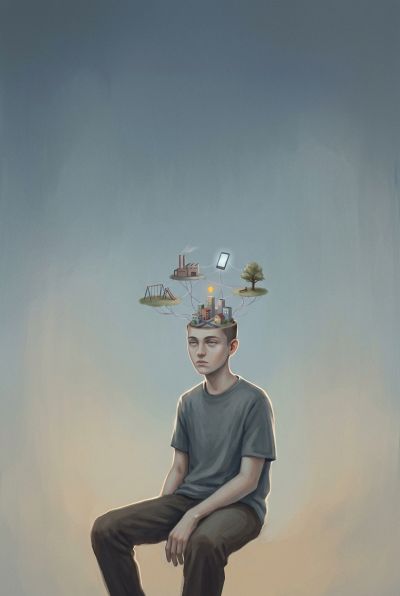
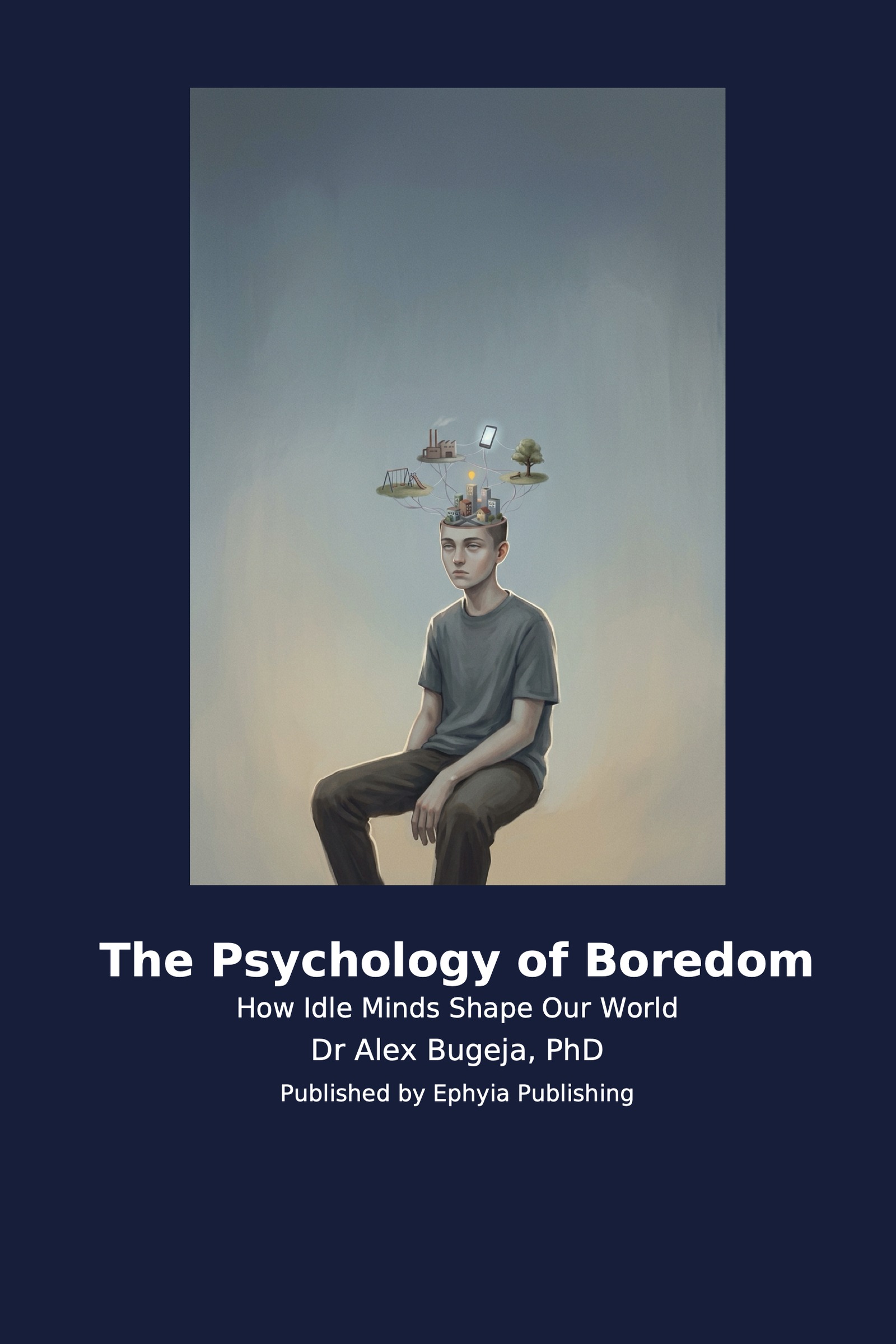
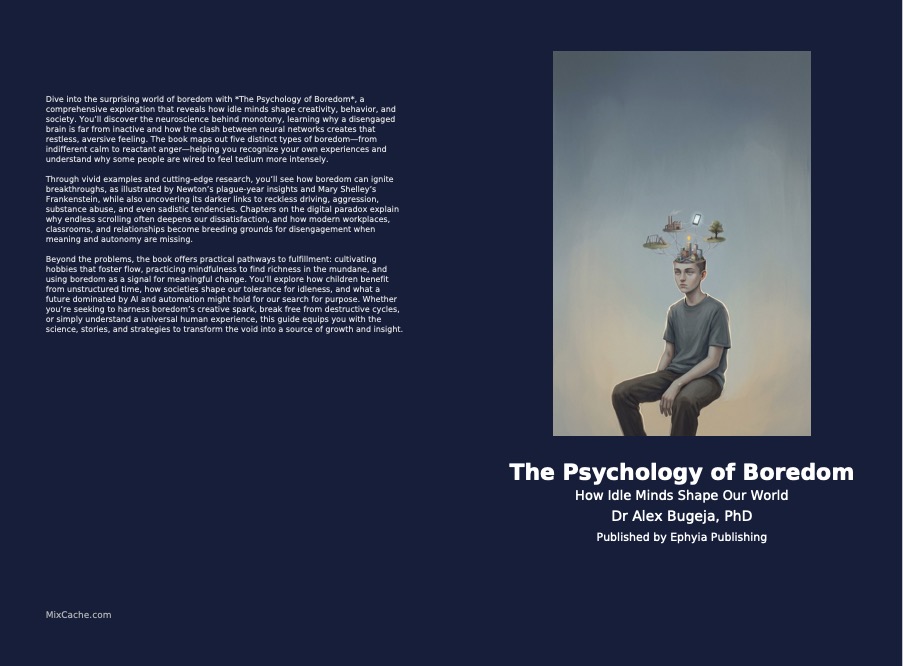
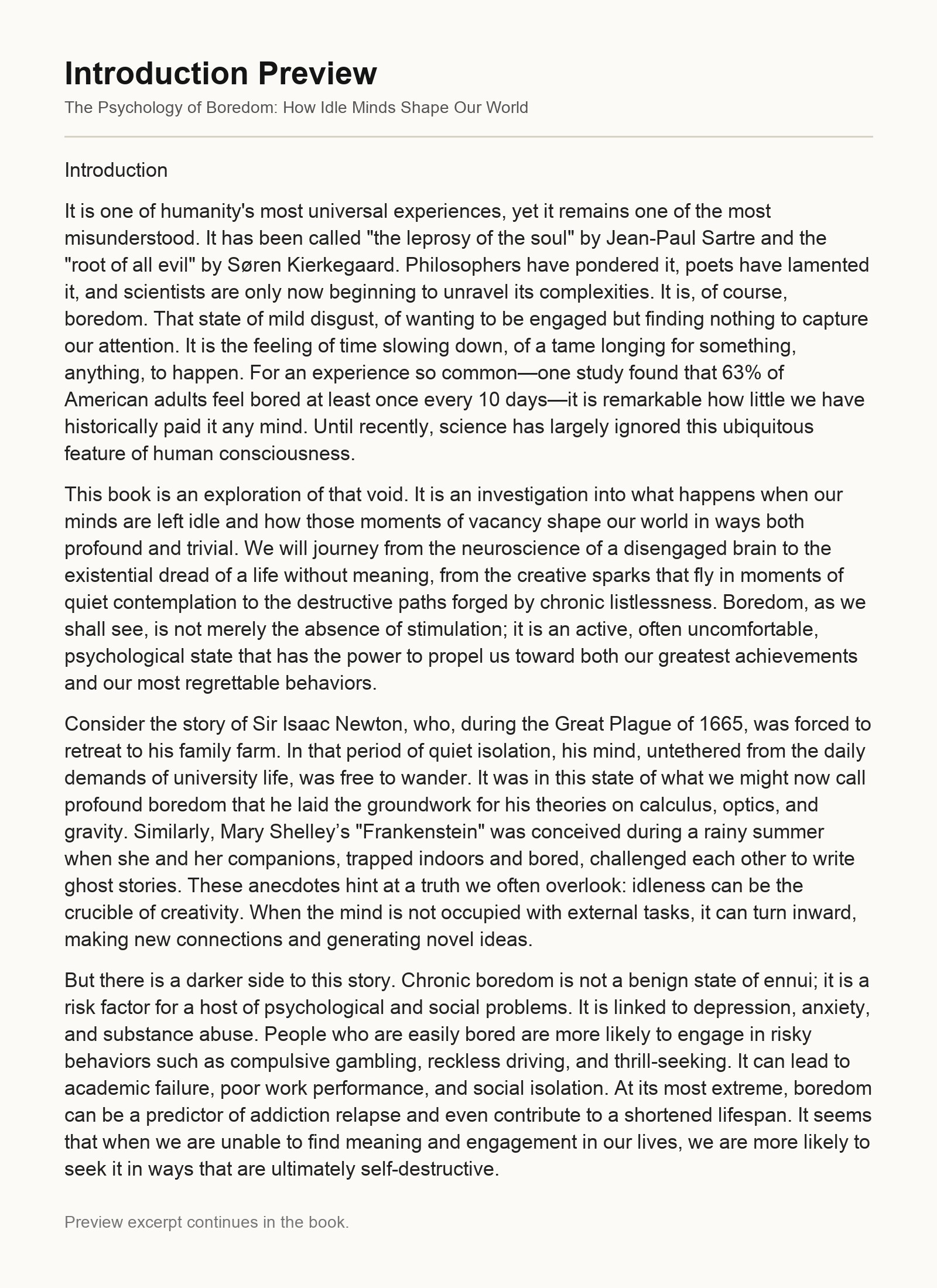
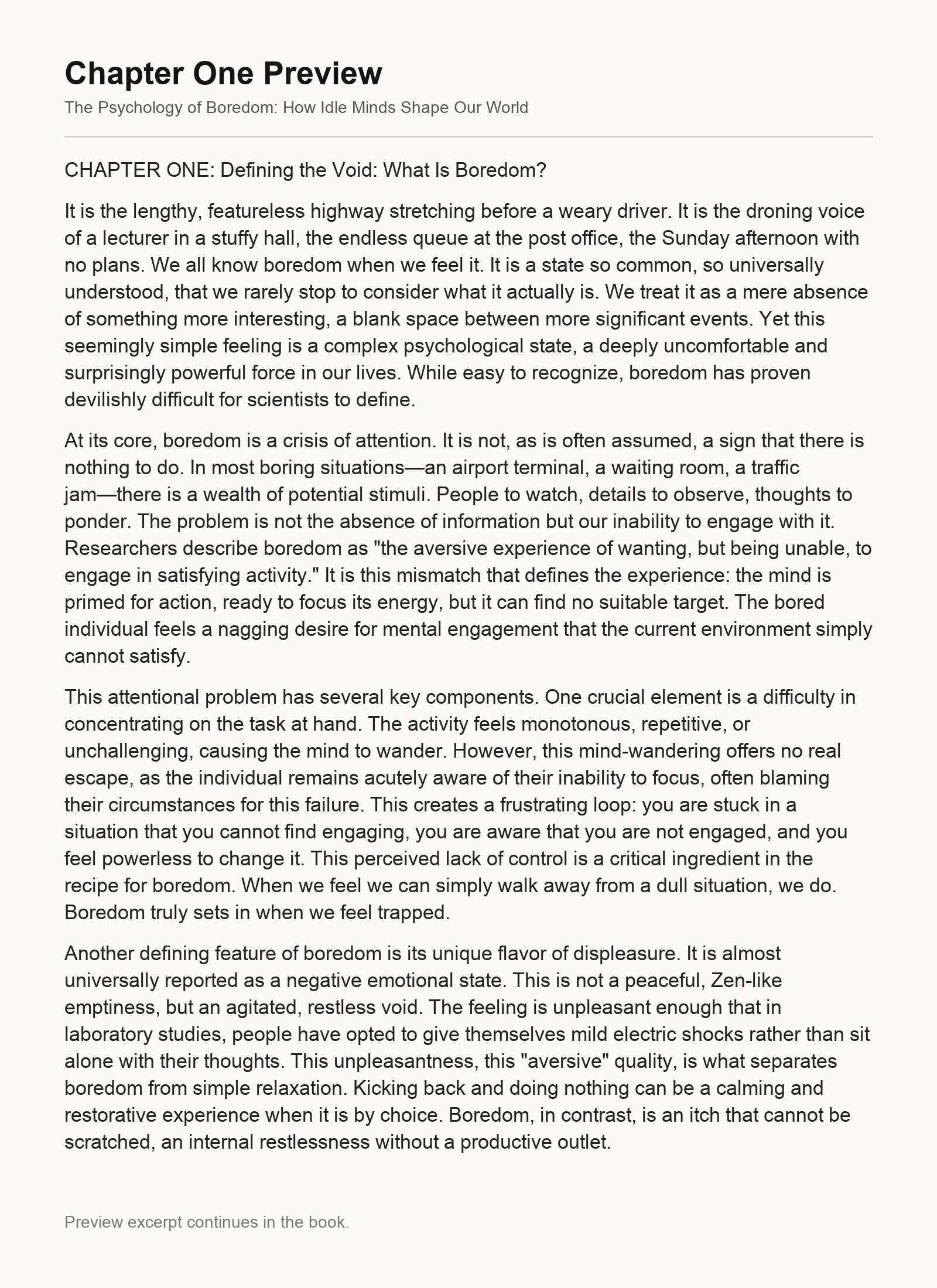
Dive into the surprising world of boredom with *The Psychology of Boredom*, a comprehensive exploration that reveals how idle minds shape creativity, behavior, and society. You’ll discover the neuroscience behind monotony, learning why a disengaged brain is far from inactive and how the clash between neural networks creates that restless, aversive feeling. The book maps out five distinct types of boredom—from indifferent calm to reactant anger—helping you recognize your own experiences and understand why some people are wired to feel tedium more intensely.
Through vivid examples and cutting‑edge research, you’ll see how boredom can ignite breakthroughs, as illustrated by Newton’s plague‑year insights and Mary Shelley’s Frankenstein, while also uncovering its darker links to reckless driving, aggression, substance abuse, and even sadistic tendencies. Chapters on the digital paradox explain why endless scrolling often deepens our dissatisfaction, and how modern workplaces, classrooms, and relationships become breeding grounds for disengagement when meaning and autonomy are missing.
Beyond the problems, the book offers practical pathways to fulfillment: cultivating hobbies that foster flow, practicing mindfulness to find richness in the mundane, and using boredom as a signal for meaningful change. You’ll explore how children benefit from unstructured time, how societies shape our tolerance for idleness, and what a future dominated by AI and automation might hold for our search for purpose. Whether you’re seeking to harness boredom’s creative spark, break free from destructive cycles, or simply understand a universal human experience, this guide equips you with the science, stories, and strategies to transform the void into a source of growth and insight.
What You'll Find Inside:
- Boredom is an active psychological state involving neural conflict between the Default Mode and Executive Control Networks, not merely a lack of external stimulation
- Researchers have identified five distinct types of boredom (indifferent, calibrating, searching, reactant, and apathetic) that vary in arousal level and emotional quality
- Boredom can fuel creativity and innovation through processes like divergent thinking and autobiographical planning when the mind is allowed to wander freely
- Chronic boredom is linked to destructive behaviors including substance abuse, aggression, self-harm, and risky activities as maladaptive attempts to escape the void
- The digital paradox shows that constant access to stimulation through technology can actually increase boredom by fragmenting attention and raising our engagement threshold
Who's It For:
This book is ideal for psychology enthusiasts, professionals in education and workplace management, parents concerned about children's development, and anyone seeking to understand the complex nature of boredom in our digital age. It offers valuable insights for those who experience frequent boredom, struggle with motivation, or want to harness idle moments for creativity while avoiding boredom's destructive potential. The book will particularly resonate with readers interested in neuroscience, behavioral psychology, and the societal impacts of technology on human experience.
Table of Contents:
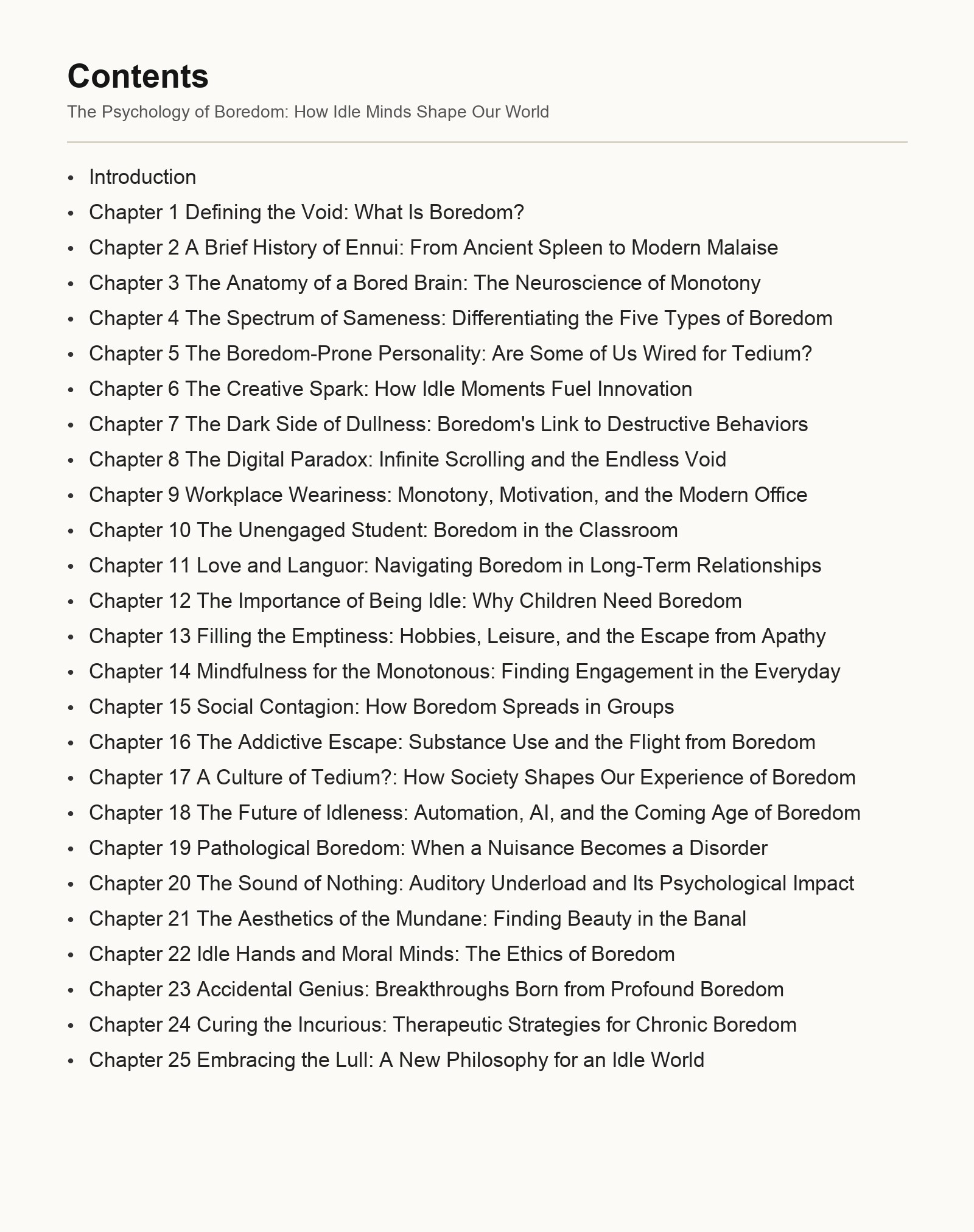
- Introduction
- Chapter 1 Defining the Void: What Is Boredom?
- Chapter 2 A Brief History of Ennui: From Ancient Spleen to Modern Malaise
- Chapter 3 The Anatomy of a Bored Brain: The Neuroscience of Monotony
- Chapter 4 The Spectrum of Sameness: Differentiating the Five Types of Boredom
- Chapter 5 The Boredom-Prone Personality: Are Some of Us Wired for Tedium?
- Chapter 6 The Creative Spark: How Idle Moments Fuel Innovation
- Chapter 7 The Dark Side of Dullness: Boredom's Link to Destructive Behaviors
- Chapter 8 The Digital Paradox: Infinite Scrolling and the Endless Void
- Chapter 9 Workplace Weariness: Monotony, Motivation, and the Modern Office
- Chapter 10 The Unengaged Student: Boredom in the Classroom
- Chapter 11 Love and Languor: Navigating Boredom in Long-Term Relationships
- Chapter 12 The Importance of Being Idle: Why Children Need Boredom
- Chapter 13 Filling the Emptiness: Hobbies, Leisure, and the Escape from Apathy
- Chapter 14 Mindfulness for the Monotonous: Finding Engagement in the Everyday
- Chapter 15 Social Contagion: How Boredom Spreads in Groups
- Chapter 16 The Addictive Escape: Substance Use and the Flight from Boredom
- Chapter 17 A Culture of Tedium?: How Society Shapes Our Experience of Boredom
- Chapter 18 The Future of Idleness: Automation, AI, and the Coming Age of Boredom
- Chapter 19 Pathological Boredom: When a Nuisance Becomes a Disorder
- Chapter 20 The Sound of Nothing: Auditory Underload and Its Psychological Impact
- Chapter 21 The Aesthetics of the Mundane: Finding Beauty in the Banal
- Chapter 22 Idle Hands and Moral Minds: The Ethics of Boredom
- Chapter 23 Accidental Genius: Breakthroughs Born from Profound Boredom
- Chapter 24 Curing the Incurious: Therapeutic Strategies for Chronic Boredom
- Chapter 25 Embracing the Lull: A New Philosophy for an Idle World
Author:
Published By:
Date Published:
May 26, 2026
Type:
Nonfiction
Language:
English
Also Available In:
Word Count:
48,211 words
Reading Time:
3 hours 23 minutes
Sample:
Order:
Buy the The Psychology of Boredom ebook on MixCache.com:
Buy NowThe full ebook will be available immediately to read instantly on any device.
$5 account credit for all new MixCache.com accounts, usable toward any ebook purchase!*


Ratings & Reviews
Ask Questions About This Book
Have a question about the content? Ask our AI assistant!
Start by asking a question about "The Psychology of Boredom"
Example: "Does this book mention William Shakespeare?"
Thinking...