
Browse by Category
Fiction
- Action & Adventure
- African American
- Anthologies
- Children's Fiction
- Classics
- Comics & Graphic Novels
- Coming of Age
- Contemporary
- Cultural & Regional
- Drama
- Erotica
- Fantasy
- General
- Historical Fiction
- Horror
- Humor & Satire
- Literary Fiction
- Mystery, Thriller & Suspense
- Poetry
- Religious & Inspirational
- Romance
- Science Fiction
- Short Stories
- War & Military
- Westerns
- Women's Fiction
- Young Adult
Non-Fiction
- Antiques & Collectibles
- Arts & Photography
- Biographies & Memoirs
- Business & Money
- Children's Non-Fiction
-
Computers & Technology
- Artificial Intelligence
- Computer Science
- Cybersecurity & Cryptography
- Data Science & Analytics
- Databases & Big Data
- Game Development & Design
- General
- Hardware & DIY
- Mobile App Development
- Networking & Cloud Computing
- Operating Systems
- Programming
- Robotics
- Software
- Software Engineering
- User Experience (UX) & Design
- Web Development & Design
- Cooking, Food & Wine
- Crafts, Hobbies & Home
- Education & Teaching
- Engineering
- General
- Health, Fitness & Dieting
-
History
- African History
- African History - North Africa
- African History - Sub-Saharan Africa
- American History
- American History - 20th Century
- American History - Civil War
- American History - Colonial Period
- Ancient History
- Asian History
- Asian History - China
- Asian History - India
- Asian History - Japan
- Asian History - Southeast Asia
- European History
- European History - Ancient Greece
- European History - Ancient Rome
- European History - Medieval
- European History - Modern
- European History - Renaissance
- General
- Middle Eastern History
- Military History
- Military History - Aviation
- Military History - Naval
- Social & Cultural History
- World History
- Humor & Entertainment
- Industrial Technology
- Language Learning
- Law
- LGBTQ+ Non-Fiction
- Literary Criticism
- Medical Books
- Parenting & Relationships
- Philosophy
- Politics & Social Sciences
- Reference
- Religion & Spirituality
-
Science & Math
- Agricultural Sciences
- Astronomy & Space Science
- Behavioral Sciences
- Biological Sciences
- Botany & Plant Science
- Chemistry
- Earth Sciences
- Engineering - Chemical
- Engineering - Civil
- Engineering - Electrical
- Engineering - Mechanical
- Environment
- General
- Geology
- Mathematics
- Nature & Ecology
- Oceanography
- Paleontology
- Physics
- Statistics
- Self-Help
- Sports & Outdoors
- Study Aids
- Sustainability & Green Living
- Textbooks
- Transportation
- Travel
- True Crime
- Urban Planning & Development
- Veterinary Medicine
- Writing & Publishing
Jump to Section
MixCache.com Total Access
Unlimited reading and audiobooks for every book published by MixCache.com.
Included titles carry the MTA badge.
Learn more →A History of Kyrgyzstan
About this book:

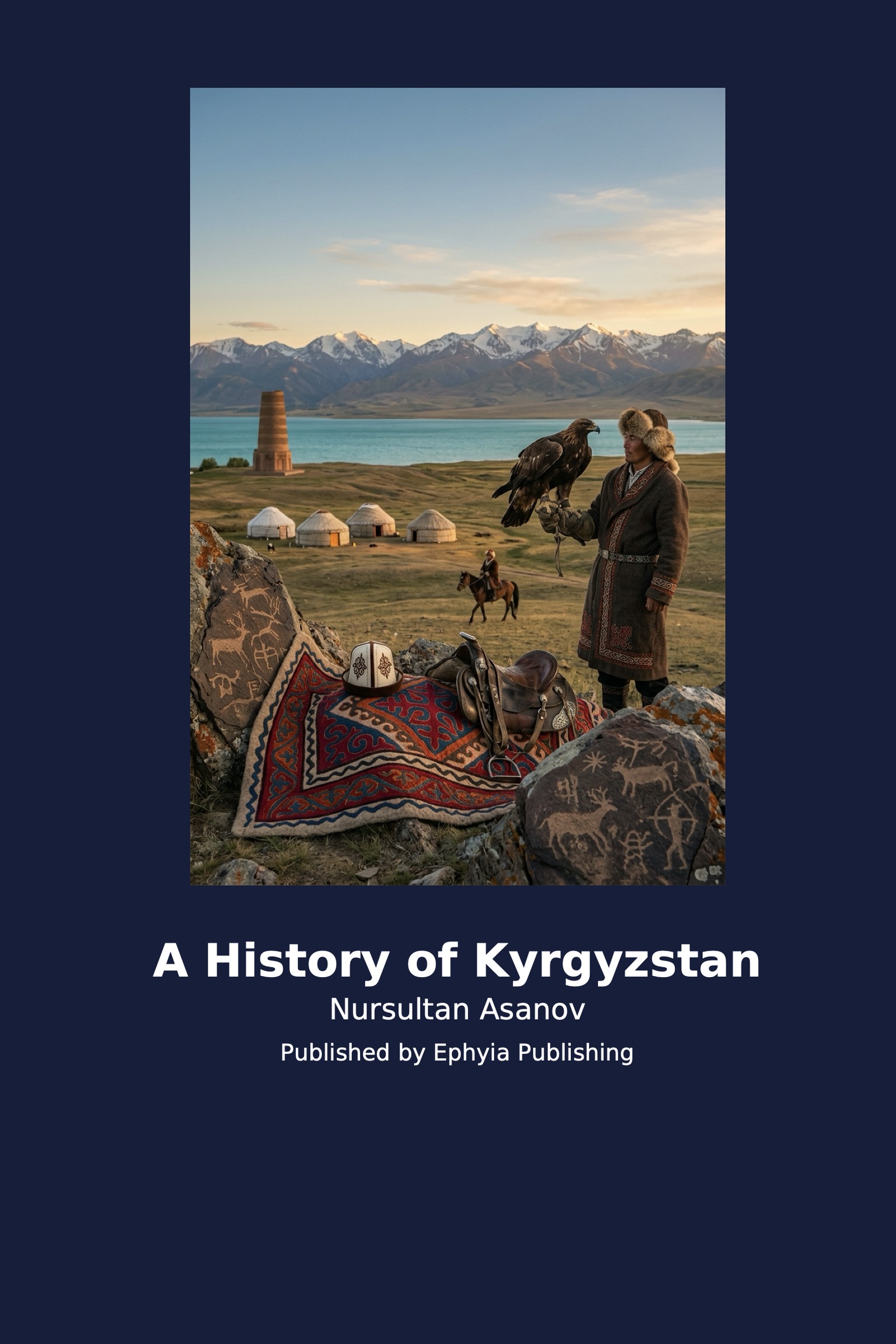
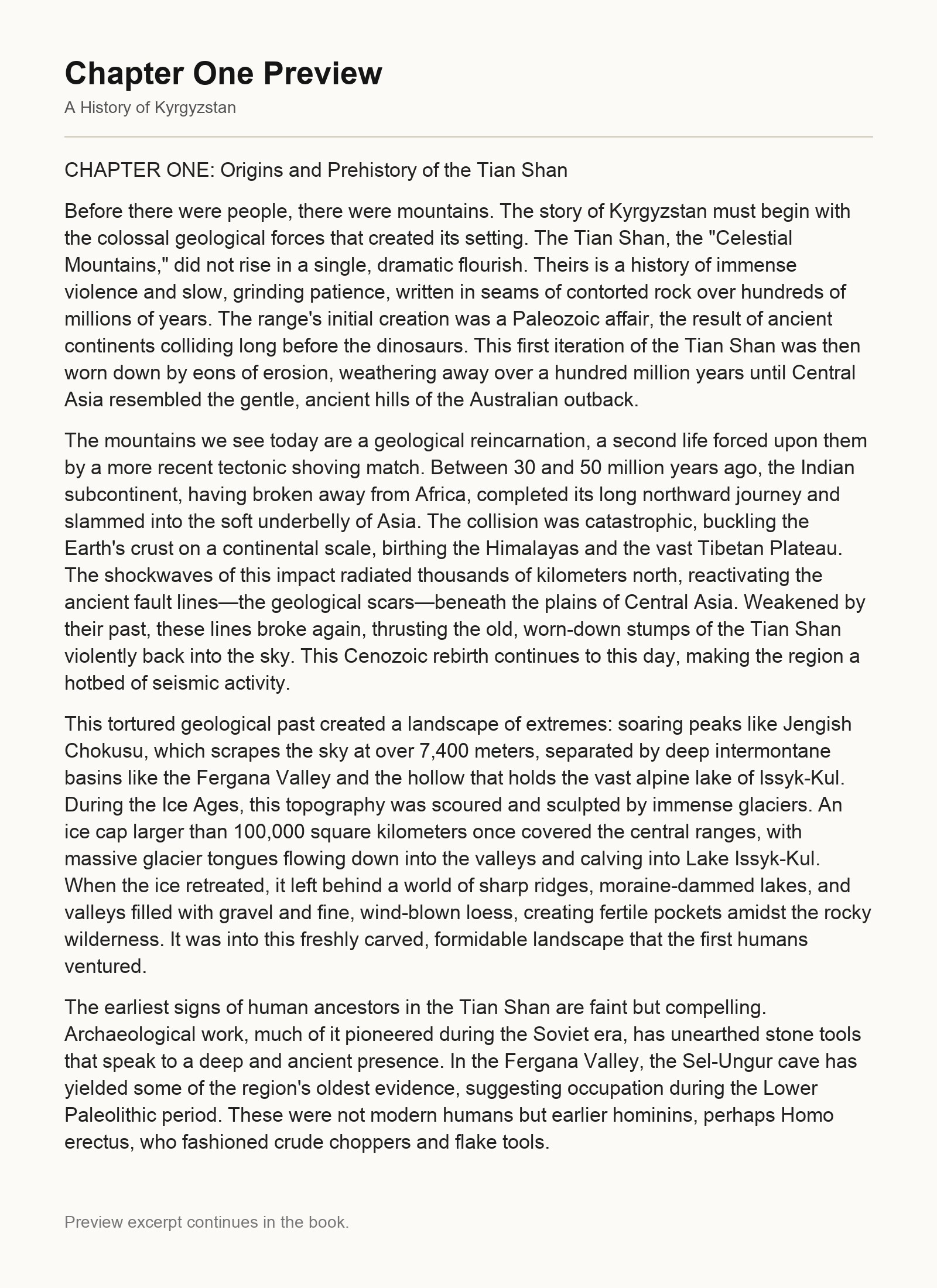
A History of Kyrgyzstan offers readers a sweeping journey from the geological birth of the Tian Shan to the nation’s most recent political upheavals, revealing how mountains have shaped every twist of the country’s destiny. Through vivid narrative and meticulous research, the book traces the Kyrgyz people’s ancient roots in the Yenisey basin, their rise as a steppe power, and the legendary Epic of Manas that binds their identity to the high pastures and valleys they now call home.
Readers will explore the early exchanges along the Silk Road, the conversion of the Karakhanids to Islam, the Mongol conquest and the formation of the Chagatai Khanate, and the gradual southward migration that forged a Kyrgyz confederation in the Celestial Mountains. The text details the era of competing khanates, the heroic leadership of Kurmanjan Datka, and the inexorable advance of the Russian Empire that turned nomadic lands into colonial settler zones.
The narrative then moves into the turbulent twentieth century: the 1916 Urkun exile, Soviet nation‑building, collectivization famine, wartime sacrifice, and the postwar industrial boom. It follows the path to independence, the optimism and corruption of the Akaev era, the Tulip Revolution, the 2010 upheaval and ethnic violence, the experimental parliamentary decade, and the 2020 rise of Sadyr Japarov, showing how each wave of change reshaped power, economy, and society.
Finally, the book confronts contemporary Kyrgyzstan: the reliance on remittances and the Kumtor gold mine, the balancing act between Russia, China, and the West, the revival of Islam and clan‑based politics, and the looming threat of climate change on glaciers and water resources. By weaving together political, cultural, environmental, and personal stories, the work equips readers to understand not only the past of a mountainous nation but also the challenges and resilience that define its present and future.
What You'll Find Inside:
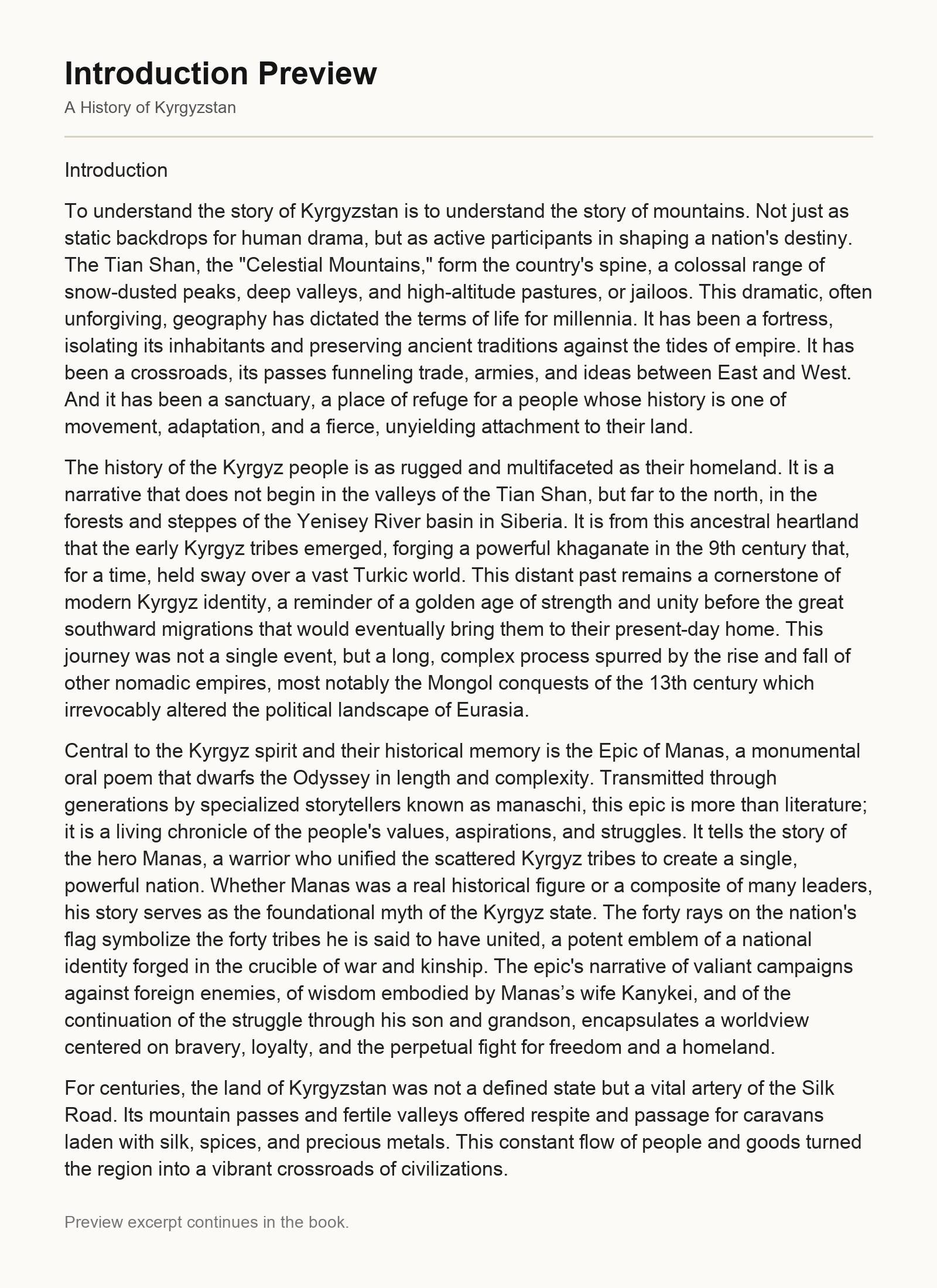
- The Tian Shan mountains as both a geographic barrier and crossroads that have shaped Kyrgyzstan's history, identity, and way of life for millennia.
- The Epic of Manas as Kyrgyzstan's foundational national myth, symbolizing unity through the forty rays on the national flag representing the tribes united by the hero Manas.
- The Kyrgyz people's migration from the Yenisey River basin in Siberia to the Tian Shan mountains, a process spanning centuries that forged their modern identity.
- The profound impact of Russian colonization and Soviet rule, including collectivization, famine, purges, and industrialization that transformed traditional nomadic society.
- Kyrgyzstan's tumultuous post-independence journey marked by revolutions, ethnic violence, experiments with parliamentary democracy, and the recent consolidation of power under a super-presidential system.
Who's It For:
This book is ideal for students, researchers, and general readers interested in Central Asian history, post-Soviet state development, and how geography influences national identity. It provides essential context for understanding Kyrgyzstan's contemporary political landscape, ethnic dynamics, and its strategic position between Russia and China. Anyone studying nation-building, nomadic cultures adapting to modernity, or the legacy of Soviet rule in Eurasia will find this comprehensive history invaluable.
Table of Contents:
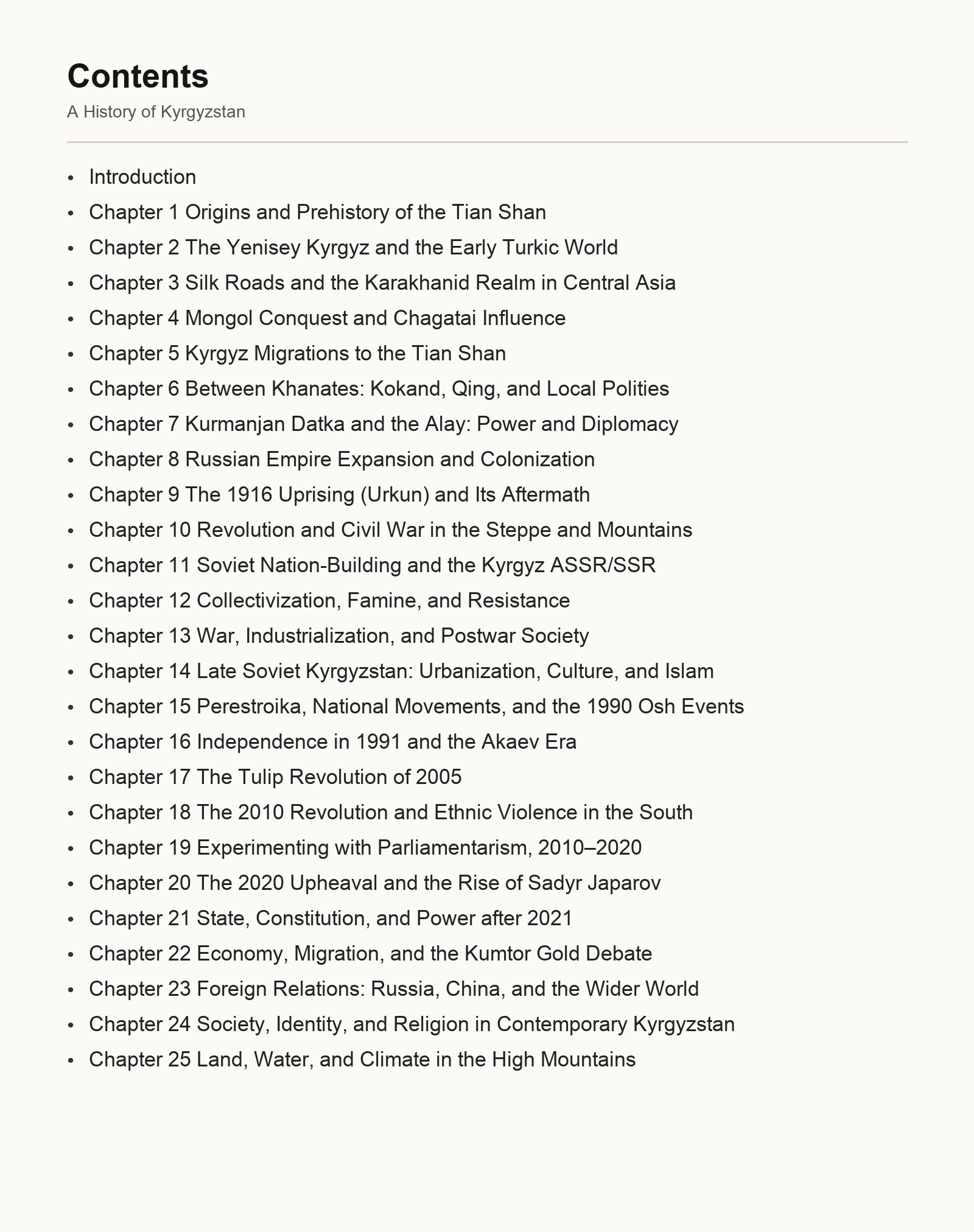
- Introduction
- Chapter 1 Origins and Prehistory of the Tian Shan
- Chapter 2 The Yenisey Kyrgyz and the Early Turkic World
- Chapter 3 Silk Roads and the Karakhanid Realm in Central Asia
- Chapter 4 Mongol Conquest and Chagatai Influence
- Chapter 5 Kyrgyz Migrations to the Tian Shan
- Chapter 6 Between Khanates: Kokand, Qing, and Local Polities
- Chapter 7 Kurmanjan Datka and the Alay: Power and Diplomacy
- Chapter 8 Russian Empire Expansion and Colonization
- Chapter 9 The 1916 Uprising (Urkun) and Its Aftermath
- Chapter 10 Revolution and Civil War in the Steppe and Mountains
- Chapter 11 Soviet Nation-Building and the Kyrgyz ASSR/SSR
- Chapter 12 Collectivization, Famine, and Resistance
- Chapter 13 War, Industrialization, and Postwar Society
- Chapter 14 Late Soviet Kyrgyzstan: Urbanization, Culture, and Islam
- Chapter 15 Perestroika, National Movements, and the 1990 Osh Events
- Chapter 16 Independence in 1991 and the Akaev Era
- Chapter 17 The Tulip Revolution of 2005
- Chapter 18 The 2010 Revolution and Ethnic Violence in the South
- Chapter 19 Experimenting with Parliamentarism, 2010–2020
- Chapter 20 The 2020 Upheaval and the Rise of Sadyr Japarov
- Chapter 21 State, Constitution, and Power after 2021
- Chapter 22 Economy, Migration, and the Kumtor Gold Debate
- Chapter 23 Foreign Relations: Russia, China, and the Wider World
- Chapter 24 Society, Identity, and Religion in Contemporary Kyrgyzstan
- Chapter 25 Land, Water, and Climate in the High Mountains
Author:
Published By:
Date Published:
May 26, 2026
Type:
Nonfiction
Language:
English
Also Available In:
German, French, Dutch, Portuguese
Word Count:
47,696 words
Reading Time:
3 hours 20 minutes
Sample:
Order:
Buy the A History of Kyrgyzstan ebook on MixCache.com:
Buy NowThe full ebook will be available immediately to read instantly on any device.
$5 account credit for all new MixCache.com accounts, usable toward any ebook purchase!*






Ratings & Reviews
Ask Questions About This Book
Have a question about the content? Ask our AI assistant!
Start by asking a question about "A History of Kyrgyzstan"
Example: "Does this book mention William Shakespeare?"
Thinking...