Browse by Category
Fiction
- Action & Adventure
- African American
- Anthologies
- Children's Fiction
- Classics
- Comics & Graphic Novels
- Coming of Age
- Contemporary
- Cultural & Regional
- Drama
- Erotica
- Fantasy
- General
- Historical Fiction
- Horror
- Humor & Satire
- Literary Fiction
- Mystery, Thriller & Suspense
- Poetry
- Religious & Inspirational
- Romance
- Science Fiction
- Short Stories
- War & Military
- Westerns
- Women's Fiction
- Young Adult
Non-Fiction
- Antiques & Collectibles
- Arts & Photography
- Biographies & Memoirs
- Business & Money
- Children's Non-Fiction
-
Computers & Technology
- Artificial Intelligence
- Computer Science
- Cybersecurity & Cryptography
- Data Science & Analytics
- Databases & Big Data
- Game Development & Design
- General
- Hardware & DIY
- Mobile App Development
- Networking & Cloud Computing
- Operating Systems
- Programming
- Robotics
- Software
- Software Engineering
- User Experience (UX) & Design
- Web Development & Design
- Cooking, Food & Wine
- Crafts, Hobbies & Home
- Education & Teaching
- Engineering
- General
- Health, Fitness & Dieting
-
History
- African History
- African History - North Africa
- African History - Sub-Saharan Africa
- American History
- American History - 20th Century
- American History - Civil War
- American History - Colonial Period
- Ancient History
- Asian History
- Asian History - China
- Asian History - India
- Asian History - Japan
- Asian History - Southeast Asia
- European History
- European History - Ancient Greece
- European History - Ancient Rome
- European History - Medieval
- European History - Modern
- European History - Renaissance
- General
- Middle Eastern History
- Military History
- Military History - Aviation
- Military History - Naval
- Social & Cultural History
- World History
- Humor & Entertainment
- Industrial Technology
- Language Learning
- Law
- LGBTQ+ Non-Fiction
- Literary Criticism
- Medical Books
- Parenting & Relationships
- Philosophy
- Politics & Social Sciences
- Reference
- Religion & Spirituality
-
Science & Math
- Agricultural Sciences
- Astronomy & Space Science
- Behavioral Sciences
- Biological Sciences
- Botany & Plant Science
- Chemistry
- Earth Sciences
- Engineering - Chemical
- Engineering - Civil
- Engineering - Electrical
- Engineering - Mechanical
- Environment
- General
- Geology
- Mathematics
- Nature & Ecology
- Oceanography
- Paleontology
- Physics
- Statistics
- Self-Help
- Sports & Outdoors
- Study Aids
- Sustainability & Green Living
- Textbooks
- Transportation
- Travel
- True Crime
- Urban Planning & Development
- Veterinary Medicine
- Writing & Publishing
Jump to Section
MixCache.com Total Access
Unlimited reading and audiobooks for every book published by MixCache.com.
Included titles carry the MTA badge.
Learn more →
Buddhist Poetics and Literature
MTA
Exploring poetry, parables, and narrative as vehicles of awakening across cultures
About this book:
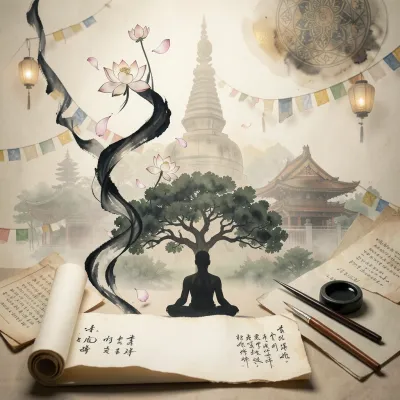
Buddhist Poetics and Literature explores how Buddhist traditions across cultures and historical periods have employed poetry, parables, and narrative not merely as illustrations of doctrine but as active vehicles for awakening. The book argues that language itself can become a path—where a line break quiets the mind, a parable unsettles habitual perception, and a chant calibrates attention to breath—transforming literary engagement into contemplative practice. Rather than presenting a static museum of texts, it invites readers into a living dialogue where reading and writing cultivate perception, clarify ethical intention, and invite compassion through direct experience of the Dharma.
The work traces a sweeping chronological and thematic journey, beginning with early Pali compositions like the Dhammapada's aphoristic verses and the personal testimonies of the Theragatha/Therigatha, then moving through narrative cycles such as the Jataka Tales and Avadanas. It examines Mahayana innovations including the Lotus Sutra's parables of skillful means, Prajnaparamita's paradoxical explorations of emptiness, and the confrontational rhetoric of Chan/Zen koans. The survey continues through hermit poetry traditions (Hanshan, Ryōkan), Tang Dynasty landscape aesthetics, Bashō's haiku form, Tibetan Songs of Realization (Milarepa), devotional liturgy, ethical narratives, women's voices, translation challenges, metaphor and imagery, humor and holy fools, modern/contemporary expressions (Thich Nhat Hanh, Ko Un), diaspora writings, ecological applications, narratives of healing and loss, and concludes with practical methods for contemplative writing and invitations for personal creative engagement.
Central to the book's thesis is the idea that Buddhist literature performs awakening through specific literary devices: impermanence finds expression in rhythmic cadence and fleeting imagery; compassion drives narrative engine and ethical imagination; emptiness functions as spacious grammar that undermines reification; and interbeing serves as a metaphor refusing separation. The text highlights how diverse forms—from the stark paradox of koans to the gentle observation of haiku, from the communal resonance of liturgical chant to the solitary insight of hermit verse—each cultivate distinct aspects of the path. Throughout, the book pairs analysis with contemplative invitations, encouraging readers to engage with texts not just intellectually but through bodily awareness, breath, and compassionate attention, transforming the page into a field of awakening where every image is an opening and every silence a teacher.
What You'll Find Inside:
- How Buddhist traditions use poetry, parable, and narrative as vehicles of awakening that perform rather than merely illustrate teachings, with language itself becoming a path to wisdom
- Exploration of early Buddhist verse (Dhammapada, Theragatha/Therigatha) as portable contemplations and personal testimonies of awakening from diverse social backgrounds
- Analysis of narrative cycles like Jatakas and Avadanas that illustrate karma, compassion, and ethical imagination through vivid stories of virtue and consequence
- Examination of Mahayana innovations including Lotus Sutra's skillful means parables, Prajnaparamita's poetic philosophy of emptiness, and Zen koan traditions that challenge conceptual thinking
- Guidance for contemplative writing practice that transforms reading into active inquiry through prompts for journaling, poetry, and personal narrative rooted in Buddhist principles
Who's It For:
This book is ideal for Buddhist practitioners seeking to deepen their engagement with literary aspects of the tradition, students of Buddhist studies or comparative literature interested in cross-cultural expressions of awakening, and writers or poets looking for contemplative writing approaches rooted in Buddhist principles. It will particularly benefit those who wish to transform passive reading into active practice through the book's contemplative writing prompts, as well as anyone interested in how literature can function as a path to wisdom, ethical development, and direct insight across diverse Buddhist traditions from ancient to contemporary voices.
Table of Contents:
- Introduction
- Chapter 1 Poetics of Awakening: Why Literature Matters in Buddhism
- Chapter 2 Sound, Silence, and the Dharma: Meter, Chant, and Mantra
- Chapter 3 The Dhammapada and the Art of Aphorism
- Chapter 4 Voices of Early Monastics: Theragatha and Therigatha
- Chapter 5 Story as Compass: Reading the Jataka Tales
- Chapter 6 Parable and Skillful Means: The Lotus Sutra’s Narrative Art
- Chapter 7 Emptiness and Form: Prajnaparamita as Poetic Philosophy
- Chapter 8 Exemplars and Wonders: Avadana Narratives
- Chapter 9 Koan, Paradox, and Shock: The Rhetoric of Chan/Zen
- Chapter 10 Cold Mountain and Company: Hermit Poetry Traditions
- Chapter 11 Landscape Mind: Buddhist Aesthetics in Tang Poetry
- Chapter 12 The Way of Haiku: Bashō and the Satori Moment
- Chapter 13 Songs of Realization: Milarepa and Tibetan Gur
- Chapter 14 Devotion in Verse: Praise, Prayer, and Liturgy
- Chapter 15 Ethics Imagined: Compassion, Karma, and Narrative Consequence
- Chapter 16 Women’s Voices and Authority: From the Therigatha to Today
- Chapter 17 Translating the Ineffable: How Buddhist Texts Travel
- Chapter 18 Metaphor, Image, and Emptiness: Reading with Buddhist Philosophies
- Chapter 19 Humor, Tricksters, and Holy Fools in Buddhist Story
- Chapter 20 Modern and Contemporary Voices: Thich Nhat Hanh, Ko Un, and Beyond
- Chapter 21 Diaspora, Identity, and Hybridity in Buddhist Writing
- Chapter 22 Ecology and Interbeing: Buddhist Poetics for a Warming World
- Chapter 23 Suffering, Loss, and Liberation: Narratives of Healing
- Chapter 24 Practice on the Page: Methods of Contemplative Writing
- Chapter 25 Your Turn: Crafting Parable, Poem, and Life Narrative
Author:
Published By:
Date Published:
May 25, 2026
Type:
Nonfiction
Language:
English
Word Count:
46,436 words
Reading Time:
3 hours 15 minutes
Sample:
Order:
Order Buddhist Poetics and Literature (Paperback) on MixCache.com:
Buy NowPrint copy is made to order and ships worldwide. Includes the ebook free, ready to read instantly.
$5 account credit for all new MixCache.com accounts, usable toward any ebook purchase!*