
Browse by Category
Fiction
- Action & Adventure
- African American
- Anthologies
- Children's Fiction
- Classics
- Comics & Graphic Novels
- Coming of Age
- Contemporary
- Cultural & Regional
- Drama
- Erotica
- Fantasy
- General
- Historical Fiction
- Horror
- Humor & Satire
- Literary Fiction
- Mystery, Thriller & Suspense
- Poetry
- Religious & Inspirational
- Romance
- Science Fiction
- Short Stories
- War & Military
- Westerns
- Women's Fiction
- Young Adult
Non-Fiction
- Antiques & Collectibles
- Arts & Photography
- Biographies & Memoirs
- Business & Money
- Children's Non-Fiction
-
Computers & Technology
- Artificial Intelligence
- Computer Science
- Cybersecurity & Cryptography
- Data Science & Analytics
- Databases & Big Data
- Game Development & Design
- General
- Hardware & DIY
- Mobile App Development
- Networking & Cloud Computing
- Operating Systems
- Programming
- Robotics
- Software
- Software Engineering
- User Experience (UX) & Design
- Web Development & Design
- Cooking, Food & Wine
- Crafts, Hobbies & Home
- Education & Teaching
- Engineering
- General
- Health, Fitness & Dieting
-
History
- African History
- African History - North Africa
- African History - Sub-Saharan Africa
- American History
- American History - 20th Century
- American History - Civil War
- American History - Colonial Period
- Ancient History
- Asian History
- Asian History - China
- Asian History - India
- Asian History - Japan
- Asian History - Southeast Asia
- European History
- European History - Ancient Greece
- European History - Ancient Rome
- European History - Medieval
- European History - Modern
- European History - Renaissance
- General
- Middle Eastern History
- Military History
- Military History - Aviation
- Military History - Naval
- Social & Cultural History
- World History
- Humor & Entertainment
- Industrial Technology
- Language Learning
- Law
- LGBTQ+ Non-Fiction
- Literary Criticism
- Medical Books
- Parenting & Relationships
- Philosophy
- Politics & Social Sciences
- Reference
- Religion & Spirituality
-
Science & Math
- Agricultural Sciences
- Astronomy & Space Science
- Behavioral Sciences
- Biological Sciences
- Botany & Plant Science
- Chemistry
- Earth Sciences
- Engineering - Chemical
- Engineering - Civil
- Engineering - Electrical
- Engineering - Mechanical
- Environment
- General
- Geology
- Mathematics
- Nature & Ecology
- Oceanography
- Paleontology
- Physics
- Statistics
- Self-Help
- Sports & Outdoors
- Study Aids
- Sustainability & Green Living
- Textbooks
- Transportation
- Travel
- True Crime
- Urban Planning & Development
- Veterinary Medicine
- Writing & Publishing
Jump to Section
MixCache.com Total Access
Unlimited reading and audiobooks for every book published by MixCache.com.
Included titles carry the MTA badge.
Learn more →
Temperature Extremes
Mankind's Fight against Extreme Heat and Cold
About this book:



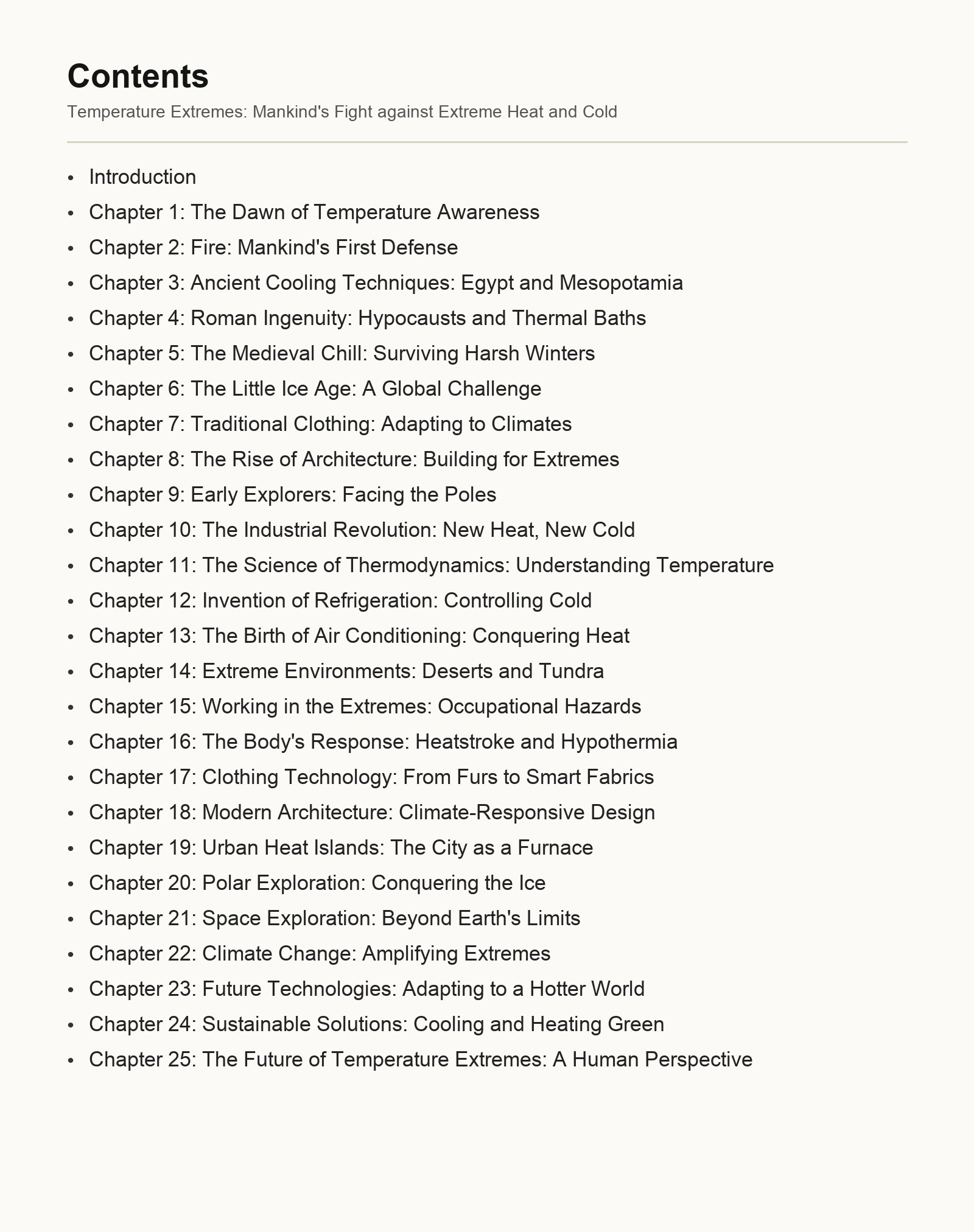
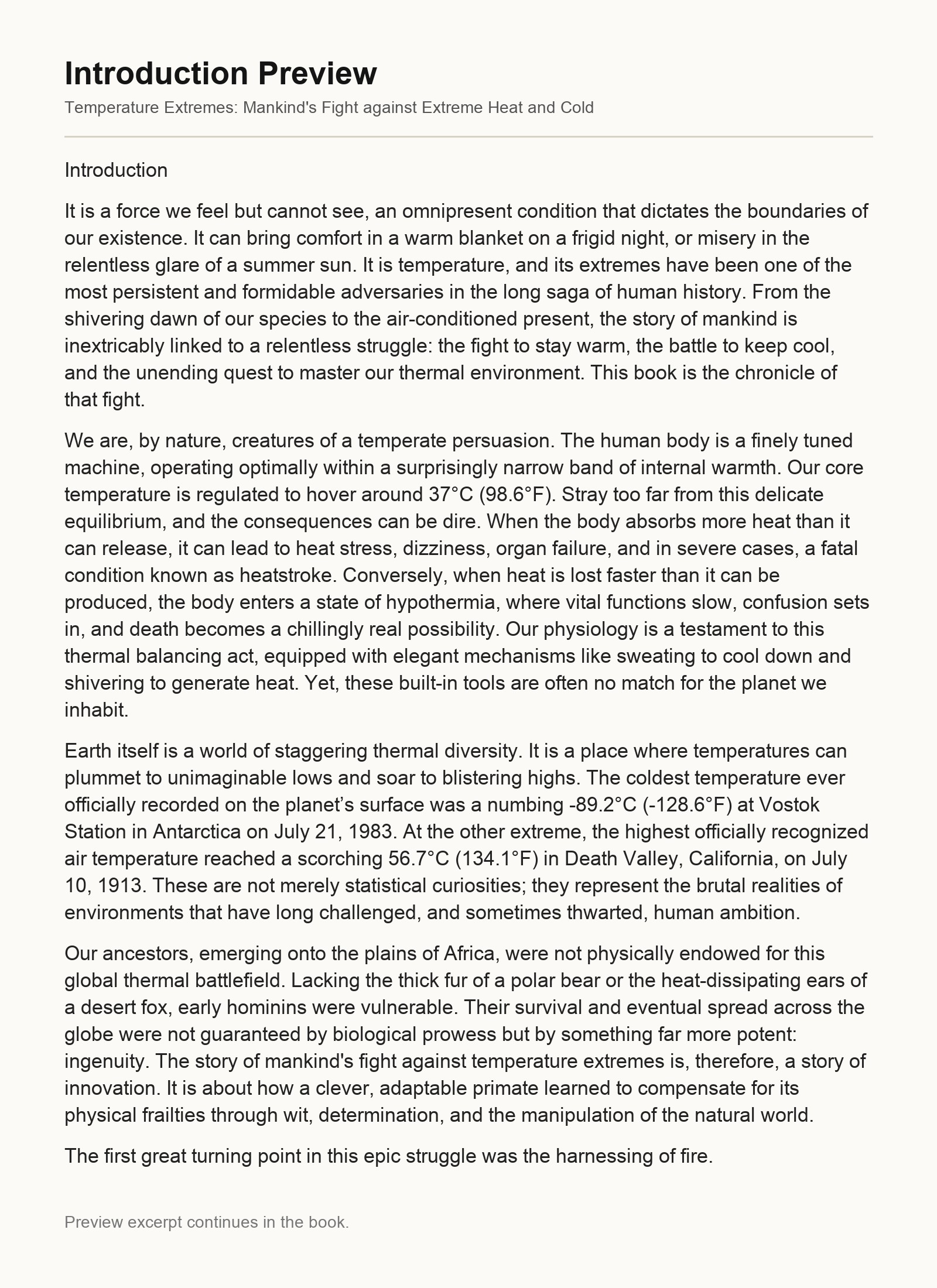
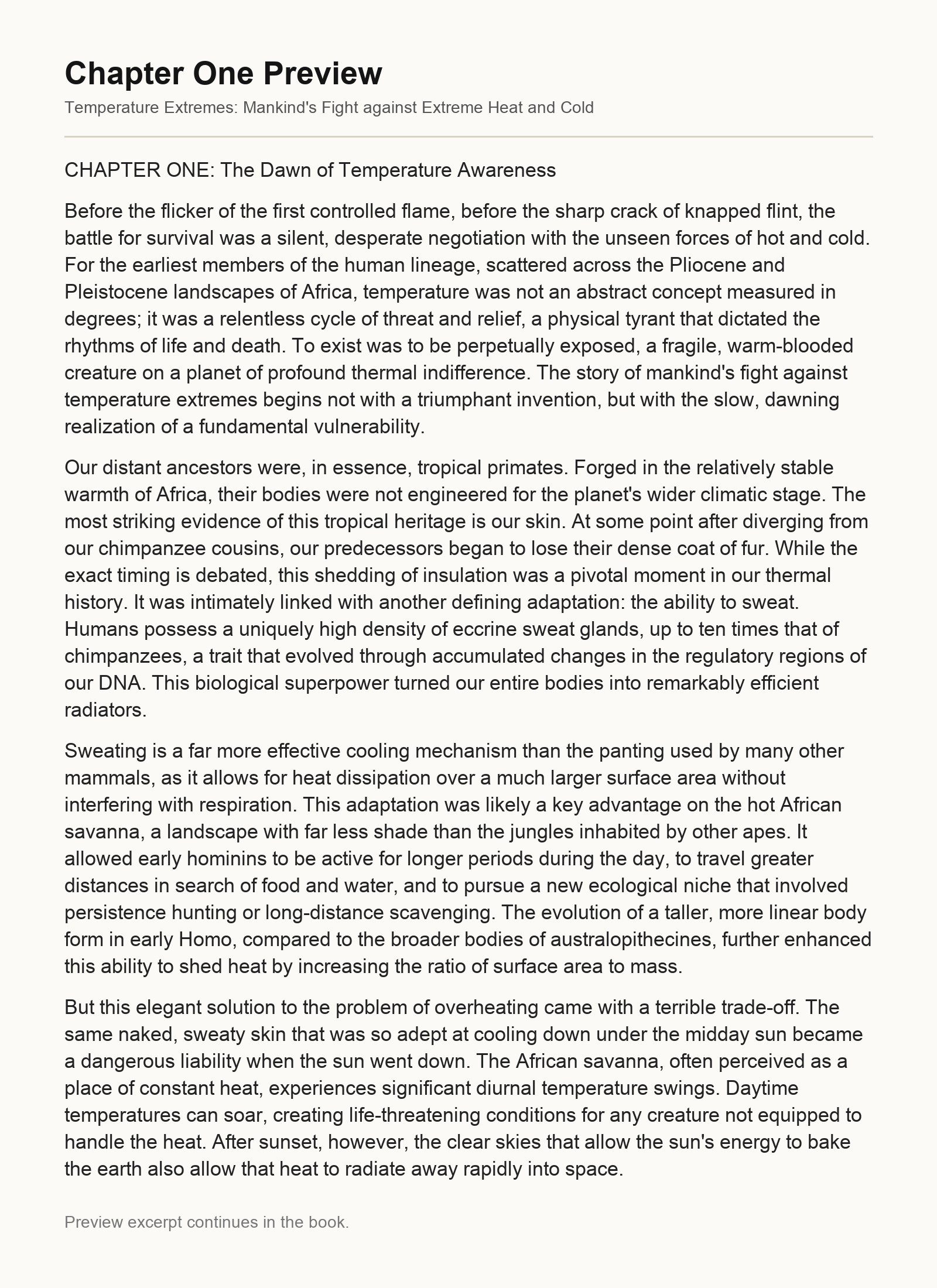
From the first flicker of fire to the whir of modern air‑conditioning units, *Temperature Extremes* traces humanity’s relentless quest to master heat and cold. Readers will discover how early hominins learned to anticipate night‑time chill, how the controlled use of fire became a portable sun, and how ancient Egyptians and Mesopotamians turned mud, water, and wind into the world’s first passive cooling systems. Each chapter builds a vivid picture of ingenuity, showing how a simple hearth, a windcatcher, or a Roman hypocaust reshaped societies and allowed people to stretch beyond the limits of their biology.
The book then walks readers through the ingenuity of the Romans, the harsh realities of medieval winters, and the global test of the Little Ice Age, revealing how clothing, architecture, and social habits evolved in lockstep with shifting climates. You’ll learn how the Industrial Revolution unleashed artificial infernos and factories of ice, how the science of thermodynamics unlocked the secrets of heat flow, and how inventions like mechanical refrigeration and Willis Carrier’s air‑conditioning unit transformed daily life, migration patterns, and city skylines. These stories are not just historical curiosities; they explain why we live where we live today and how our comfort is engineered.
Moving into the modern era, the narrative confronts the paradox of our success: the very technologies that shield us from extremes are now amplifying them through urban heat islands and climate change. Readers will gain a clear understanding of the body’s responses to heatstroke and hypothermia, the occupational hazards faced by those who work in furnaces and freezers, and the cutting‑edge clothing and building designs that promise personal cooling, smart fabrics, and climate‑responsive architecture. The book also explores the frontiers of space exploration, where thermal engineering must balance the scorching sun and the frigid void, and looks ahead to sustainable solutions such as heat pumps, geothermal systems, radiative sky‑cooling, and waste‑heat recovery.
Finally, *Temperature Extremes* offers a human‑centered view of the future, describing how rising temperatures are redrawing work, leisure, and migration patterns, creating a thermal divide between those who can afford constant cooling and those who cannot. It explains the societal, economic, and health challenges of a world where stepping outside requires a daily thermal‑stress forecast, and it highlights the adaptive strategies—cool roofs, green infrastructure, personal cooling garments, and district energy systems—that may help us thrive in a hotter, more volatile planet. By the end, readers will not only understand the epic history of our fight against temperature extremes but also feel equipped to think critically about the technologies and choices that will shape our thermal future.
What You'll Find Inside:
- A chronological narrative tracing humanity's battle against temperature extremes—from the control of fire and passive cooling in ancient Egypt to modern smart fabrics and radiative sky‑cooling materials.
- Detailed explanations of pivotal inventions such as the Roman hypocaust, mechanical refrigeration, Willis Carrier’s air conditioning, and contemporary heat‑pump and geothermal systems that reshaped how we heat and cool our spaces.
- Insights into the evolution of personal and architectural defenses, including layered clothing traditions, windcatchers, courtyards, thick‑walled adobe, and today’s climate‑responsive, net‑zero building designs.
- An examination of the physiological limits of the human body—heatstroke, hypothermia, frostbite—and the occupational hazards faced by workers in extreme heat (steel mills, foundries) and extreme cold (Arctic fisheries, cold storage).
- A critical look at the feedback loop where our heating and cooling technologies exacerbate climate change, followed by sustainable solutions like heat pumps, district energy, waste‑heat recovery, and emerging geo‑engineering concepts.
Who's It For:
This book is ideal for readers interested in the intersection of history, technology, and environmental science—including students, engineers, architects, urban planners, and anyone curious about how humanity has adapted to heat and cold over millennia. It offers both a sweeping historical overview and practical insights into modern cooling and heating innovations, making it valuable for professionals seeking sustainable design strategies as well as general readers who want to understand the challenges and solutions surrounding temperature extremes in the era of climate change.
Table of Contents:
-
Introduction
-
Chapter 1: The Dawn of Temperature Awareness
-
Chapter 2: Fire: Mankind's First Defense
-
Chapter 3: Ancient Cooling Techniques: Egypt and Mesopotamia
-
Chapter 4: Roman Ingenuity: Hypocausts and Thermal Baths
-
Chapter 5: The Medieval Chill: Surviving Harsh Winters
-
Chapter 6: The Little Ice Age: A Global Challenge
-
Chapter 7: Traditional Clothing: Adapting to Climates
-
Chapter 8: The Rise of Architecture: Building for Extremes
-
Chapter 9: Early Explorers: Facing the Poles
-
Chapter 10: The Industrial Revolution: New Heat, New Cold
-
Chapter 11: The Science of Thermodynamics: Understanding Temperature
-
Chapter 12: Invention of Refrigeration: Controlling Cold
-
Chapter 13: The Birth of Air Conditioning: Conquering Heat
-
Chapter 14: Extreme Environments: Deserts and Tundra
-
Chapter 15: Working in the Extremes: Occupational Hazards
-
Chapter 16: The Body's Response: Heatstroke and Hypothermia
-
Chapter 17: Clothing Technology: From Furs to Smart Fabrics
-
Chapter 18: Modern Architecture: Climate-Responsive Design
-
Chapter 19: Urban Heat Islands: The City as a Furnace
-
Chapter 20: Polar Exploration: Conquering the Ice
-
Chapter 21: Space Exploration: Beyond Earth's Limits
-
Chapter 22: Climate Change: Amplifying Extremes
-
Chapter 23: Future Technologies: Adapting to a Hotter World
-
Chapter 24: Sustainable Solutions: Cooling and Heating Green
-
Chapter 25: The Future of Temperature Extremes: A Human Perspective
Author:
Published By:
Date Published:
May 25, 2026
Type:
Nonfiction
Language:
English
Also Available In:
Spanish, French, Italian, Dutch, Portuguese
Word Count:
53,157 words
Reading Time:
3 hours 43 minutes
Sample:
Order:
Buy the Temperature Extremes ebook on MixCache.com:
Buy NowThe full ebook will be available immediately to read instantly on any device.
$5 account credit for all new MixCache.com accounts, usable toward any ebook purchase!*




Ratings & Reviews
Ask Questions About This Book
Have a question about the content? Ask our AI assistant!
Start by asking a question about "Temperature Extremes"
Example: "Does this book mention William Shakespeare?"
Thinking...