Browse by Category
Fiction
- Action & Adventure
- African American
- Anthologies
- Children's Fiction
- Classics
- Comics & Graphic Novels
- Coming of Age
- Contemporary
- Cultural & Regional
- Drama
- Erotica
- Fantasy
- General
- Historical Fiction
- Horror
- Humor & Satire
- Literary Fiction
- Mystery, Thriller & Suspense
- Poetry
- Religious & Inspirational
- Romance
- Science Fiction
- Short Stories
- War & Military
- Westerns
- Women's Fiction
- Young Adult
Non-Fiction
- Antiques & Collectibles
- Arts & Photography
- Biographies & Memoirs
- Business & Money
- Children's Non-Fiction
-
Computers & Technology
- Artificial Intelligence
- Computer Science
- Cybersecurity & Cryptography
- Data Science & Analytics
- Databases & Big Data
- Game Development & Design
- General
- Hardware & DIY
- Mobile App Development
- Networking & Cloud Computing
- Operating Systems
- Programming
- Robotics
- Software
- Software Engineering
- User Experience (UX) & Design
- Web Development & Design
- Cooking, Food & Wine
- Crafts, Hobbies & Home
- Education & Teaching
- Engineering
- General
- Health, Fitness & Dieting
-
History
- African History
- African History - North Africa
- African History - Sub-Saharan Africa
- American History
- American History - 20th Century
- American History - Civil War
- American History - Colonial Period
- Ancient History
- Asian History
- Asian History - China
- Asian History - India
- Asian History - Japan
- Asian History - Southeast Asia
- European History
- European History - Ancient Greece
- European History - Ancient Rome
- European History - Medieval
- European History - Modern
- European History - Renaissance
- General
- Middle Eastern History
- Military History
- Military History - Aviation
- Military History - Naval
- Social & Cultural History
- World History
- Humor & Entertainment
- Industrial Technology
- Language Learning
- Law
- LGBTQ+ Non-Fiction
- Literary Criticism
- Medical Books
- Parenting & Relationships
- Philosophy
- Politics & Social Sciences
- Reference
- Religion & Spirituality
-
Science & Math
- Agricultural Sciences
- Astronomy & Space Science
- Behavioral Sciences
- Biological Sciences
- Botany & Plant Science
- Chemistry
- Earth Sciences
- Engineering - Chemical
- Engineering - Civil
- Engineering - Electrical
- Engineering - Mechanical
- Environment
- General
- Geology
- Mathematics
- Nature & Ecology
- Oceanography
- Paleontology
- Physics
- Statistics
- Self-Help
- Sports & Outdoors
- Study Aids
- Sustainability & Green Living
- Textbooks
- Transportation
- Travel
- True Crime
- Urban Planning & Development
- Veterinary Medicine
- Writing & Publishing
Jump to Section
MixCache.com Total Access
Unlimited reading and audiobooks for every book published by MixCache.com.
Included titles carry the MTA badge.
Learn more →
Europe
A Concise History
About this book:
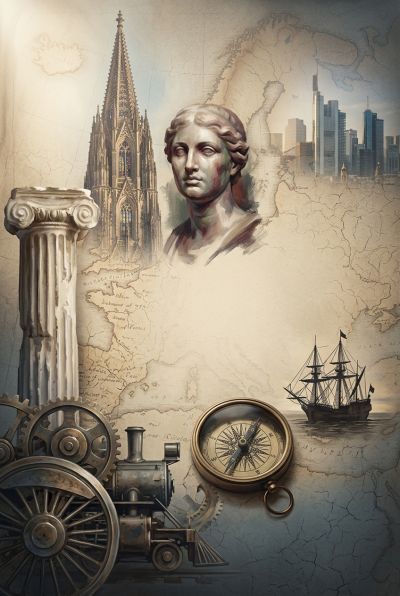


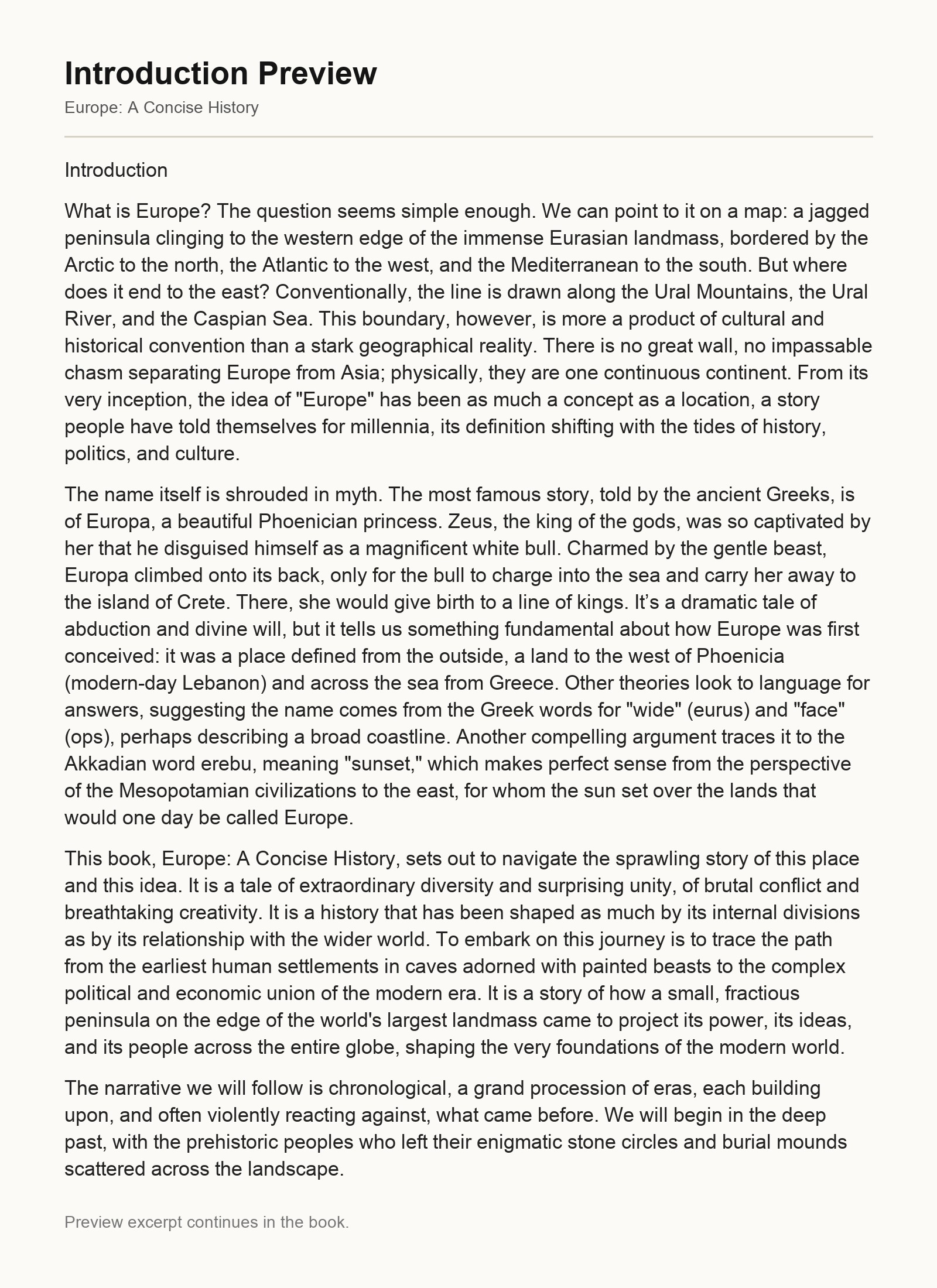
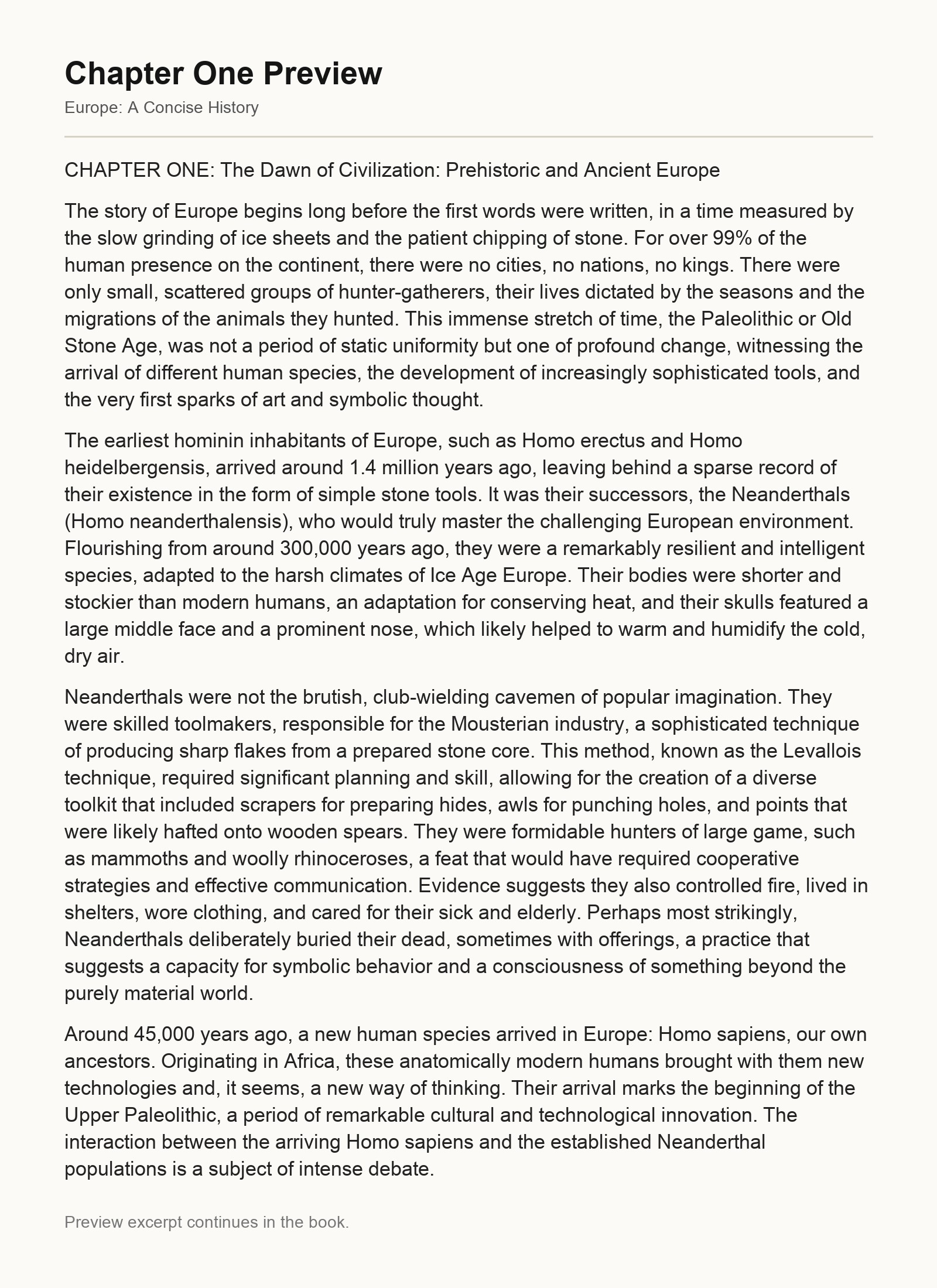
Europe: A Concise History invites readers on a sweeping journey through the continent’s past, from the earliest hunter‑gatherer bands that left their marks on stone caves to the complex political and economic union of the twenty‑first century. Dr Alex Bugeja presents a clear, chronological narrative that connects each era—prehistoric settlements, the rise of Greece and Rome, the medieval world of knights and cathedrals, the Renaissance rebirth, the Reformation’s religious upheaval, the Age of Exploration, the Industrial Revolution, and the tumultuous twentieth century—showing how each period built upon, reacted against, and transformed what came before.
Readers will discover how Europe’s identity has been shaped by the constant tension between unity and fragmentation, from the dream of a Roman‑style empire to the modern push for European integration. They will explore the interplay of religious faith and secular power, witnessing how Christendom gave way to religious wars, Enlightenment secularism, and the ongoing negotiation of church and state. The book also highlights the movement of peoples—migrations, invasions, colonization, and the ongoing flows that continue to redefine European societies today—revealing how these currents have left lasting cultural and demographic imprints.
Through vivid storytelling, the text illuminates the ideas that originated in Europe and reshaped the world: democracy, human rights, individualism, the scientific method, and the darker legacies of absolutism, racial supremacy, fascism, and communism. By tracing these concepts from the Agora of Athens to the salons of Enlightenment Paris and beyond, readers gain insight into the intellectual foundations that have inspired revolutions, toppled monarchies, and fueled global movements for change, while also confronting the continent’s capacity for both profound creativity and catastrophic destruction.
The work emphasizes Europe’s role as a bridge between East and West, showing how encounters with Islamic civilization, the Byzantine Empire, and the Columbian Exchange introduced new knowledge, goods, and perspectives that sparked medieval revivals, Renaissance art, and modern scientific thought. Readers will experience how trade routes, technological innovations, and artistic movements crossed borders, creating a shared yet diverse cultural heritage that still influences contemporary life.
Finally, the book equips readers to understand the present by revealing how today’s political borders, economic systems, and cultural assumptions are direct products of Europe’s long, turbulent history. By grasping the forces that have driven war, peace, innovation, and conflict, readers will be better prepared to engage with current debates about migration, nationalism, European integration, and the continent’s place in a rapidly changing world. Europe: A Concise History offers not just a record of the past, but a lens through which to view the ongoing story of a continent that continues to be made and remade with each generation.
What You'll Find Inside:
- Traces Europe's journey from prehistoric settlements and ancient civilizations through medieval kingdoms to the modern European Union, showing how geography and culture shaped its development.
- Explores the constant tension between European unity and fragmentation, from Roman imperial dreams to the rise of nation-states and contemporary integration efforts.
- Examines how religious conflict—from pagan rituals to Christian schisms and the Reformation—reshaped European politics, society, and its relationship with secular power.
- Details Europe's global impact through exploration, imperialism, and the spread of transformative ideas like democracy, human rights, and the scientific method, while confronting its darker legacies.
- Highlights pivotal turning points including the Black Death, Renaissance, Scientific Revolution, Enlightenment, French Revolution, Industrial Revolution, and World Wars that fundamentally altered European society.
Who's It For:
This book is ideal for students, history enthusiasts, and general readers seeking a comprehensive yet accessible overview of European history. It would particularly benefit those preparing for academic study in history, political science, or international relations who need a solid foundation in Europe's historical development. General readers interested in understanding how Europe's past shapes current global politics, cultural dynamics, and ideological debates will find valuable insights. The book serves both as an introductory text and a reference for those wanting to explore specific periods in greater depth.
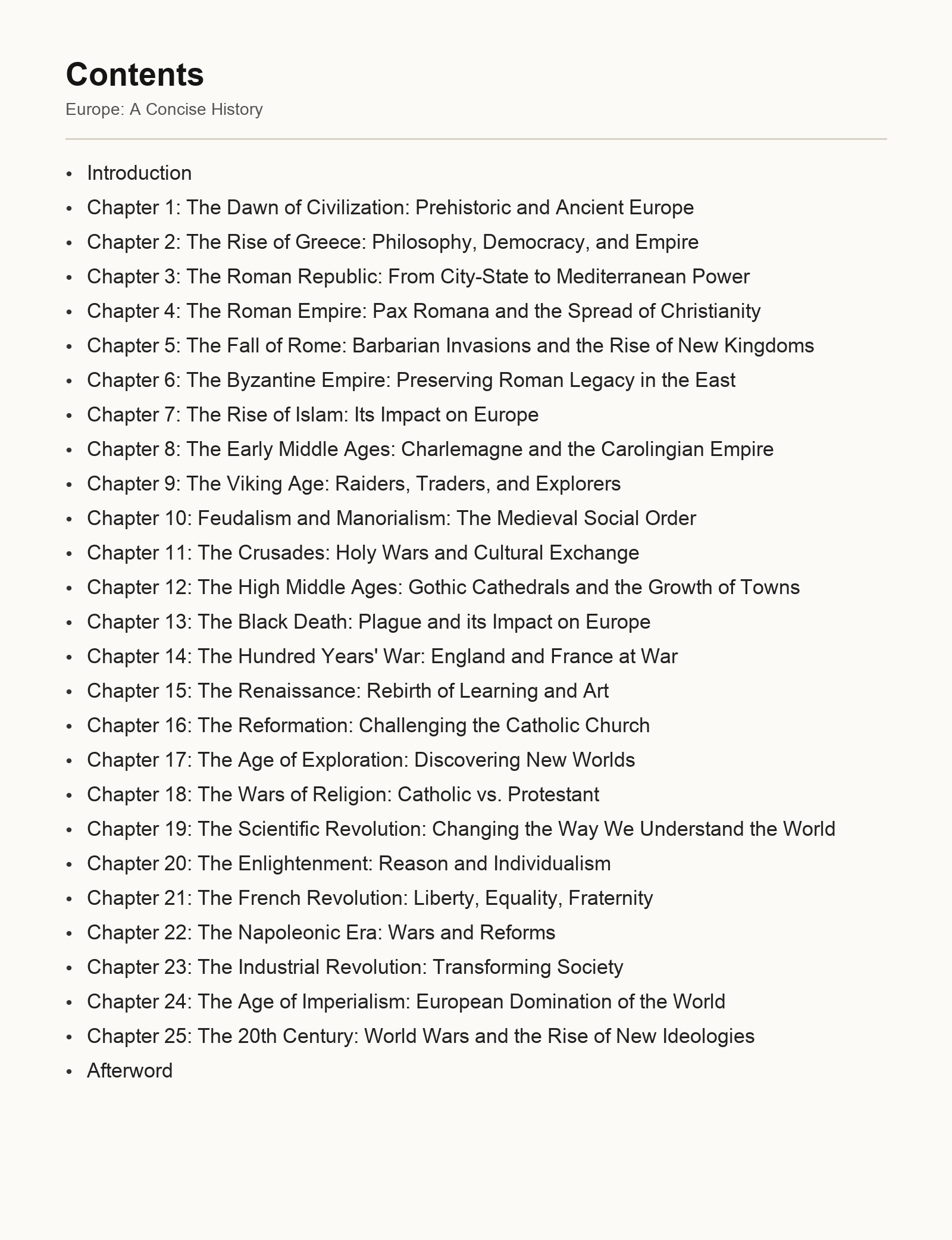
Table of Contents:
-
Introduction
-
Chapter 1: The Dawn of Civilization: Prehistoric and Ancient Europe
-
Chapter 2: The Rise of Greece: Philosophy, Democracy, and Empire
-
Chapter 3: The Roman Republic: From City-State to Mediterranean Power
-
Chapter 4: The Roman Empire: Pax Romana and the Spread of Christianity
-
Chapter 5: The Fall of Rome: Barbarian Invasions and the Rise of New Kingdoms
-
Chapter 6: The Byzantine Empire: Preserving Roman Legacy in the East
-
Chapter 7: The Rise of Islam: Its Impact on Europe
-
Chapter 8: The Early Middle Ages: Charlemagne and the Carolingian Empire
-
Chapter 9: The Viking Age: Raiders, Traders, and Explorers
-
Chapter 10: Feudalism and Manorialism: The Medieval Social Order
-
Chapter 11: The Crusades: Holy Wars and Cultural Exchange
-
Chapter 12: The High Middle Ages: Gothic Cathedrals and the Growth of Towns
-
Chapter 13: The Black Death: Plague and its Impact on Europe
-
Chapter 14: The Hundred Years' War: England and France at War
-
Chapter 15: The Renaissance: Rebirth of Learning and Art
-
Chapter 16: The Reformation: Challenging the Catholic Church
-
Chapter 17: The Age of Exploration: Discovering New Worlds
-
Chapter 18: The Wars of Religion: Catholic vs. Protestant
-
Chapter 19: The Scientific Revolution: Changing the Way We Understand the World
-
Chapter 20: The Enlightenment: Reason and Individualism
-
Chapter 21: The French Revolution: Liberty, Equality, Fraternity
-
Chapter 22: The Napoleonic Era: Wars and Reforms
-
Chapter 23: The Industrial Revolution: Transforming Society
-
Chapter 24: The Age of Imperialism: European Domination of the World
-
Chapter 25: The 20th Century: World Wars and the Rise of New Ideologies
-
Afterword
Author:
Published By:
Date Published:
May 24, 2026
Type:
Nonfiction
Language:
English
Also Available In:
German, Spanish, French, Portuguese
Word Count:
72,006 words
Reading Time:
5 hours 3 minutes
Sample:
Order:
Order Europe (Hardcover) on MixCache.com:
Buy NowPrint copy is made to order and ships worldwide. Includes the ebook free, ready to read instantly.
$5 account credit for all new MixCache.com accounts, usable toward any ebook purchase!*