Browse by Category
Fiction
- Action & Adventure
- African American
- Anthologies
- Children's Fiction
- Classics
- Comics & Graphic Novels
- Coming of Age
- Contemporary
- Cultural & Regional
- Drama
- Erotica
- Fantasy
- General
- Historical Fiction
- Horror
- Humor & Satire
- Literary Fiction
- Mystery, Thriller & Suspense
- Poetry
- Religious & Inspirational
- Romance
- Science Fiction
- Short Stories
- War & Military
- Westerns
- Women's Fiction
- Young Adult
Non-Fiction
- Antiques & Collectibles
- Arts & Photography
- Biographies & Memoirs
- Business & Money
- Children's Non-Fiction
-
Computers & Technology
- Artificial Intelligence
- Computer Science
- Cybersecurity & Cryptography
- Data Science & Analytics
- Databases & Big Data
- Game Development & Design
- General
- Hardware & DIY
- Mobile App Development
- Networking & Cloud Computing
- Operating Systems
- Programming
- Robotics
- Software
- Software Engineering
- User Experience (UX) & Design
- Web Development & Design
- Cooking, Food & Wine
- Crafts, Hobbies & Home
- Education & Teaching
- Engineering
- General
- Health, Fitness & Dieting
-
History
- African History
- African History - North Africa
- African History - Sub-Saharan Africa
- American History
- American History - 20th Century
- American History - Civil War
- American History - Colonial Period
- Ancient History
- Asian History
- Asian History - China
- Asian History - India
- Asian History - Japan
- Asian History - Southeast Asia
- European History
- European History - Ancient Greece
- European History - Ancient Rome
- European History - Medieval
- European History - Modern
- European History - Renaissance
- General
- Middle Eastern History
- Military History
- Military History - Aviation
- Military History - Naval
- Social & Cultural History
- World History
- Humor & Entertainment
- Industrial Technology
- Language Learning
- Law
- LGBTQ+ Non-Fiction
- Literary Criticism
- Medical Books
- Parenting & Relationships
- Philosophy
- Politics & Social Sciences
- Reference
- Religion & Spirituality
-
Science & Math
- Agricultural Sciences
- Astronomy & Space Science
- Behavioral Sciences
- Biological Sciences
- Botany & Plant Science
- Chemistry
- Earth Sciences
- Engineering - Chemical
- Engineering - Civil
- Engineering - Electrical
- Engineering - Mechanical
- Environment
- General
- Geology
- Mathematics
- Nature & Ecology
- Oceanography
- Paleontology
- Physics
- Statistics
- Self-Help
- Sports & Outdoors
- Study Aids
- Sustainability & Green Living
- Textbooks
- Transportation
- Travel
- True Crime
- Urban Planning & Development
- Veterinary Medicine
- Writing & Publishing
Jump to Section
MixCache.com Total Access
Unlimited reading and audiobooks for every book published by MixCache.com.
Included titles carry the MTA badge.
Learn more →
Boardrooms of War
Inside the Companies That Arm the World
About this book:



Step inside the hidden corridors where the instruments of modern conflict are conceived, financed, and shipped to battlefields around the globe. This book pulls back the curtain on the boardrooms of the world’s largest defense contractors, revealing how decisions made in quiet meetings translate into fighter jets, missile systems, naval vessels, and the high‑tech components that keep today’s militaries operating. Readers will gain a clear view of the scale and structure of these corporations, from the multinational giants of the United States and Europe to the rapidly rising powerhouses of China, Russia, South Korea, Israel, and Japan.
Through detailed profiles of companies such as Lockheed Martin, RTX, Northrop Grumman, BAE Systems, AVIC, NORINCO, and many others, you will learn how each firm organizes its divisions— aeronautics, missiles, space, naval systems, cyber warfare, and more— and how their flagship products like the F‑35 Lightning II, THAAD, B‑21 Raider, P‑8 Poseidon, and the VT‑4 tank shape national security strategies. The narrative explains the technology driving future warfare, including artificial intelligence, autonomous systems, hypersonic flight, directed energy, and the networked battlefield that links sensors, shooters, and commanders in real time.
Beyond hardware, the book explores the intricate web of politics, economics, and influence that sustains the defense industry. You will discover how lobbying, offset agreements, government‑to‑government sales, and the revolving door between military service and corporate leadership create a symbiotic relationship between states and the corporations that arm them. Case studies illustrate how billions of dollars in contracts are secured, how international arms deals are structured, and how commercial innovations— from jet engines to GPS— often trace their origins to military research and development.
Readers will also experience the human side of this enterprise: the engineers pushing the limits of stealth and sensor fusion, the executives balancing shareholder expectations with national security imperatives, and the workers on assembly lines building everything from nuclear submarines to precision‑guided munitions. By examining both the triumphs and the controversies— from cost overruns on the KC‑46 tanker to sanctions on Chinese electronics giants— the book offers a balanced, fact‑based portrait of an industry that is simultaneously a driver of technological progress and a potent instrument of foreign policy.
Ultimately, this journey inside the boardrooms of war equips you with a deeper understanding of how modern warfare is planned, funded, and executed at the highest levels of corporate power. Whether you are a student of international relations, a professional in aerospace or defense, a policy analyst, or simply a curious reader, you will finish with a clear grasp of the economic forces, technological trends, and geopolitical stakes that shape the tools of conflict and the peace that follows.
What You'll Find Inside:
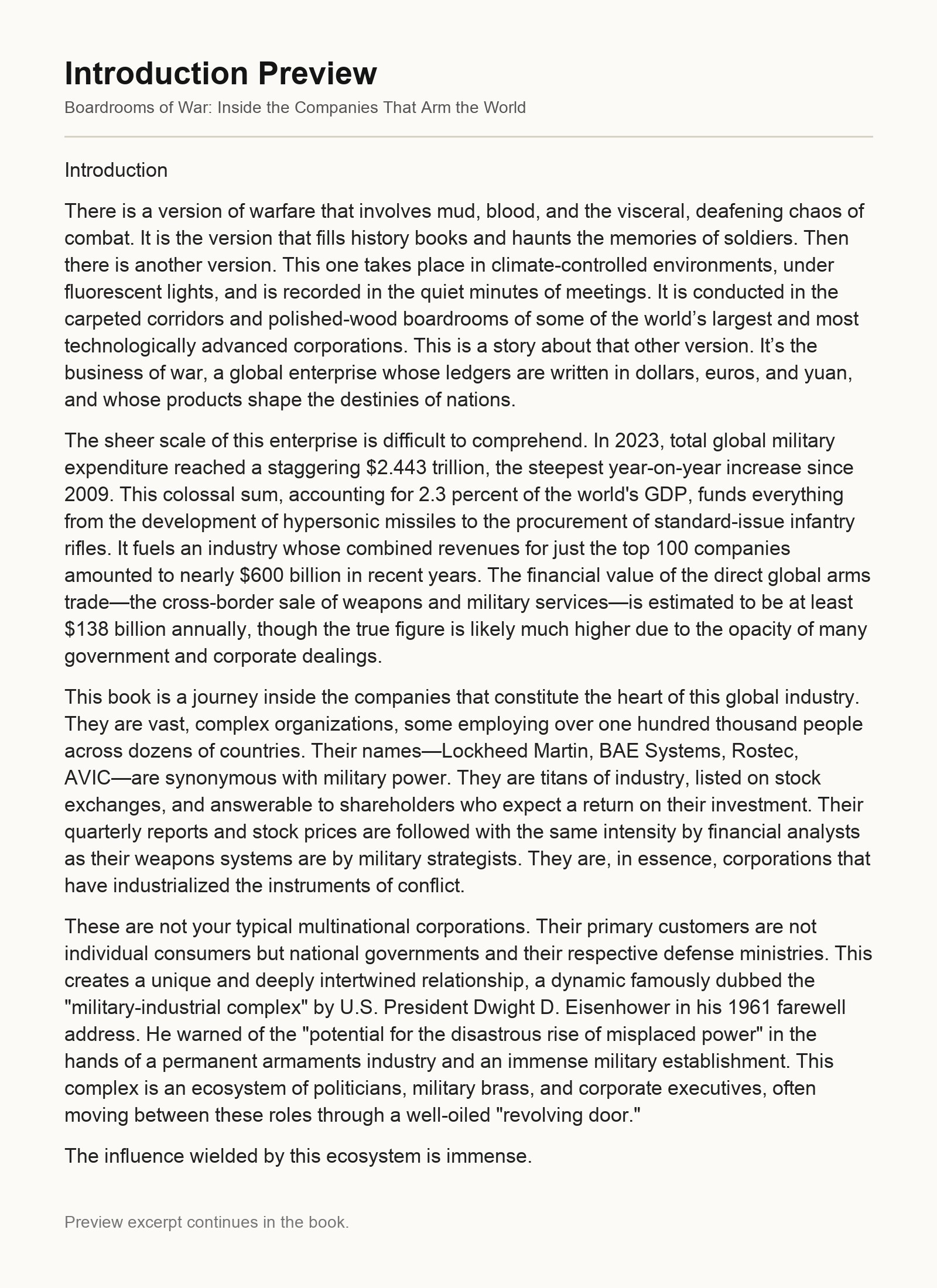
- The book examines the global defense industry as a 'business of war' where major contractors operate in boardrooms rather than battlefields, shaping national security through corporate decisions.
- It profiles 25 major defense companies worldwide, including American giants (Lockheed Martin, RTX), European champions (BAE Systems, Airbus), Asian powerhouses (AVIC, NORINCO), and specialized technology firms (L3Harris, Thales).
- Explores the symbiotic relationship between defense contractors and governments, detailing lobbying efforts, the 'military-industrial complex,' and how corporate strategy aligns with national security priorities.
- Highlights how defense R&D drives technological innovation with civilian applications (jet engines, GPS, internet) and current focus on future technologies like AI, autonomous systems, cyber warfare, and hypersonics.
- Explains complex international arms deal mechanics including offset agreements, technology transfer, and how defense sales function as tools of foreign policy and economic statecraft.
Who's It For:
This book is ideal for business professionals, analysts, and investors seeking to understand the defense industry's corporate structure and market dynamics. It will also benefit students and scholars of international relations, political science, or defense studies who want insight into the real-world operations of the military-industrial complex. Professionals working in government defense procurement, policy-making, or adjacent industries like aerospace and technology will find valuable context on how defense contractors operate and influence global security. The accessible yet detailed approach makes it suitable for readers with some background in business or international affairs who wish to deepen their understanding of this critical global sector.
Table of Contents:
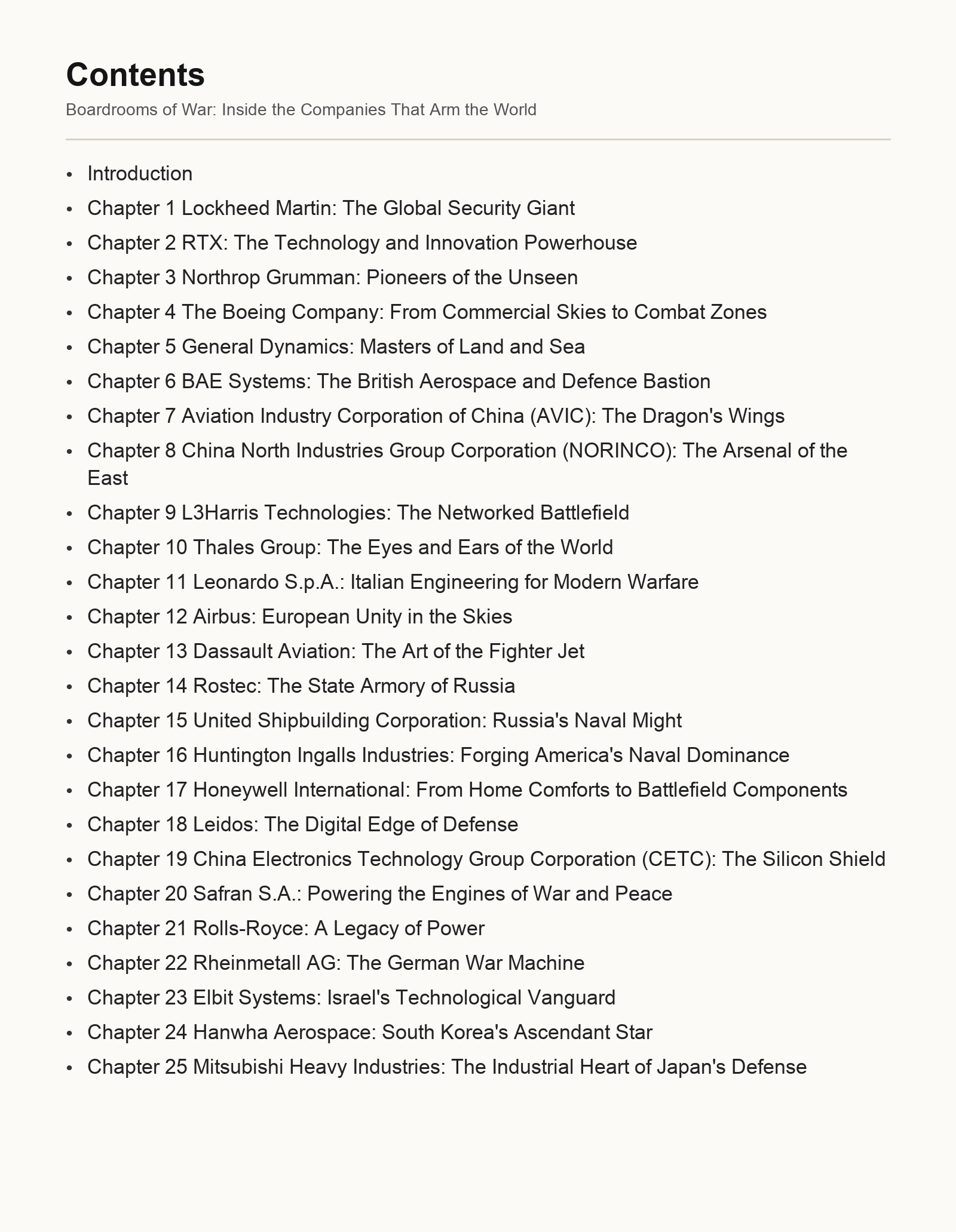
- Introduction
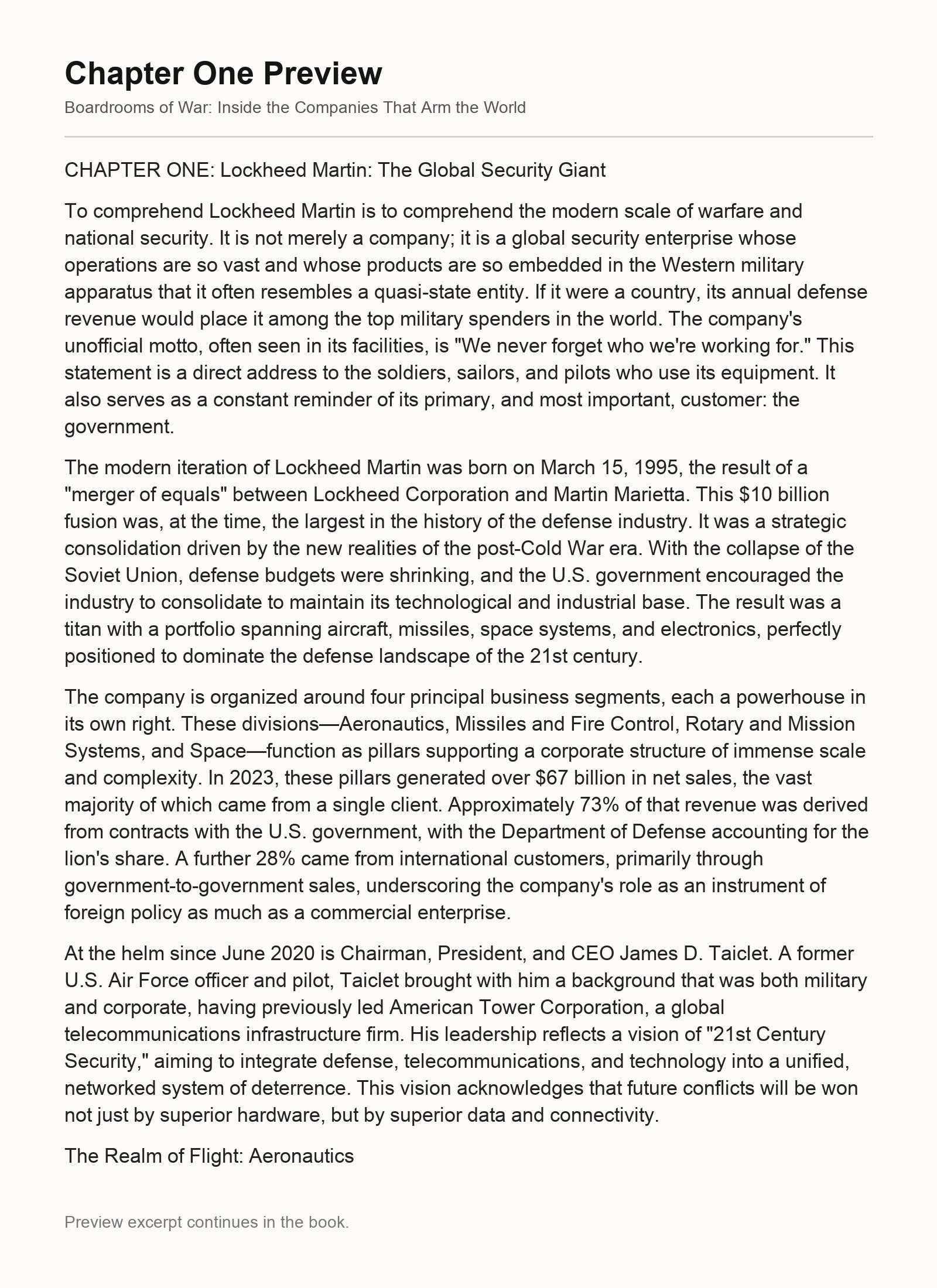
- Chapter 1 Lockheed Martin: The Global Security Giant
- Chapter 2 RTX: The Technology and Innovation Powerhouse
- Chapter 3 Northrop Grumman: Pioneers of the Unseen
- Chapter 4 The Boeing Company: From Commercial Skies to Combat Zones
- Chapter 5 General Dynamics: Masters of Land and Sea
- Chapter 6 BAE Systems: The British Aerospace and Defence Bastion
- Chapter 7 Aviation Industry Corporation of China (AVIC): The Dragon's Wings
- Chapter 8 China North Industries Group Corporation (NORINCO): The Arsenal of the East
- Chapter 9 L3Harris Technologies: The Networked Battlefield
- Chapter 10 Thales Group: The Eyes and Ears of the World
- Chapter 11 Leonardo S.p.A.: Italian Engineering for Modern Warfare
- Chapter 12 Airbus: European Unity in the Skies
- Chapter 13 Dassault Aviation: The Art of the Fighter Jet
- Chapter 14 Rostec: The State Armory of Russia
- Chapter 15 United Shipbuilding Corporation: Russia's Naval Might
- Chapter 16 Huntington Ingalls Industries: Forging America's Naval Dominance
- Chapter 17 Honeywell International: From Home Comforts to Battlefield Components
- Chapter 18 Leidos: The Digital Edge of Defense
- Chapter 19 China Electronics Technology Group Corporation (CETC): The Silicon Shield
- Chapter 20 Safran S.A.: Powering the Engines of War and Peace
- Chapter 21 Rolls-Royce: A Legacy of Power
- Chapter 22 Rheinmetall AG: The German War Machine
- Chapter 23 Elbit Systems: Israel's Technological Vanguard
- Chapter 24 Hanwha Aerospace: South Korea's Ascendant Star
- Chapter 25 Mitsubishi Heavy Industries: The Industrial Heart of Japan's Defense
Author:
Published By:
Date Published:
May 23, 2026
Type:
Nonfiction
Language:
English
Also Available In:
Word Count:
48,254 words
Reading Time:
3 hours 23 minutes
Sample:
Order:
Order Boardrooms of War (Paperback) on MixCache.com:
Buy NowPrint copy is made to order and ships worldwide. Includes the ebook free, ready to read instantly.
$5 account credit for all new MixCache.com accounts, usable toward any ebook purchase!*