
Browse by Category
Fiction
- Action & Adventure
- African American
- Anthologies
- Children's Fiction
- Classics
- Comics & Graphic Novels
- Coming of Age
- Contemporary
- Cultural & Regional
- Drama
- Erotica
- Fantasy
- General
- Historical Fiction
- Horror
- Humor & Satire
- Literary Fiction
- Mystery, Thriller & Suspense
- Poetry
- Religious & Inspirational
- Romance
- Science Fiction
- Short Stories
- War & Military
- Westerns
- Women's Fiction
- Young Adult
Non-Fiction
- Antiques & Collectibles
- Arts & Photography
- Biographies & Memoirs
- Business & Money
- Children's Non-Fiction
-
Computers & Technology
- Artificial Intelligence
- Computer Science
- Cybersecurity & Cryptography
- Data Science & Analytics
- Databases & Big Data
- Game Development & Design
- General
- Hardware & DIY
- Mobile App Development
- Networking & Cloud Computing
- Operating Systems
- Programming
- Robotics
- Software
- Software Engineering
- User Experience (UX) & Design
- Web Development & Design
- Cooking, Food & Wine
- Crafts, Hobbies & Home
- Education & Teaching
- Engineering
- General
- Health, Fitness & Dieting
-
History
- African History
- African History - North Africa
- African History - Sub-Saharan Africa
- American History
- American History - 20th Century
- American History - Civil War
- American History - Colonial Period
- Ancient History
- Asian History
- Asian History - China
- Asian History - India
- Asian History - Japan
- Asian History - Southeast Asia
- European History
- European History - Ancient Greece
- European History - Ancient Rome
- European History - Medieval
- European History - Modern
- European History - Renaissance
- General
- Middle Eastern History
- Military History
- Military History - Aviation
- Military History - Naval
- Social & Cultural History
- World History
- Humor & Entertainment
- Industrial Technology
- Language Learning
- Law
- LGBTQ+ Non-Fiction
- Literary Criticism
- Medical Books
- Parenting & Relationships
- Philosophy
- Politics & Social Sciences
- Reference
- Religion & Spirituality
-
Science & Math
- Agricultural Sciences
- Astronomy & Space Science
- Behavioral Sciences
- Biological Sciences
- Botany & Plant Science
- Chemistry
- Earth Sciences
- Engineering - Chemical
- Engineering - Civil
- Engineering - Electrical
- Engineering - Mechanical
- Environment
- General
- Geology
- Mathematics
- Nature & Ecology
- Oceanography
- Paleontology
- Physics
- Statistics
- Self-Help
- Sports & Outdoors
- Study Aids
- Sustainability & Green Living
- Textbooks
- Transportation
- Travel
- True Crime
- Urban Planning & Development
- Veterinary Medicine
- Writing & Publishing
Jump to Section
MixCache.com Total Access
Unlimited reading and audiobooks for every book published by MixCache.com.
Included titles carry the MTA badge.
Learn more →A History of Genetics
About this book:
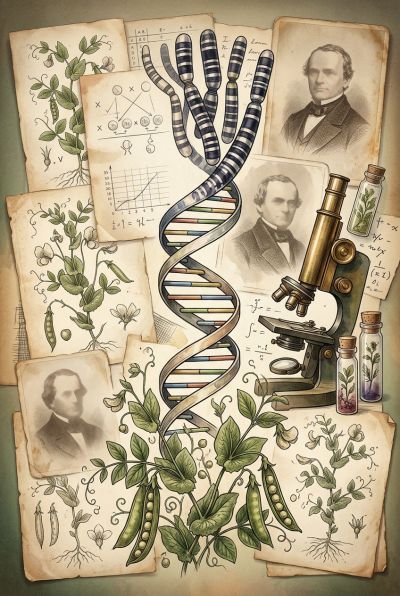
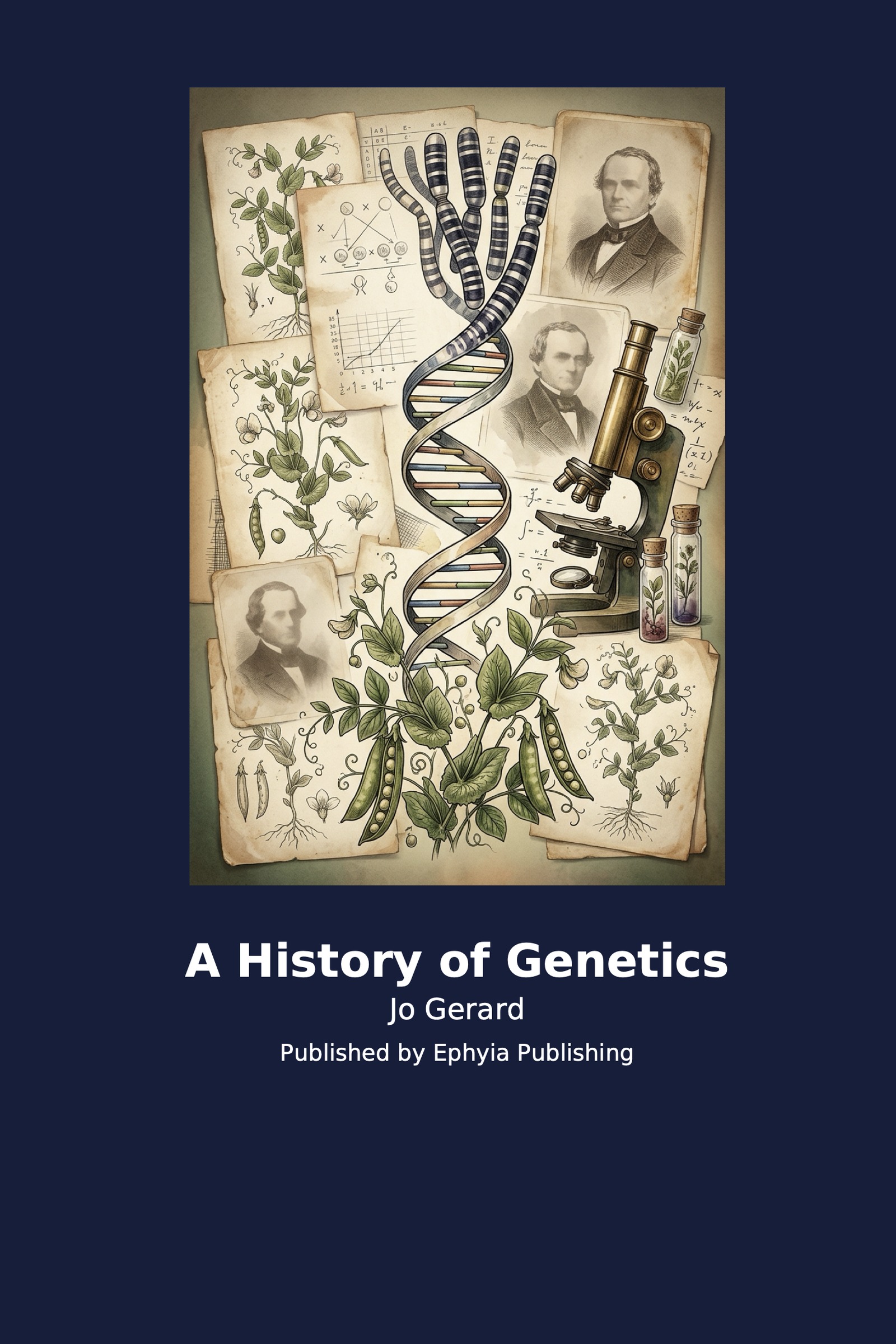
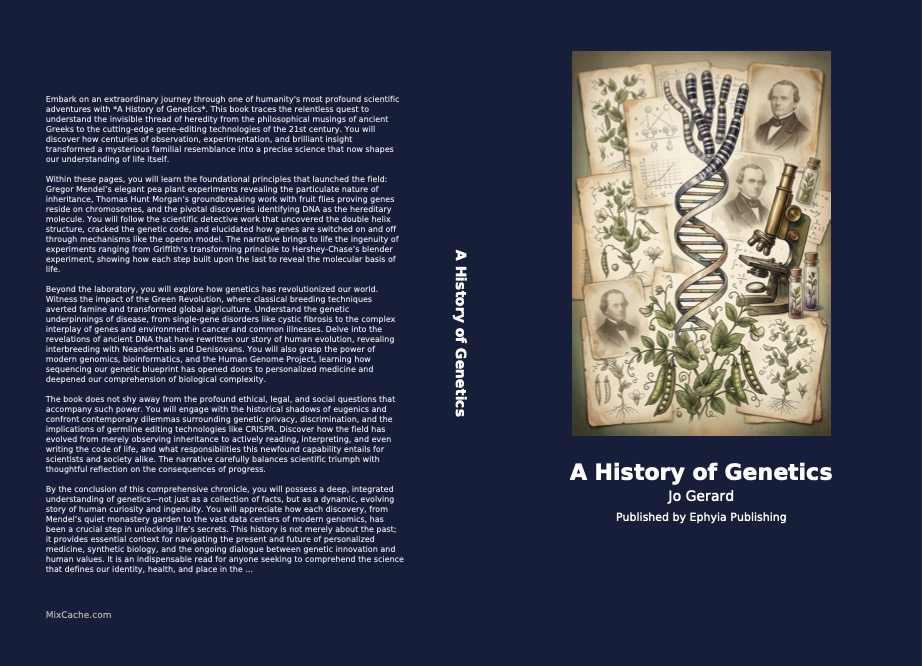
Embark on an extraordinary journey through one of humanity's most profound scientific adventures with *A History of Genetics*. This book traces the relentless quest to understand the invisible thread of heredity from the philosophical musings of ancient Greeks to the cutting-edge gene-editing technologies of the 21st century. You will discover how centuries of observation, experimentation, and brilliant insight transformed a mysterious familial resemblance into a precise science that now shapes our understanding of life itself.
Within these pages, you will learn the foundational principles that launched the field: Gregor Mendel’s elegant pea plant experiments revealing the particulate nature of inheritance, Thomas Hunt Morgan’s groundbreaking work with fruit flies proving genes reside on chromosomes, and the pivotal discoveries identifying DNA as the hereditary molecule. You will follow the scientific detective work that uncovered the double helix structure, cracked the genetic code, and elucidated how genes are switched on and off through mechanisms like the operon model. The narrative brings to life the ingenuity of experiments ranging from Griffith’s transforming principle to Hershey-Chase’s blender experiment, showing how each step built upon the last to reveal the molecular basis of life.
Beyond the laboratory, you will explore how genetics has revolutionized our world. Witness the impact of the Green Revolution, where classical breeding techniques averted famine and transformed global agriculture. Understand the genetic underpinnings of disease, from single-gene disorders like cystic fibrosis to the complex interplay of genes and environment in cancer and common illnesses. Delve into the revelations of ancient DNA that have rewritten our story of human evolution, revealing interbreeding with Neanderthals and Denisovans. You will also grasp the power of modern genomics, bioinformatics, and the Human Genome Project, learning how sequencing our genetic blueprint has opened doors to personalized medicine and deepened our comprehension of biological complexity.
The book does not shy away from the profound ethical, legal, and social questions that accompany such power. You will engage with the historical shadows of eugenics and confront contemporary dilemmas surrounding genetic privacy, discrimination, and the implications of germline editing technologies like CRISPR. Discover how the field has evolved from merely observing inheritance to actively reading, interpreting, and even writing the code of life, and what responsibilities this newfound capability entails for scientists and society alike. The narrative carefully balances scientific triumph with thoughtful reflection on the consequences of progress.
By the conclusion of this comprehensive chronicle, you will possess a deep, integrated understanding of genetics—not just as a collection of facts, but as a dynamic, evolving story of human curiosity and ingenuity. You will appreciate how each discovery, from Mendel’s quiet monastery garden to the vast data centers of modern genomics, has been a crucial step in unlocking life’s secrets. This history is not merely about the past; it provides essential context for navigating the present and future of personalized medicine, synthetic biology, and the ongoing dialogue between genetic innovation and human values. It is an indispensable read for anyone seeking to comprehend the science that defines our identity, health, and place in the natural world.
What You'll Find Inside:
- The complete historical journey of genetics from ancient philosophical theories (pangenesis, preformationism) to 21st-century gene-editing technologies like CRISPR.
- Detailed accounts of pivotal experiments and discoveries: Mendel's pea plants, Morgan's fruit fly work, Avery's transforming principle, Watson-Crick's double helix, Nirenberg's genetic code cracking, and the Human Genome Project.
- The evolution of genetic tools and techniques from microscopic observation to molecular manipulation, including restriction enzymes, PCR, DNA sequencing, and recombinant DNA technology.
- Applications of genetics in transforming agriculture (Green Revolution), medicine (understanding cancer genetics and inherited disorders), and industry (birth of biotechnology and synthetic biology).
- Exploration of the ethical, legal, and social dimensions of genetic science, from historical eugenics movements to contemporary debates about germline editing and genetic privacy.
Who's It For:
This book is ideal for students, educators, and professionals in biology, genetics, medicine, and related life sciences who seek a comprehensive understanding of how genetic knowledge has developed over time. It will particularly benefit those interested in the historical context of modern genetic technologies and their societal implications. Science historians and intellectually curious readers wanting to grasp the profound impact of genetics on our understanding of life, health, and evolution will also find great value in this narrative.
Table of Contents:
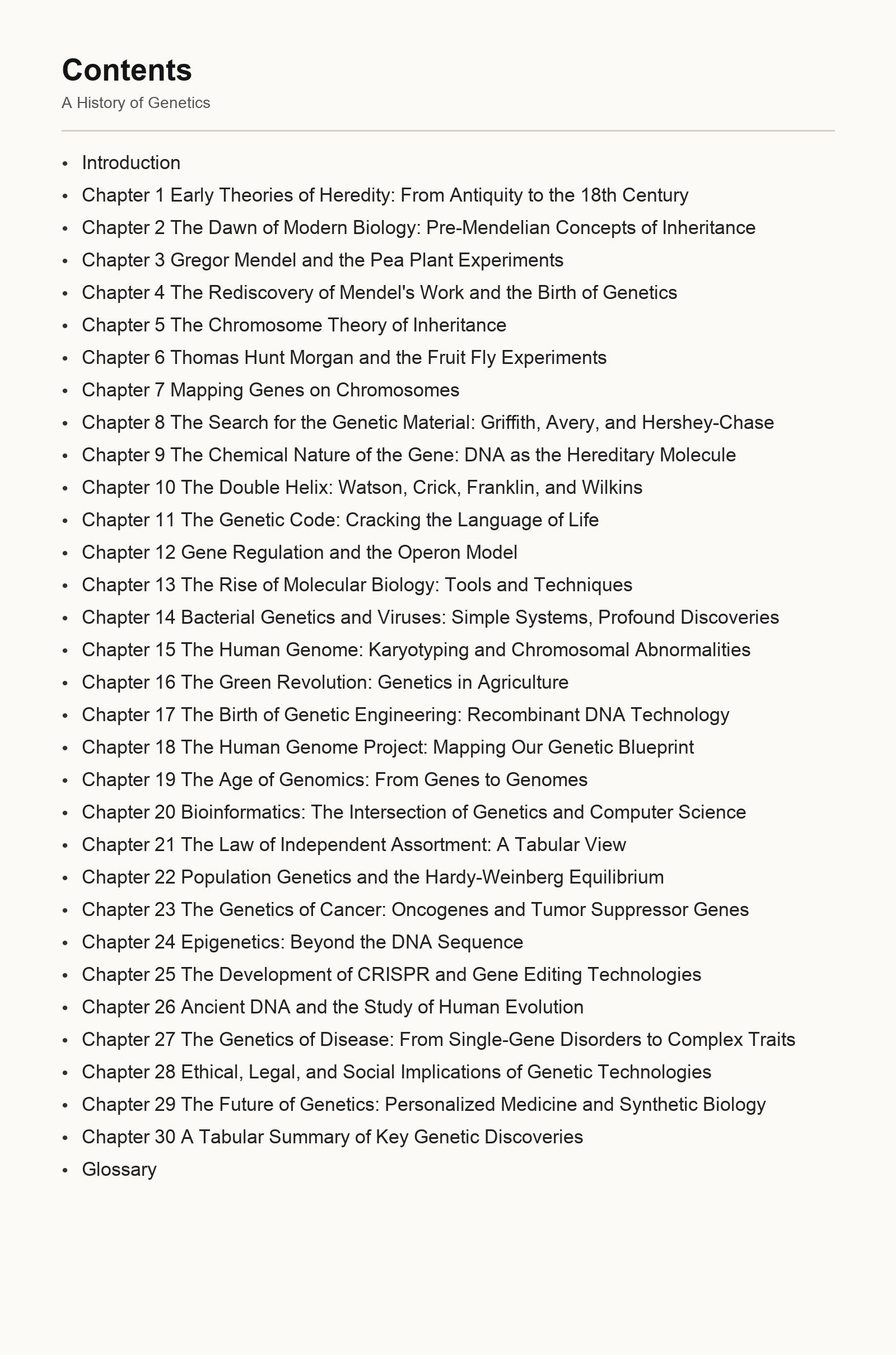
- Introduction
- Chapter 1 Early Theories of Heredity: From Antiquity to the 18th Century
- Chapter 2 The Dawn of Modern Biology: Pre-Mendelian Concepts of Inheritance
- Chapter 3 Gregor Mendel and the Pea Plant Experiments
- Chapter 4 The Rediscovery of Mendel's Work and the Birth of Genetics
- Chapter 5 The Chromosome Theory of Inheritance
- Chapter 6 Thomas Hunt Morgan and the Fruit Fly Experiments
- Chapter 7 Mapping Genes on Chromosomes
- Chapter 8 The Search for the Genetic Material: Griffith, Avery, and Hershey-Chase
- Chapter 9 The Chemical Nature of the Gene: DNA as the Hereditary Molecule
- Chapter 10 The Double Helix: Watson, Crick, Franklin, and Wilkins
- Chapter 11 The Genetic Code: Cracking the Language of Life
- Chapter 12 Gene Regulation and the Operon Model
- Chapter 13 The Rise of Molecular Biology: Tools and Techniques
- Chapter 14 Bacterial Genetics and Viruses: Simple Systems, Profound Discoveries
- Chapter 15 The Human Genome: Karyotyping and Chromosomal Abnormalities
- Chapter 16 The Green Revolution: Genetics in Agriculture
- Chapter 17 The Birth of Genetic Engineering: Recombinant DNA Technology
- Chapter 18 The Human Genome Project: Mapping Our Genetic Blueprint
- Chapter 19 The Age of Genomics: From Genes to Genomes
- Chapter 20 Bioinformatics: The Intersection of Genetics and Computer Science
- Chapter 21 The Law of Independent Assortment: A Tabular View
- Chapter 22 Population Genetics and the Hardy-Weinberg Equilibrium
- Chapter 23 The Genetics of Cancer: Oncogenes and Tumor Suppressor Genes
- Chapter 24 Epigenetics: Beyond the DNA Sequence
- Chapter 25 The Development of CRISPR and Gene Editing Technologies
- Chapter 26 Ancient DNA and the Study of Human Evolution
- Chapter 27 The Genetics of Disease: From Single-Gene Disorders to Complex Traits
- Chapter 28 Ethical, Legal, and Social Implications of Genetic Technologies
- Chapter 29 The Future of Genetics: Personalized Medicine and Synthetic Biology
- Chapter 30 A Tabular Summary of Key Genetic Discoveries
- Glossary
Author:
Published By:
Date Published:
May 21, 2026
Type:
Nonfiction
Language:
English
Word Count:
91,976 words
Reading Time:
6 hours 26 minutes
Sample:
Order:
Buy the A History of Genetics ebook on MixCache.com:
Buy NowThe full ebook will be available immediately to read instantly on any device.
$5 account credit for all new MixCache.com accounts, usable toward any ebook purchase!*





Ratings & Reviews
Ask Questions About This Book
Have a question about the content? Ask our AI assistant!
Start by asking a question about "A History of Genetics"
Example: "Does this book mention William Shakespeare?"
Thinking...