Browse by Category
Fiction
- Action & Adventure
- African American
- Anthologies
- Children's Fiction
- Classics
- Comics & Graphic Novels
- Coming of Age
- Contemporary
- Cultural & Regional
- Drama
- Erotica
- Fantasy
- General
- Historical Fiction
- Horror
- Humor & Satire
- Literary Fiction
- Mystery, Thriller & Suspense
- Poetry
- Religious & Inspirational
- Romance
- Science Fiction
- Short Stories
- War & Military
- Westerns
- Women's Fiction
- Young Adult
Non-Fiction
- Antiques & Collectibles
- Arts & Photography
- Biographies & Memoirs
- Business & Money
- Children's Non-Fiction
-
Computers & Technology
- Artificial Intelligence
- Computer Science
- Cybersecurity & Cryptography
- Data Science & Analytics
- Databases & Big Data
- Game Development & Design
- General
- Hardware & DIY
- Mobile App Development
- Networking & Cloud Computing
- Operating Systems
- Programming
- Robotics
- Software
- Software Engineering
- User Experience (UX) & Design
- Web Development & Design
- Cooking, Food & Wine
- Crafts, Hobbies & Home
- Education & Teaching
- Engineering
- General
- Health, Fitness & Dieting
-
History
- African History
- African History - North Africa
- African History - Sub-Saharan Africa
- American History
- American History - 20th Century
- American History - Civil War
- American History - Colonial Period
- Ancient History
- Asian History
- Asian History - China
- Asian History - India
- Asian History - Japan
- Asian History - Southeast Asia
- European History
- European History - Ancient Greece
- European History - Ancient Rome
- European History - Medieval
- European History - Modern
- European History - Renaissance
- General
- Middle Eastern History
- Military History
- Military History - Aviation
- Military History - Naval
- Social & Cultural History
- World History
- Humor & Entertainment
- Industrial Technology
- Language Learning
- Law
- LGBTQ+ Non-Fiction
- Literary Criticism
- Medical Books
- Parenting & Relationships
- Philosophy
- Politics & Social Sciences
- Reference
- Religion & Spirituality
-
Science & Math
- Agricultural Sciences
- Astronomy & Space Science
- Behavioral Sciences
- Biological Sciences
- Botany & Plant Science
- Chemistry
- Earth Sciences
- Engineering - Chemical
- Engineering - Civil
- Engineering - Electrical
- Engineering - Mechanical
- Environment
- General
- Geology
- Mathematics
- Nature & Ecology
- Oceanography
- Paleontology
- Physics
- Statistics
- Self-Help
- Sports & Outdoors
- Study Aids
- Sustainability & Green Living
- Textbooks
- Transportation
- Travel
- True Crime
- Urban Planning & Development
- Veterinary Medicine
- Writing & Publishing
Jump to Section
MixCache.com Total Access
Unlimited reading and audiobooks for every book published by MixCache.com.
Included titles carry the MTA badge.
Learn more →
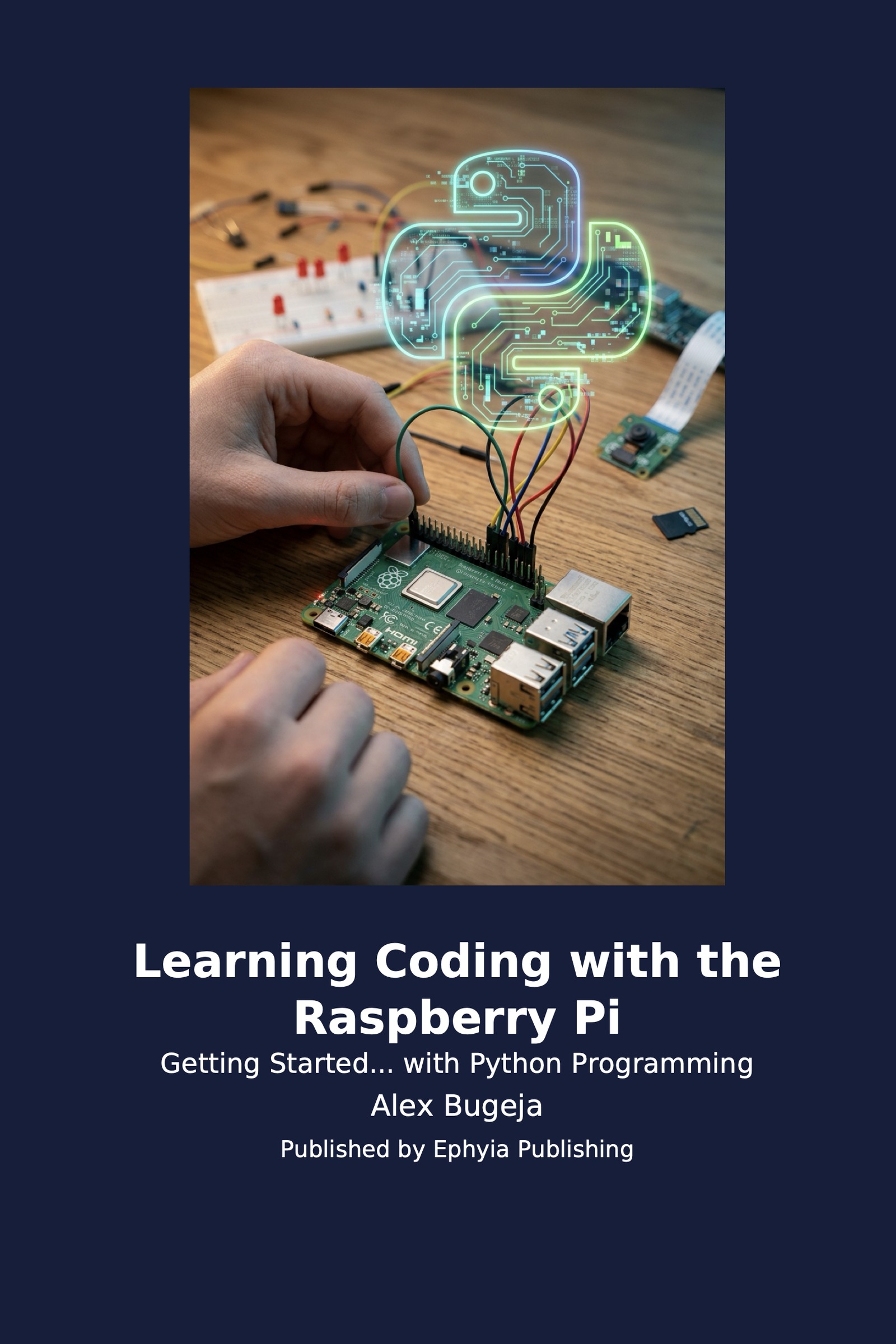
Learning Coding with the Raspberry Pi
Getting Started... with Python Programming
About this book:
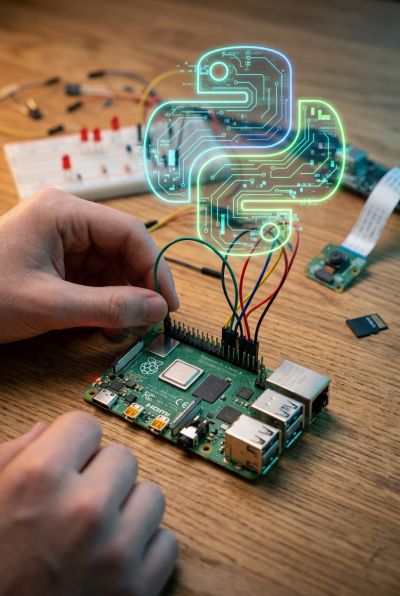
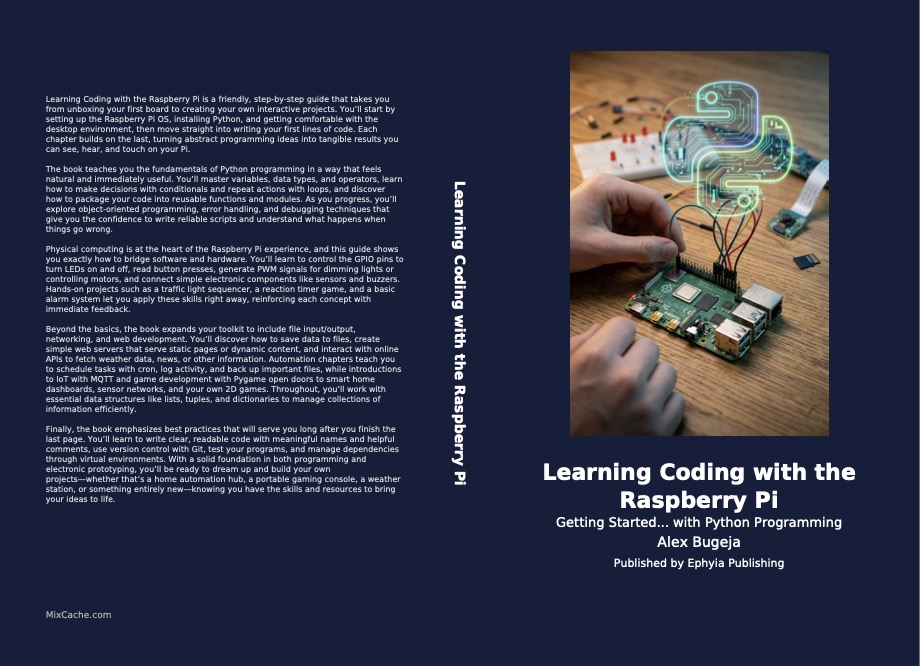
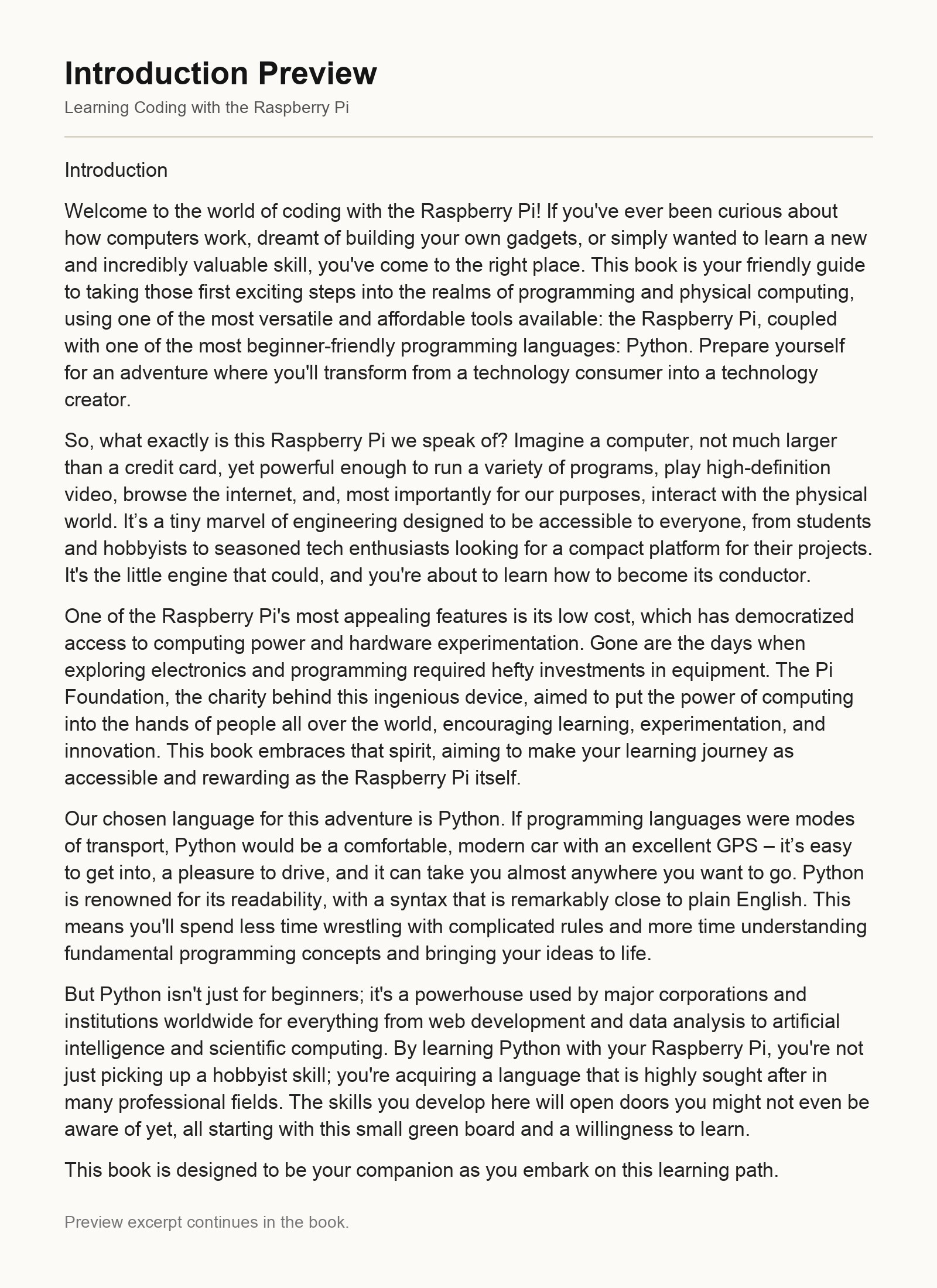
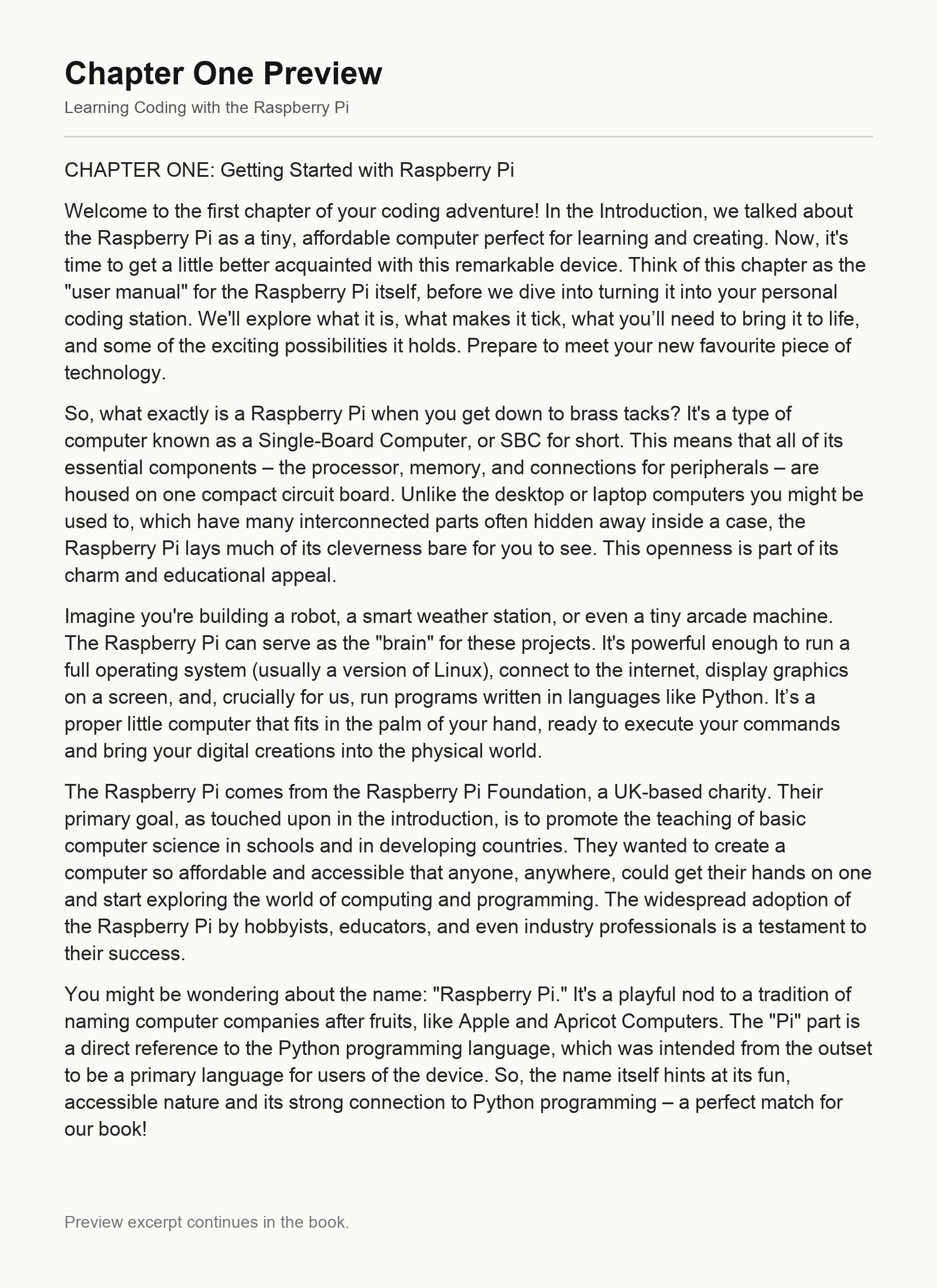
Learning Coding with the Raspberry Pi is a friendly, step‑by‑step guide that takes you from unboxing your first board to creating your own interactive projects. You’ll start by setting up the Raspberry Pi OS, installing Python, and getting comfortable with the desktop environment, then move straight into writing your first lines of code. Each chapter builds on the last, turning abstract programming ideas into tangible results you can see, hear, and touch on your Pi.
The book teaches you the fundamentals of Python programming in a way that feels natural and immediately useful. You’ll master variables, data types, and operators, learn how to make decisions with conditionals and repeat actions with loops, and discover how to package your code into reusable functions and modules. As you progress, you’ll explore object‑oriented programming, error handling, and debugging techniques that give you the confidence to write reliable scripts and understand what happens when things go wrong.
Physical computing is at the heart of the Raspberry Pi experience, and this guide shows you exactly how to bridge software and hardware. You’ll learn to control the GPIO pins to turn LEDs on and off, read button presses, generate PWM signals for dimming lights or controlling motors, and connect simple electronic components like sensors and buzzers. Hands‑on projects such as a traffic light sequencer, a reaction timer game, and a basic alarm system let you apply these skills right away, reinforcing each concept with immediate feedback.
Beyond the basics, the book expands your toolkit to include file input/output, networking, and web development. You’ll discover how to save data to files, create simple web servers that serve static pages or dynamic content, and interact with online APIs to fetch weather data, news, or other information. Automation chapters teach you to schedule tasks with cron, log activity, and back up important files, while introductions to IoT with MQTT and game development with Pygame open doors to smart home dashboards, sensor networks, and your own 2D games. Throughout, you’ll work with essential data structures like lists, tuples, and dictionaries to manage collections of information efficiently.
Finally, the book emphasizes best practices that will serve you long after you finish the last page. You’ll learn to write clear, readable code with meaningful names and helpful comments, use version control with Git, test your programs, and manage dependencies through virtual environments. With a solid foundation in both programming and electronic prototyping, you’ll be ready to dream up and build your own projects—whether that’s a home automation hub, a portable gaming console, a weather station, or something entirely new—knowing you have the skills and resources to bring your ideas to life.
What You'll Find Inside:
- Learn Raspberry Pi hardware fundamentals including setup, components, and GPIO pin usage for physical computing projects
- Master Python programming basics from variables and data types to control structures, functions, and object-oriented concepts
- Build hands-on electronics projects controlling LEDs, reading sensors, and creating interactive hardware with Python code
- Explore networking capabilities including APIs, web servers, and IoT applications to connect your Raspberry Pi to the digital world
- Develop practical skills through game development, GUI creation, task automation, and advanced project integration
Who's It For:
This book is designed for absolute beginners interested in learning coding and physical computing, including students exploring programming concepts, hobbyists with electronic components seeking to bring them to life, teachers looking for engaging ways to introduce coding to students, and parents wanting to learn alongside their children. No prior programming or electronics experience is required—just curiosity, a Raspberry Pi, and a willingness to experiment.
Table of Contents:
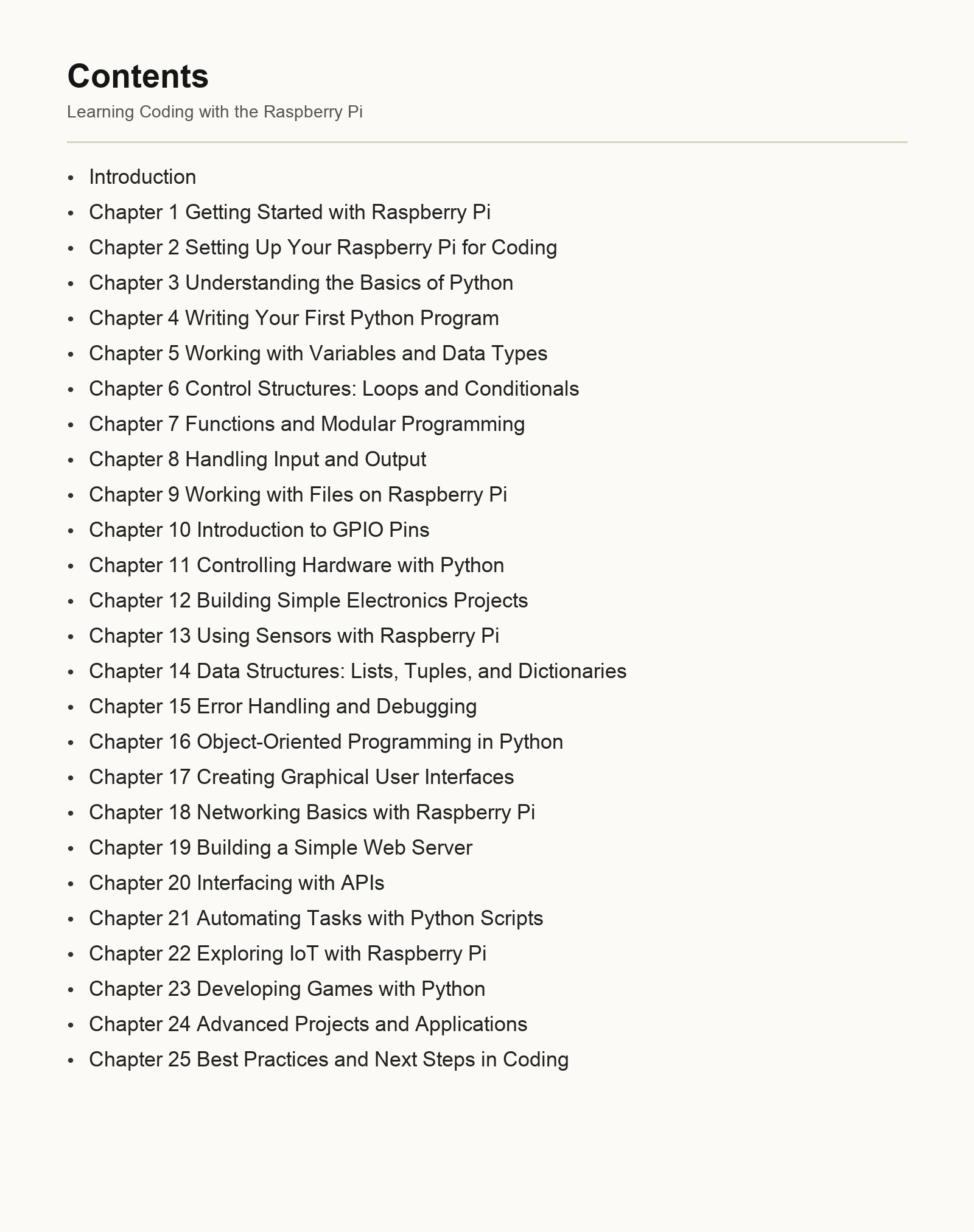
- Introduction
- Chapter 1 Getting Started with Raspberry Pi
- Chapter 2 Setting Up Your Raspberry Pi for Coding
- Chapter 3 Understanding the Basics of Python
- Chapter 4 Writing Your First Python Program
- Chapter 5 Working with Variables and Data Types
- Chapter 6 Control Structures: Loops and Conditionals
- Chapter 7 Functions and Modular Programming
- Chapter 8 Handling Input and Output
- Chapter 9 Working with Files on Raspberry Pi
- Chapter 10 Introduction to GPIO Pins
- Chapter 11 Controlling Hardware with Python
- Chapter 12 Building Simple Electronics Projects
- Chapter 13 Using Sensors with Raspberry Pi
- Chapter 14 Data Structures: Lists, Tuples, and Dictionaries
- Chapter 15 Error Handling and Debugging
- Chapter 16 Object-Oriented Programming in Python
- Chapter 17 Creating Graphical User Interfaces
- Chapter 18 Networking Basics with Raspberry Pi
- Chapter 19 Building a Simple Web Server
- Chapter 20 Interfacing with APIs
- Chapter 21 Automating Tasks with Python Scripts
- Chapter 22 Exploring IoT with Raspberry Pi
- Chapter 23 Developing Games with Python
- Chapter 24 Advanced Projects and Applications
- Chapter 25 Best Practices and Next Steps in Coding
Ephyia Publishing MixCache.com Book Reference: 15643
Author:
Published By:
Date Published:
May 19, 2026
Type:
Nonfiction
Language:
English
Word Count:
80,186 words
Reading Time:
5 hours 37 minutes
Sample:
Order:
Order Learning Coding with the Raspberry Pi (Paperback) on MixCache.com:
Buy NowPrint copy is made to order and ships worldwide. Includes the ebook free, ready to read instantly.
$5 account credit for all new MixCache.com accounts, usable toward any ebook purchase!*