Browse by Category
Fiction
- Action & Adventure
- African American
- Anthologies
- Children's Fiction
- Classics
- Comics & Graphic Novels
- Coming of Age
- Contemporary
- Cultural & Regional
- Drama
- Erotica
- Fantasy
- General
- Historical Fiction
- Horror
- Humor & Satire
- Literary Fiction
- Mystery, Thriller & Suspense
- Poetry
- Religious & Inspirational
- Romance
- Science Fiction
- Short Stories
- War & Military
- Westerns
- Women's Fiction
- Young Adult
Non-Fiction
- Antiques & Collectibles
- Arts & Photography
- Biographies & Memoirs
- Business & Money
- Children's Non-Fiction
-
Computers & Technology
- Artificial Intelligence
- Computer Science
- Cybersecurity & Cryptography
- Data Science & Analytics
- Databases & Big Data
- Game Development & Design
- General
- Hardware & DIY
- Mobile App Development
- Networking & Cloud Computing
- Operating Systems
- Programming
- Robotics
- Software
- Software Engineering
- User Experience (UX) & Design
- Web Development & Design
- Cooking, Food & Wine
- Crafts, Hobbies & Home
- Education & Teaching
- Engineering
- General
- Health, Fitness & Dieting
-
History
- African History
- African History - North Africa
- African History - Sub-Saharan Africa
- American History
- American History - 20th Century
- American History - Civil War
- American History - Colonial Period
- Ancient History
- Asian History
- Asian History - China
- Asian History - India
- Asian History - Japan
- Asian History - Southeast Asia
- European History
- European History - Ancient Greece
- European History - Ancient Rome
- European History - Medieval
- European History - Modern
- European History - Renaissance
- General
- Middle Eastern History
- Military History
- Military History - Aviation
- Military History - Naval
- Social & Cultural History
- World History
- Humor & Entertainment
- Industrial Technology
- Language Learning
- Law
- LGBTQ+ Non-Fiction
- Literary Criticism
- Medical Books
- Parenting & Relationships
- Philosophy
- Politics & Social Sciences
- Reference
- Religion & Spirituality
-
Science & Math
- Agricultural Sciences
- Astronomy & Space Science
- Behavioral Sciences
- Biological Sciences
- Botany & Plant Science
- Chemistry
- Earth Sciences
- Engineering - Chemical
- Engineering - Civil
- Engineering - Electrical
- Engineering - Mechanical
- Environment
- General
- Geology
- Mathematics
- Nature & Ecology
- Oceanography
- Paleontology
- Physics
- Statistics
- Self-Help
- Sports & Outdoors
- Study Aids
- Sustainability & Green Living
- Textbooks
- Transportation
- Travel
- True Crime
- Urban Planning & Development
- Veterinary Medicine
- Writing & Publishing
Jump to Section
MixCache.com Total Access
Unlimited reading and audiobooks for every book published by MixCache.com.
Included titles carry the MTA badge.
Learn more →A History of Lombardy
About this book:
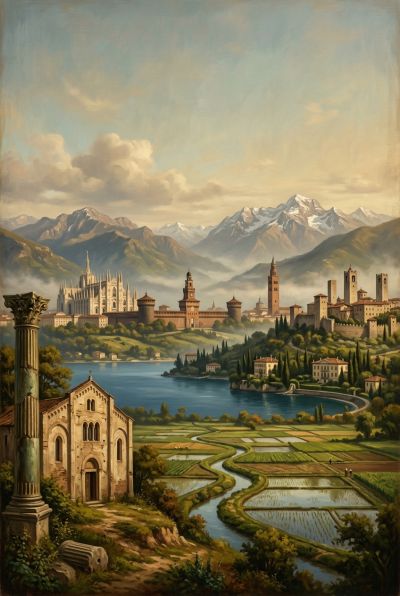
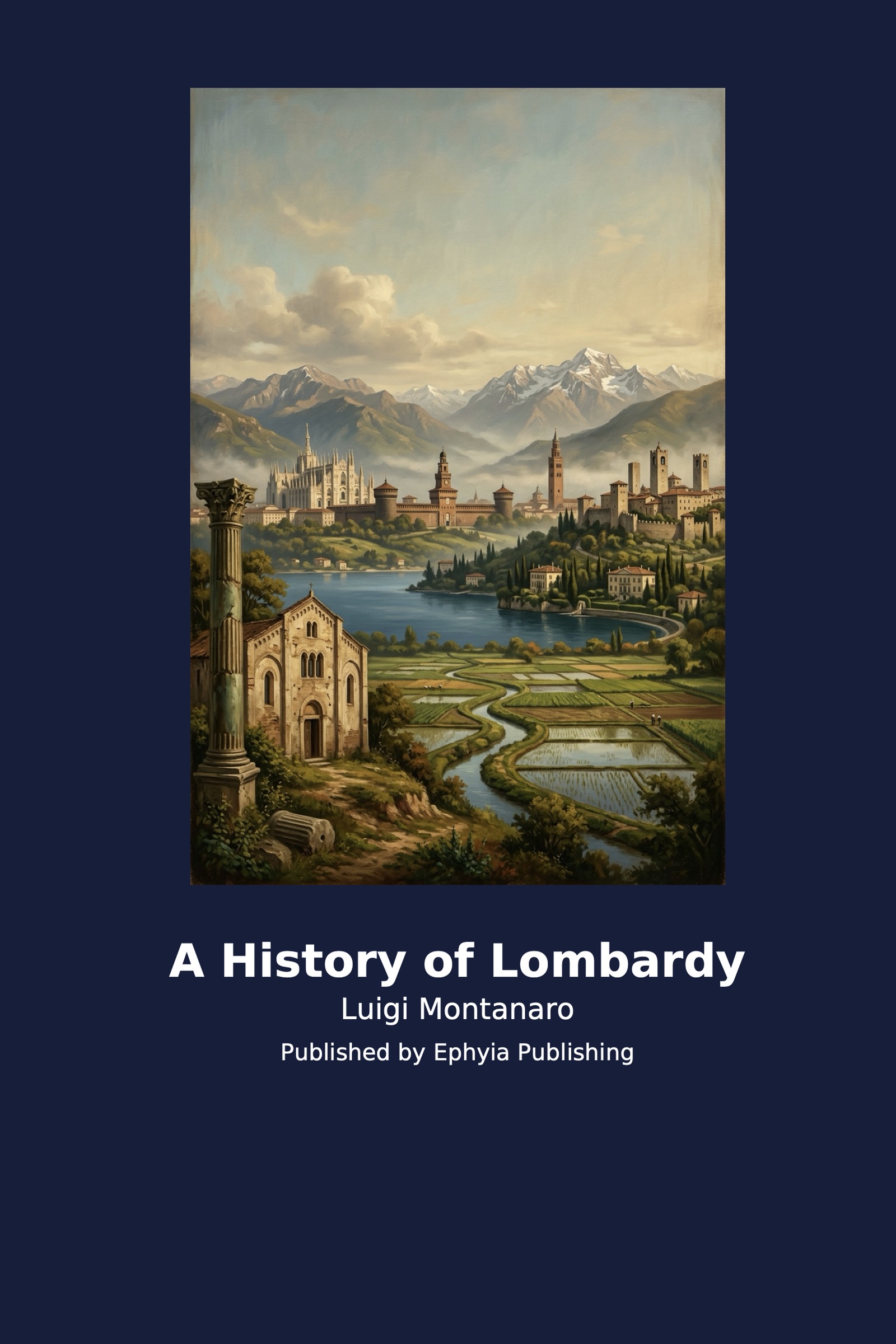
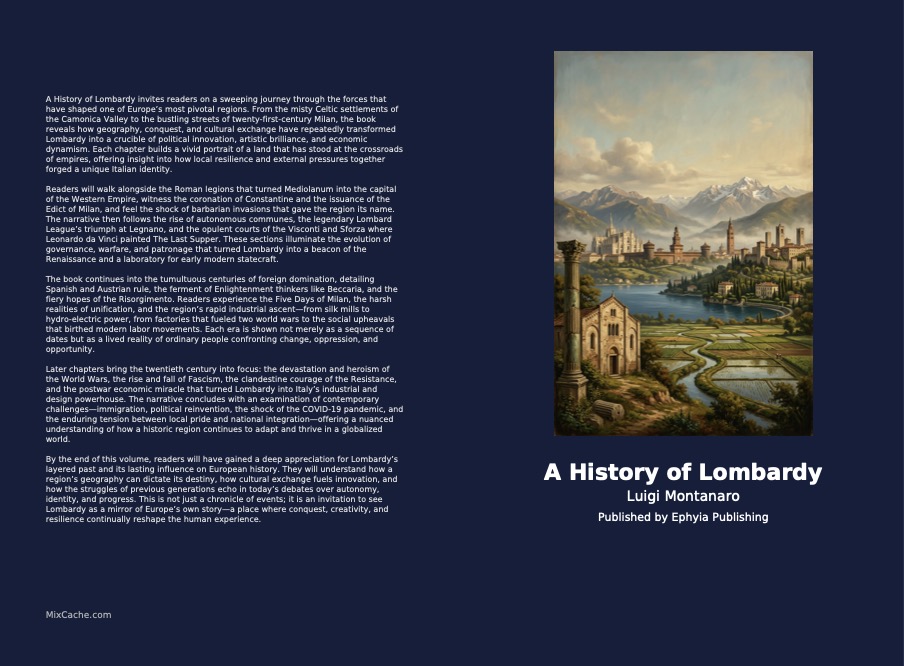
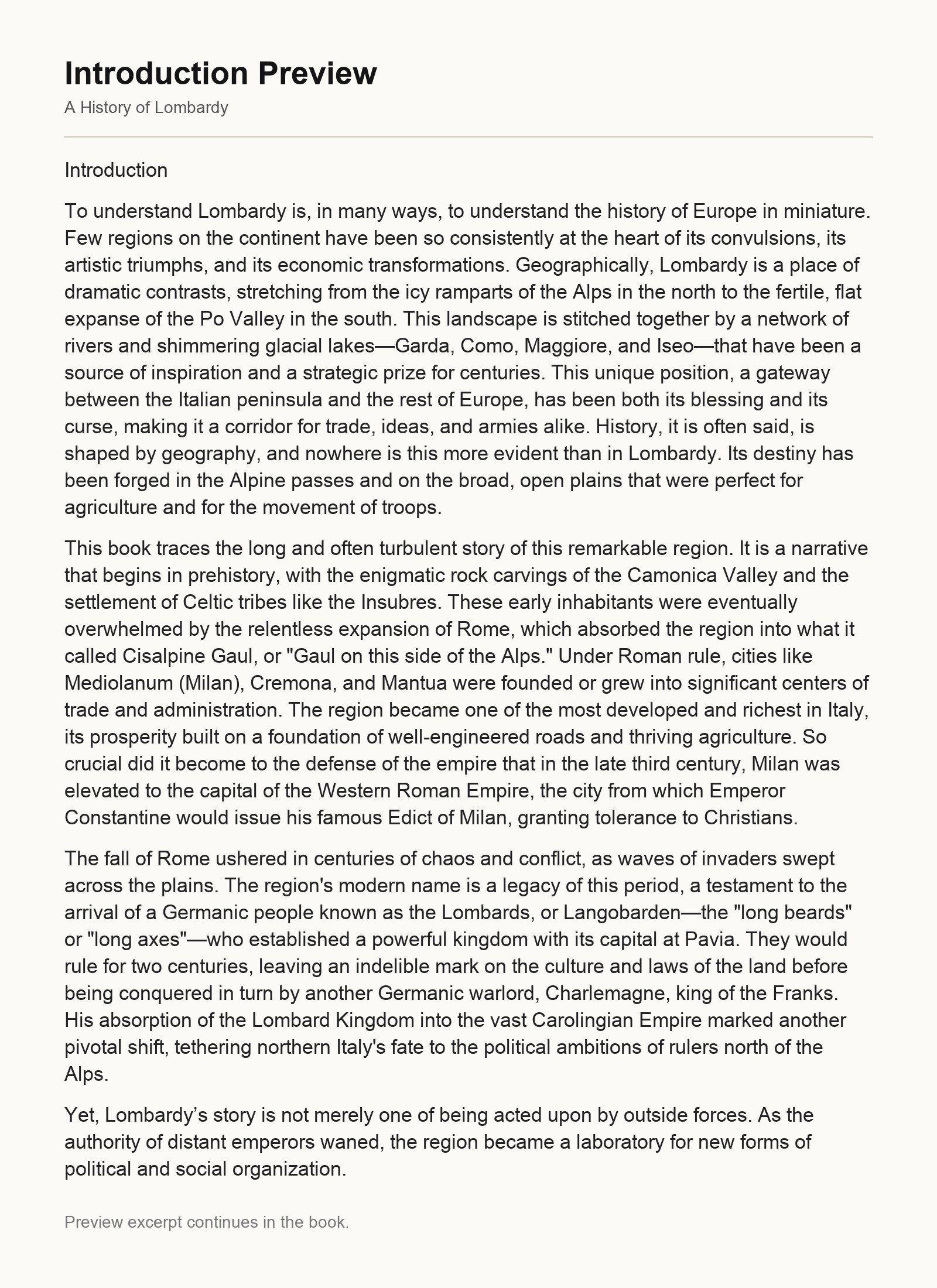
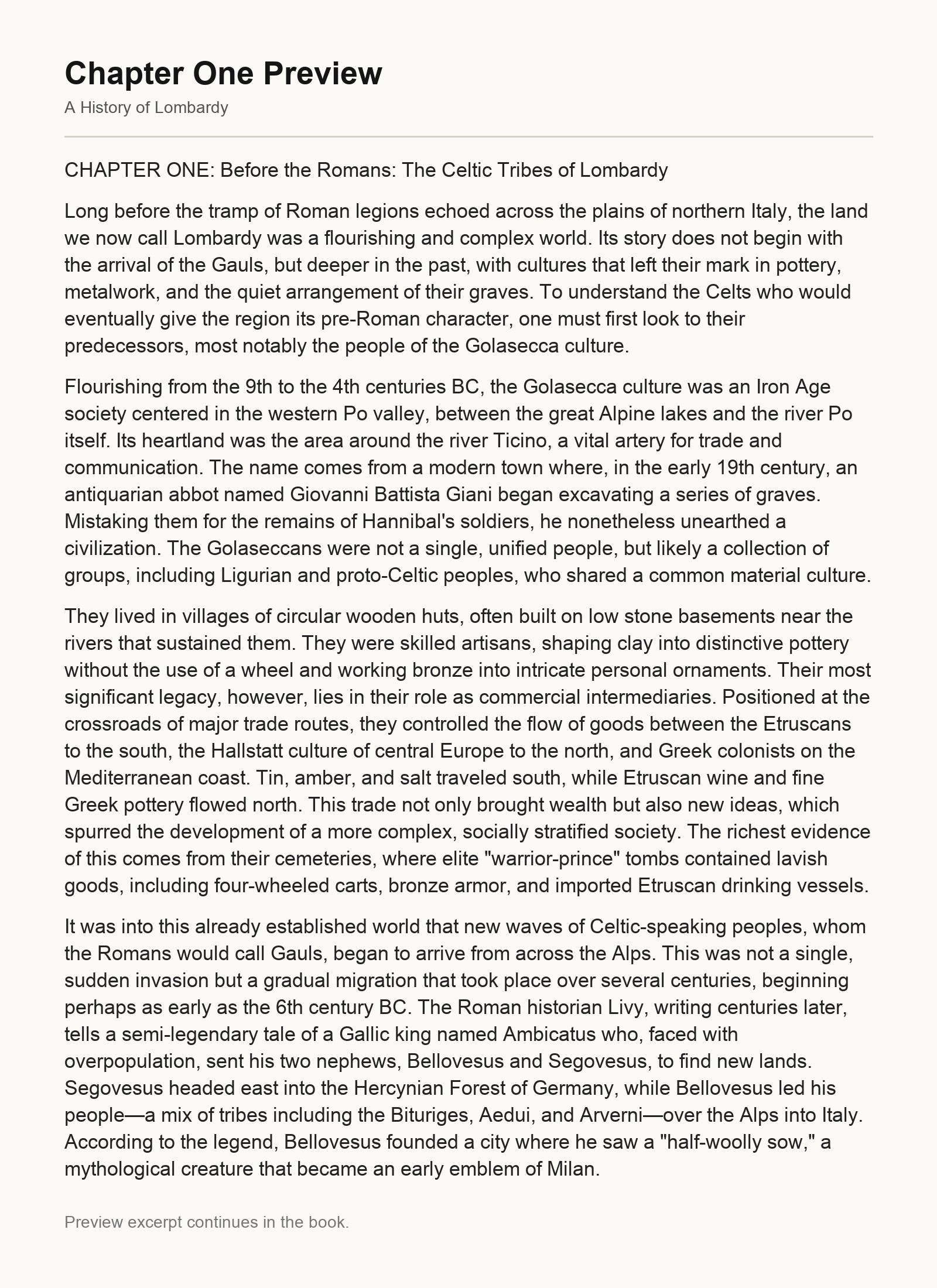
A History of Lombardy invites readers on a sweeping journey through the forces that have shaped one of Europe’s most pivotal regions. From the misty Celtic settlements of the Camonica Valley to the bustling streets of twenty‑first‑century Milan, the book reveals how geography, conquest, and cultural exchange have repeatedly transformed Lombardy into a crucible of political innovation, artistic brilliance, and economic dynamism. Each chapter builds a vivid portrait of a land that has stood at the crossroads of empires, offering insight into how local resilience and external pressures together forged a unique Italian identity.
Readers will walk alongside the Roman legions that turned Mediolanum into the capital of the Western Empire, witness the coronation of Constantine and the issuance of the Edict of Milan, and feel the shock of barbarian invasions that gave the region its name. The narrative then follows the rise of autonomous communes, the legendary Lombard League’s triumph at Legnano, and the opulent courts of the Visconti and Sforza where Leonardo da Vinci painted The Last Supper. These sections illuminate the evolution of governance, warfare, and patronage that turned Lombardy into a beacon of the Renaissance and a laboratory for early modern statecraft.
The book continues into the tumultuous centuries of foreign domination, detailing Spanish and Austrian rule, the ferment of Enlightenment thinkers like Beccaria, and the fiery hopes of the Risorgimento. Readers experience the Five Days of Milan, the harsh realities of unification, and the region’s rapid industrial ascent—from silk mills to hydro‑electric power, from factories that fueled two world wars to the social upheavals that birthed modern labor movements. Each era is shown not merely as a sequence of dates but as a lived reality of ordinary people confronting change, oppression, and opportunity.
Later chapters bring the twentieth century into focus: the devastation and heroism of the World Wars, the rise and fall of Fascism, the clandestine courage of the Resistance, and the postwar economic miracle that turned Lombardy into Italy’s industrial and design powerhouse. The narrative concludes with an examination of contemporary challenges—immigration, political reinvention, the shock of the COVID‑19 pandemic, and the enduring tension between local pride and national integration—offering a nuanced understanding of how a historic region continues to adapt and thrive in a globalized world.
By the end of this volume, readers will have gained a deep appreciation for Lombardy’s layered past and its lasting influence on European history. They will understand how a region’s geography can dictate its destiny, how cultural exchange fuels innovation, and how the struggles of previous generations echo in today’s debates over autonomy, identity, and progress. This is not just a chronicle of events; it is an invitation to see Lombardy as a mirror of Europe’s own story—a place where conquest, creativity, and resilience continually reshape the human experience.
What You'll Find Inside:
- The region's evolution from Celtic tribal settlements through Roman rule to becoming the capital of the Western Roman Empire in Mediolanum (Milan)
- The establishment of the Lombard Kingdom and its cultural fusion of Germanic and Roman traditions that shaped northern Italian identity
- Lombardy's pivotal role in medieval communal independence, including the formation of the Lombard League and victory at Legnano against Frederick Barbarossa
- The region's transformation during the Renaissance as a center of art, innovation, and powerful dynasties like the Visconti and Sforza
- Lombardy's journey from Austrian rule through unification, industrialization, Fascism, Resistance, and into its modern role as Italy's economic engine
Who's It For:
This book is ideal for students, scholars, and enthusiasts of Italian and European history seeking a comprehensive understanding of how one region has consistently shaped continental events. It will particularly appeal to readers interested in the interplay between local developments and broader historical movements, from Roman imperial politics to the Risorgimento and industrialization. Anyone wishing to grasp Lombardy's unique position as a crossroads between Mediterranean and Northern European influences will find valuable insights into its cultural, economic, and political evolution across two millennia.
Table of Contents:
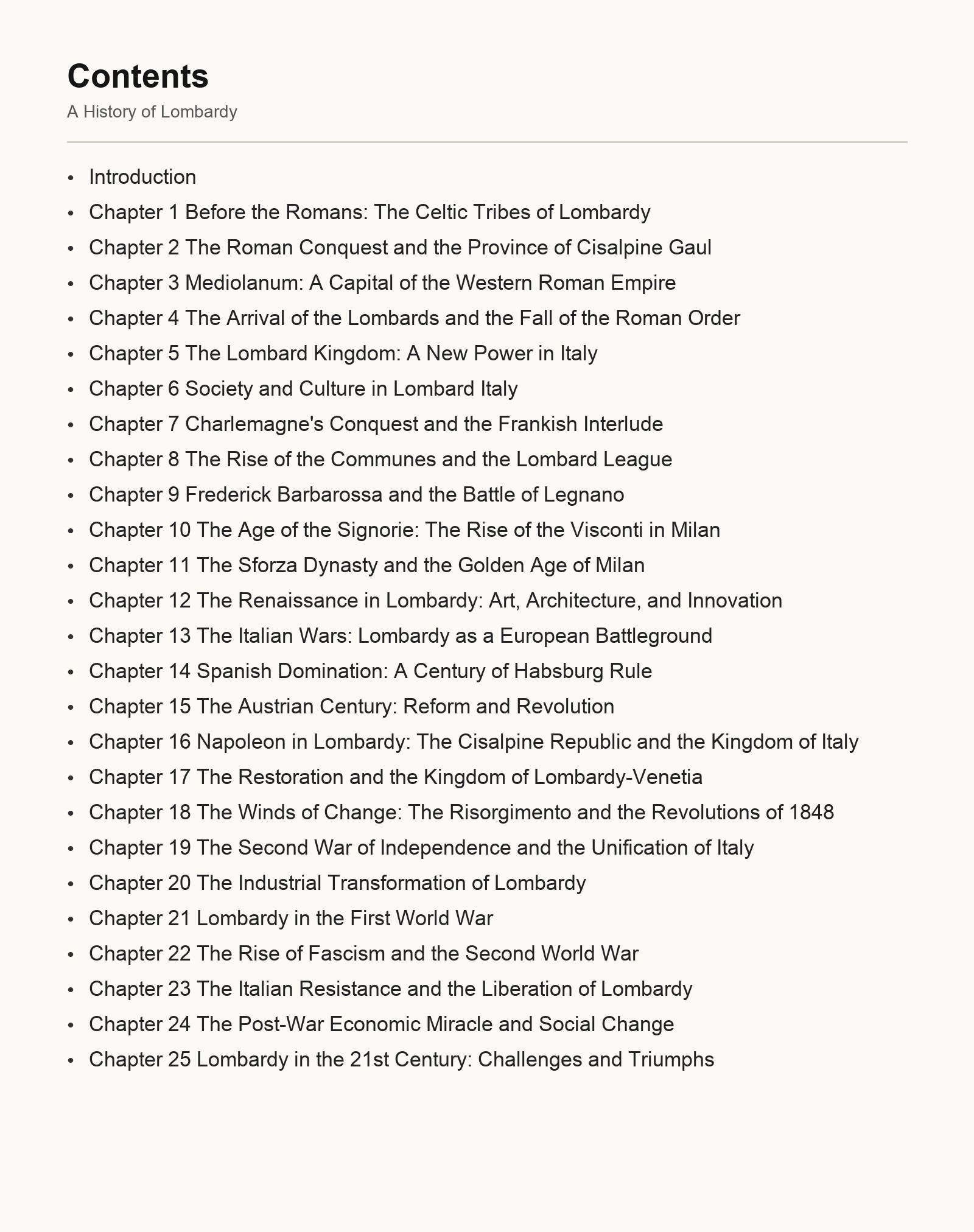
- Introduction
- Chapter 1 Before the Romans: The Celtic Tribes of Lombardy
- Chapter 2 The Roman Conquest and the Province of Cisalpine Gaul
- Chapter 3 Mediolanum: A Capital of the Western Roman Empire
- Chapter 4 The Arrival of the Lombards and the Fall of the Roman Order
- Chapter 5 The Lombard Kingdom: A New Power in Italy
- Chapter 6 Society and Culture in Lombard Italy
- Chapter 7 Charlemagne's Conquest and the Frankish Interlude
- Chapter 8 The Rise of the Communes and the Lombard League
- Chapter 9 Frederick Barbarossa and the Battle of Legnano
- Chapter 10 The Age of the Signorie: The Rise of the Visconti in Milan
- Chapter 11 The Sforza Dynasty and the Golden Age of Milan
- Chapter 12 The Renaissance in Lombardy: Art, Architecture, and Innovation
- Chapter 13 The Italian Wars: Lombardy as a European Battleground
- Chapter 14 Spanish Domination: A Century of Habsburg Rule
- Chapter 15 The Austrian Century: Reform and Revolution
- Chapter 16 Napoleon in Lombardy: The Cisalpine Republic and the Kingdom of Italy
- Chapter 17 The Restoration and the Kingdom of Lombardy-Venetia
- Chapter 18 The Winds of Change: The Risorgimento and the Revolutions of 1848
- Chapter 19 The Second War of Independence and the Unification of Italy
- Chapter 20 The Industrial Transformation of Lombardy
- Chapter 21 Lombardy in the First World War
- Chapter 22 The Rise of Fascism and the Second World War
- Chapter 23 The Italian Resistance and the Liberation of Lombardy
- Chapter 24 The Post-War Economic Miracle and Social Change
- Chapter 25 Lombardy in the 21st Century: Challenges and Triumphs
Author:
Published By:
Date Published:
May 18, 2026
Type:
Nonfiction
Language:
English
Also Available In:
Word Count:
50,911 words
Reading Time:
3 hours 34 minutes
Sample:
Order:
Order A History of Lombardy (Hardcover) on MixCache.com:
Buy NowPrint copy is made to order and ships worldwide. Includes the ebook free, ready to read instantly.
$5 account credit for all new MixCache.com accounts, usable toward any ebook purchase!*