
Browse by Category
Fiction
- Action & Adventure
- African American
- Anthologies
- Children's Fiction
- Classics
- Comics & Graphic Novels
- Coming of Age
- Contemporary
- Cultural & Regional
- Drama
- Erotica
- Fantasy
- General
- Historical Fiction
- Horror
- Humor & Satire
- Literary Fiction
- Mystery, Thriller & Suspense
- Poetry
- Religious & Inspirational
- Romance
- Science Fiction
- Short Stories
- War & Military
- Westerns
- Women's Fiction
- Young Adult
Non-Fiction
- Antiques & Collectibles
- Arts & Photography
- Biographies & Memoirs
- Business & Money
- Children's Non-Fiction
-
Computers & Technology
- Artificial Intelligence
- Computer Science
- Cybersecurity & Cryptography
- Data Science & Analytics
- Databases & Big Data
- Game Development & Design
- General
- Hardware & DIY
- Mobile App Development
- Networking & Cloud Computing
- Operating Systems
- Programming
- Robotics
- Software
- Software Engineering
- User Experience (UX) & Design
- Web Development & Design
- Cooking, Food & Wine
- Crafts, Hobbies & Home
- Education & Teaching
- Engineering
- General
- Health, Fitness & Dieting
-
History
- African History
- African History - North Africa
- African History - Sub-Saharan Africa
- American History
- American History - 20th Century
- American History - Civil War
- American History - Colonial Period
- Ancient History
- Asian History
- Asian History - China
- Asian History - India
- Asian History - Japan
- Asian History - Southeast Asia
- European History
- European History - Ancient Greece
- European History - Ancient Rome
- European History - Medieval
- European History - Modern
- European History - Renaissance
- General
- Middle Eastern History
- Military History
- Military History - Aviation
- Military History - Naval
- Social & Cultural History
- World History
- Humor & Entertainment
- Industrial Technology
- Language Learning
- Law
- LGBTQ+ Non-Fiction
- Literary Criticism
- Medical Books
- Parenting & Relationships
- Philosophy
- Politics & Social Sciences
- Reference
- Religion & Spirituality
-
Science & Math
- Agricultural Sciences
- Astronomy & Space Science
- Behavioral Sciences
- Biological Sciences
- Botany & Plant Science
- Chemistry
- Earth Sciences
- Engineering - Chemical
- Engineering - Civil
- Engineering - Electrical
- Engineering - Mechanical
- Environment
- General
- Geology
- Mathematics
- Nature & Ecology
- Oceanography
- Paleontology
- Physics
- Statistics
- Self-Help
- Sports & Outdoors
- Study Aids
- Sustainability & Green Living
- Textbooks
- Transportation
- Travel
- True Crime
- Urban Planning & Development
- Veterinary Medicine
- Writing & Publishing
Jump to Section
MixCache.com Total Access
Unlimited reading and audiobooks for every book published by MixCache.com.
Included titles carry the MTA badge.
Learn more →
Acoustics and Indoor Environmental Design for Commercial Spaces
MTA
Practical solutions for sound control, HVAC noise mitigation, and occupant comfort in retail, office, and multi-family buildings
About this book:
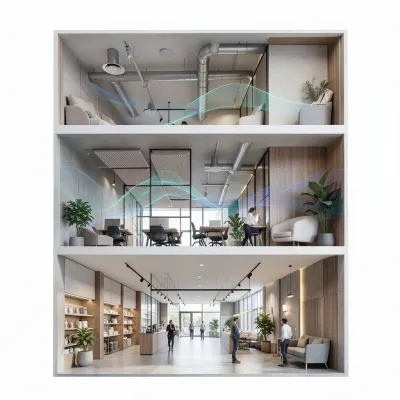
Acoustics and Indoor Environmental Design for Commercial Spaces explains how sound performance directly influences occupant comfort, productivity, tenant satisfaction, and the financial success of retail, office, and multi‑family buildings. It introduces the core acoustic metrics—STC, OITC, IIC, NC/RC/NR, and dBA—and shows how they relate to design decisions, while also clarifying the gap between laboratory ratings and field performance. The book links these metrics to applicable codes, standards, and certification pathways (ASHRAE, ANSI, WELL, LEED, local ordinances), demonstrating how minimum requirements can be exceeded to achieve truly comfortable environments.
Practical guidance is provided for selecting and specifying acoustic materials and assemblies, including gypsum board, insulation, resilient channels, isolation clips, mass‑loaded vinyl, acoustic doors, windows, and ceiling treatments. Room acoustics fundamentals—reverberation, absorption, diffusion—are covered with strategies for controlling RT60 in various space types. Speech privacy in open‑plan offices and call centers is examined through articulation index, speech transmission index, panel height, plenum treatment, and sound‑masking systems. Sound isolation through walls, doors, and windows is detailed, emphasizing mass‑spring‑mass construction, perimeter sealing, and the avoidance of flanking paths. Flanking paths themselves are addressed with specific detailing strategies for perimeter joints, structural bypass, ceiling plenums, and penetrations. Impact noise control in floor–ceiling assemblies is explained via IIC/FIIC, resilient underlayments, floating floors, and appropriate floor finishes. Facade design for exterior noise control discusses OITC, laminated glass, asymmetric glazing, acoustic louvers, and site planning. HVAC noise mitigation receives extensive treatment, from source selection (low‑sound‑power fans, motors, compressors) to transmission path control (duct sizing, low velocities, lined ducts, silencers, plenums, vibration isolation, flexible connectors) and receiver‑space treatment (absorption, diffuser selection). Specialized chapters apply these principles to retail environments, restaurants and food halls, multi‑family and mixed‑use buildings, meeting rooms and classrooms, and specialized office spaces, highlighting the unique acoustic goals and solutions for each.
The book stresses that successful acoustic performance depends on meticulous construction practices, quality‑control checks, and coordinated execution among architects, engineers, contractors, and tradespeople. It outlines commissioning and verification procedures—field measurement of ASTC/FIIC, background noise (NC/RC), reverberation time (RT60), and speech transmission index (STI)—to confirm that installed systems meet design targets. Troubleshooting methodologies, cost‑benefit remediation playbooks, and proactive maintenance recommendations are provided to address field failures efficiently. Throughout, the text emphasizes integrating acoustic intent early in design, verifying performance at turnover, and treating sound as a design variable that enhances clarity, comfort, and well‑being rather than merely a nuisance to be tolerated.
What You'll Find Inside:
- Practical strategies for controlling sound transmission through walls, floors, and ceilings using proper materials, detailing, and construction techniques to achieve target STC, IIC, and OITC ratings
- Comprehensive HVAC noise control methods including equipment selection, duct design, silencer application, and vibration isolation to meet NC/RC background noise targets
- Room acoustics fundamentals for managing reverberation, absorption, and diffusion in commercial spaces to optimize speech intelligibility and occupant comfort
- Speech privacy solutions for open-plan offices and call centers combining absorption, blocking, and sound masking to achieve target Articulation Index levels
- Construction quality control procedures and field verification methods to ensure acoustic performance matches design intent and avoids costly field failures
Who's It For:
This book is designed for architects, MEP engineers, contractors, building owners, and acoustic consultants working on commercial projects including retail, office, and multi-family buildings. It provides actionable guidance for professionals who need to specify, detail, construct, or verify acoustic performance in real-world conditions. The content is particularly valuable for those involved in meeting code requirements, pursuing green building certifications (LEED, WELL), or addressing tenant complaints related to noise and comfort. Readers will find practical solutions that balance acoustic performance with budget, schedule, and aesthetic considerations.
Table of Contents:
- Introduction
- Chapter 1 The Role of Acoustics in Commercial Environments
- Chapter 2 Metrics and Performance Criteria: STC, OITC, IIC, NC/RC/NR, and dBA
- Chapter 3 Codes, Standards, and Certification Pathways (ASHRAE, ANSI, WELL, LEED, and Local Ordinances)
- Chapter 4 Acoustic Materials and Assemblies: Selection, Specifications, and Submittals
- Chapter 5 Room Acoustics Fundamentals: Reverberation, Absorption, and Diffusion
- Chapter 6 Speech Privacy in Open-Plan Offices and Call Centers
- Chapter 7 Sound Isolation Through Walls, Doors, and Windows
- Chapter 8 Flanking Paths: Detailing Strategies That Actually Work
- Chapter 9 Floor–Ceiling Systems and Impact Noise Control
- Chapter 10 Facades and Exterior Noise in Urban and Transit-Adjacent Sites
- Chapter 11 HVAC Noise Basics: Sources, Transmission, and Perception
- Chapter 12 Quiet Ductwork: Sizing, Layout, and Pressure Management
- Chapter 13 Silencers, Plenums, and Lined Ducts: Prescriptive HVAC Solutions
- Chapter 14 Fans, Air Terminals, and Diffusers: Selection for Low Sound Power
- Chapter 15 Rooftop Units, Chillers, and Cooling Towers: Outdoor-to-Indoor Noise Control
- Chapter 16 VRF and Heat Pump Systems in Low-Carbon Buildings: Acoustic Considerations
- Chapter 17 Vibration Control: Bases, Springs, Hangers, and Building Structure
- Chapter 18 Plumbing, Drainage, and Mechanical Piping Noise Mitigation
- Chapter 19 Retail Acoustics: Customer Experience, Wayfinding, and Sales
- Chapter 20 Restaurants, Cafés, and Food Halls: Managing Reverberation and Buzz
- Chapter 21 Multi-Family and Mixed-Use: Partitions, Floor Assemblies, and Privacy
- Chapter 22 Meeting Rooms, Classrooms, and Specialized Office Spaces
- Chapter 23 Construction Practices, QA/QC, and Avoiding Field Failures
- Chapter 24 Commissioning, Measurement Methods, and Verification Plans
- Chapter 25 Troubleshooting, Remediation, and Cost–Benefit Playbooks
Author:
Published By:
Date Published:
May 17, 2026
Type:
Nonfiction
Language:
English
Word Count:
68,290 words
Reading Time:
4 hours 47 minutes
Sample:
MixCache.com Total Access
Get unlimited access to this book + all books published by MixCache.com for $11.99/month
Subscribe to MTAOr purchase this book individually below
Order:
Buy the Acoustics and Indoor Environmental Design for Commercial Spaces ebook on MixCache.com:
Buy Now
Full ebook will be available immediately
- read online or download as a PDF file.
$5 account credit for all new MixCache.com accounts, usable toward any ebook purchase!*



Ratings & Reviews
Ask Questions About This Book
Have a question about the content? Ask our AI assistant!
Start by asking a question about "Acoustics and Indoor Environmental Design for Commercial Spaces"
Example: "Does this book mention William Shakespeare?"
Thinking...