Browse by Category
Fiction
- Action & Adventure
- African American
- Anthologies
- Children's Fiction
- Classics
- Comics & Graphic Novels
- Coming of Age
- Contemporary
- Cultural & Regional
- Drama
- Erotica
- Fantasy
- General
- Historical Fiction
- Horror
- Humor & Satire
- Literary Fiction
- Mystery, Thriller & Suspense
- Poetry
- Religious & Inspirational
- Romance
- Science Fiction
- Short Stories
- War & Military
- Westerns
- Women's Fiction
- Young Adult
Non-Fiction
- Antiques & Collectibles
- Arts & Photography
- Biographies & Memoirs
- Business & Money
- Children's Non-Fiction
-
Computers & Technology
- Artificial Intelligence
- Computer Science
- Cybersecurity & Cryptography
- Data Science & Analytics
- Databases & Big Data
- Game Development & Design
- General
- Hardware & DIY
- Mobile App Development
- Networking & Cloud Computing
- Operating Systems
- Programming
- Robotics
- Software
- Software Engineering
- User Experience (UX) & Design
- Web Development & Design
- Cooking, Food & Wine
- Crafts, Hobbies & Home
- Education & Teaching
- Engineering
- General
- Health, Fitness & Dieting
-
History
- African History
- African History - North Africa
- African History - Sub-Saharan Africa
- American History
- American History - 20th Century
- American History - Civil War
- American History - Colonial Period
- Ancient History
- Asian History
- Asian History - China
- Asian History - India
- Asian History - Japan
- Asian History - Southeast Asia
- European History
- European History - Ancient Greece
- European History - Ancient Rome
- European History - Medieval
- European History - Modern
- European History - Renaissance
- General
- Middle Eastern History
- Military History
- Military History - Aviation
- Military History - Naval
- Social & Cultural History
- World History
- Humor & Entertainment
- Industrial Technology
- Language Learning
- Law
- LGBTQ+ Non-Fiction
- Literary Criticism
- Medical Books
- Parenting & Relationships
- Philosophy
- Politics & Social Sciences
- Reference
- Religion & Spirituality
-
Science & Math
- Agricultural Sciences
- Astronomy & Space Science
- Behavioral Sciences
- Biological Sciences
- Botany & Plant Science
- Chemistry
- Earth Sciences
- Engineering - Chemical
- Engineering - Civil
- Engineering - Electrical
- Engineering - Mechanical
- Environment
- General
- Geology
- Mathematics
- Nature & Ecology
- Oceanography
- Paleontology
- Physics
- Statistics
- Self-Help
- Sports & Outdoors
- Study Aids
- Sustainability & Green Living
- Textbooks
- Transportation
- Travel
- True Crime
- Urban Planning & Development
- Veterinary Medicine
- Writing & Publishing
Jump to Section
MixCache.com Total Access
Unlimited reading and audiobooks for every book published by MixCache.com.
Included titles carry the MTA badge.
Learn more →
Landmark Commercial Projects Casebook
MTA
Detailed case studies of shopping centers, data centers, multifamily towers and industrial campuses with lessons learned
About this book:
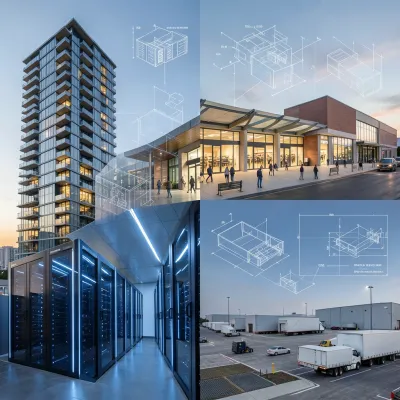
This casebook presents twenty‑five detailed studies of large‑scale commercial projects—shopping centers, data centers, multifamily towers, and industrial campuses—illustrating how owners, developers, and contractors navigated complex technical, financial, and regulatory challenges. Each chapter follows a consistent structure: setting developer goals and site context, selecting a procurement path (design‑bid‑build, design‑build, CM at risk, progressive design‑build, or hybrid models), tracing design and construction hurdles, comparing baseline budgets and schedules to actual outcomes, and highlighting innovations and lessons learned. Recurring themes include the value of early contractor involvement, the use of performance‑based design and shared‑savings incentives, the importance of robust subsurface investigations and contingency planning, and the benefits of modular, prefabricated, or standardized components for schedule compression and quality control.
Across the sectors, several patterns emerge. In retail redevelopments, phased construction that keeps existing tenants open—such as the quadrant sequencing at Harbor Vista or the Main Street‑style transformation of an enclosed mall—requires careful coordination of demolition, utility work, and temporary services, while storm‑water and environmental contingencies often prove underestimated. Data center cases emphasize water stewardship, energy efficiency, and resilience: the Desert Hyperscale campus shows how hybrid cooling, thermal energy storage, and liquid‑to‑chip readiness can cut water use and PUE, whereas the Tier IV financial services facility demonstrates the cost and testing rigor needed for fault‑tolerant power and cooling architectures. Multifamily and mixed‑use towers illustrate structural innovations—timber‑hybrid systems, base isolation, vibration‑mitigation mats, and modular high‑rise stacking—that address fire, acoustics, seismic, and schedule pressures while meeting urban density goals. Industrial and logistics projects reveal how adaptive reuse of warehouses, cold‑storage ammonia plants, robotics‑enabled fulfillment centers, and net‑zero microgrids can accelerate delivery, lower operating costs, and meet sustainability targets, provided that utility interconnections, site‑specific hazards, and regulatory approvals are addressed early.
The book’s overarching message is that successful delivery hinges on treating risk, design, and construction as interlinked disciplines rather than sequential steps. Early investment in detailed subsurface surveys, performance‑based modeling, and integrated BIM coordination reduces costly rework and change orders. Procurement models that align incentives—such as progressive design‑build with shared‑savings clauses or CMAR with early contractor involvement—enable teams to absorb unforeseen conditions without derailing schedules or budgets. Finally, the case studies show that innovations in façade systems, modular connections, energy recovery, and standardized kits of parts can be replicated across projects, but only when paired with rigorous quality control, realistic contingency sizing, and a collaborative governance structure that respects both technical complexity and stakeholder expectations.
What You'll Find Inside:
- In-depth case studies of shopping centers, data centers, multifamily towers, and industrial campuses with transparent analysis of budget/schedule performance versus baselines
- Practical insights on procurement strategies including CM at Risk, progressive design-build, and hybrid models for complex stakeholder environments
- Innovations in sustainability and resilience covering water stewardship, energy efficiency, carbon accounting, and extreme weather adaptation
- Technical solutions for specialized challenges like building over active utilities, vibration control above transit, and structural upgrades for adaptive reuse
- Real-world applications of innovation through standardization, modularization, digital delivery (BIM), and integrated project approaches
Who's It For:
This book is intended for owners, developers, program managers, architects and engineers, general contractors, trade partners, lenders, and public agencies. Whether you are preparing a pro forma, crafting a bridging set, or standing up a commissioning plan, you will find patterns you can reuse and pitfalls you can avoid. If these cases help you ask sharper questions earlier—and make bolder, better-informed decisions—then the projects chronicled here will have delivered value beyond their original sites.
Table of Contents:
- Introduction
- Chapter 1 Harbor Vista Open-Air Retail Redevelopment: From Enclosed Mall to Main Street
- Chapter 2 Midtown Transit Hub Retail: Integrating a Shopping Center with a Multimodal Station
- Chapter 3 Coastal Outlet Village: Phased Delivery under Extreme Weather Risk
- Chapter 4 Downtown Infill Market Hall: Building Over Active Utilities
- Chapter 5 Suburban Power Center Refresh: Big-Box Reconfiguration and Lease Roll Strategy
- Chapter 6 Desert Hyperscale Data Center Campus: Water Stewardship and 24/7 Reliability
- Chapter 7 Colocation Retrofit in a 1970s Office Tower: Power Density and Structural Upgrades
- Chapter 8 Edge Micro Data Center Network: Standardization at Scale Across 20 Sites
- Chapter 9 Tier IV Financial Services Data Center: Concurrent Maintainability in Practice
- Chapter 10 Warehouse-to-Data Center Adaptive Reuse: Speed to Market with Existing Fabric
- Chapter 11 Mixed-Use Multifamily Tower Over Transit: Vibration, Ventilation, and Life Safety
- Chapter 12 Modular High-Rise Apartments: Lessons from a 32-Story Stack
- Chapter 13 Affordable Housing Tower via P3: Balancing Cost, Speed, and Community Goals
- Chapter 14 Timber-Hybrid Multifamily Tower: Fire, Acoustics, and Carbon Accounting
- Chapter 15 Seismic-Resilient Waterfront Tower: Performance-Based Design Under Salt Air
- Chapter 16 Robotics-Enabled Fulfillment Center: Throughput-Driven Layout and MEP Integration
- Chapter 17 Cold Storage Logistics Park: Refrigeration, Ammonia Safety, and Energy Recovery
- Chapter 18 EV Components Manufacturing Campus: Cleanrooms, Utilities, and Expansion Strategy
- Chapter 19 Biomanufacturing Cluster: GMP Compliance from Groundbreaking to Validation
- Chapter 20 Last-Mile Distribution Hub in a Dense Urban Core: Vertical Racking and Traffic Mitigation
- Chapter 21 University-Linked Innovation District: Flexible R&D and Light-Industrial Mix
- Chapter 22 Retail-to-Residential Conversion: Transforming a Vacant Big-Box into Mid-Rise Housing
- Chapter 23 Net-Zero Industrial Park: Onsite Renewables, Storage, and Microgrid Operations
- Chapter 24 Coastal Retail Portfolio Resilience: Programmatic Hardening and Insurance Outcomes
- Chapter 25 City-Block Redevelopment: Progressive Design-Build for a Mega Mixed-Use Deal
Author:
Published By:
Date Published:
May 17, 2026
Type:
Nonfiction
Language:
English
Word Count:
89,404 words
Reading Time:
6 hours 16 minutes
Sample:
Order:
Order Landmark Commercial Projects Casebook (Hardcover) on MixCache.com:
Buy NowPrint copy is made to order and ships worldwide. Includes the ebook free, ready to read instantly.
$5 account credit for all new MixCache.com accounts, usable toward any ebook purchase!*