
Browse by Category
Fiction
- Action & Adventure
- African American
- Anthologies
- Children's Fiction
- Classics
- Comics & Graphic Novels
- Coming of Age
- Contemporary
- Cultural & Regional
- Drama
- Erotica
- Fantasy
- General
- Historical Fiction
- Horror
- Humor & Satire
- Literary Fiction
- Mystery, Thriller & Suspense
- Poetry
- Religious & Inspirational
- Romance
- Science Fiction
- Short Stories
- War & Military
- Westerns
- Women's Fiction
- Young Adult
Non-Fiction
- Antiques & Collectibles
- Arts & Photography
- Biographies & Memoirs
- Business & Money
- Children's Non-Fiction
-
Computers & Technology
- Artificial Intelligence
- Computer Science
- Cybersecurity & Cryptography
- Data Science & Analytics
- Databases & Big Data
- Game Development & Design
- General
- Hardware & DIY
- Mobile App Development
- Networking & Cloud Computing
- Operating Systems
- Programming
- Robotics
- Software
- Software Engineering
- User Experience (UX) & Design
- Web Development & Design
- Cooking, Food & Wine
- Crafts, Hobbies & Home
- Education & Teaching
- Engineering
- General
- Health, Fitness & Dieting
-
History
- African History
- African History - North Africa
- African History - Sub-Saharan Africa
- American History
- American History - 20th Century
- American History - Civil War
- American History - Colonial Period
- Ancient History
- Asian History
- Asian History - China
- Asian History - India
- Asian History - Japan
- Asian History - Southeast Asia
- European History
- European History - Ancient Greece
- European History - Ancient Rome
- European History - Medieval
- European History - Modern
- European History - Renaissance
- General
- Middle Eastern History
- Military History
- Military History - Aviation
- Military History - Naval
- Social & Cultural History
- World History
- Humor & Entertainment
- Industrial Technology
- Language Learning
- Law
- LGBTQ+ Non-Fiction
- Literary Criticism
- Medical Books
- Parenting & Relationships
- Philosophy
- Politics & Social Sciences
- Reference
- Religion & Spirituality
-
Science & Math
- Agricultural Sciences
- Astronomy & Space Science
- Behavioral Sciences
- Biological Sciences
- Botany & Plant Science
- Chemistry
- Earth Sciences
- Engineering - Chemical
- Engineering - Civil
- Engineering - Electrical
- Engineering - Mechanical
- Environment
- General
- Geology
- Mathematics
- Nature & Ecology
- Oceanography
- Paleontology
- Physics
- Statistics
- Self-Help
- Sports & Outdoors
- Study Aids
- Sustainability & Green Living
- Textbooks
- Transportation
- Travel
- True Crime
- Urban Planning & Development
- Veterinary Medicine
- Writing & Publishing
Jump to Section
MixCache.com Total Access
Unlimited reading and audiobooks for every book published by MixCache.com.
Included titles carry the MTA badge.
Learn more →
Die Post
Eine kurze Geschichte
Über dieses Buch:





Dieses Buch nimmt die Leser mit auf eine umfassende Reise durch die Geschichte des Postwesens und zeigt auf, wie das menschliche Bedürfnis, Distanzen zu überbrücken, Reiche, Volkswirtschaften und den Alltag geprägt hat. Von den Tontafeln Mesopotamiens und den Papyrusrollen Ägyptens bis hin zu den hochentwickelten Stafettensystemen Persiens, Roms und des kaiserlichen Chinas enthüllt jedes Kapitel den Einfallsreichtum und die Organisation hinter den frühen staatlichen Kurierdiensten. Die Leser erfahren, wie Herrscher Kommunikation als Machtinstrument nutzten, wie Kaufleute private Netzwerke zur Handelsförderung aufbauten und wie Innovationen wie das Wachssiegel und das Rollsiegel die Grundlage für Vertrauen und Sicherheit im Schriftverkehr schufen.
Die Erzählung führt weiter durch das Mittelalter und zeichnet den Aufstieg klösterlicher, universitärer und kaufmännischer Postsysteme nach, bevor sie die tiefgreifenden Auswirkungen der „Penny Post“ in Großbritannien beleuchtet. Rowland Hills Reform führte ein einheitliches, im Voraus bezahltes Porto sowie die weltweit erste Briefmarke zum Aufkleben ein; dies demokratisierte die Kommunikation und löste einen enormen Anstieg der Alphabetisierung, der privaten Korrespondenz und des kommerziellen Austauschs aus. Das Buch erläutert, wie diese eine politische Neuerung die Gesellschaft veränderte, Familien über Kontinente hinweg verband und den Aufstieg von Massenmarketing, Zeitungen und Welthandel ermöglichte.
Spätere Kapitel widmen sich dem Streben nach Geschwindigkeit und Standardisierung – vom römischen *Cursus Publicus* und der persischen *Angarium* bis hin zum Aufkommen von Dampfschiffen, Eisenbahnen und Telegrafie im 19. Jahrhundert. Die Leser entdecken, wie diese Technologien Zeit und Raum verkürzten, wie fahrende Postämter in Zügen zu mobilen Sortierzentren wurden und wie der Weltpostverein ein wahrhaft globales Postsystem schuf. Zudem wird die Rolle des Postwesens in Kriegszeiten, bei der Propaganda und in der Spionage untersucht; dabei zeigt sich, wie die Post sowohl zur Lebensader für Soldaten als auch zum Instrument staatlicher Überwachung wurde.
Schließlich setzt sich das Buch mit den Herausforderungen des digitalen Zeitalters auseinander und zeichnet den Rückgang des Briefverkehrs angesichts der E-Mail sowie den Aufstieg des E-Commerce nach, der das Postnetzwerk als Rückgrat der modernen Logistik wiederbelebt hat. Die Leser erfahren, wie sich Postämter angepasst haben, indem sie Paketzustellung, Finanzdienstleistungen, Einzelhandelspartnerschaften und modernste Automatisierung integrierten – und dabei stets ihren Kernauftrag bewahrten, Absender und Empfänger miteinander zu verbinden. Die abschließenden Kapitel reflektieren den bleibenden menschlichen Wert eines greifbaren Briefes oder Pakets in einer Welt flüchtiger digitaler Nachrichten und bieten einen nachdenklichen Ausblick darauf, was die Zukunft der Post in einer Ära von Drohnen, Robotern und globalen Lieferketten bereithalten könnte.
Was Sie darin finden:
- Das Buch zeichnet nach, wie frühe Hochkulturen mündliche Botschaften in schriftliche, durch Siegel gesicherte Nachrichten überführten und damit den Grundstein für organisierte Postsysteme legten.
- Weltreiche wie Persien, Rom, China und die islamischen Kalifate schufen staatliche Stafettensysteme, die eine rasche Kommunikation über riesige Gebiete hinweg ermöglichten.
- Die Einführung der „Penny Post“ im 19. Jahrhundert demokratisierte den Postverkehr durch einheitliche, im Voraus bezahlte Portogebühren und förderte so die Alphabetisierung, den privaten Briefwechsel sowie den gesellschaftlichen Zusammenhalt.
- Die internationale Zusammenarbeit mündete in der Gründung des Weltpostvereins, der ein einheitliches globales Postgebiet, Standardtarife und Transitfreiheit schuf und damit den grenzüberschreitenden Postverkehr einfach und erschwinglich machte.
- Im digitalen Zeitalter haben sich Postunternehmen zu Logistikzentren für den E-Commerce gewandelt; sie setzen auf Automatisierung, Paketverfolgung sowie hybride Lösungen aus physischer und digitaler Post, ohne dabei ihren Kernauftrag – die Verbindung von Absender und Empfänger – aus den Augen zu verlieren.
Für wen ist es:
Dieses Werk eignet sich hervorragend für Geschichtsinteressierte, Studierende der Kommunikations- und Technikwissenschaften, Fachleute aus den Bereichen Post und Logistik sowie für alle, die sich dafür interessieren, wie Gesellschaften den Austausch von Informationen und Gütern im Laufe der Zeit organisiert haben. Es bietet eine umfassende und zugleich gut verständliche Darstellung, die technologische Innovationen, staatliche Macht, Handel und gesellschaftlichen Wandel von der Antike bis zur Gegenwart miteinander verknüpft.
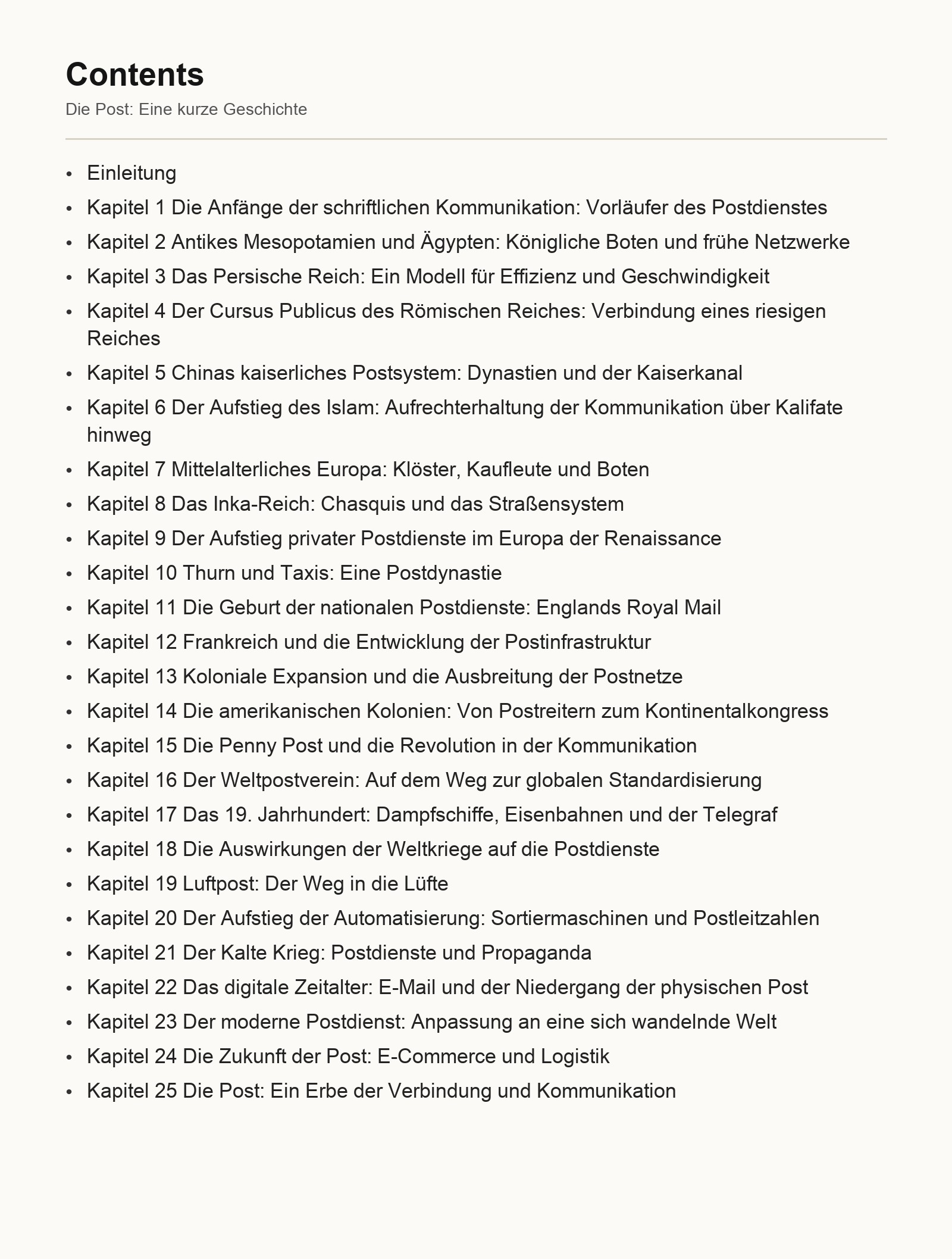
Inhaltsverzeichnis:
-
Einleitung
-
Kapitel 1 Die Anfänge der schriftlichen Kommunikation: Vorläufer des Postdienstes
-
Kapitel 2 Antikes Mesopotamien und Ägypten: Königliche Boten und frühe Netzwerke
-
Kapitel 3 Das Persische Reich: Ein Modell für Effizienz und Geschwindigkeit
-
Kapitel 4 Der Cursus Publicus des Römischen Reiches: Verbindung eines riesigen Reiches
-
Kapitel 5 Chinas kaiserliches Postsystem: Dynastien und der Kaiserkanal
-
Kapitel 6 Der Aufstieg des Islam: Aufrechterhaltung der Kommunikation über Kalifate hinweg
-
Kapitel 7 Mittelalterliches Europa: Klöster, Kaufleute und Boten
-
Kapitel 8 Das Inka-Reich: Chasquis und das Straßensystem
-
Kapitel 9 Der Aufstieg privater Postdienste im Europa der Renaissance
-
Kapitel 10 Thurn und Taxis: Eine Postdynastie
-
Kapitel 11 Die Geburt der nationalen Postdienste: Englands Royal Mail
-
Kapitel 12 Frankreich und die Entwicklung der Postinfrastruktur
-
Kapitel 13 Koloniale Expansion und die Ausbreitung der Postnetze
-
Kapitel 14 Die amerikanischen Kolonien: Von Postreitern zum Kontinentalkongress
-
Kapitel 15 Die Penny Post und die Revolution in der Kommunikation
-
Kapitel 16 Der Weltpostverein: Auf dem Weg zur globalen Standardisierung
-
Kapitel 17 Das 19. Jahrhundert: Dampfschiffe, Eisenbahnen und der Telegraf
-
Kapitel 18 Die Auswirkungen der Weltkriege auf die Postdienste
-
Kapitel 19 Luftpost: Der Weg in die Lüfte
-
Kapitel 20 Der Aufstieg der Automatisierung: Sortiermaschinen und Postleitzahlen
-
Kapitel 21 Der Kalte Krieg: Postdienste und Propaganda
-
Kapitel 22 Das digitale Zeitalter: E-Mail und der Niedergang der physischen Post
-
Kapitel 23 Der moderne Postdienst: Anpassung an eine sich wandelnde Welt
-
Kapitel 24 Die Zukunft der Post: E-Commerce und Logistik
-
Kapitel 25 Die Post: Ein Erbe der Verbindung und Kommunikation
Ephyia Publishing MixCache.com Book Reference: 15378
Autor:
Verlag:
Veröffentlicht am:
17. Mai 2026
Art:
Sachbuch
Sprache:
Deutsch
Auch verfügbar in:
Englisch, Spanisch, Italienisch, Portugiesisch
Wortanzahl:
47.102 Wörter
Lesezeit:
3 Stunden 18 Minuten
Leseprobe:
Bestellen:
Die Post als E-Book auf MixCache.com kaufen:
Jetzt kaufenDas vollständige E-Book ist sofort verfügbar und auf jedem Gerät lesbar.
$5 Guthaben für alle neuen MixCache.com-Konten, einlösbar für jeden E-Book-Kauf!*
 DE
DE
 DE
DE
 DE
DE
 DE
DE
 DE
DE
 DE
DE
Ratings & Reviews
Ask Questions About This Book
Have a question about the content? Ask our AI assistant!
Start by asking a question about "Die Post"
Example: "Does this book mention William Shakespeare?"
Thinking...