Browse by Category
Fiction
- Action & Adventure
- African American
- Anthologies
- Children's Fiction
- Classics
- Comics & Graphic Novels
- Coming of Age
- Contemporary
- Cultural & Regional
- Drama
- Erotica
- Fantasy
- General
- Historical Fiction
- Horror
- Humor & Satire
- Literary Fiction
- Mystery, Thriller & Suspense
- Poetry
- Religious & Inspirational
- Romance
- Science Fiction
- Short Stories
- War & Military
- Westerns
- Women's Fiction
- Young Adult
Non-Fiction
- Antiques & Collectibles
- Arts & Photography
- Biographies & Memoirs
- Business & Money
- Children's Non-Fiction
-
Computers & Technology
- Artificial Intelligence
- Computer Science
- Cybersecurity & Cryptography
- Data Science & Analytics
- Databases & Big Data
- Game Development & Design
- General
- Hardware & DIY
- Mobile App Development
- Networking & Cloud Computing
- Operating Systems
- Programming
- Robotics
- Software
- Software Engineering
- User Experience (UX) & Design
- Web Development & Design
- Cooking, Food & Wine
- Crafts, Hobbies & Home
- Education & Teaching
- Engineering
- General
- Health, Fitness & Dieting
-
History
- African History
- African History - North Africa
- African History - Sub-Saharan Africa
- American History
- American History - 20th Century
- American History - Civil War
- American History - Colonial Period
- Ancient History
- Asian History
- Asian History - China
- Asian History - India
- Asian History - Japan
- Asian History - Southeast Asia
- European History
- European History - Ancient Greece
- European History - Ancient Rome
- European History - Medieval
- European History - Modern
- European History - Renaissance
- General
- Middle Eastern History
- Military History
- Military History - Aviation
- Military History - Naval
- Social & Cultural History
- World History
- Humor & Entertainment
- Industrial Technology
- Language Learning
- Law
- LGBTQ+ Non-Fiction
- Literary Criticism
- Medical Books
- Parenting & Relationships
- Philosophy
- Politics & Social Sciences
- Reference
- Religion & Spirituality
-
Science & Math
- Agricultural Sciences
- Astronomy & Space Science
- Behavioral Sciences
- Biological Sciences
- Botany & Plant Science
- Chemistry
- Earth Sciences
- Engineering - Chemical
- Engineering - Civil
- Engineering - Electrical
- Engineering - Mechanical
- Environment
- General
- Geology
- Mathematics
- Nature & Ecology
- Oceanography
- Paleontology
- Physics
- Statistics
- Self-Help
- Sports & Outdoors
- Study Aids
- Sustainability & Green Living
- Textbooks
- Transportation
- Travel
- True Crime
- Urban Planning & Development
- Veterinary Medicine
- Writing & Publishing
Jump to Section
MixCache.com Total Access
Unlimited reading and audiobooks for every book published by MixCache.com.
Included titles carry the MTA badge.
Learn more →A History of Hebei
About this book:

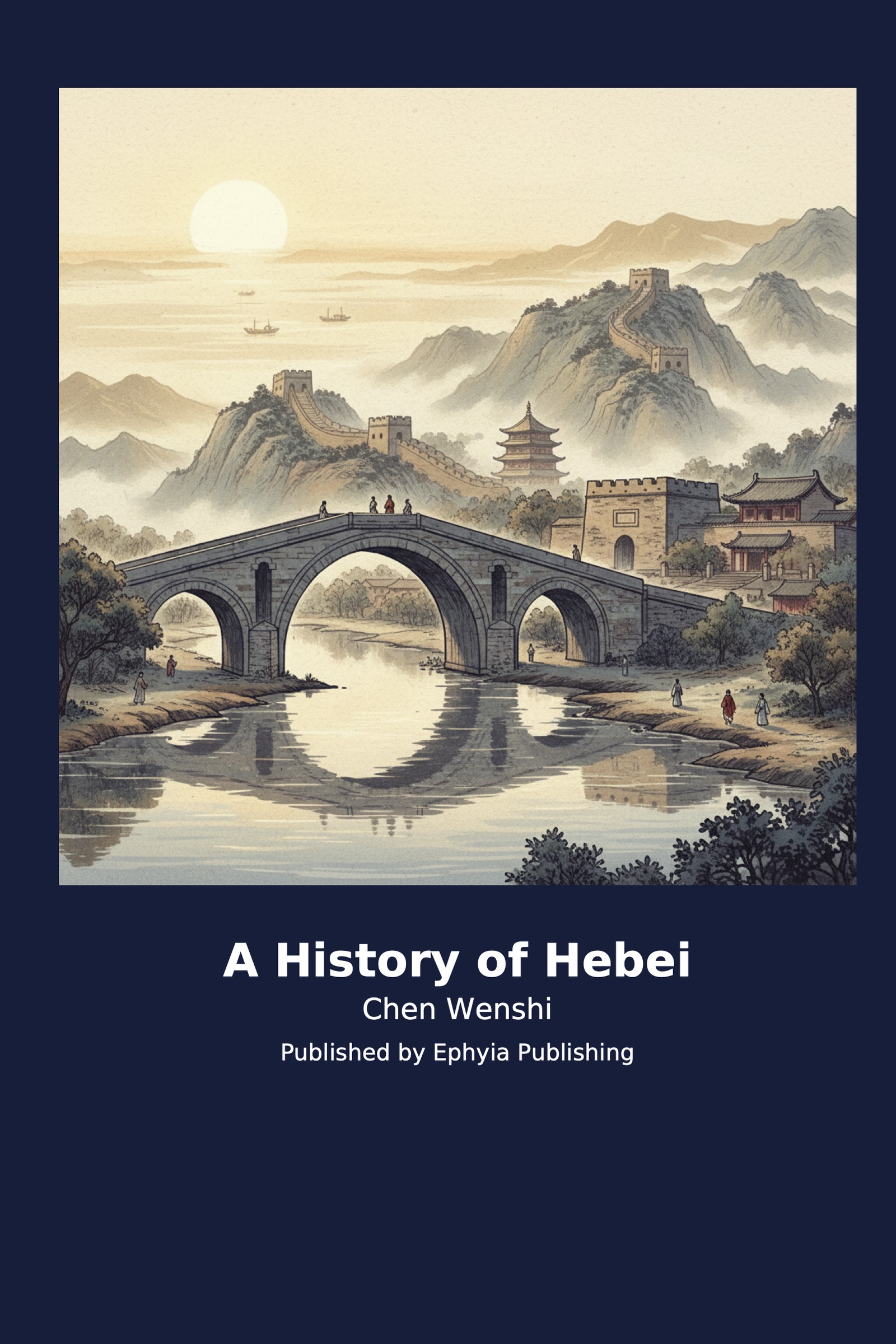
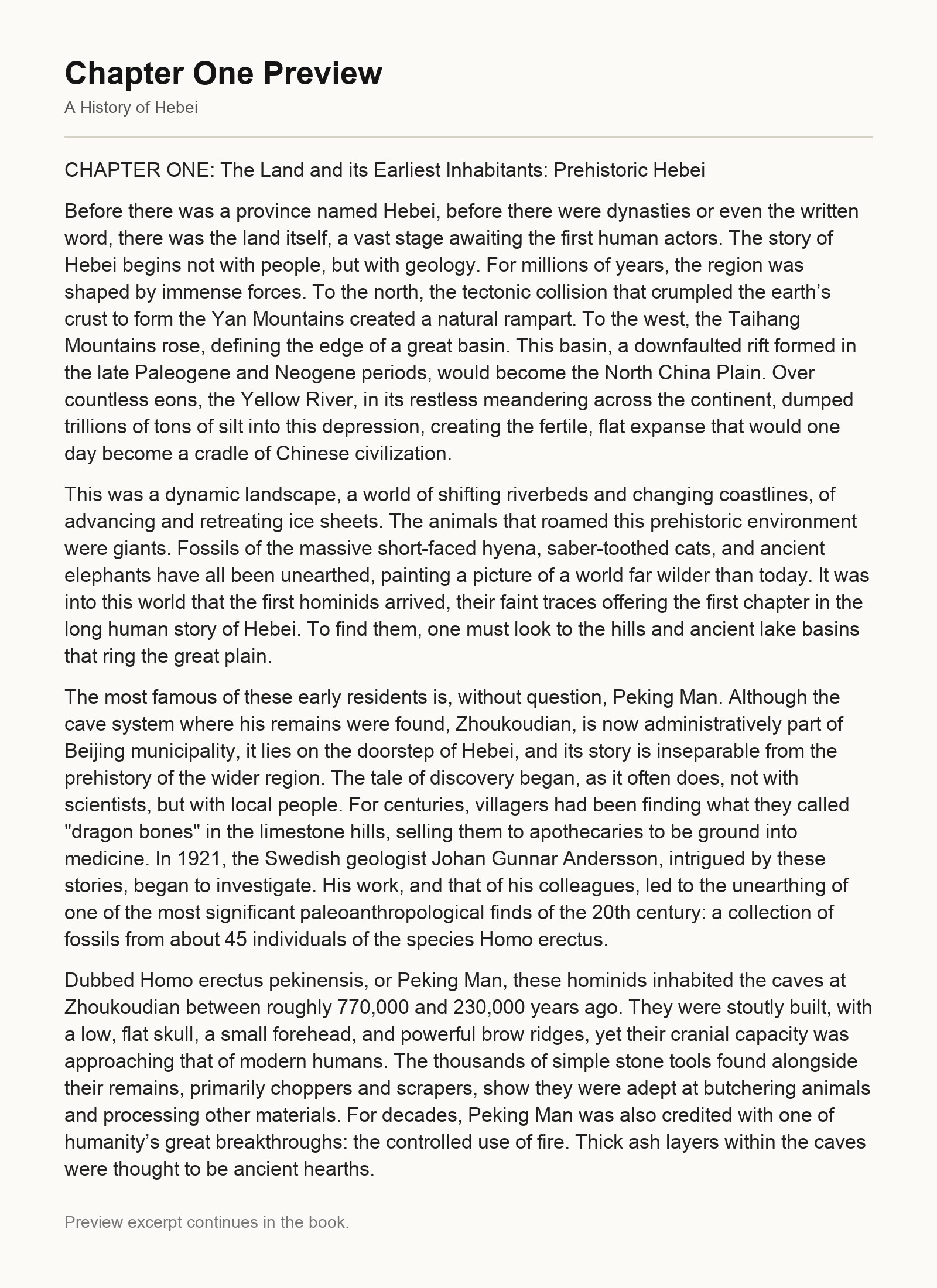
This book offers a comprehensive journey through Hebei’s past, revealing how a province that surrounds Beijing and Tianjin has shaped—and been shaped by—China’s greatest turning points. Readers will trace the land’s geological formation, encounter the earliest hominids such as Peking Man and the Nihewan Basin inhabitants, and follow the rise of Neolithic cultures that laid the foundations of Chinese agriculture and ritual life. The narrative then moves into the bronze age, detailing Hebei’s role as a contested frontier during the Shang and Zhou dynasties, where the states of Yan and Xing guarded the heartland and where early innovations in metallurgy, divination, and fortified settlement first emerged.
Continuing into the tumultuous eras of conflict, the work explores how Hebei became the battleground of the Spring and Autumn and Warring States periods, witnessing the military reforms of King Wuling of Zhao, the devastating Battle of Changping, and the infamous assassination attempt by Jing Ke. It then follows the province’s incorporation into the Qin and Han empires, highlighting the construction of the Great Wall, the strategic importance of the Grand Canal, and Hebei’s transformation into a vital agricultural and industrial base that sustained successive dynasties while enduring waves of rebellion, from the Yellow Turbans to the warlord struggles of the Three Kingdoms and Northern Dynasties.
The book further examines Hebei’s pivotal position during the Sui and Tang reunifications, the Liao‑Song standoff that produced the Treaty of Chanyuan, the Mongol conquest that saw the rise of Dadu (Beijing) as the Yuan capital, and the Ming dynasty’s monumental wall‑building projects that turned the province into a militarized frontier. Readers will experience the dramatic shifts of the Qing conquest, the self‑strengthening reforms centered in Tianjin, the Boxer Uprising’s violent aftermath, and the pivotal role Hebei played in the Xinhai Revolution, the warlord era, and the eventual Communist victory that re‑linked the province to Beijing as the heart of the new People’s Republic.
Moving into the modern age, the text details Hebei’s endurance through the Great Leap Forward, the Cultural Revolution, and the catastrophic Tangshan earthquake, before charting its economic resurgence under Deng Xiaoping’s reforms, the rise of the Bohai Bay Economic Rim, and the pressing environmental challenges of pollution and water scarcity. Finally, it looks ahead to the twenty‑first‑century experiments of Xiong’an New Area and the Beijing‑Tianjin‑Hebei coordinated development strategy, showing how Hebei is being reimagined as an ecological shield, a logistical hub, and a partner in a emerging megalopolis. Throughout, readers will gain insight into the province’s cultural heritage—from the Zhaozhou Bridge and Chengde Mountain Resort to Longxing Monastery and the folk arts of Wuqiao and Hebei Bangzi—and understand how Hebei’s story is, in many ways, a microcosm of China’s own enduring journey.
What You'll Find Inside:
- Hebei's unique geographical position as the region surrounding Beijing and Tianjin, shaping its historical role as China's political buffer zone, industrial heartland, and agricultural base.
- The province's prehistoric significance including Peking Man and the Nihewan Basin, revealing Hebei as a crucial site for understanding early human evolution in East Asia.
- Hebei's role as a perennial frontier and battleground, from the legendary Battle of Zhuolu through the Warring States period, Mongol conquests, and 20th-century conflicts like the Second Sino-Japanese War and Chinese Civil War.
- The province's contribution to China's grand engineering projects including the Grand Canal, Great Wall fortifications, and modern initiatives like the South-to-North Water Diversion Project and Xiong'an New Area.
- Contemporary Hebei's transformation through economic reforms, environmental challenges (pollution and water scarcity), and its evolving role within the Beijing-Tianjin-Hebei megalopolis strategy.
Who's It For:
This book is ideal for students, researchers, and general readers interested in Chinese history, regional studies, and urban development. It will particularly benefit those seeking to understand how Hebei's relationship with the capital has shaped its historical trajectory, as well as readers interested in contemporary China's environmental challenges, economic reforms, and the complexities of regional integration strategies like the Jing-Jin-Ji megalopolis initiative.
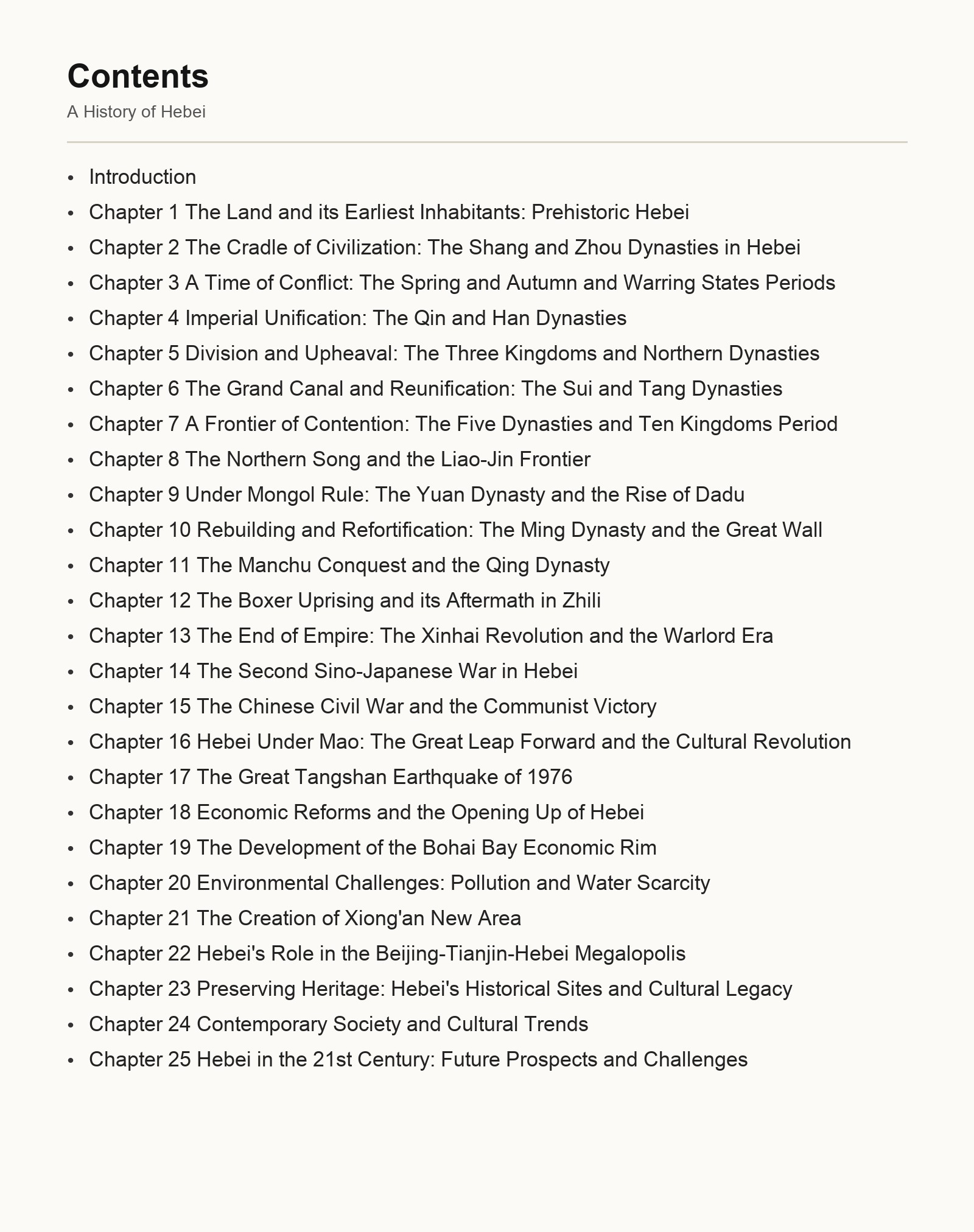
Table of Contents:
- Introduction
- Chapter 1 The Land and its Earliest Inhabitants: Prehistoric Hebei
- Chapter 2 The Cradle of Civilization: The Shang and Zhou Dynasties in Hebei
- Chapter 3 A Time of Conflict: The Spring and Autumn and Warring States Periods
- Chapter 4 Imperial Unification: The Qin and Han Dynasties
- Chapter 5 Division and Upheaval: The Three Kingdoms and Northern Dynasties
- Chapter 6 The Grand Canal and Reunification: The Sui and Tang Dynasties
- Chapter 7 A Frontier of Contention: The Five Dynasties and Ten Kingdoms Period
- Chapter 8 The Northern Song and the Liao-Jin Frontier
- Chapter 9 Under Mongol Rule: The Yuan Dynasty and the Rise of Dadu
- Chapter 10 Rebuilding and Refortification: The Ming Dynasty and the Great Wall
- Chapter 11 The Manchu Conquest and the Qing Dynasty
- Chapter 12 The Boxer Uprising and its Aftermath in Zhili
- Chapter 13 The End of Empire: The Xinhai Revolution and the Warlord Era
- Chapter 14 The Second Sino-Japanese War in Hebei
- Chapter 15 The Chinese Civil War and the Communist Victory
- Chapter 16 Hebei Under Mao: The Great Leap Forward and the Cultural Revolution
- Chapter 17 The Great Tangshan Earthquake of 1976
- Chapter 18 Economic Reforms and the Opening Up of Hebei
- Chapter 19 The Development of the Bohai Bay Economic Rim
- Chapter 20 Environmental Challenges: Pollution and Water Scarcity
- Chapter 21 The Creation of Xiong'an New Area
- Chapter 22 Hebei's Role in the Beijing-Tianjin-Hebei Megalopolis
- Chapter 23 Preserving Heritage: Hebei's Historical Sites and Cultural Legacy
- Chapter 24 Contemporary Society and Cultural Trends
- Chapter 25 Hebei in the 21st Century: Future Prospects and Challenges
Author:
Published By:
Date Published:
May 16, 2026
Type:
Nonfiction
Language:
English
Also Available In:
Word Count:
49,539 words
Reading Time:
3 hours 28 minutes
Sample:
Order:
Order A History of Hebei (Hardcover) on MixCache.com:
Buy NowPrint copy is made to order and ships worldwide. Includes the ebook free, ready to read instantly.
$5 account credit for all new MixCache.com accounts, usable toward any ebook purchase!*