
Browse by Category
Fiction
- Action & Adventure
- African American
- Anthologies
- Children's Fiction
- Classics
- Comics & Graphic Novels
- Coming of Age
- Contemporary
- Cultural & Regional
- Drama
- Erotica
- Fantasy
- General
- Historical Fiction
- Horror
- Humor & Satire
- Literary Fiction
- Mystery, Thriller & Suspense
- Poetry
- Religious & Inspirational
- Romance
- Science Fiction
- Short Stories
- War & Military
- Westerns
- Women's Fiction
- Young Adult
Non-Fiction
- Antiques & Collectibles
- Arts & Photography
- Biographies & Memoirs
- Business & Money
- Children's Non-Fiction
-
Computers & Technology
- Artificial Intelligence
- Computer Science
- Cybersecurity & Cryptography
- Data Science & Analytics
- Databases & Big Data
- Game Development & Design
- General
- Hardware & DIY
- Mobile App Development
- Networking & Cloud Computing
- Operating Systems
- Programming
- Robotics
- Software
- Software Engineering
- User Experience (UX) & Design
- Web Development & Design
- Cooking, Food & Wine
- Crafts, Hobbies & Home
- Education & Teaching
- Engineering
- General
- Health, Fitness & Dieting
-
History
- African History
- African History - North Africa
- African History - Sub-Saharan Africa
- American History
- American History - 20th Century
- American History - Civil War
- American History - Colonial Period
- Ancient History
- Asian History
- Asian History - China
- Asian History - India
- Asian History - Japan
- Asian History - Southeast Asia
- European History
- European History - Ancient Greece
- European History - Ancient Rome
- European History - Medieval
- European History - Modern
- European History - Renaissance
- General
- Middle Eastern History
- Military History
- Military History - Aviation
- Military History - Naval
- Social & Cultural History
- World History
- Humor & Entertainment
- Industrial Technology
- Language Learning
- Law
- LGBTQ+ Non-Fiction
- Literary Criticism
- Medical Books
- Parenting & Relationships
- Philosophy
- Politics & Social Sciences
- Reference
- Religion & Spirituality
-
Science & Math
- Agricultural Sciences
- Astronomy & Space Science
- Behavioral Sciences
- Biological Sciences
- Botany & Plant Science
- Chemistry
- Earth Sciences
- Engineering - Chemical
- Engineering - Civil
- Engineering - Electrical
- Engineering - Mechanical
- Environment
- General
- Geology
- Mathematics
- Nature & Ecology
- Oceanography
- Paleontology
- Physics
- Statistics
- Self-Help
- Sports & Outdoors
- Study Aids
- Sustainability & Green Living
- Textbooks
- Transportation
- Travel
- True Crime
- Urban Planning & Development
- Veterinary Medicine
- Writing & Publishing
Jump to Section

Want unlimited access to all books published by MixCache.com (plus their audiobooks)? Try MixCache.com Total Access. Look for the MTA badge on book covers to identify included titles.
Access to infinite ebooks: Don't see the book you want? Suggest it and we'll create it (free!) for you from scratch with our powerful AI book writer. Then read it with MTA - besides profiting from any sales it makes!
A History of Madagascar
About this book:
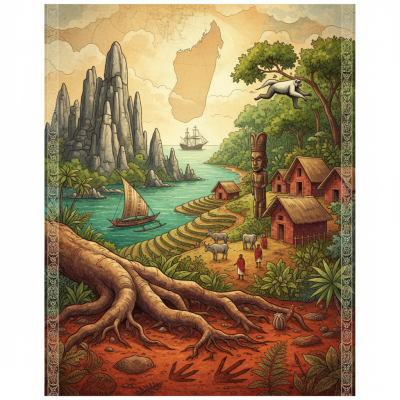
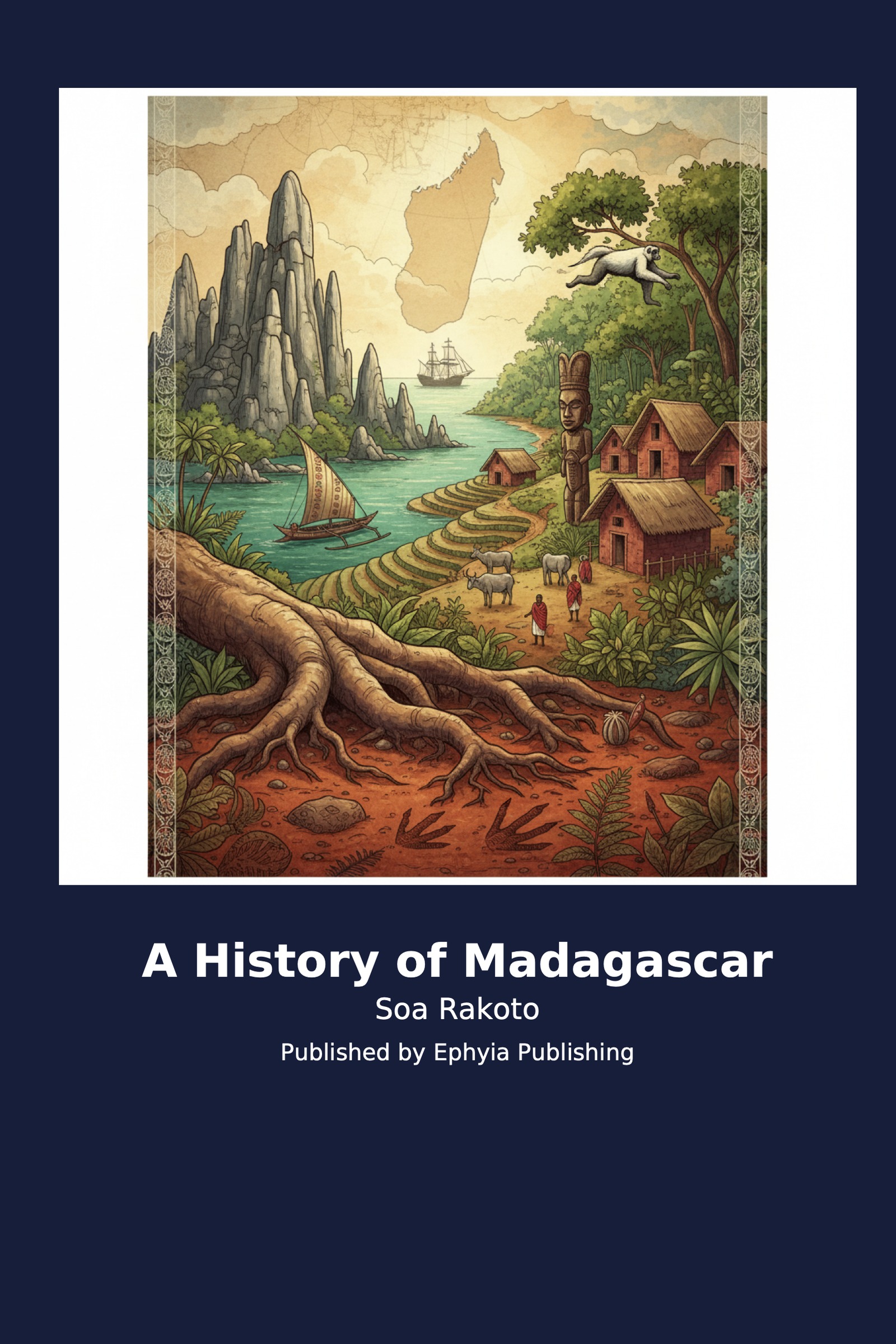
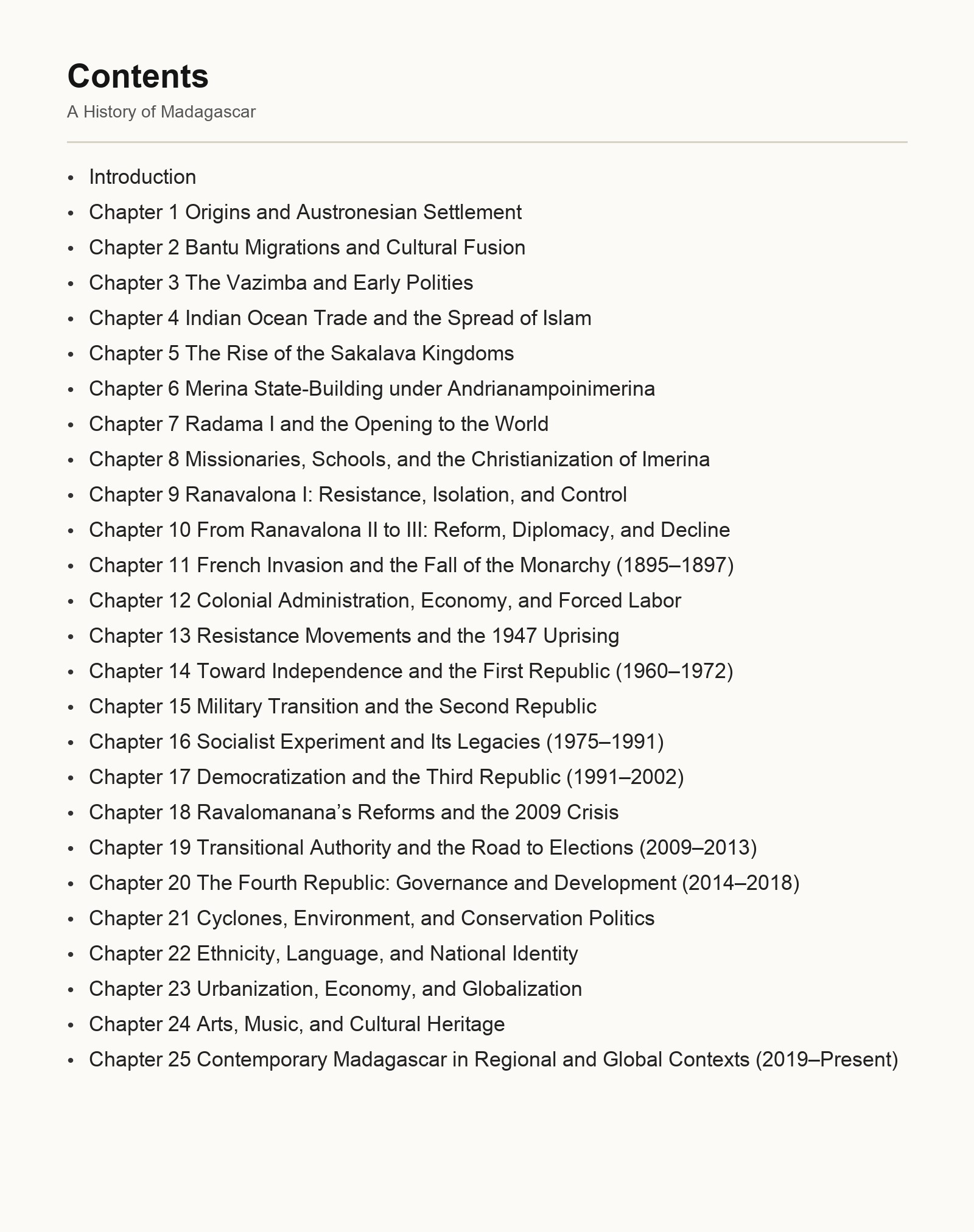
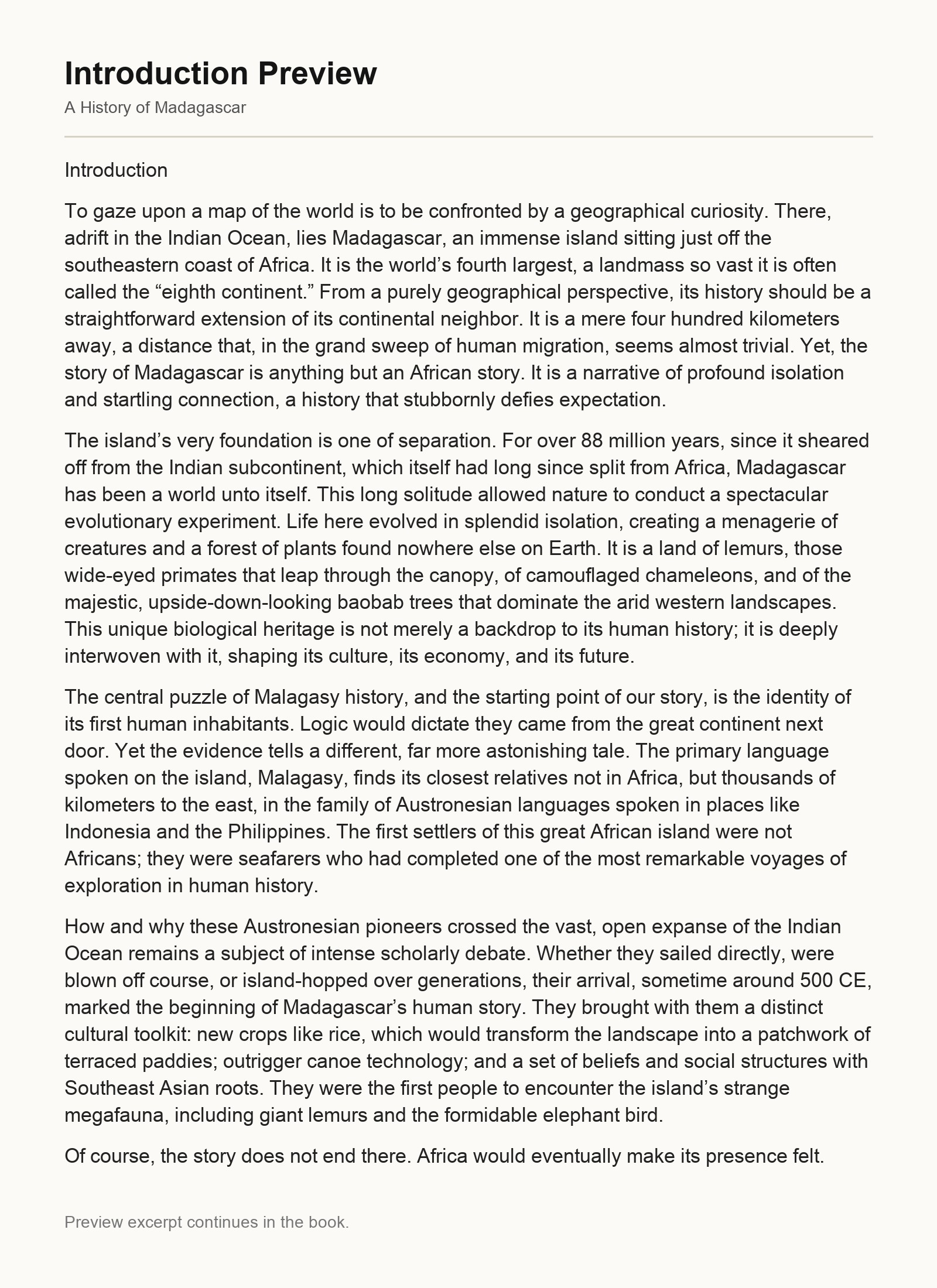
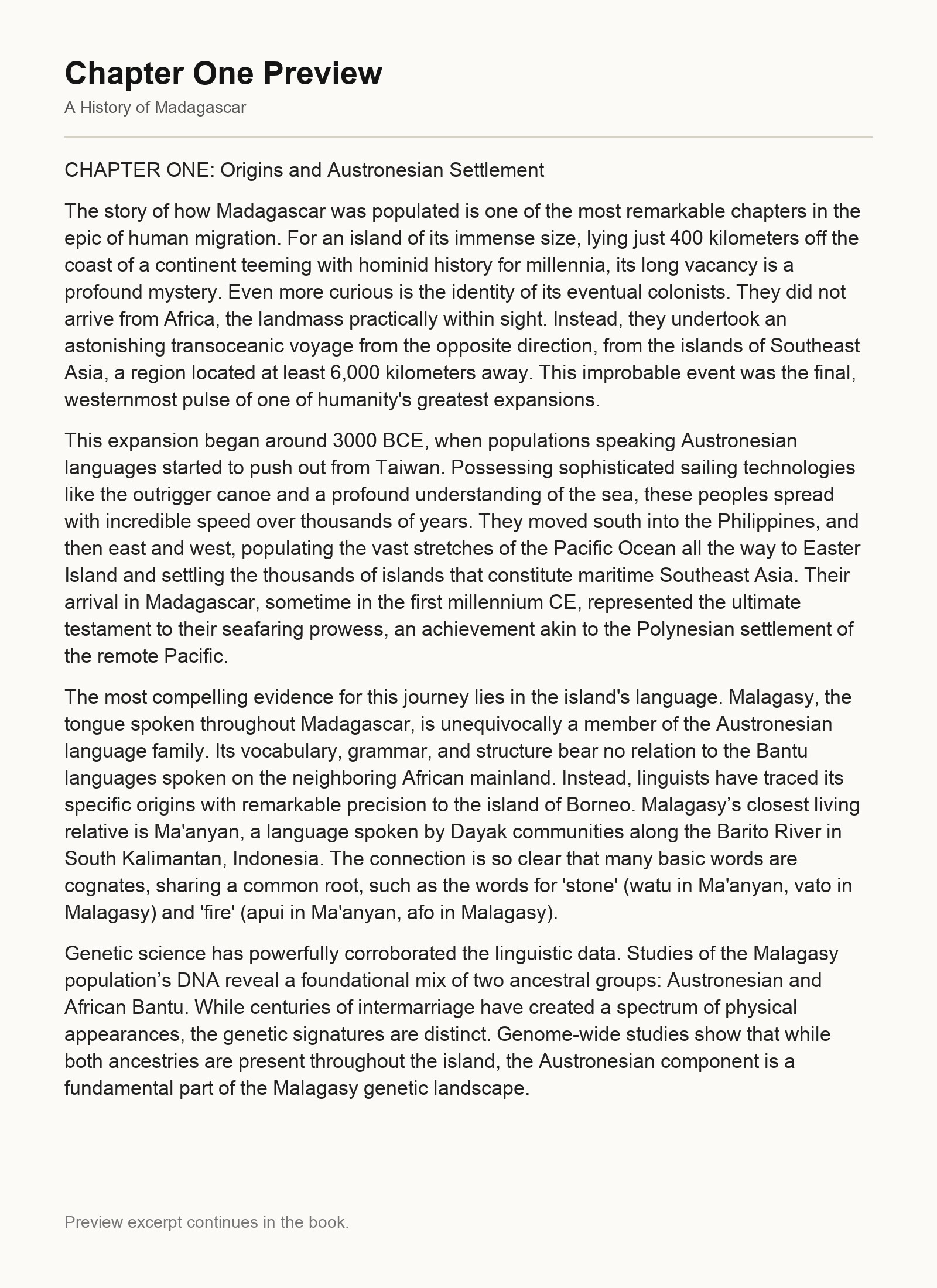
Discover the extraordinary story of Madagascar, an island that defies simple categorization as either African or Asian, in this sweeping narrative that traces its human journey from the first Austronesian voyagers who crossed the Indian Ocean to the vibrant, contested nation of today. Readers will follow the island’s earliest settlers as they introduced rice cultivation and outrigger canoe technology, then witness the profound cultural fusion that arose when Bantu-speaking peoples arrived with zebu cattle, iron‑working, and new agricultural practices, creating the unique Malagasy identity that endures in language, music, and spiritual belief.
The book guides you through the rise and fall of powerful kingdoms, from the cattle‑rich Sakalava empires that dominated the western coast through the gun‑slave trade, to the Merina state‑builders who unified the highlands under visionary leaders like Andrianampoinimerina and Radama I, whose opening to European missionaries and modern weaponry reshaped the island’s political landscape. You will experience the dramatic reign of Queen Ranavalona I, her fierce resistance to foreign influence, and the subsequent era of reform, French invasion, and colonial exploitation that left deep scars on Malagasy society while sparking relentless resistance movements, culminating in the 1947 uprising and the long road to independence.
Beyond politics and war, this work explores the enduring themes that shape everyday life in Madagascar. You will learn how the island’s extraordinary biodiversity—lemurs, baobabs, chameleons, and countless endemic species—has intertwined with human history, from early megafauna extinctions to modern conservation politics and the increasing threat of cyclones and climate‑induced famine. The narrative also delves into the complex interplay of ethnicity, language, caste, and the powerful concept of fihavanana that attempts to bind a diverse populace together, while examining how urbanization, globalization, and informal economies continue to transform livelihoods from the rice paddies of Imerina to the bustling streets of Antananarivo.
Readers will gain insight into Madagascar’s tumultuous post‑independence era, navigating the socialist experiment of the Second Republic, the democratic hopes and disappointments of the Third and Fourth Republics, and the recurring cycles of crisis—coups, protests, and international isolation—that have tested the nation’s resilience. The book concludes with a contemporary look at Madagascar’s place in regional and global affairs, illuminating how its vast natural wealth, cultural heritage, and ongoing struggles for governance and development define its role in Africa, the Indian Ocean, and the wider world.
Ultimately, this history offers more than a chronicle of dates and dynasties; it invites you to feel the pulse of a land that is both a continent in miniature and an island world of its own making. You will come away with a deeper appreciation of Madagascar’s remarkable cultural synthesis, its environmental challenges, and the enduring spirit of a people who have continually adapted, resisted, and reimagined their destiny amid isolation and connection, tradition and change.
What You'll Find Inside:
- The island’s first settlers were Austronesian seafarers from Borneo, not Africans, who introduced rice cultivation and outrigger canoe technology around the first millennium CE.
- Later Bantu migrations brought zebu cattle, iron-working, and African crops, creating a unique Austronesian‑Bantu cultural fusion that defines Malagasy society today.
- From the 17th to 19th centuries, the Sakalava kingdoms dominated the west via the gun‑slave cycle, while the Merina state in the highlands unified the island under leaders like Andrianampoinimerina and Radama I before European intervention.
- French colonial rule (1895–1960) imposed forced labor, extractive economies, and a divide‑and‑rule policy, sparking resistance culminating in the 1947 uprising and eventually leading to independence in 1960.
- Post‑independence Madagascar has cycled through socialist experiments, democratic transitions, political crises, and environmental challenges, while striving to forge a national identity rooted in fihavanana and shared Austronesian‑African heritage.
Who's It For:
This book is ideal for undergraduate and graduate students of African history, postcolonial studies, and anthropology, as well as general readers interested in understanding Madagascar’s unique cultural origins, its tumultuous political journey, and its contemporary challenges in globalization and conservation.
Author:
Published By:
Date Published:
May 16, 2026
Type:
Nonfiction
Language:
English
Also Available In:
Word Count:
47,690 words
Reading Time:
3 hours 20 minutes
Sample:
Order:
Buy the A History of Madagascar ebook on MixCache.com:
Buy NowThe full ebook will be available immediately to read instantly on any device.
$5 account credit for all new MixCache.com accounts, usable toward any ebook purchase!*




Ratings & Reviews
Ask Questions About This Book
Have a question about the content? Ask our AI assistant!
Start by asking a question about "A History of Madagascar"
Example: "Does this book mention William Shakespeare?"
Thinking...