Browse by Category
Fiction
- Action & Adventure
- African American
- Anthologies
- Children's Fiction
- Classics
- Comics & Graphic Novels
- Coming of Age
- Contemporary
- Cultural & Regional
- Drama
- Erotica
- Fantasy
- General
- Historical Fiction
- Horror
- Humor & Satire
- Literary Fiction
- Mystery, Thriller & Suspense
- Poetry
- Religious & Inspirational
- Romance
- Science Fiction
- Short Stories
- War & Military
- Westerns
- Women's Fiction
- Young Adult
Non-Fiction
- Antiques & Collectibles
- Arts & Photography
- Biographies & Memoirs
- Business & Money
- Children's Non-Fiction
-
Computers & Technology
- Artificial Intelligence
- Computer Science
- Cybersecurity & Cryptography
- Data Science & Analytics
- Databases & Big Data
- Game Development & Design
- General
- Hardware & DIY
- Mobile App Development
- Networking & Cloud Computing
- Operating Systems
- Programming
- Robotics
- Software
- Software Engineering
- User Experience (UX) & Design
- Web Development & Design
- Cooking, Food & Wine
- Crafts, Hobbies & Home
- Education & Teaching
- Engineering
- General
- Health, Fitness & Dieting
-
History
- African History
- African History - North Africa
- African History - Sub-Saharan Africa
- American History
- American History - 20th Century
- American History - Civil War
- American History - Colonial Period
- Ancient History
- Asian History
- Asian History - China
- Asian History - India
- Asian History - Japan
- Asian History - Southeast Asia
- European History
- European History - Ancient Greece
- European History - Ancient Rome
- European History - Medieval
- European History - Modern
- European History - Renaissance
- General
- Middle Eastern History
- Military History
- Military History - Aviation
- Military History - Naval
- Social & Cultural History
- World History
- Humor & Entertainment
- Industrial Technology
- Language Learning
- Law
- LGBTQ+ Non-Fiction
- Literary Criticism
- Medical Books
- Parenting & Relationships
- Philosophy
- Politics & Social Sciences
- Reference
- Religion & Spirituality
-
Science & Math
- Agricultural Sciences
- Astronomy & Space Science
- Behavioral Sciences
- Biological Sciences
- Botany & Plant Science
- Chemistry
- Earth Sciences
- Engineering - Chemical
- Engineering - Civil
- Engineering - Electrical
- Engineering - Mechanical
- Environment
- General
- Geology
- Mathematics
- Nature & Ecology
- Oceanography
- Paleontology
- Physics
- Statistics
- Self-Help
- Sports & Outdoors
- Study Aids
- Sustainability & Green Living
- Textbooks
- Transportation
- Travel
- True Crime
- Urban Planning & Development
- Veterinary Medicine
- Writing & Publishing
Jump to Section
MixCache.com Total Access
Unlimited reading and audiobooks for every book published by MixCache.com.
Included titles carry the MTA badge.
Learn more →
Façade Engineering and Building Envelope Performance
MTA
Design, materials, and installation best practices to deliver durable, efficient commercial façades
About this book:
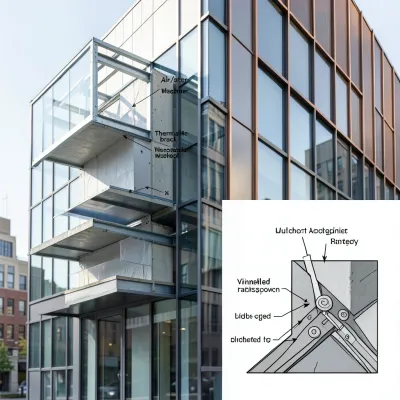
*Façade Engineering and Building Envelope Performance* provides a comprehensive technical guide to the design, materials, and lifecycle management of modern commercial building skins. The book emphasizes that the façade is a complex, multi-functional system sitting at the intersection of architecture, building science, and structural engineering. It details various systems—including unitized and stick-built curtain walls, rainscreens, and diverse cladding materials like terracotta and GFRC—while highlighting the critical importance of maintaining continuous air, water, and thermal control layers across complex building interfaces.
The text delves deeply into the physics of performance, covering structural loads (wind, seismic, and thermal), hygrothermal analysis for condensation risk, and the balancing act between daylighting, solar control, and visual comfort. Significant attention is given to life-safety regulations, specifically fire propagation and NFPA 285 compliance, alongside contemporary concerns regarding resilience against extreme weather and security threats. The book argues that high-performance façades require rigorous engineering to mitigate thermal bridging and manage acoustic intrusion in dense urban environments.
A major portion of the book is dedicated to the practical delivery and maintenance of these systems. It outlines best practices for digital coordination through BIM, fabrication tolerances, and the necessity of both laboratory and field mock-up testing (following ASTM and AAMA protocols). By framing commissioning and performance verification as essential risk-management tools, the text connects initial construction quality to long-term operational success. It provides frameworks for maintenance scheduling, access logistics, and warranty strategies necessary to preserve asset value.
Finally, the book addresses the evolving landscape of sustainable construction, shifting the focus from purely operational energy efficiency to the reduction of embodied carbon and the implementation of circular design principles. It concludes by exploring the complexities of retrofitting and re-cladding existing buildings, presenting these interventions as vital strategies for urban renewal and decarbonization. Overall, the work serves as a professional manual for delivering façades that are aesthetically ambitious, technically durable, and environmentally responsible.
What You'll Find Inside:
- Climate-responsive envelope design fundamentals, including solar geometry, shading strategies, and hygrothermal analysis to tune façades to local conditions
- Comprehensive coverage of curtain wall systems: types (stick-built, unitized), components, detailing, and installation best practices for durable performance
- Critical continuity of air, water, and vapor control layers across interfaces and penetrations, where most façade failures originate
- Thermal performance optimization and bridging mitigation strategies at slab edges and anchors to improve energy efficiency and prevent condensation
- Testing, commissioning, and performance verification protocols (ASTM E1105, E783, E330) to ensure façades meet design intent and code requirements
Who's It For:
This book is essential for façade engineers, architects, contractors, and building owners involved in commercial envelope design and delivery. It bridges disciplinary perspectives by providing designers with decision frameworks connecting concept choices to measurable performance, builders with fabrication and installation sequencing details to reduce rework, and owners with technical requirements translated into procurement criteria, commissioning plans, and maintenance strategies that protect lifecycle performance and financial returns.
Table of Contents:
- Introduction
- Chapter 1 The Role of Façade Engineering in Building Performance
- Chapter 2 Climate-Responsive Envelope Design Fundamentals
- Chapter 3 Codes, Standards, and Compliance (IBC, IECC, ASHRAE, NFRC, AAMA)
- Chapter 4 Loads, Movements, and Serviceability (Wind, Seismic, Thermal)
- Chapter 5 Curtain Wall Systems: Types, Components, and Detailing
- Chapter 6 Rainscreen Principles and Pressure-Equalized Assemblies
- Chapter 7 Cladding Selection: Metals, Terracotta, Stone, GFRC, HPL, and Fiber Cement
- Chapter 8 Glazing Systems: IGUs, Coatings, and Edge Conditions
- Chapter 9 Air, Water, and Vapor Control Layers: Continuity and Transitions
- Chapter 10 Thermal Performance and Bridging Mitigation at Slab Edges and Anchors
- Chapter 11 Hygrothermal Analysis and Condensation Risk Management
- Chapter 12 Daylighting, Solar Control, and Visual Comfort
- Chapter 13 Acoustic Performance and Urban Noise Control
- Chapter 14 Fire, Smoke, and Life-Safety in Façades (Including NFPA 285)
- Chapter 15 Resilience: Extreme Weather, Impact, and Security
- Chapter 16 Interfaces: Structure, MEP Penetrations, and Roof–Wall–Parapet Details
- Chapter 17 Materials Durability, Corrosion, Sealants, and Gaskets
- Chapter 18 Digital Delivery: BIM Coordination and Tolerance Management
- Chapter 19 Fabrication, Unitization, and Mock-Ups
- Chapter 20 Installation Sequencing, Tolerances, and Field QA/QC
- Chapter 21 Testing and Commissioning: Lab and Field Protocols (ASTM E1105, E783, E330)
- Chapter 22 Performance Verification and Building Enclosure Commissioning (BECx)
- Chapter 23 Operations, Access, Maintenance, and Warranty Strategy
- Chapter 24 Sustainability, Embodied Carbon, and Circular Façade Design
- Chapter 25 Retrofit and Re-Cladding of Existing Buildings
Author:
Published By:
Date Published:
May 15, 2026
Type:
Nonfiction
Language:
English
Word Count:
77,554 words
Reading Time:
5 hours 26 minutes
Sample:
Order:
Order Façade Engineering and Building Envelope Performance (Hardcover) on MixCache.com:
Buy NowPrint copy is made to order and ships worldwide. Includes the ebook free, ready to read instantly.
$5 account credit for all new MixCache.com accounts, usable toward any ebook purchase!*