Browse by Category
Fiction
- Action & Adventure
- African American
- Anthologies
- Children's Fiction
- Classics
- Comics & Graphic Novels
- Coming of Age
- Contemporary
- Cultural & Regional
- Drama
- Erotica
- Fantasy
- General
- Historical Fiction
- Horror
- Humor & Satire
- Literary Fiction
- Mystery, Thriller & Suspense
- Poetry
- Religious & Inspirational
- Romance
- Science Fiction
- Short Stories
- War & Military
- Westerns
- Women's Fiction
- Young Adult
Non-Fiction
- Antiques & Collectibles
- Arts & Photography
- Biographies & Memoirs
- Business & Money
- Children's Non-Fiction
-
Computers & Technology
- Artificial Intelligence
- Computer Science
- Cybersecurity & Cryptography
- Data Science & Analytics
- Databases & Big Data
- Game Development & Design
- General
- Hardware & DIY
- Mobile App Development
- Networking & Cloud Computing
- Operating Systems
- Programming
- Robotics
- Software
- Software Engineering
- User Experience (UX) & Design
- Web Development & Design
- Cooking, Food & Wine
- Crafts, Hobbies & Home
- Education & Teaching
- Engineering
- General
- Health, Fitness & Dieting
-
History
- African History
- African History - North Africa
- African History - Sub-Saharan Africa
- American History
- American History - 20th Century
- American History - Civil War
- American History - Colonial Period
- Ancient History
- Asian History
- Asian History - China
- Asian History - India
- Asian History - Japan
- Asian History - Southeast Asia
- European History
- European History - Ancient Greece
- European History - Ancient Rome
- European History - Medieval
- European History - Modern
- European History - Renaissance
- General
- Middle Eastern History
- Military History
- Military History - Aviation
- Military History - Naval
- Social & Cultural History
- World History
- Humor & Entertainment
- Industrial Technology
- Language Learning
- Law
- LGBTQ+ Non-Fiction
- Literary Criticism
- Medical Books
- Parenting & Relationships
- Philosophy
- Politics & Social Sciences
- Reference
- Religion & Spirituality
-
Science & Math
- Agricultural Sciences
- Astronomy & Space Science
- Behavioral Sciences
- Biological Sciences
- Botany & Plant Science
- Chemistry
- Earth Sciences
- Engineering - Chemical
- Engineering - Civil
- Engineering - Electrical
- Engineering - Mechanical
- Environment
- General
- Geology
- Mathematics
- Nature & Ecology
- Oceanography
- Paleontology
- Physics
- Statistics
- Self-Help
- Sports & Outdoors
- Study Aids
- Sustainability & Green Living
- Textbooks
- Transportation
- Travel
- True Crime
- Urban Planning & Development
- Veterinary Medicine
- Writing & Publishing
Jump to Section
MixCache.com Total Access
Unlimited reading and audiobooks for every book published by MixCache.com.
Included titles carry the MTA badge.
Learn more →
MEP Coordination and Commissioning for Commercial Buildings
MTA
Design, installation sequencing, and commissioning strategies for complex mechanical, electrical and plumbing systems
About this book:
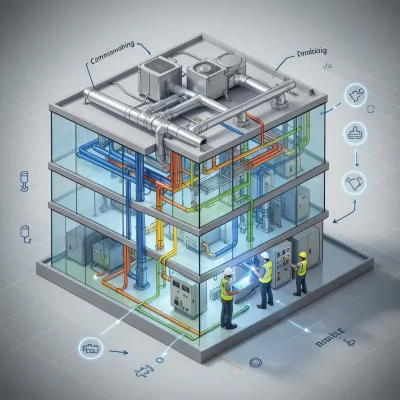
This book provides a comprehensive technical guide to the lifecycle of mechanical, electrical, and plumbing (MEP) systems in commercial buildings, spanning from initial design to long-term operation. It begins by establishing the foundational importance of the Owner’s Project Requirements (OPR) and Basis of Design (BOD), which serve as the performance benchmarks for all subsequent coordination. The text emphasizes that modern MEP success relies on disciplined Building Information Modeling (BIM), where rigorous Level of Development (LOD) standards and proactive clash detection allow trades to resolve spatial conflicts digitally before physical installation begins.
The middle chapters detail the practicalities of field execution, highlighting strategies such as prefabrication, modular MEP racks, and advanced scheduling techniques like Pull Planning and Takt time. By shifting complex assembly work to controlled factory environments and using collaborative "last planner" workflows, project teams can reduce onsite risks, improve safety, and ensure that systems like ductwork, hydronic piping, and electrical distribution are installed in a logical, efficient sequence. Special attention is given to the critical interfaces of these systems, including structural supports, seismic bracing, and fire-rated penetrations.
A significant portion of the book is dedicated to the commissioning process, which it frames as a continuous quality assurance thread rather than a final checklist. The text outlines rigorous procedures for equipment start-up, testing and balancing (TAB), and functional performance testing (FPT) to verify that integrated systems—particularly life safety and building automation—work in concert. It also explores the integration of controls architecture, ensuring that the "nervous system" of the building is properly programmed to meet energy and comfort targets.
The final section focuses on the transition from construction to occupancy and long-term sustainability. It covers the essential requirements for operator training and O&M documentation, alongside enhanced commissioning and Measurement and Verification (M&V) strategies to track energy performance. By advocating for a culture of continuous improvement and "lessons learned" reviews, the book provides a roadmap for delivering resilient, high-performing buildings that maintain their design intent and occupant comfort throughout their operational life.
What You'll Find Inside:
- Establishing clear Owner's Project Requirements (OPR) and Basis of Design (BOD) as the performance foundation for all MEP coordination and commissioning activities
- Implementing BIM-based coordination workflows with Level of Development (LOD) specifications, clash detection, and resolution processes to prevent field conflicts
- Developing logical installation sequences and 4D plans that optimize construction workflows and prevent costly rework
- Executing comprehensive commissioning processes from prefunctional checks through functional testing, seasonal verification, and documentation
- Validating long-term performance through Measurement and Verification (M&V) and Indoor Environmental Quality (IEQ) assessment to ensure occupant comfort and energy efficiency
Who's It For:
This book is designed for engineers, trade contractors, and commissioning professionals involved in commercial building projects. Engineers will benefit from guidance on defining performance criteria, detailing systems for fabrication, and creating coordination drawings that reduce ambiguity. Trade contractors will gain insights into pull planning, takt control, and prefabrication strategies to de-risk installation and improve quality. Commissioning agents will find valuable checklists, test protocols, and integration strategies to verify system performance without disrupting construction schedules.
Table of Contents:
- Introduction
- Chapter 1 Defining the Owner’s Project Requirements (OPR) and Basis of Design (BOD)
- Chapter 2 Codes, Standards, and Performance Criteria for MEP Systems
- Chapter 3 BIM for Coordination: Level of Development and Model Management
- Chapter 4 Clash Detection and Resolution Workflows
- Chapter 5 Coordination Drawings: Best Practices and Deliverables
- Chapter 6 Installation Sequencing and 4D Planning
- Chapter 7 Pull Planning, Takt, and the Last Planner System
- Chapter 8 Prefabrication and Modular MEP Racks
- Chapter 9 Hangers, Supports, Seismic Bracing, and Vibration Isolation
- Chapter 10 Penetrations, Sleeves, and Firestopping Coordination
- Chapter 11 Ductwork Routing, Leakage Classes, and Airside Details
- Chapter 12 Hydronic Piping, Valving Strategies, and Flushing Plans
- Chapter 13 Domestic Water, Sanitary, and Storm Systems Integration
- Chapter 14 Electrical Distribution, Grounding, and Short-Circuit Coordination
- Chapter 15 Emergency Power, UPS, and Generator Systems
- Chapter 16 Controls Architecture and Building Automation Integration
- Chapter 17 Life Safety: Fire Alarm, Smoke Control, and Egress Pressurization
- Chapter 18 Test, Adjust, and Balance (TAB): Procedures and Acceptance Criteria
- Chapter 19 Equipment Start-up and Functional Performance Testing
- Chapter 20 Commissioning Plans, Checklists, and Documentation
- Chapter 21 Measurement and Verification (M&V) for Energy Performance
- Chapter 22 Indoor Environmental Quality and Occupant Comfort Validation
- Chapter 23 Seasonal and Enhanced Commissioning Strategies
- Chapter 24 Turnover: O&M Manuals, Training, and Closeout
- Chapter 25 Lessons Learned, Risk Management, and Continuous Improvement
Author:
Published By:
Date Published:
May 15, 2026
Type:
Nonfiction
Language:
English
Word Count:
97,836 words
Reading Time:
6 hours 51 minutes
Sample:
Order:
Order MEP Coordination and Commissioning for Commercial Buildings (Paperback) on MixCache.com:
Buy NowPrint copy is made to order and ships worldwide. Includes the ebook free, ready to read instantly.
$5 account credit for all new MixCache.com accounts, usable toward any ebook purchase!*