
Browse by Category
Fiction
- Action & Adventure
- African American
- Anthologies
- Children's Fiction
- Classics
- Comics & Graphic Novels
- Coming of Age
- Contemporary
- Cultural & Regional
- Drama
- Erotica
- Fantasy
- General
- Historical Fiction
- Horror
- Humor & Satire
- Literary Fiction
- Mystery, Thriller & Suspense
- Poetry
- Religious & Inspirational
- Romance
- Science Fiction
- Short Stories
- War & Military
- Westerns
- Women's Fiction
- Young Adult
Non-Fiction
- Antiques & Collectibles
- Arts & Photography
- Biographies & Memoirs
- Business & Money
- Children's Non-Fiction
-
Computers & Technology
- Artificial Intelligence
- Computer Science
- Cybersecurity & Cryptography
- Data Science & Analytics
- Databases & Big Data
- Game Development & Design
- General
- Hardware & DIY
- Mobile App Development
- Networking & Cloud Computing
- Operating Systems
- Programming
- Robotics
- Software
- Software Engineering
- User Experience (UX) & Design
- Web Development & Design
- Cooking, Food & Wine
- Crafts, Hobbies & Home
- Education & Teaching
- Engineering
- General
- Health, Fitness & Dieting
-
History
- African History
- African History - North Africa
- African History - Sub-Saharan Africa
- American History
- American History - 20th Century
- American History - Civil War
- American History - Colonial Period
- Ancient History
- Asian History
- Asian History - China
- Asian History - India
- Asian History - Japan
- Asian History - Southeast Asia
- European History
- European History - Ancient Greece
- European History - Ancient Rome
- European History - Medieval
- European History - Modern
- European History - Renaissance
- General
- Middle Eastern History
- Military History
- Military History - Aviation
- Military History - Naval
- Social & Cultural History
- World History
- Humor & Entertainment
- Industrial Technology
- Language Learning
- Law
- LGBTQ+ Non-Fiction
- Literary Criticism
- Medical Books
- Parenting & Relationships
- Philosophy
- Politics & Social Sciences
- Reference
- Religion & Spirituality
-
Science & Math
- Agricultural Sciences
- Astronomy & Space Science
- Behavioral Sciences
- Biological Sciences
- Botany & Plant Science
- Chemistry
- Earth Sciences
- Engineering - Chemical
- Engineering - Civil
- Engineering - Electrical
- Engineering - Mechanical
- Environment
- General
- Geology
- Mathematics
- Nature & Ecology
- Oceanography
- Paleontology
- Physics
- Statistics
- Self-Help
- Sports & Outdoors
- Study Aids
- Sustainability & Green Living
- Textbooks
- Transportation
- Travel
- True Crime
- Urban Planning & Development
- Veterinary Medicine
- Writing & Publishing
Jump to Section
MixCache.com Total Access
Unlimited reading and audiobooks for every book published by MixCache.com.
Included titles carry the MTA badge.
Learn more →
Green Commercial Construction Blueprint
MTA
Design and construction strategies for energy-efficient, low-carbon apartments, offices, malls and warehouses
About this book:
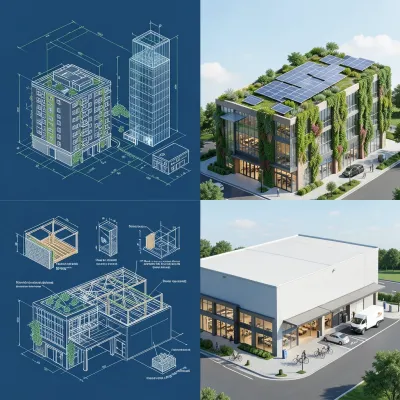
"Green Commercial Construction Blueprint" provides a comprehensive guide to designing, constructing, and operating energy-efficient, low-carbon commercial buildings across various sectors, including apartments, offices, malls, and warehouses. The book systematically outlines strategies for integrating sustainability from initial project conception through to long-term operations. It emphasizes that a truly green building is not merely an environmentally conscious choice but a financially prudent investment, detailing the business case for low-carbon construction through reduced operating costs, increased asset valuation, enhanced tenant demand, and mitigated regulatory and climate risks.
The blueprint begins with foundational design principles, stressing the importance of integrated design and early stakeholder engagement. It explores how crucial initial decisions in site selection, climate analysis, massing, orientation, and daylighting fundamentally impact a building's energy performance. Subsequent chapters delve into the technical specifics of high-performance envelopes, focusing on insulation, airtightness, thermal bridge mitigation, and advanced glazing and shading systems. The book then transitions to active building systems, detailing the efficient selection and deployment of HVAC technologies, particularly heat pumps and heat recovery systems for both space conditioning and domestic hot water, while also addressing the shift towards low-GWP refrigerants and all-electric buildings.
Beyond energy, the book highlights healthy interiors, covering ventilation strategies, indoor air quality management, and thermal comfort, with an emphasis on occupant well-being and productivity. It also addresses water efficiency, rainwater harvesting, greywater reuse, and comprehensive stormwater management. A significant portion is dedicated to sustainable materials and embodied carbon, analyzing the impacts of concrete, steel, and mass timber, and advocating for material transparency through Environmental Product Declarations. The concept of circularity, waste minimization, and design for disassembly is introduced, advocating for materials and buildings that can be reused or recycled.
The latter part of the book focuses on the implementation and validation of green building strategies. It covers the critical role of energy modeling and simulation for informed decision-making, as well as commissioning, measurement, and verification to ensure buildings perform as designed. The importance of digital tools like Building Information Modeling (BIM) and digital twins for lifecycle data management and ongoing optimization is also detailed. The book concludes with practical guidance on financing, incentives, procurement, and contractor engagement for green projects, offering sector-specific playbooks for apartments, offices, malls, and warehouses, and emphasizing the continuous improvement needed in operations and maintenance for long-term sustainable performance.
What You'll Find Inside:
- Passive design fundamentals (massing, orientation, daylighting) are the most cost-effective strategy for reducing energy loads before adding mechanical systems.
- High-performance envelopes require continuous insulation, meticulous airtightness, and thermal bridge mitigation to minimize heating and cooling loads.
- Integrated design and delivery processes ensure sustainability measures survive value engineering and are properly implemented from concept through construction.
- Addressing both operational and embodied carbon is essential, with specific strategies for concrete, steel, timber, and other materials to reduce total life-cycle emissions.
- Sector-specific playbooks provide tailored strategies for apartments, offices, malls, and warehouses based on their unique occupancy patterns, loads, and business drivers.
Who's It For:
This book is designed for commercial real estate professionals including owners, developers, architects, engineers, contractors, and sustainability consultants who are responsible for delivering energy-efficient, low-carbon buildings. It will be most valuable for project teams working on apartments, offices, retail centers, and warehouses that need practical, actionable strategies to meet ESG commitments, regulatory requirements, and performance targets while managing costs and risks. Those seeking to integrate passive design, high-performance systems, sustainable materials, and digital tools into their projects will find particularly relevant guidance.
Table of Contents:
- Introduction
- Chapter 1 The Business Case for Low-Carbon Commercial Buildings
- Chapter 2 Policy, Codes, and Standards Landscape
- Chapter 3 Setting Project Goals: ESG, Carbon, and Performance Targets
- Chapter 4 Integrated Design and Delivery for Sustainability
- Chapter 5 Site Selection, Climate Analysis, and Urban Context
- Chapter 6 Passive Design Fundamentals: Massing, Orientation, and Daylighting
- Chapter 7 High-Performance Envelopes: Insulation, Airtightness, and Thermal Bridges
- Chapter 8 Glazing, Shading, and Advanced Façade Systems
- Chapter 9 Healthy Interiors: Ventilation, IAQ, and Thermal Comfort
- Chapter 10 Efficient HVAC and Heat Pumps for Commercial Uses
- Chapter 11 Domestic Hot Water and Heat Recovery Strategies
- Chapter 12 Electrical Systems, Lighting, and Smart Controls
- Chapter 13 On-Site Renewables, Storage, and Grid Interaction
- Chapter 14 Water Efficiency, Reuse, and Stormwater Management
- Chapter 15 Materials and Embodied Carbon: Concrete, Steel, and Timber
- Chapter 16 Circularity, Waste Minimization, and Deconstruction Planning
- Chapter 17 Energy Modeling and Simulation for Decision-Making
- Chapter 18 Commissioning, Measurement & Verification, and Analytics
- Chapter 19 Digital Tools: BIM, Digital Twins, and Lifecycle Data
- Chapter 20 Procurement, Specifications, and Contractor Engagement
- Chapter 21 Construction Methods: Prefabrication and Low-Carbon Jobsite Practices
- Chapter 22 Financing, Incentives, and Total Cost of Ownership
- Chapter 23 Certification Pathways: LEED, WELL, and Complementary Frameworks
- Chapter 24 Sector Playbooks: Apartments, Offices, Malls, and Warehouses
- Chapter 25 Operations, Maintenance, and Continuous Improvement
Author:
Published By:
Date Published:
May 15, 2026
Type:
Nonfiction
Language:
English
Word Count:
81,718 words
Reading Time:
5 hours 43 minutes
Sample:
Order:
Order Green Commercial Construction Blueprint (Paperback) on MixCache.com:
Buy NowPrint copy is made to order and ships worldwide. Includes the ebook free, ready to read instantly.
$5 account credit for all new MixCache.com accounts, usable toward any ebook purchase!*


