
Browse by Category
Fiction
- Action & Adventure
- African American
- Anthologies
- Children's Fiction
- Classics
- Comics & Graphic Novels
- Coming of Age
- Contemporary
- Cultural & Regional
- Drama
- Erotica
- Fantasy
- General
- Historical Fiction
- Horror
- Humor & Satire
- Literary Fiction
- Mystery, Thriller & Suspense
- Poetry
- Religious & Inspirational
- Romance
- Science Fiction
- Short Stories
- War & Military
- Westerns
- Women's Fiction
- Young Adult
Non-Fiction
- Antiques & Collectibles
- Arts & Photography
- Biographies & Memoirs
- Business & Money
- Children's Non-Fiction
-
Computers & Technology
- Artificial Intelligence
- Computer Science
- Cybersecurity & Cryptography
- Data Science & Analytics
- Databases & Big Data
- Game Development & Design
- General
- Hardware & DIY
- Mobile App Development
- Networking & Cloud Computing
- Operating Systems
- Programming
- Robotics
- Software
- Software Engineering
- User Experience (UX) & Design
- Web Development & Design
- Cooking, Food & Wine
- Crafts, Hobbies & Home
- Education & Teaching
- Engineering
- General
- Health, Fitness & Dieting
-
History
- African History
- African History - North Africa
- African History - Sub-Saharan Africa
- American History
- American History - 20th Century
- American History - Civil War
- American History - Colonial Period
- Ancient History
- Asian History
- Asian History - China
- Asian History - India
- Asian History - Japan
- Asian History - Southeast Asia
- European History
- European History - Ancient Greece
- European History - Ancient Rome
- European History - Medieval
- European History - Modern
- European History - Renaissance
- General
- Middle Eastern History
- Military History
- Military History - Aviation
- Military History - Naval
- Social & Cultural History
- World History
- Humor & Entertainment
- Industrial Technology
- Language Learning
- Law
- LGBTQ+ Non-Fiction
- Literary Criticism
- Medical Books
- Parenting & Relationships
- Philosophy
- Politics & Social Sciences
- Reference
- Religion & Spirituality
-
Science & Math
- Agricultural Sciences
- Astronomy & Space Science
- Behavioral Sciences
- Biological Sciences
- Botany & Plant Science
- Chemistry
- Earth Sciences
- Engineering - Chemical
- Engineering - Civil
- Engineering - Electrical
- Engineering - Mechanical
- Environment
- General
- Geology
- Mathematics
- Nature & Ecology
- Oceanography
- Paleontology
- Physics
- Statistics
- Self-Help
- Sports & Outdoors
- Study Aids
- Sustainability & Green Living
- Textbooks
- Transportation
- Travel
- True Crime
- Urban Planning & Development
- Veterinary Medicine
- Writing & Publishing
Jump to Section

Want unlimited access to all books published by MixCache.com (plus their audiobooks)? Try MixCache.com Total Access. Look for the MTA badge on book covers to identify included titles.
Access to infinite ebooks: Don't see the book you want? Suggest it and we'll create it (free!) for you from scratch with our powerful AI book writer. Then read it with MTA - besides profiting from any sales it makes!
Culinary Remains: Recipes for the Last Kitchen
MTA
A darkly comic culinary guide novel presenting recipes, supply chains, and food politics in the apocalypse
About this book:
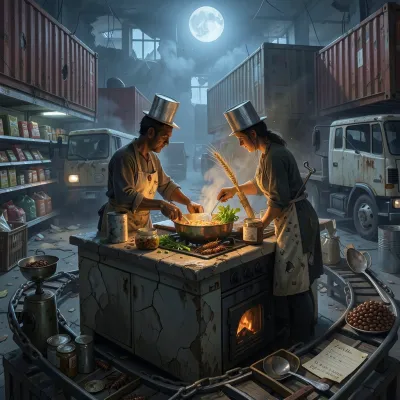
"Culinary Remains: Recipes for the Last Kitchen" is a darkly comic culinary guide novel set in a post-apocalyptic world, narrated by Maren, a former bistro chef who now runs a communal kitchen in a repurposed loading dock. The book transcends a mere recipe collection, offering a profound exploration of survival, community, and the inherent politics of food in a collapsed society. Maren details the daily struggle to feed a diverse group of survivors, focusing on resourcefulness, adaptation, and the unexpected ways that ordinary culinary practices become acts of profound significance.
The narrative outlines the kitchen's operations, from scavenging for ingredients in ruins and managing a precarious supply chain through a complex barter system, to the rigorous sanitization protocols necessary for survival. Each chapter delves into specific culinary techniques crucial for the apocalypse, such as making soups that stretch meager ingredients, baking flatbreads from coarse flour, and utilizing ancient preservation methods like fermentation, smoking, and sun-drying. These practices are not just about sustenance; they are about generating morale, fostering trust, and maintaining a sense of humanity in a world stripped bare.
Beyond the practicalities of cooking, the book delves into the "quiet politics of the pot," examining how decisions about food distribution and resource allocation are made within the community. The "Committee for Taste and Fairness" acts as an informal governing body, mediating disputes and ensuring that dignity and equity are maintained, even in scarcity. The novel highlights the formation of a "Cooks' Union" – a network of kitchens across the ruins that share knowledge, recipes, and surplus, demonstrating that collaboration and mutual aid are vital for collective endurance.
Ultimately, "Culinary Remains" reveals that the act of cooking in the apocalypse is more than just feeding bodies; it is a continuous act of defiance against entropy, a celebration of resilience, and a stubborn belief in the future. Maren emphasizes that "the recipe is not the meal," but rather a guide, and the true meal is the sum of human attention, adaptation, and the shared experience around a warm fire. The book concludes by reflecting on the intangible things the community keeps warm – hope, connection, and the unwavering conviction that even in a broken world, the act of cooking for others is an essential and enduring testament to life.
Author:
Published By:
Date Published:
May 13, 2026
Type:
Fiction
Language:
English
Word Count:
102,526 words
Reading Time:
7 hours 11 minutes
Sample:
Order:
Order Culinary Remains: Recipes for the Last Kitchen (Paperback) on MixCache.com:
Buy NowPrint copy is made to order and ships worldwide. Includes the ebook free, ready to read instantly.
$5 account credit for all new MixCache.com accounts, usable toward any ebook purchase!*


