Browse by Category
Fiction
- Action & Adventure
- African American
- Anthologies
- Children's Fiction
- Classics
- Comics & Graphic Novels
- Coming of Age
- Contemporary
- Cultural & Regional
- Drama
- Erotica
- Fantasy
- General
- Historical Fiction
- Horror
- Humor & Satire
- Literary Fiction
- Mystery, Thriller & Suspense
- Poetry
- Religious & Inspirational
- Romance
- Science Fiction
- Short Stories
- War & Military
- Westerns
- Women's Fiction
- Young Adult
Non-Fiction
- Antiques & Collectibles
- Arts & Photography
- Biographies & Memoirs
- Business & Money
- Children's Non-Fiction
-
Computers & Technology
- Artificial Intelligence
- Computer Science
- Cybersecurity & Cryptography
- Data Science & Analytics
- Databases & Big Data
- Game Development & Design
- General
- Hardware & DIY
- Mobile App Development
- Networking & Cloud Computing
- Operating Systems
- Programming
- Robotics
- Software
- Software Engineering
- User Experience (UX) & Design
- Web Development & Design
- Cooking, Food & Wine
- Crafts, Hobbies & Home
- Education & Teaching
- Engineering
- General
- Health, Fitness & Dieting
-
History
- African History
- African History - North Africa
- African History - Sub-Saharan Africa
- American History
- American History - 20th Century
- American History - Civil War
- American History - Colonial Period
- Ancient History
- Asian History
- Asian History - China
- Asian History - India
- Asian History - Japan
- Asian History - Southeast Asia
- European History
- European History - Ancient Greece
- European History - Ancient Rome
- European History - Medieval
- European History - Modern
- European History - Renaissance
- General
- Middle Eastern History
- Military History
- Military History - Aviation
- Military History - Naval
- Social & Cultural History
- World History
- Humor & Entertainment
- Industrial Technology
- Language Learning
- Law
- LGBTQ+ Non-Fiction
- Literary Criticism
- Medical Books
- Parenting & Relationships
- Philosophy
- Politics & Social Sciences
- Reference
- Religion & Spirituality
-
Science & Math
- Agricultural Sciences
- Astronomy & Space Science
- Behavioral Sciences
- Biological Sciences
- Botany & Plant Science
- Chemistry
- Earth Sciences
- Engineering - Chemical
- Engineering - Civil
- Engineering - Electrical
- Engineering - Mechanical
- Environment
- General
- Geology
- Mathematics
- Nature & Ecology
- Oceanography
- Paleontology
- Physics
- Statistics
- Self-Help
- Sports & Outdoors
- Study Aids
- Sustainability & Green Living
- Textbooks
- Transportation
- Travel
- True Crime
- Urban Planning & Development
- Veterinary Medicine
- Writing & Publishing
Jump to Section

Want unlimited access to all books published by MixCache.com (plus their audiobooks)? Try MixCache.com Total Access. Look for the MTA badge on book covers to identify included titles.
Access to infinite ebooks: Don't see the book you want? Suggest it and we'll create it (free!) for you from scratch with our powerful AI book writer. Then read it with MTA - besides profiting from any sales it makes!
Naval Command and Control: Sea Power from Triremes to Aircraft Carriers
MTA
Maritime Strategy, Logistics, and the Economics of Naval Warfare
About this book:
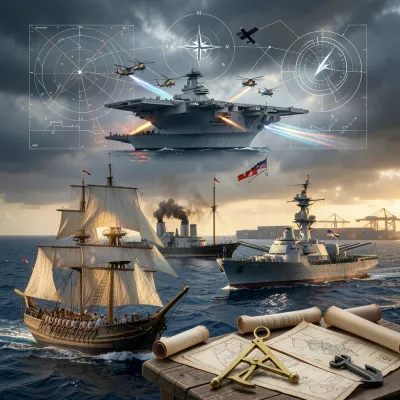
This book provides a comprehensive history of naval command and control, arguing that sea power is fundamentally an economic and logistical endeavor. From the ancient Mediterranean to the modern Pacific, the narrative traces how navies have served as instruments to control the movement of goods, people, and information. It illustrates how the evolution of technology—from oars and sails to steam, nuclear propulsion, and satellites—has consistently shifted the balance between centralized authority and decentralized initiative, while always remaining tethered to the industrial capacity and fiscal health of the state.
The text examines the development of formal doctrines, such as the "line of battle" and the "fighting instructions" of the Age of Sail, alongside the rise of logistical infrastructures like dockyards and victualing yards. It highlights the strategic shift brought about by the industrial revolution, where coaling stations and telegraph cables created the first truly global networks of command. The book contrasts the classic Mahanian focus on decisive fleet engagements with the economic warfare and commerce-raiding strategies championed by thinkers like Corbett and the French *Jeune École*, demonstrating how asymmetric threats like the torpedo and the submarine forced a rethinking of the cost of sea control.
In the twentieth century, the narrative focuses on the information revolution, detailing how radar, signals intelligence (such as ULTRA), and carrier aviation transformed the "geometry of deterrence." It explores the logistical triumphs of World War II, specifically the development of underway replenishment and mass-produced merchant shipping, as the ultimate deciders of global conflict. During the Cold War, the focus shifts to the silent struggle of nuclear-armed submarines and the elaborate sensor networks built to track them, emphasizing that the ocean became a sanctuary for the ultimate guarantor of national security.
The final chapters address contemporary challenges, including the rise of "gray zone" conflict in the littoral, the strategic importance of maritime chokepoints and global supply chains, and the emerging influence of cyber warfare, algorithms, and autonomous systems. The book concludes by stressing that while technology has reached unprecedented levels of complexity, the core of naval command remains a management of uncertainty and industrial resilience. The ability to sense, decide, and act faster than an adversary—while maintaining the capacity to repair and replace expensive assets—remains the timeless prerequisite for commanding the global commons.
What You'll Find Inside:
- Command at sea is fundamentally an economic act shaped by logistics, finance, and industrial capacity - from triremes to carrier groups
- The recurring tension between centralized control and decentralized initiative across naval history, influenced by available communication technologies
- How technological innovations (ram, gunpowder, steam, radar, satellites) have transformed command challenges while core problems persist
- The critical role of information advantage, from ancient deception to ULTRA and satellite intelligence in determining naval outcomes
- Economic warfare through blockade, commerce raiding, and chokepoint control as a persistent strategy throughout naval history
Who's It For:
This book is designed for students of naval history, military practitioners, and strategic thinkers who seek to understand how economic factors, logistics, and technological innovation shape maritime power. It will particularly benefit those interested in the intersection of naval strategy with economics, industrial capacity, and command-and-control systems across historical periods. Professionals in defense planning, maritime security, and international relations will find valuable insights for contemporary challenges.
Author:
Published By:
Date Published:
May 13, 2026
Type:
Nonfiction
Language:
English
Word Count:
78,849 words
Reading Time:
5 hours 31 minutes
Sample:
Order:
Order Naval Command and Control: Sea Power from Triremes to Aircraft Carriers (Hardcover) on MixCache.com:
Buy NowPrint copy is made to order and ships worldwide. Includes the ebook free, ready to read instantly.
$5 account credit for all new MixCache.com accounts, usable toward any ebook purchase!*