
Browse by Category
Fiction
- Action & Adventure
- African American
- Anthologies
- Children's Fiction
- Classics
- Comics & Graphic Novels
- Coming of Age
- Contemporary
- Cultural & Regional
- Drama
- Erotica
- Fantasy
- General
- Historical Fiction
- Horror
- Humor & Satire
- Literary Fiction
- Mystery, Thriller & Suspense
- Poetry
- Religious & Inspirational
- Romance
- Science Fiction
- Short Stories
- War & Military
- Westerns
- Women's Fiction
- Young Adult
Non-Fiction
- Antiques & Collectibles
- Arts & Photography
- Biographies & Memoirs
- Business & Money
- Children's Non-Fiction
-
Computers & Technology
- Artificial Intelligence
- Computer Science
- Cybersecurity & Cryptography
- Data Science & Analytics
- Databases & Big Data
- Game Development & Design
- General
- Hardware & DIY
- Mobile App Development
- Networking & Cloud Computing
- Operating Systems
- Programming
- Robotics
- Software
- Software Engineering
- User Experience (UX) & Design
- Web Development & Design
- Cooking, Food & Wine
- Crafts, Hobbies & Home
- Education & Teaching
- Engineering
- General
- Health, Fitness & Dieting
-
History
- African History
- African History - North Africa
- African History - Sub-Saharan Africa
- American History
- American History - 20th Century
- American History - Civil War
- American History - Colonial Period
- Ancient History
- Asian History
- Asian History - China
- Asian History - India
- Asian History - Japan
- Asian History - Southeast Asia
- European History
- European History - Ancient Greece
- European History - Ancient Rome
- European History - Medieval
- European History - Modern
- European History - Renaissance
- General
- Middle Eastern History
- Military History
- Military History - Aviation
- Military History - Naval
- Social & Cultural History
- World History
- Humor & Entertainment
- Industrial Technology
- Language Learning
- Law
- LGBTQ+ Non-Fiction
- Literary Criticism
- Medical Books
- Parenting & Relationships
- Philosophy
- Politics & Social Sciences
- Reference
- Religion & Spirituality
-
Science & Math
- Agricultural Sciences
- Astronomy & Space Science
- Behavioral Sciences
- Biological Sciences
- Botany & Plant Science
- Chemistry
- Earth Sciences
- Engineering - Chemical
- Engineering - Civil
- Engineering - Electrical
- Engineering - Mechanical
- Environment
- General
- Geology
- Mathematics
- Nature & Ecology
- Oceanography
- Paleontology
- Physics
- Statistics
- Self-Help
- Sports & Outdoors
- Study Aids
- Sustainability & Green Living
- Textbooks
- Transportation
- Travel
- True Crime
- Urban Planning & Development
- Veterinary Medicine
- Writing & Publishing
Jump to Section
MixCache.com Total Access
Unlimited reading and audiobooks for every book published by MixCache.com.
Included titles carry the MTA badge.
Learn more →
Guerrilla Warfare and Insurgency: Theory, Practice, and Countermeasures
MTA
From Mao and Che to Modern Urban Insurgencies—Strategies for Irregular Conflict
About this book:
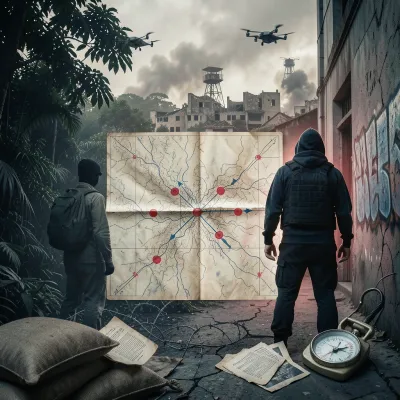
This book provides a comprehensive analysis of the evolution, strategy, and containment of irregular warfare, tracing its development from classical theorists like Sun Tzu and Clausewitz to modern digital and urban insurgencies. It synthesizes the foundational doctrines of Mao Zedong’s protracted war, Che Guevara’s focalism, and Võ Nguyên Giáp’s "dau tranh" to illustrate how revolutionary movements transform social grievances into strategic military effects. By examining the organizational structures, ideological mobilization, and financial systems of groups ranging from the IRA to the Islamic State, the text highlights that insurgency is primarily a political competition for legitimacy rather than a purely military one.
The narrative details a significant "urban turn" in modern conflict, where the traditional jungle sanctuary has been replaced by the density of megacities and the anonymity of encrypted digital networks. It explores how technological advancements—specifically drones, cyber warfare, and social media—have democratized lethality and propaganda, allowing non-state actors to challenge sovereign states with disproportionate impact. These shifts necessitate a move away from "body count" metrics toward a sophisticated understanding of "human terrain" and the "governance gaps" created by state fragility and corruption.
In addressing countermeasures, the book evaluates the historical tension between population-centric and enemy-centric strategies. Through case studies in Latin America, the Middle East, and South Asia, it argues that military force alone is insufficient for lasting stability. Instead, successful counterinsurgency requires the integration of intelligence-led policing, the rule of law, and eventual political reconciliation. The text concludes that durable security emerges only when a state can out-govern the insurgent, addressing the underlying socio-economic grievances that provide the "spark" for rebellion.
The final chapters reflect on the ethical and legal dilemmas inherent in asymmetric conflict, particularly the challenges of detention, targeted killings, and the use of artificial intelligence. It emphasizes that the future of irregular warfare will be defined by a persistent struggle for moral and political legitimacy. Ultimately, the book asserts that while the tools of war continue to evolve, the fundamental requirement for victory remains the ability to protect a population and provide a credible, just alternative to the insurgent’s vision.
What You'll Find Inside:
- Comparative analysis of foundational insurgency theories including Mao Zedong's protracted war doctrine, Che Guevara's foco theory, and Võ Nguyên Giáp's Vietnamese experience, showing how these frameworks continue to influence modern movements
- Examination of insurgent organization and leadership structures, from hierarchical models to decentralized networks, and how security culture, recruitment, and political-military integration determine movement resilience
- Analysis of how insurgencies mobilize support through the construction of grievances, identity-based appeals, and narrative framing that transforms private suffering into collective political action
- Exploration of the urban turn in insurgency, detailing how insurgents exploit density, infrastructure, and governance gaps in cities and megacities while facing unique challenges of civilian proximity and state countermeasures
- Investigation of the legitimacy competition between states and insurgents, covering competitive governance, information warfare strategies, population-centric vs enemy-centric approaches, and the ethical dimensions of force in irregular conflict
Who's It For:
This book is essential reading for students, scholars, and practitioners in security studies, international relations, and military affairs who seek a comprehensive understanding of insurgency and counterinsurgency. It will particularly benefit policymakers, government officials, and military personnel involved in conflict resolution, stabilization operations, or irregular warfare planning. Researchers analyzing conflict dynamics and journalists covering insurgencies will find valuable theoretical frameworks and case studies. The work also serves humanitarian workers and NGO staff operating in conflict-affected areas by explaining the political and social dimensions of insurgent movements.
Table of Contents:
- Introduction
- Chapter 1 The Nature of Irregular War: Definitions, Concepts, and Terms
- Chapter 2 Classical Foundations: Sun Tzu, Clausewitz, and the People’s War
- Chapter 3 Mao Zedong’s Protracted War Doctrine
- Chapter 4 Ernesto “Che” Guevara and the Foco Theory
- Chapter 5 Võ Nguyên Giáp and the Vietnamese Experience
- Chapter 6 Organization and Leadership in Insurgent Movements
- Chapter 7 Ideology, Identity, and Grievance: Mobilizing the Base
- Chapter 8 The Urban Turn: Insurgency in Cities and Megacities
- Chapter 9 Information Warfare: Propaganda, Narratives, and Social Media
- Chapter 10 Logistics, Finance, and Illicit Economies
- Chapter 11 Intelligence, Counterintelligence, and Security Culture
- Chapter 12 Terrain, Geography, and Sanctuary: From Hinterlands to Safe Havens
- Chapter 13 Technology in Irregular Conflict: Drones, Cyber, and Encryption
- Chapter 14 External Support, Diasporas, and Cross-Border Dynamics
- Chapter 15 Violence, Coercion, and Restraint: The Strategic Use of Force
- Chapter 16 State Fragility, Governance Gaps, and the Insurgency Opportunity
- Chapter 17 Counterinsurgency Theory: From Galula to FM 3-24
- Chapter 18 Population-Centric vs. Enemy-Centric Approaches
- Chapter 19 Stabilization, Nation-Building, and Legitimacy
- Chapter 20 Policing, Intelligence-Led Operations, and the Rule of Law
- Chapter 21 Negotiation, Amnesty, and Reintegration
- Chapter 22 Measuring Success and Failure in Irregular War
- Chapter 23 Case Studies I: Latin America after the Cold War
- Chapter 24 Case Studies II: Middle East and South Asia Post-2001
- Chapter 25 Ethics, Law, and the Future of Insurgency and Counterinsurgency
Author:
Published By:
Date Published:
May 13, 2026
Type:
Nonfiction
Language:
English
Word Count:
80,744 words
Reading Time:
5 hours 39 minutes
Sample:
MixCache.com Total Access
Get unlimited access to this book + all books published by MixCache.com for $11.99/month
Subscribe to MTAOr purchase this book individually below
Order:
Buy the Guerrilla Warfare and Insurgency: Theory, Practice, and Countermeasures ebook on MixCache.com:
Buy Now
Full ebook will be available immediately
- read online or download as a PDF file.
$5 account credit for all new MixCache.com accounts, usable toward any ebook purchase!*





Ratings & Reviews
Ask Questions About This Book
Have a question about the content? Ask our AI assistant!
Start by asking a question about "Guerrilla Warfare and Insurgency: Theory, Practice, and Countermeasures"
Example: "Does this book mention William Shakespeare?"
Thinking...